
How to prepare for a cyber insurance audit
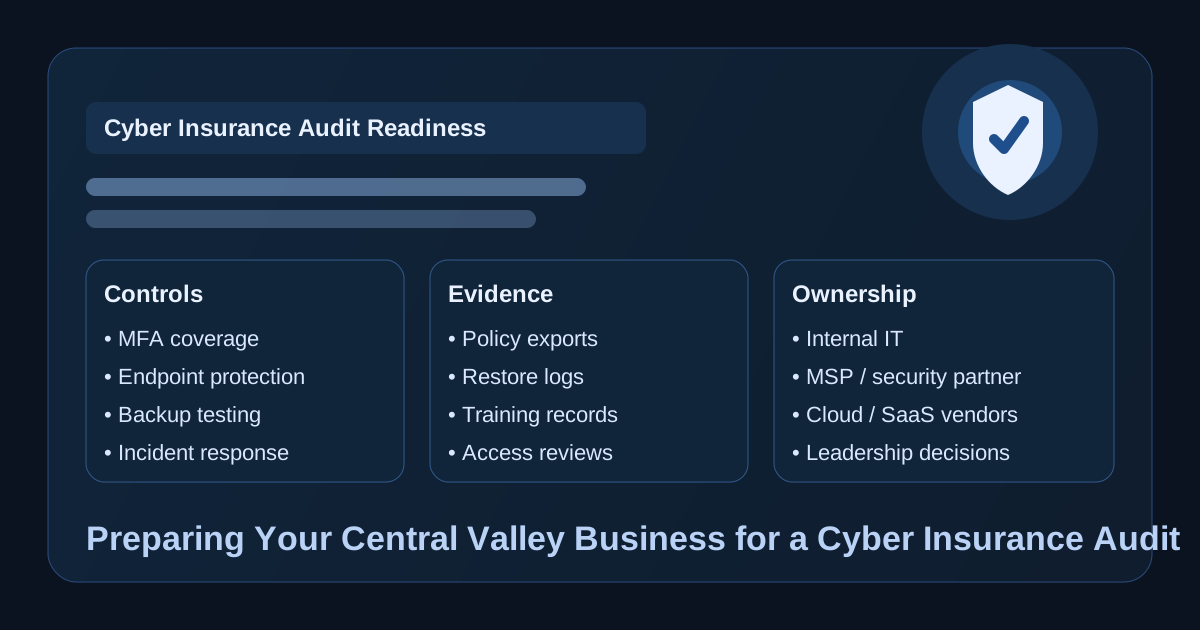
To prepare for a cyber insurance audit, gather proof that security controls are operating: MFA coverage, endpoint protection, backup and recovery evidence, incident response documentation, privileged-access review, employee security awareness, vendor accountability, and a clear sensitive-data inventory.123 Insurers and auditors increasingly want evidence, not broad statements.
That shift matters for Central Valley organizations because many of them sit in the same operational middle: large enough to depend on Microsoft 365, cloud software, remote access, line-of-business systems, and outside vendors, but not always staffed like a full enterprise security department. When renewal season arrives, the challenge is rarely “Do we care about security?” It is “Can we demonstrate, in a clean and defensible way, how security is actually being run?”
We think that is the right lens. A cyber insurance audit is not just paperwork for underwriting. It is a stress test of operational clarity. If documentation is stale, ownership is fuzzy, or controls exist only as assumptions, the audit usually exposes that quickly.
Preparing for a cyber insurance audit?
Datapath can review MFA, endpoint, backup, incident response, recovery evidence, and owner handoffs before your renewal, underwriting review, or audit deadline.
What are cyber insurance audit searchers trying to prove?
Most cyber insurance audit searches are really evidence questions. The buyer wants to know what to collect, who should own each control, and how to prove that recovery will work if ransomware, account compromise, or vendor disruption hits after the policy renews.
| Search signal | What the buyer needs to prove | Best Datapath next step |
|---|---|---|
| how to prepare for cyber insurance audit | Controls are implemented, monitored, documented, and mapped to the carrier questionnaire | Start with a cybersecurity risk assessment |
| how to prepare for cyber insurance audit San Francisco | California-specific teams need audit evidence, control owners, questionnaire mapping, and current regulatory awareness | Review cybersecurity and insurance-readiness evidence before renewal |
| how to prepare for cyber insurance audits in healthcare | EHR access, HIPAA-aligned safeguards, backups, remote access, audit logs, and downtime plans are defensible | Pair HIPAA IT services with assessment work |
| evidence for counsel, cyber insurance, and the board that recovered systems will not be reinfected | Recovery evidence is clean, tested, documented, and tied to incident-response decisions | Review incident response retainer services and disaster recovery services |
Why are cyber insurance audits getting more demanding?
Cyber insurers have spent the last several years tightening underwriting expectations as ransomware, business email compromise, and third-party exposure have become more expensive and more common. At the same time, California businesses are operating in a regulatory environment that increasingly emphasizes demonstrable accountability, evidence capture, and independent review instead of policy language alone.45
PwC notes that the standard is moving from documented intent to defensible proof that cybersecurity practices are operating effectively over time.4 That framing is useful because it mirrors what many insurers now want to see at renewal: not simply whether MFA, logging, or backup exists, but whether those controls are monitored, reviewed, and tied to actual risk reduction.
For Central Valley businesses, the practical consequence is simple. If your environment has grown through acquisitions, multiple offices, healthcare workflows, financial data handling, or vendor sprawl, renewal questions get harder to answer casually. The more complex the business, the more important evidence and governance become.
What do insurers and auditors usually review?
The exact questionnaire varies by carrier and business size, but most reviews cluster around a few predictable areas.
Identity and access controls
Auditors commonly want to understand how the business controls access to email, cloud platforms, remote access tools, and privileged systems. That means proving MFA is deployed broadly, showing how new users are provisioned, explaining how access is removed during offboarding, and documenting who has elevated rights.67
If leadership cannot answer who approves admin access, how dormant accounts are found, or whether vendor access is reviewed, that usually signals a larger governance problem.
Endpoint, email, and monitoring coverage
Insurers also care whether the organization can detect suspicious behavior quickly. That often includes endpoint protection or EDR, email filtering, logging, alert review, and a defined escalation path when something suspicious appears.68
The important point here is operational maturity. Buying tools helps, but tool ownership, review cadence, and follow-up discipline matter more than a long product list.
Backup, recovery, and business continuity
Backup evidence is one of the most common underwriting flashpoints. Auditors may ask whether backups are protected from tampering, how often recoveries are tested, what systems are covered, and how long restoration would take for critical workflows.69
That is why cyber insurance preparation should connect naturally to broader resilience planning. If the business cannot explain restore readiness for Microsoft 365, file shares, line-of-business applications, or cloud systems, the insurer may question how survivable a ransomware or outage event would be.
What recovery evidence helps counsel, cyber insurance, and the board?
Recovery assurance evidence should show that restored systems are clean enough to trust, usable by the business, and backed by a documented decision process. That usually means restore-test results, backup integrity checks, containment notes, privileged-access resets, endpoint validation, vulnerability remediation, and open exceptions that counsel, insurers, and executives can review.
| Evidence area | What to prepare | Why it matters |
|---|---|---|
| Backup integrity | Backup job reports, immutable or isolated copy status, restore-test notes, and data-age checks | Shows that the business can recover from ransomware, deletion, or corruption |
| Clean recovery | Endpoint/EDR status, identity resets, malware scan results, and re-entry approval notes | Reduces the risk of restoring systems into the same compromise |
| Incident timeline | When the event was detected, who acted, what was contained, and what remains unresolved | Gives counsel, cyber insurance, and leadership a defensible sequence of decisions |
| Business validation | Application owner signoff, sample file checks, EHR or ERP usability, and user-access confirmation | Proves recovery is operational, not just visible in a backup console |
| Remediation ownership | Open findings, owners, due dates, accepted-risk notes, and next test date | Turns recovery into measurable risk reduction after the audit |
Datapath does not replace breach counsel, insurers, or forensic firms. We help the business organize the technical evidence those parties often need: backup and restore proof, identity and endpoint status, escalation notes, network changes, recovery assumptions, and follow-up remediation. That work connects naturally to incident response retainer services and disaster recovery testing.
Incident response readiness
A credible incident response plan is rarely just a document sitting in a folder. Insurers want to know whether the business has an escalation path, outside legal or technical contacts if needed, communication expectations, and defined recovery priorities.108
For many mid-market teams, this is where preparation work starts paying off. Once response roles, vendor contacts, and decision authority are clarified, many other audit questions become easier to answer.
Data inventory, governance, and third-party risk
Cyber insurance reviews increasingly overlap with privacy and governance expectations. Businesses should know what sensitive data they collect, where it is stored, which vendors touch it, and what controls protect it.1011
That does not mean every company needs an enterprise governance office. It does mean the business should be able to explain its data footprint and show that security decisions reflect business risk, not guesswork.
How should Central Valley businesses prepare before the audit starts?
The strongest audit preparation is not a frantic week of document cleanup. It is a structured readiness pass that turns real operations into reviewable evidence.
1. Start with a short readiness assessment
Before the insurer asks for evidence, review the environment honestly:
- Which controls are definitely in place?
- Which controls are partially deployed or inconsistently enforced?
- Which processes depend on one person’s memory?
- Which vendors, cloud tools, or locations create extra complexity?
This kind of readiness review helps separate what is real from what is merely assumed.48
2. Update the documentation that always drifts first
In most environments, the first things to drift are onboarding and offboarding steps, incident procedures, asset inventories, access reviews, network diagrams, and backup documentation. That is normal. Systems change faster than documents do.
The goal is not perfect paperwork. The goal is documentation that reflects how the environment actually operates today.8 If your incident response plan still names the wrong systems, old vendors, or employees who left six months ago, fix that before the audit starts.
3. Gather proof, not just statements
Auditors may not rely primarily on management assertions.7 That means businesses should be ready to provide evidence such as:
- MFA enrollment screenshots or policy exports
- backup job reports and restore-test notes
- security awareness completion records
- access review logs or privileged group exports
- endpoint protection dashboards
- documented incident procedures and escalation contacts
A common failure mode is having the control but not the evidence. From an audit perspective, that distinction matters a lot.
4. Clarify ownership across internal staff and vendors
Many businesses in the Central Valley rely on a mix of internal admins, MSP support, cloud vendors, software vendors, and outside security providers. That model can work well, but only if ownership is clear.
A useful prep question is: who owns each of these areas?
| Audit area | Questions to answer |
|---|---|
| Identity | Who approves access? Who reviews admin rights? |
| Endpoints | Who monitors alerts and who escalates them? |
| Backup | Who checks failures and who validates restores? |
| Email security | Who tunes protections and investigates suspicious activity? |
| Incident response | Who makes decisions after hours and who is called first? |
| Vendor risk | Which third parties touch sensitive systems or data? |
If those answers are vague during preparation, they will be vague during the audit too.
5. Review the policy and questionnaire language carefully
Different insurers emphasize different things. Some focus heavily on ransomware controls, some on privileged access, and some on governance and reporting. Review the renewal application or questionnaire line by line and map each question to a person, system owner, or evidence source before the deadline arrives.1213
That reduces last-minute scrambling and helps leadership see where the real gaps are.
How should healthcare teams prepare for cyber insurance audits?
Healthcare teams should prepare for cyber insurance audits by tying technical evidence to clinical uptime, ePHI protection, EHR access, backup recovery, remote-access controls, audit logs, vendor access, and incident escalation. The goal is to show that patient-care systems and sensitive data have owners, safeguards, monitoring, and recovery plans.
In practical terms, healthcare preparation should include:
- EHR and practice-management access review, including privileged users and terminated accounts
- MFA and remote-access evidence for employees, vendors, and administrators
- backup coverage and restore-test evidence for clinical and billing workflows
- endpoint protection status for workstations, laptops, and shared clinical devices
- audit-log and alert-review process for systems touching ePHI
- vendor and BAA inventory for third parties that support patient data or systems
- downtime procedures and escalation contacts for patient-care interruptions
For healthcare organizations, the cyber insurance conversation often overlaps with HIPAA Security Rule safeguards, contingency planning, vendor accountability, and clinical operations. Pair this audit-prep work with HIPAA compliant IT services or healthcare disaster recovery planning when the evidence needs to support care delivery, not only a renewal questionnaire.
Does cyber insurance audit preparation change for San Francisco or California businesses?
The core preparation steps are the same for San Francisco, Central Valley, Irvine, and other California businesses: gather evidence, map owners, validate recovery, and avoid overstating controls. What changes is the regulatory context. CPPA regulations addressing cybersecurity audits and risk assessments became effective January 1, 2026, with phased cybersecurity-audit certification deadlines beginning April 1, 2028 for covered businesses.5
A cyber insurance audit is not automatically the same thing as a CPPA cybersecurity audit. Treat them as overlapping evidence demands, then confirm legal applicability with counsel. The practical prep package still looks familiar: MFA, backup and restore evidence, incident-response workflow, vendor accountability, data inventory, risk decisions, and documentation that reflects the environment as it operates today.
What usually blocks a clean cyber insurance audit?
In our experience, businesses are usually blocked less by a total absence of security controls and more by operational inconsistency.
Controls are real, but uneven
Maybe MFA is enabled for most users but not every privileged workflow. Maybe backups run, but restore testing is ad hoc. Maybe the EDR platform is deployed, but alert review is inconsistent. Those are not imaginary controls, but they are hard to defend cleanly.
Documentation lags behind reality
This is probably the most common issue. The environment evolves, people change roles, vendors come and go, and documentation stops matching reality. When that gap widens, even decent security work becomes harder to prove.
Nobody has assembled the evidence in one place
The evidence may exist across Microsoft 365, backup consoles, HR records, endpoint platforms, password managers, and ticketing systems, but if nobody has organized it into a usable package, the audit still feels chaotic.
Leadership has not defined acceptable risk clearly
Some audit questions are really governance questions. Which systems matter most? Which vendors are critical? How fast must recovery happen? What exceptions are acceptable? If leadership has never aligned on those answers, security teams end up improvising during the review.
Why this matters beyond the insurance renewal
A cleaner cyber insurance audit usually reflects something more valuable than better questionnaire answers. It reflects a business that understands its environment, can explain its security operating model, and can recover faster when something goes wrong.
That is why this topic ties naturally into broader Datapath priorities like managed cybersecurity services, cybersecurity risk assessments, Microsoft 365 security best practices, and backup and disaster recovery planning. The audit may start as an insurance requirement, but the work behind it improves resilience everywhere else too.
Why Datapath for cyber insurance audit preparation?
At Datapath, we think businesses preparing for a cyber insurance audit need more than a generic checklist. They need help translating real operations into evidence leadership, insurers, counsel, and auditors can follow. That means clarifying ownership, updating stale documentation, validating which controls are actually in place, and identifying the gaps that could create renewal friction.
For Central Valley, San Francisco, healthcare, finance, K-12, and mid-market businesses balancing growth, regulated-industry expectations, and limited internal bandwidth, that kind of preparation work is usually most useful when it is practical and specific. If your team wants help getting ready for underwriting review or tightening the controls that insurers now expect, start with our cybersecurity risk assessment services, review managed cybersecurity services, or talk with our team.
Frequently Asked Questions
What is a cyber insurance audit?
A cyber insurance audit is a review of your organization’s cybersecurity controls, documentation, and operating practices to help an insurer evaluate risk during underwriting, renewal, or claims-related review.
What do cyber insurers usually ask for?
They commonly ask about MFA, endpoint protection, backups, phishing defenses, privileged access, incident response, user awareness training, vendor risk, and evidence that these controls are actively managed.
How should a business prepare for a cyber insurance audit?
Start with a readiness assessment, update key documentation, gather evidence that controls are operating, clarify ownership across internal staff and vendors, and review the insurer’s questionnaire before deadlines get close.
What evidence helps prove recovered systems will not be reinfected?
Prepare backup integrity results, restore-test notes, endpoint validation, privileged-access resets, incident timeline notes, containment actions, application-owner signoff, unresolved exceptions, and remediation owners. The goal is to show counsel, cyber insurance, and the board that recovery was tested, reviewed, and not simply assumed.
How should healthcare teams prepare for cyber insurance audits?
Healthcare teams should prepare EHR access evidence, MFA and remote-access records, endpoint protection status, backup and restore-test results, audit-log review notes, vendor/BAA inventory, downtime procedures, and incident escalation contacts tied to clinical workflows and ePHI risk.
Does preparation change for San Francisco or California businesses?
The core control evidence is similar, but California businesses should also track CPPA cybersecurity-audit and risk-assessment developments with counsel. As of this update, CPPA regulations are effective January 1, 2026, with phased cybersecurity-audit certification deadlines beginning April 1, 2028 for covered businesses.
Why do businesses fail cyber insurance reviews?
Most problems come from uneven control deployment, stale documentation, weak evidence collection, unclear ownership, or renewal answers that overstate what the environment actually supports.
Sources
- PwC: CCPA cybersecurity audit requirements
- CPPA: California Finalizes Regulations to Strengthen Consumers’ Privacy
- CPPA: CCPA Updates, Insurance, Cybersecurity Audits, Risk Assessments, and ADMT Regulations
- CISA: Cybersecurity Performance Goals 2.0
- CISA: StopRansomware Guide
- FTC: Safeguards Rule - What Your Business Needs to Know
- NIST: Cybersecurity Framework 2.0
- NIST: SP 800-61 Rev. 3 Incident Response Recommendations
- Perkins Coie: Preparing for the California Cyber Audit Regulations
- Taft: Understanding California Cyber Audit Requirements
- BPM: California Cybersecurity Audit Requirements 2026
- CLA: Top 3 Things to Know About California’s New Cybersecurity Mandate
- Insureon: Cybersecurity Insurance Audit
- Elevity: What Cyber Insurance Auditors Want to See
Footnotes
-
CPPA: CCPA Updates, Insurance, Cybersecurity Audits, Risk Assessments, and ADMT Regulations ↩ ↩2
-
Taft: Understanding California Cyber Audit Requirements ↩ ↩2
-
CLA: Top 3 Things to Know About California’s New Cybersecurity Mandate ↩ ↩2 ↩3 ↩4
-
Perkins Coie: Preparing for the California Cyber Audit Regulations ↩ ↩2
