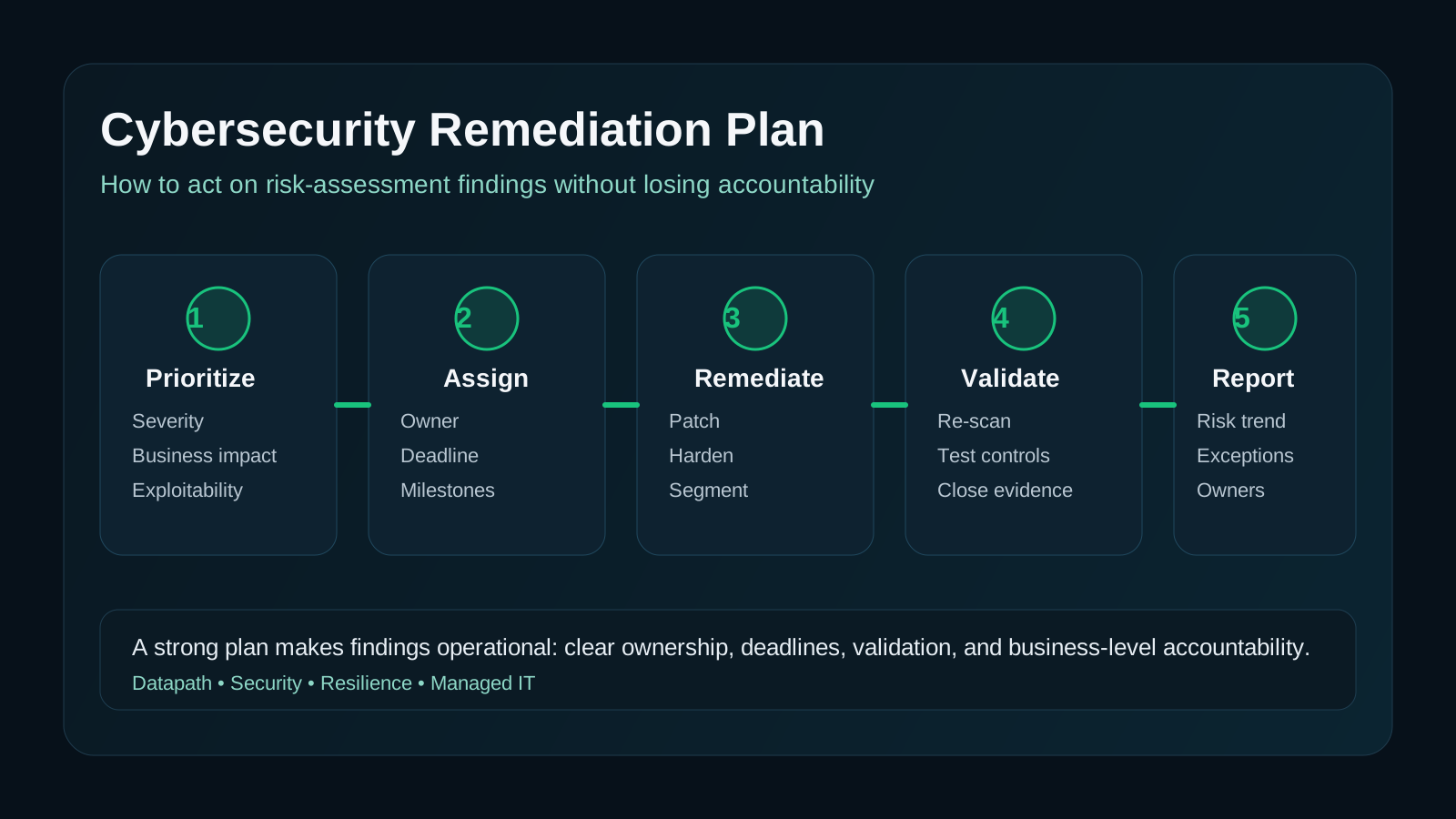

What should a cybersecurity remediation plan include after a risk assessment?
A practical cybersecurity remediation plan should include prioritized findings, business context, named owners, target deadlines, compensating controls, validation steps, exception handling, and an executive reporting rhythm. The goal is not to produce another static spreadsheet. It is to make sure the business knows what needs to change, who owns it, and how progress will be measured.123
That distinction matters because many organizations are not really missing findings. They are missing follow-through. A risk assessment often surfaces outdated systems, weak identity controls, incomplete logging, exposed vendors, untested recovery paths, and ambiguous ownership. If those issues do not get translated into a working remediation roadmap, the assessment becomes expensive documentation rather than an operational decision tool.
At Datapath, we think remediation planning works best when it is treated as part of the operating model, not a one-time security project. That usually means connecting assessment findings to support workflows, leadership reporting, compliance responsibilities, and the systems that actually keep the business running.
Why do so many organizations struggle after the assessment is finished?
Most organizations struggle after the assessment because the report arrives as a list of findings, while the business needs a sequence of decisions. Security teams may understand the technical issue, but leadership still needs to know what can wait, what cannot, which fixes might disrupt operations, and which items need budget or vendor coordination.14
This is where the gap usually shows up. A vulnerability might be critical on paper, but the real question is whether it affects a public-facing system, a regulated workflow, a privileged identity path, or a recovery dependency. Another finding might score lower technically but create bigger business exposure because it touches payroll, EHR access, finance systems, or remote access for multi-site users. A good remediation plan closes that gap between technical severity and business consequence.
How should you prioritize remediation work?
You should prioritize remediation work by combining severity, exploitability, business impact, regulatory exposure, and operational dependency. That means the right order is not always the same as the scanner order. The best first fixes are the ones that materially reduce risk to uptime, sensitive data, privileged access, or compliance posture.14
In practical terms, we usually recommend grouping findings into four buckets:
- Immediate action — exploitable issues affecting critical systems, privileged access, internet-facing assets, or regulated data.
- Near-term reduction — important weaknesses that are not actively catastrophic but still increase the blast radius of an incident.
- Planned improvement — issues that need architecture, budget, or vendor coordination.
- Accepted or compensated risk — items the business chooses not to remediate immediately because existing controls or cost realities change the decision.
This is also why remediation planning should not live in a vacuum. A finding around identity hardening may depend on broader Microsoft 365 security best practices, while backup weaknesses often tie back to a more formal backup and disaster recovery strategy. If vendor exposure is part of the picture, it may also connect to a more structured third-party cyber risk assessment checklist.
What are the core sections of a practical remediation plan?
A useful remediation plan should be easy for both technical and non-technical stakeholders to read. We recommend structuring it around a repeatable set of fields.
1. Finding summary and business context
Each item should clearly explain what the issue is, where it exists, why it matters, and what business process or system it touches. Avoid writing findings in scanner shorthand only. A remediation owner should not have to reverse-engineer the risk from a plugin title.
2. Risk rating and prioritization logic
Show how the organization decided the priority. That usually includes severity, exploitability, exposure, asset criticality, compensating controls, and business impact. NIST still provides a useful baseline for thinking about threats, vulnerabilities, likelihood, and impact in context.5
3. Named owner
Every remediation item needs a person or team responsible for moving it forward. If ownership is vague, the item usually drifts. The owner does not always perform the fix personally, but they do own coordination, status, and escalation.
4. Target date and milestone dates
The plan should define when the issue will be fixed, validated, or formally excepted. For larger items, use milestone dates rather than one distant due date. That helps leadership see whether progress is real or fictional.
5. Remediation action
State exactly what will change. Examples include patching a system, tightening conditional access, removing stale admin rights, segmenting a network, replacing unsupported software, updating a vendor contract, or testing restoration workflows.
6. Validation method
Do not stop at “fix applied.” Define how the team will verify the problem is actually closed. That may include re-scanning, log review, control testing, sample restoration, access review, or penetration retesting.4
7. Exception path
Some findings will not be remediated immediately. That does not mean they disappear. A mature plan should document accepted risk decisions, compensating controls, review dates, and the business owner who signed off.
How do you turn findings into actionable remediation tasks?
You turn findings into actionable tasks by rewriting them in operational language. Instead of “critical misconfiguration on remote access gateway,” the task becomes “enforce MFA for all remote-access users, disable legacy authentication, validate conditional-access coverage, and confirm logging reaches the SIEM.” That gives engineering, support, and leadership a shared understanding of what done actually means.
A strong remediation task usually answers five questions:
- What is changing?
- Who owns it?
- What systems or users are affected?
- How will we validate success?
- What happens if it cannot be completed on time?
This is one reason we think remediation plans should be written close to operations. If the plan is too abstract, it will not survive contact with change windows, application dependencies, user impact, or vendor limitations. Security work becomes much easier to govern when each item can be translated into a ticket, project phase, or change-control entry.
What should executives and managers see in remediation reporting?
Executives should see open high-risk items, overdue findings, remediation velocity, exception decisions, and any unresolved exposures that could still affect uptime, customer data, or compliance. They do not need a dashboard full of scanner trivia. They need clarity about business risk and accountability.23
A useful executive view usually includes:
- total open findings by priority
- the oldest unresolved critical or high-risk items
- remediation progress by owner or business function
- issues blocked by budget, vendors, or architecture constraints
- accepted-risk decisions and review dates
- trends in time-to-remediate
- whether the environment is getting more or less defensible over time
For regulated industries, this reporting is not just nice to have. It often becomes part of how the business demonstrates control maturity during audits, customer reviews, cyber insurance renewals, or board discussions.
How should teams handle findings that cannot be fixed quickly?
Teams should handle slow-moving findings through formal exception management, compensating controls, and staged remediation. Sometimes the cleanest fix depends on hardware replacement, application upgrades, contract changes, or downtime windows that are not immediately available. That reality is normal. What matters is whether the organization makes the exposure explicit and reduces it as much as possible in the meantime.12
For example, if a legacy system cannot yet be patched, interim controls might include tighter network segmentation, stronger admin restrictions, enhanced monitoring, reduced internet exposure, and better backup validation. The answer is not to pretend the finding is closed. The answer is to document what risk remains and what the path forward looks like.
How often should a remediation plan be reviewed and updated?
A remediation plan should be reviewed continuously for active items and formally refreshed whenever major findings, environment changes, or threat shifts occur. In practice, many organizations need weekly or biweekly working reviews, monthly management reporting, and a broader reassessment after major infrastructure, vendor, or regulatory changes.12
That rhythm matters because remediation is not a one-and-done event. New exposures appear as applications change, teams grow, vendors gain access, or business units adopt new tools. The plan should behave like a living operating document, not an annual artifact.
What mistakes make remediation plans fail?
The most common remediation-plan failures are vague ownership, unrealistic deadlines, no validation step, poor business prioritization, and no exception discipline. Another major problem is treating the assessment as a security-only document rather than a cross-functional operating issue.234
We also see plans fail when teams try to “fix everything” without sequencing. That usually leads to partial execution, broken change windows, exhausted staff, and leadership losing confidence in the whole process. A better approach is to reduce the most meaningful risk first, then build momentum through visible wins and recurring review.
Why Datapath for remediation planning and follow-through?
We think organizations get better outcomes when remediation planning is tied directly to how IT is actually run. That means ownership, service accountability, change coordination, security hardening, backup validation, and executive communication all need to fit together.
Datapath helps businesses connect security findings to the broader operating model around managed IT, cybersecurity, and resilience. If your team needs help turning assessment results into a practical roadmap, start with our managed cybersecurity services guide, review our broader cybersecurity risk assessment services overview, or talk with our team about building a remediation plan that leadership can actually govern.
FAQ: Cybersecurity remediation plan
What is a cybersecurity remediation plan?
A cybersecurity remediation plan is a structured roadmap that translates risk assessment or vulnerability findings into specific corrective actions, owners, deadlines, validation steps, and exception decisions.
What should be in a remediation plan after a risk assessment?
It should include prioritized findings, business impact, named owners, target dates, required fixes, validation methods, compensating controls, and accepted-risk documentation where needed.
How do you prioritize remediation items?
The best prioritization combines severity, exploitability, asset criticality, business impact, regulatory exposure, and whether existing controls already reduce the risk.
What is the difference between remediation and mitigation?
Remediation aims to remove or fix the underlying issue. Mitigation reduces the likelihood or impact when the issue cannot be fully eliminated right away.1
How do you prove remediation actually worked?
You prove remediation through validation steps such as re-scanning, access review, configuration testing, log review, backup restoration tests, or follow-up penetration testing depending on the issue.4
Footnotes
-
Splunk explains that remediation is the process of identifying, addressing, fixing, and minimizing cybersecurity threats, while mitigation defines what happens when a risk still materializes. (https://www.splunk.com/en_us/blog/learn/risk-remediation.html) ↩ ↩2 ↩3 ↩4 ↩5 ↩6
-
Bitsight recommends setting risk thresholds, defining owners, proactively notifying vendors when relevant, and driving continuous improvement after remediation. (https://www.bitsight.com/blog/5-tips-crafting-cybersecurity-risk-remediation-plan) ↩ ↩2 ↩3 ↩4 ↩5
-
Cynomi emphasizes linking assessment findings to concrete remediation tasks, target deadlines, and stakeholder accountability across IT, GRC, compliance, and leadership. (https://cynomi.com/learn/cybersecurity-risk-assessment-checklist/) ↩ ↩2 ↩3
-
SentinelOne outlines a stepwise remediation flow of identifying vulnerabilities, prioritizing risks, fixing issues, validating the remediation, and documenting results. (https://www.sentinelone.com/cybersecurity-101/cybersecurity/vulnerability-remediation/) ↩ ↩2 ↩3 ↩4 ↩5
-
NIST SP 800-30 remains a useful baseline for assessing threats, vulnerabilities, likelihood, and impact in context. (https://csrc.nist.gov/pubs/sp/800/30/r1/final) ↩