import CTA from ’../../components/CTA.astro’;
How should buyers compare Datapath vs CIOSolutions for mid-market IT outsourcing?
Buyers should compare Datapath vs CIOSolutions by looking at accountability, security operating depth, cloud support, and fit for the business environment instead of relying on broad managed IT language alone. A serious comparison should explain how each provider handles day-to-day support, after-hours escalation, backup and recovery accountability, identity controls, vendor coordination, and executive visibility when something important goes sideways.1234
That matters because most mid-market organizations are not really shopping for “IT support” in the abstract. They are trying to reduce downtime, tighten security discipline, control cloud sprawl, and make sure someone clearly owns the overlap between users, vendors, infrastructure, and compliance pressure. In our experience, the better outsourcing partner is usually the one that makes the environment calmer and easier to govern over time.
We are writing this from Datapath’s perspective, but the goal is not to take cheap shots at CIOSolutions. The goal is to help buyers understand where Datapath and CIOSolutions appear to differ, where they overlap, and what questions matter most before signing an outsourcing agreement.
Why does this comparison matter for mid-market teams?
This comparison matters because two providers can both offer managed IT, cybersecurity, cloud support, and strategic guidance while still producing very different outcomes for a 75-user, 200-user, or multi-site business. The difference usually shows up in execution quality: who owns recurring issues, how clearly risk gets escalated, how backup and identity controls are governed, and whether leadership gets useful reporting instead of technical noise.125
CISA continues to emphasize practical controls such as multifactor authentication, secure configuration, vulnerability management, and recovery readiness because those fundamentals still shape real-world resilience.5 NIST’s Cybersecurity Framework 2.0 reinforces the same point from a governance perspective: strong outcomes depend on governance, protection, detection, response, and recovery operating together instead of as disconnected projects.6
That is why mid-market buyers should compare Datapath and CIOSolutions at the operating-model level, not just the feature-list level. A regulated healthcare organization, financial firm, multi-site services business, or growth-stage company usually needs more than a help desk. It needs a partner that can keep technology accountable while the business keeps moving.
What should buyers compare first?
Buyers should start with the categories that most directly affect outcomes: support ownership, security depth, cloud and infrastructure coverage, leadership visibility, and business fit. Those areas usually expose real differences faster than polished sales language.
A practical scorecard looks like this:
| Evaluation area | What buyers should compare | Why it matters |
|---|---|---|
| Support and escalation | After-hours coverage, on-site reach, ownership of recurring problems, vendor follow-through | Determines whether urgent issues turn into real action quickly |
| Security operating depth | Identity controls, endpoint oversight, backup verification, recovery drills, incident workflows | Reduces the chance that avoidable gaps turn into outages or claims |
| Cloud and infrastructure support | Microsoft 365, Azure, private or hybrid cloud, lifecycle planning, network operations | Matters when the environment is changing instead of standing still |
| Leadership visibility | Reporting, roadmap guidance, business reviews, accountability for open risks | Helps executives understand what needs attention and why |
| Business fit | Regulated-industry readiness, multi-site consistency, local responsiveness, co-managed flexibility | Important when the business cannot afford fuzzy ownership |
How do Datapath and CIOSolutions appear to differ?
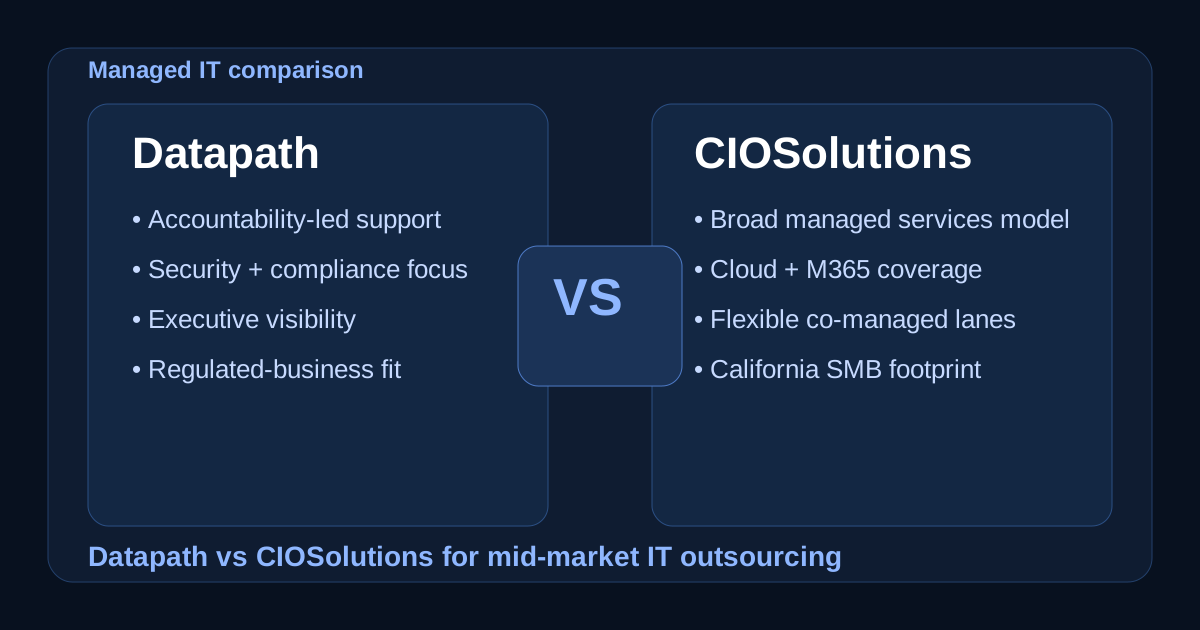
CIOSolutions appears to position itself as a broad managed IT partner for small to mid-sized organizations, while Datapath positions more heavily around accountability-led managed IT, cybersecurity, and regulated-business support. CIOSolutions publicly emphasizes managed services, managed cloud, cybersecurity, help desk support, vendor coordination, and fit for organizations ranging from roughly 15 users to 1,000+ users across fully managed and co-managed models.1 Datapath’s public positioning emphasizes managed IT services, cybersecurity, compliance support, and strategic IT accountability for regulated and growth-stage teams.27
That distinction matters. Some buyers want a provider with broad California MSP coverage and a familiar full-service support model. Others care more about whether the provider can connect support, security, compliance pressure, and executive reporting into one clear operating rhythm. Both models can be legitimate. The fit depends on what the business is actually trying to solve.
How important is cloud and Microsoft 365 capability here?
Cloud capability matters because many mid-market outsourcing decisions are really decisions about Microsoft 365, Azure, identity, remote access, backup, and day-two operations. CIOSolutions explicitly highlights Microsoft 365, Azure, private cloud, hybrid cloud, MFA, SSO, migrations, backup and recovery, cost control, permissions management, and performance optimization as part of its managed cloud program.1 Datapath also centers cloud modernization, cybersecurity, and managed IT accountability across environments where growth, risk, and vendor complexity are colliding.28
For buyers, the right question is not just whether both providers “do cloud.” It is whether they can support your version of cloud complexity:
- multi-site identity and permissions
- backup and restore accountability
- vendor coordination during outages or migrations
- cost and license governance
- secure remote access for distributed users
- reporting that leadership can actually use
If the environment is Microsoft-heavy and changing quickly, those details matter far more than generic cloud marketing.
Where are the biggest differences likely to show up?
The biggest differences are likely to show up in governance style, compliance alignment, and the type of business each provider is best built to support. Two MSPs can overlap on service categories while still serving different buyers especially well.
When might CIOSolutions be the better fit?
CIOSolutions may be the better fit for businesses that want a broad managed services partner with visible strength in California, modern cloud operations, end-user support, and flexible fully managed or co-managed service lanes. Its public material emphasizes proactive monitoring, patching, backup, cloud support, vendor management, support for single-site and multi-site organizations, and service models that scale from smaller teams to larger co-managed environments.134
That may appeal to organizations that want:
- a provider already speaking to small and mid-sized business operations
- broad support around Microsoft 365, Azure, and hybrid cloud
- a more traditional managed services structure
- California market familiarity and regional delivery depth
- a partner comfortable splitting responsibilities with internal IT
When might Datapath be the better fit?
Datapath is often the better fit when the business wants managed IT tied tightly to accountability, cybersecurity outcomes, and executive clarity. Datapath’s positioning leans into accountability, security, compliance support, and operating discipline for organizations that need ownership to be explicit rather than implied.278
In practical terms, that tends to matter most for organizations that want:
- stronger visibility into risk, ownership, and follow-through
- managed IT and cybersecurity aligned with leadership priorities
- support for regulated or audit-sensitive environments
- a partner that emphasizes governance and accountability, not just ticket handling
- a steadier operating model for multi-site or lean internal IT teams
How should regulated or high-accountability teams evaluate the two?
Regulated or accountability-heavy buyers should compare how well each provider supports documentation, executive reporting, recovery readiness, identity governance, and operational follow-through. That includes asking about backup verification, access reviews, cyber insurance support, recurring issue management, and whether leadership gets decision-ready reporting instead of a spreadsheet of closed tickets.567
We think this is where Datapath deserves especially close attention. If a business needs its MSP to help connect security controls, compliance expectations, and business accountability into one operating rhythm, that is a different requirement from simply wanting broad outsourced IT coverage. Buyers should still ask both providers direct questions, but the fit often becomes clearer very quickly.
That evaluation also connects naturally to Datapath resources like our managed IT services overview, our financial services solutions page, our healthcare solutions page, and our resources and guides hub.
What questions should buyers ask both providers before deciding?
Buyers should ask questions that expose execution quality instead of surface-level service lists. The goal is to understand how the provider behaves under pressure and how clearly they define ownership.
We recommend asking both Datapath and CIOSolutions:
- What happens after hours if a security or infrastructure incident appears?
- How do you verify backup success and recovery readiness?
- How do you handle recurring issues that involve users, vendors, and cloud systems at the same time?
- What does leadership reporting look like each month or quarter?
- What is included in the core managed service versus a separate project or add-on?
- How do you support regulated, insured, or audit-sensitive environments?
- When do you recommend fully managed versus co-managed IT?
- What kinds of mid-market clients are you actually best suited for?
A serious MSP should answer those clearly. If the answer is mostly tools, badges, or general reassurance, keep digging.
When is Datapath likely the better choice for mid-market IT outsourcing?
Datapath is likely the better choice when the business wants a managed IT partner that combines support, security, compliance support, and accountability into one operating model. We think that matters most for teams that cannot afford fuzzy ownership, unclear communication, or a disconnect between technical activity and business risk.
That often includes:
- regulated or accountability-heavy businesses
- organizations with lean internal IT leadership
- multi-site companies that need steadier standards across locations
- teams that want clearer guidance on vendors, risk, and roadmap priorities
- buyers who care about governance and communication as much as raw service breadth
CIOSolutions may still be a strong option for businesses prioritizing a broader California MSP footprint, flexible co-managed structures, or a more traditional managed services model. But if the business wants tighter accountability and a more governance-oriented operating rhythm, we believe Datapath is the stronger fit.
Why Datapath for accountability-led IT outsourcing?
We think the best outsourcing partner is the one that makes technology easier to govern, not just easier to buy. That means support that does not stop at ticket closure, security work that improves resilience instead of adding noise, and reporting that helps leadership act before small issues become expensive ones.
If your team is comparing Datapath and CIOSolutions now, use that lens. Ask who owns the outcome, who keeps the environment accountable, and who can help your business stay clearheaded when systems, vendors, cloud changes, and security pressure all collide. If you want to evaluate that fit in practice, start with the Datapath homepage, review our managed IT services overview, explore our MSP evaluation guide for 100+ employees, and talk with our team.
FAQ: Datapath vs CIOSolutions for mid-market IT outsourcing
What is the best way to compare Datapath vs CIOSolutions?
The best way is to compare escalation quality, security operating discipline, cloud support depth, reporting clarity, and business fit rather than relying on generic feature lists.
Is this mainly a pricing decision?
No. Pricing matters, but the bigger issue is how each provider handles accountability, recovery readiness, recurring issues, vendor coordination, and leadership communication over time.
Which provider is stronger for regulated or accountability-heavy businesses?
The stronger fit is usually the provider that can support documentation, governance, reporting, and follow-through in a way leadership can actually use. Buyers should ask both providers for concrete examples.
Should a mid-market team choose fully managed or co-managed IT?
That depends on internal capacity, compliance pressure, and how much day-to-day ownership the business wants to retain. The right provider should be able to explain the tradeoffs clearly.
Sources
- CIOSolutions homepage
- CIOSolutions about page
- CIOSolutions systems management page
- CIOSolutions managed cloud services page
- CISA Cyber Essentials
- NIST Cybersecurity Framework 2.0
- Datapath homepage
- Datapath Dublin, Ohio location page
