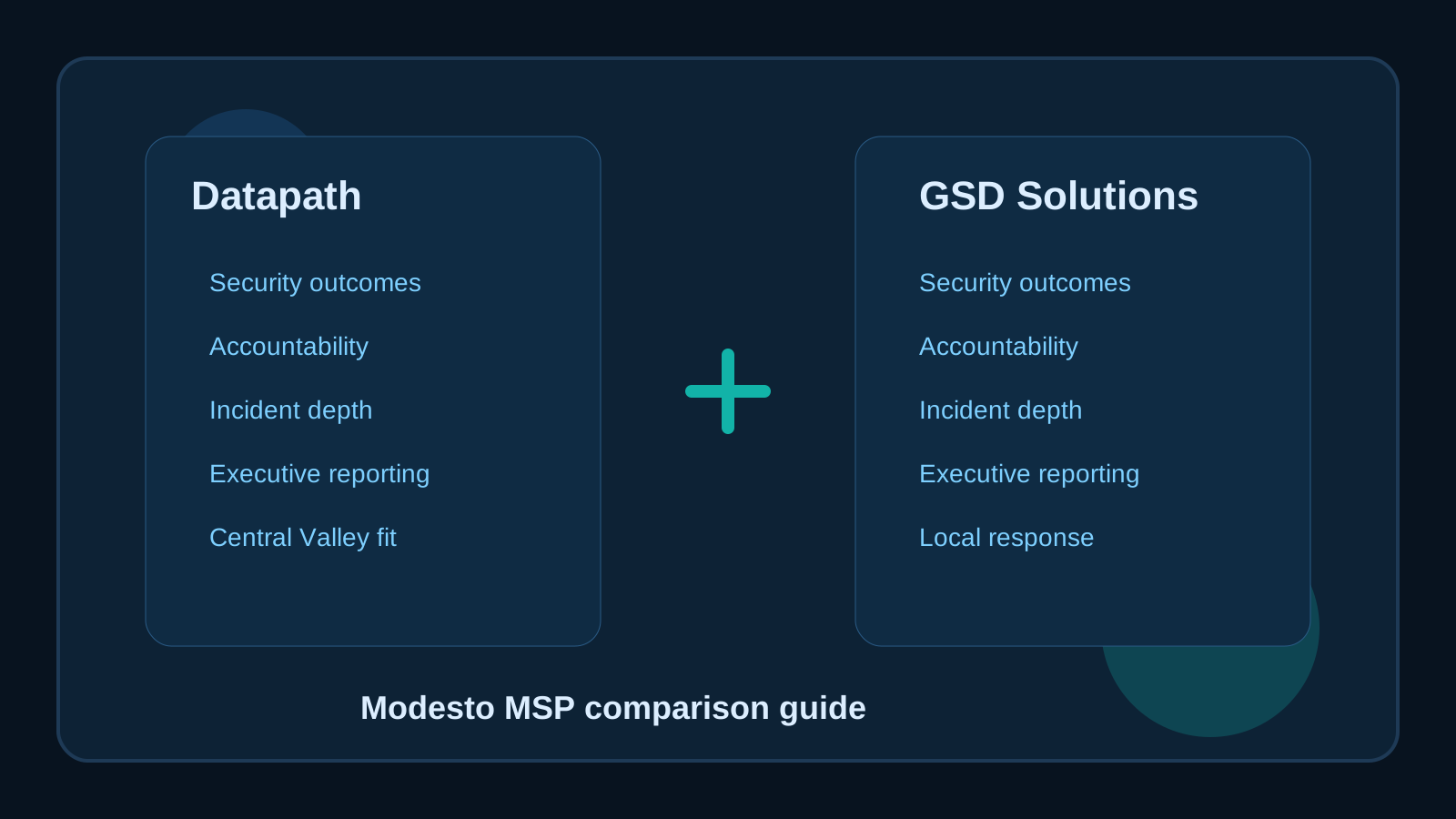

How should buyers compare Datapath vs GSD Solutions in Modesto?
Buyers should compare Datapath vs GSD Solutions in Modesto by looking at security outcomes, operational accountability, and fit for the business environment rather than relying on general MSP language alone. A useful comparison should measure how each provider approaches identity protection, backup resilience, incident response, reporting, and strategic guidance for organizations that cannot afford recurring downtime or unclear ownership.1234
That matters because most businesses are not really trying to buy “IT support” in the abstract. They are trying to reduce interruption, tighten cybersecurity discipline, satisfy insurance or compliance pressure, and make sure leadership gets clearer answers when something breaks or a risk decision has to be made. In our experience, the strongest managed IT partnership is the one that turns technology operations into a calmer, more governable system month after month.
This article is intentionally balanced. We are writing from Datapath’s perspective, but the goal is not to disparage another local provider. The goal is to help a serious buyer decide which managed IT partner is a better fit for their priorities in Modesto and the broader Central Valley. If you are also comparing broader service models, review our managed IT services overview, our Modesto location page, and our article on how managed IT services in Modesto can prevent costly cyber attacks.
Why does the Datapath vs GSD Solutions decision matter for security outcomes?
The Datapath vs GSD Solutions decision matters because the MSP operating model affects how quickly your team detects issues, contains risk, recovers from outages, and communicates with leadership during stressful events. The difference between providers often shows up in execution quality, not in whether both can name the same tool categories.345
CISA continues to emphasize practical controls such as multifactor authentication, phishing-resistant identity protections, vulnerability reduction, and tested recovery because those basics still change real-world security outcomes.3 NIST’s Cybersecurity Framework 2.0 reinforces the same point from an operating-model angle: resilience depends on governance, protection, detection, response, and recovery working together rather than being treated like disconnected tasks.4
For Modesto-area organizations, that means the MSP comparison should go deeper than “local versus local.” A healthcare clinic, financial firm, distributor, city-adjacent contractor, or multi-site business needs to know which provider can support real accountability when the environment is under pressure. If a phishing event compromises a mailbox, if backups fail silently, or if a critical vendor issue lands after hours, the right question is not which website sounds stronger. It is which provider can operate more reliably in the moment that matters.
What evaluation criteria should serious buyers use first?
Serious buyers should start with criteria tied to operating outcomes: identity security, incident readiness, backup recoverability, reporting clarity, and strategic ownership. Those categories expose meaningful differences faster than generic feature checklists.
A practical scorecard looks like this:
| Evaluation area | What buyers should compare | Why it affects outcomes |
|---|---|---|
| Identity and access | MFA enforcement, privileged access control, onboarding/offboarding discipline | Identity abuse remains one of the fastest paths to compromise |
| Security monitoring | What is watched, who triages alerts, and how escalation works | Determines whether important signals become action in time |
| Backup and recovery | Monitoring, restore testing, recovery planning, and accountability | Reduces the risk that an outage becomes a prolonged business interruption |
| Reporting and governance | Executive summaries, roadmap guidance, and owner-based follow-up | Turns IT into a managed business function instead of a black box |
| Local operating fit | On-site support, Central Valley familiarity, and communication cadence | Improves responsiveness when business context matters |
How should buyers compare security depth?
Buyers should compare security depth by asking how each provider handles identity, endpoint, email, firewall, and recovery workflows in daily operations. It is not enough for an MSP to say security is included. The provider should explain how the work is reviewed, escalated, and improved over time.
We recommend asking both Datapath and GSD Solutions:
- How do you harden Microsoft 365 and administrative identities?
- What happens when suspicious activity is detected after hours?
- How are backup failures tracked and validated?
- What do clients receive monthly that helps leadership make decisions?
- How do you separate routine support noise from risks that need executive attention?
The answers to those questions usually reveal more than a pricing sheet.
How important is local context in Modesto?
Local context matters when it improves response quality, communication, and business understanding, not just when it puts a provider nearby on a map. In Modesto, buyers often need support for distributed offices, regulated workflows, lean internal IT staffing, and real-world coordination with internet providers, software vendors, cyber insurers, and leadership stakeholders.
That is why we think “local” should be evaluated in two dimensions. The first is practical availability for on-site issues such as firewall changes, office moves, hardware failures, and network troubleshooting. The second is whether the provider understands how Central Valley businesses actually operate. A provider who can explain how downtime affects logistics, accounting, healthcare operations, or executive reporting is usually more valuable than one who only promises friendliness and fast ticket closure.
Where are the most important differences likely to show up?
The most important differences usually show up in accountability, escalation design, and the ability to connect technical work to business risk. Two providers can offer support, monitoring, and cybersecurity services, but still deliver very different outcomes.
Does the provider run a disciplined security operating model?
A disciplined security operating model is visible in the boring details. Buyers should look for documented review cycles, clear ownership of unresolved issues, practical remediation planning, and communication that makes decisions easier instead of noisier. We think that is where Datapath’s approach tends to stand out: we focus heavily on translating technical findings into business-ready action, especially for organizations that need clearer governance and steadier follow-through.
That said, buyers should verify this directly with both providers. Ask for examples of monthly reporting, roadmap planning, incident communication, and how recurring issues are prevented from resurfacing. A provider that cannot show operational structure will usually struggle to maintain security outcomes consistently.
Can the provider support regulated or accountability-heavy environments?
Regulated and accountability-heavy environments should compare how well each MSP supports documentation, evidence, and control follow-through. That includes cyber insurance questionnaires, customer security reviews, audit preparation, vendor-risk conversations, and leadership reporting.
This does not mean every Modesto business needs the same compliance framework. It means buyers should favor the partner that can connect day-to-day support with stronger documentation, backup readiness, access control, and risk review. We think Datapath is often a strong fit for organizations that want managed IT and cybersecurity decisions to hold up under more scrutiny, especially in healthcare, finance, government-adjacent, and multi-site environments.
Which provider is a better fit for multi-site or growth-stage companies?
Growth-stage and multi-site companies should compare how each provider handles standardization across locations, vendor coordination, onboarding consistency, and executive-level planning. An MSP that only reacts to tickets may feel adequate in a small environment and then start breaking down as the organization adds locations, users, applications, and external requirements.
In our experience, the right fit for a growing company is usually the provider that can combine local responsiveness with planning discipline. That means fewer avoidable surprises, better visibility into asset and identity sprawl, and more confidence that one office or one aging system is not quietly creating risk for the rest of the business.
What questions should a buyer ask Datapath and GSD Solutions before deciding?
A buyer should ask Datapath and GSD Solutions questions that expose execution quality rather than marketing polish. The goal is to understand how each MSP behaves under pressure and whether the service model matches your risk tolerance.
Here are the questions we think matter most:
- How do you structure after-hours incident escalation?
- What security controls are included in your core managed IT service versus treated as add-ons?
- How do you verify backups and recovery readiness?
- What does your monthly reporting look like for executives and IT leadership?
- How do you handle recurring issues that span users, systems, and third-party vendors?
- What kinds of organizations are you best suited for in Modesto?
- How do you support cyber insurance, compliance, or customer security requirements?
A serious buyer should also ask for concrete examples. If the answer is only a list of tools, keep pushing. Better providers can explain process, ownership, and escalation paths in plain language.
When is Datapath likely the better fit?
Datapath is likely the better fit when a business wants managed IT tied closely to security outcomes, accountability, and strategic operating discipline. We are usually strongest when clients want more than ticket response and need a partner that can help leadership make better decisions about risk, resilience, vendor coordination, and roadmap priorities.
That tends to matter most for:
- regulated or accountability-heavy environments
- organizations with lean internal IT leadership
- multi-site companies that need consistency across locations
- teams that want stronger visibility into backup, identity, and security posture
- buyers who care about executive communication as much as technical execution
We do not think every company should choose the same MSP. If a buyer mainly wants lightweight support with a narrower scope, another provider may be a fine fit. But if the business is looking for a managed IT partner that treats cybersecurity, uptime, and accountability as part of one operating system, we believe Datapath deserves serious consideration.
Why Datapath for managed IT and cybersecurity outcomes in Modesto?
We think the best managed IT partner is the one that lowers operational friction while making risk easier to understand and control. That means support that does not stop at ticket closure, reporting that helps leadership act, and security work that improves resilience instead of just adding alerts.
For Modesto businesses comparing local MSPs, our view is simple: choose the provider that can explain ownership clearly, prove how it handles incidents and recovery, and support the kind of accountability your business actually needs. If you want to compare options with that lens, start with our Datapath homepage, review our resources and guides, or talk with our team about your environment.
Comparing Datapath vs GSD Solutions in Modesto?
We help Modesto-area teams evaluate managed IT partners based on security outcomes, accountability, and real operating fit instead of vague MSP claims.
FAQ: Datapath vs GSD Solutions in Modesto
What is the best way to compare Datapath vs GSD Solutions in Modesto?
The best way is to compare identity controls, backup readiness, escalation depth, reporting quality, and strategic ownership rather than relying on broad service lists. Those areas reveal which provider is more likely to improve security outcomes over time.
Is Datapath vs GSD Solutions only a pricing decision?
No. Pricing matters, but the bigger issue is how each provider handles accountability, incident response, recovery planning, and executive communication. A cheaper MSP can become more expensive if recurring risk and downtime stay unresolved.
Which provider is better for regulated or multi-site businesses?
The better fit is usually the provider that can document controls clearly, support evidence-heavy workflows, and standardize operations across users, locations, and vendors. Buyers should ask both providers for examples of how they handle those environments in practice.
Should a Modesto business prioritize local presence or security maturity?
It should prioritize both, but security maturity matters more if the provider cannot translate local presence into disciplined service delivery. The strongest MSP combines regional responsiveness with a repeatable operating model that holds up under pressure.
Sources
- Datapath Managed IT Services
- GSD Solutions Cyber Security Services in Modesto
- CISA Cyber Essentials
- NIST Cybersecurity Framework 2.0
- IBM Cost of a Data Breach Report