Why do Westerville businesses need to evaluate managed IT providers carefully?
For a lot of Westerville businesses, managed IT is not just about outsourcing help desk tickets. It is about deciding who will help run the operational layer behind devices, Microsoft 365, networking, vendor coordination, security controls, backup oversight, and issue escalation day after day.12
That matters because most companies do not fail because they lack technology. They struggle because ownership gets fuzzy. Support feels reactive. Security tools exist, but nobody can say with confidence how patching, identity, backup testing, and incident response are actually being handled. When that happens, leadership gets noise instead of clarity.
A strong managed IT partner should make the environment feel more stable, more secure, and easier to govern. That means fewer repeat issues, clearer expectations, and better visibility into open risks and next steps.3 If a provider cannot explain how it operates in practical terms, that is usually a warning sign.
Comparing managed IT providers in Westerville?
Datapath can help you compare IT support scope, escalation paths, cybersecurity coverage, backup ownership, reporting, and local response before you choose an MSP.
What should buyers in Westerville actually compare?
The easiest mistake is comparing providers on generic claims like “proactive,” “strategic,” or “security-focused.” Almost every MSP says those things. The better test is whether the provider can explain exactly what it owns, how it works, and how that operating model helps your business make better decisions.34
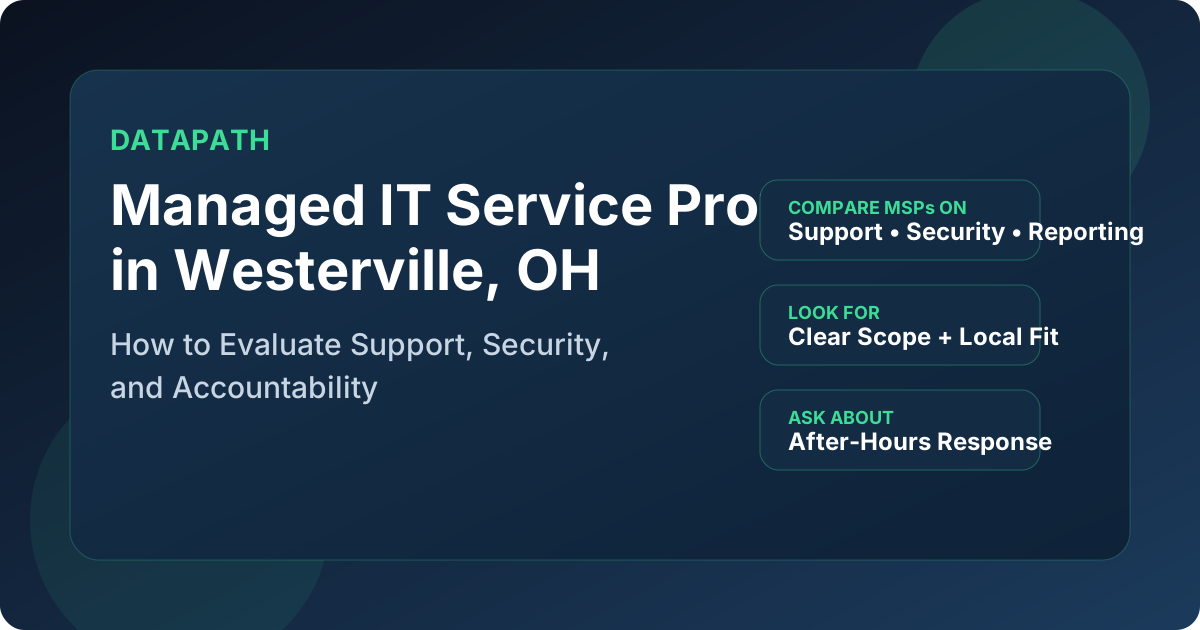
We think Westerville buyers should compare providers across four areas: support quality, security depth, accountability, and local fit.
1. Support quality
Most businesses first experience an MSP through support. That includes account issues, new device setup, Microsoft 365 administration, connectivity problems, onboarding and offboarding, printer issues, and vendor escalation when another platform breaks.3
But good support does more than close tickets. It should reduce repeated issues through documentation, standardization, and root-cause follow-up. If the same mailbox problem, Wi-Fi complaint, permissions error, or workstation issue keeps resurfacing, the provider should be able to explain what is being fixed systemically instead of just closing another ticket.34
Questions worth asking:
- Is support available after hours for urgent issues?
- What are the response targets for critical incidents?
- What gets handled directly versus escalated to third-party vendors?
- How does the provider track recurring problems and permanent fixes?
- What does onboarding look like for new users, devices, and locations?
Several Westerville-area providers market 24/7 monitoring or help desk support, but buyers should push past the headline and ask how emergencies are triaged, what the escalation path looks like, and what evidence the provider can show that response standards are being met.156
2. Security depth
Managed IT without real security discipline is just outsourced instability. A serious provider should be able to explain how identity, endpoint protection, email security, patching, backup oversight, and incident escalation are handled in the environment.3
That does not mean every Westerville business needs the same stack. It does mean the provider should have a clear baseline and be able to separate what is included from what is optional.
At minimum, buyers should ask about:
- multifactor authentication and identity controls
- endpoint protection or EDR oversight
- patching cadence and exception tracking
- email protection and phishing response
- backup monitoring, retention, and restore testing
- incident escalation and communication during an event
- strategic security guidance, including whether vCISO-style support is available
Some Ohio-area providers explicitly advertise penetration testing, threat hunting, 24x7 monitoring, managed cybersecurity, or vCISO services.127 Those offerings can be useful, but the real question is whether the provider can show how those controls are actually managed and reviewed over time.
3. Accountability and reporting
This is where weak MSP relationships usually break down. If scope stays vague during the sales process, it usually stays vague after the agreement is signed.3
Before comparing proposals, define what the provider is expected to own. That usually includes support, monitoring, patching, backup oversight, baseline security administration, reporting, vendor coordination, and planning.3
Then ask for specifics:
- Which users, systems, and sites are in scope?
- What happens after hours or during a high-severity incident?
- Which security controls are included versus sold separately?
- Who owns vendor escalations and recurring issue review?
- What reporting is delivered to leadership each month or quarter?
- How are aging devices, failed backups, and patch exceptions tracked?
The right MSP should give leadership better visibility into performance, risks, and priorities. Service reviews should not just recap ticket counts. They should help the business understand what is changing, what is getting better, what remains exposed, and what should happen next.34
4. Local fit across the Columbus market
Yes, local fit still matters, but not in the simplistic sense of having an office nearby. It matters when it improves accountability, on-site response, escalation clarity, and practical support for office changes, networking work, or hardware failures that cannot be solved well through remote access alone.3
For Westerville buyers, local relevance usually means the provider can support the broader Columbus-area footprint, not just one zip code. Providers serving Westerville often also cover Dublin, Worthington, Hilliard, Gahanna, and nearby business corridors.258
That kind of regional coverage is useful if your team has multiple offices, shared vendors, hybrid users, or growth plans that extend beyond one location.
What should a good MSP proposal include?
A good proposal should make the operating model easier to understand, not harder. Buyers should expect clarity around:
- scope of support and devices covered
- response and escalation expectations
- security baseline responsibilities
- backup and recovery ownership
- reporting cadence
- project and change-management boundaries
- on-site support expectations
- pricing model and contract assumptions
If a proposal leaves those areas fuzzy, the business is being asked to buy trust without enough evidence. That is a bad trade.
What are red flags when comparing Westerville MSPs?
The biggest red flags are usually operational, not cosmetic.
Watch for providers that:
- rely on vague marketing claims without explaining process
- cannot describe their after-hours incident model clearly
- blur the line between included security controls and add-ons
- avoid questions about reporting, ownership, or backup testing
- focus only on ticket closure instead of recurring issue reduction
- give unclear pricing or broad assumptions that shift later
In our view, the right MSP should make the environment feel calmer and more legible. Staff should have less friction. Leadership should have clearer reporting. Vendor ownership should be easier to explain. Security and backup controls should be validated, not guessed.3
How should Westerville businesses make the final decision?
Do not pick the provider with the nicest slide deck. Pick the one that gives the clearest answers.
A strong buyer process usually looks like this:
- Define what the MSP is expected to own.
- Compare after-hours support and escalation models.
- Review security coverage in practical detail.
- Confirm what reporting leadership will actually receive.
- Check whether the provider can support the broader Columbus-area operating model.
- Ask for references from businesses with similar size, complexity, or regulatory pressure.
That approach helps expose the difference between a provider that sounds polished and one that is actually prepared to run the work well.
Related resources and next steps
If you are comparing providers in Westerville, it may also help to review Datapath’s managed IT services in Westerville, our broader managed IT services overview, our Ohio market guide on managed IT services in Dublin and Columbus, OH, and our nearby location pages for Worthington, Ohio and Upper Arlington, Ohio.
If your team wants a provider that can support day-to-day operations while improving security discipline and accountability, start with the Datapath homepage, review our solutions, or talk with our team about what managed IT should look like for your environment.
Sources
- All Lines Technology: Westerville managed IT services
- Cloud Cover: Managed IT & cloud solutions in Ohio
- Datapath: Managed IT Services in Westerville, OH
- Datapath: Managed IT Services in Dublin and Columbus, OH: What Serious Buyers Should Evaluate
- BPM: How to Choose the Right Managed IT Provider
- Visual Edge IT: IT Services in Westerville & Columbus, Ohio
- EasyIT: IT Services in Westerville, OH
- Westerville Area Chamber: Cyber Security Services listing
- ClearlyRated: IT Services Firms in Westerville, OH