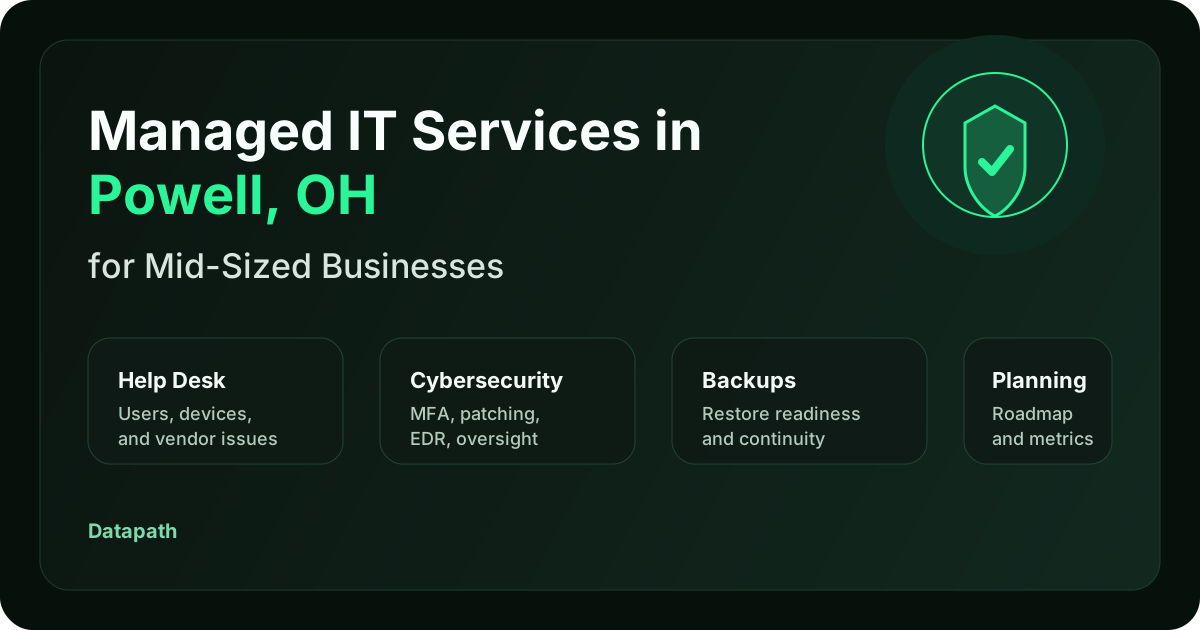
What should mid-sized businesses expect from managed IT services in Powell, OH?
Managed IT services in Powell, OH for mid-sized businesses should deliver more than outsourced ticket handling. A serious managed service provider should take recurring responsibility for support, monitoring, patching, backup oversight, cybersecurity administration, vendor coordination, and planning so leadership gets a steadier operating model instead of a pile of disconnected IT chores.123 For a growing company, the practical question is not just who can fix laptops faster. It is who can help the business run with less downtime, cleaner accountability, and fewer avoidable surprises.
That matters in Powell because many businesses sit in the same awkward middle ground. They are too complex for an informal break-fix model, but not large enough to staff every IT specialty internally. They still depend on Microsoft 365, remote access, line-of-business software, cloud platforms, backups, wireless networks, endpoint security, and third-party vendors. As that stack grows, so does the cost of ambiguity. One unresolved backup alert, one stale admin account, or one poorly handled outage can spill into customer service, operations, finance, and leadership time.
In our experience, the best managed IT relationship feels quieter over time. Repeating issues show up less often. Backup readiness becomes testable instead of assumed. Security ownership gets clearer. Leaders get more useful reporting. That is what mid-sized businesses in Powell should actually expect from managed IT.
What should managed IT services in Powell actually include?
A credible provider should cover the recurring work that keeps the environment stable, secure, and governable. NIST’s Cybersecurity Framework 2.0 emphasizes that mature operations depend on governance, protection, detection, response, and recovery working together rather than living in separate silos.3 CISA’s Cyber Essentials guidance points in the same direction: resilience depends on disciplined fundamentals, not just more tools.4
What should help desk and end-user support look like?
Most buyers first notice managed IT through support responsiveness, but support is only one layer of value. Mid-sized businesses in Powell should expect help with user issues, workstation setup, onboarding and offboarding, Microsoft 365 administration, connectivity problems, printer trouble, line-of-business application support, and vendor escalation when something outside the core stack breaks.
Good support should not just close tickets. It should reduce repeat friction through documentation, standardization, and root-cause follow-up. If the same mailbox issue, VPN problem, wireless complaint, or workstation slowdown keeps coming back, the provider should be able to explain what is being fixed systemically instead of just cleaning up the symptom.
That is one reason we recommend comparing providers on process, not just friendliness. A support desk that resolves one-off issues quickly is useful. A support model that helps the business have fewer of those issues in the first place is better.
What should monitoring, maintenance, and security cover?
A strong managed IT model should also include the less glamorous work that prevents disruption from piling up:
- endpoint and server monitoring
- operating system and application patching
- alert review and remediation follow-up
- backup job monitoring and restore escalation
- endpoint protection oversight
- identity and MFA administration
- documentation that survives staff turnover
- hardware lifecycle and warranty tracking
For many Powell businesses, that baseline matters more than another flashy security product. If routine maintenance slips, the environment gets noisier and leadership gradually absorbs the cost through downtime, security exceptions, and vendor confusion.
A practical baseline should also connect support to recovery readiness. We see the most stable environments treat backups, endpoint protection, patching, email security, and access control as operating disciplines rather than isolated tools. Businesses exploring the broader model should compare this against Datapath’s managed IT services overview, our backup and disaster recovery guide, and our article on managed cybersecurity services.
What should strategic IT planning include for a mid-sized company?
Mid-sized businesses usually do not just need technical coverage. They need stronger decision-making. That means a managed IT partner should help leadership understand what is aging, where risk is accumulating, which vendors need more oversight, and what should happen in the next quarter instead of waiting for a crisis.
A useful planning layer often includes:
| Managed IT area | What mid-sized businesses should expect | Why it matters |
|---|---|---|
| Service reviews | Recurring review of tickets, trends, and open issues | Helps leadership see patterns instead of noise |
| Security baseline | Clear ownership of MFA, endpoint protection, and backup oversight | Reduces preventable exposure |
| Vendor coordination | Escalation with Microsoft, ISPs, app vendors, and telecom providers | Keeps responsibility from getting lost |
| Roadmap planning | Refresh planning, project prioritization, and budgeting guidance | Supports growth without reactive spending |
| Documentation | Current network, admin, backup, and asset records | Lowers key-person risk |
That planning function is part of why many growing organizations eventually move away from break-fix support. A reactive provider can restore service after a problem. A stronger MSP should make the environment easier to run six months from now.
Why do mid-sized businesses in Powell move to managed IT services?
Most companies do not switch because they suddenly want to outsource everything. They move because the business has outgrown a reactive operating model and leadership can feel the strain.
Has the business outgrown one internal generalist or informal support?
This is one of the most common triggers. A single internal IT manager, office operations lead, or technically capable employee can only absorb so much help desk work, Microsoft 365 administration, patch review, security follow-up, backup monitoring, and vendor wrangling before something important starts slipping.
Managed IT gives the business a way to spread that operational load without waiting to build a full internal team. In some environments, that means fully outsourced support. In others, it means a co-managed model where internal staff keep business-specific ownership while the MSP handles recurring operational coverage. We cover that approach in our co-managed IT services guide.
For many Powell companies, that shift happens when growth adds more users, more devices, more SaaS vendors, and more executive expectations than one person can realistically govern well.
Is downtime becoming more expensive and harder to ignore?
As the environment matures, downtime gets harder to absorb quietly. A cloud outage, account lockout, wireless issue, firewall problem, failed update, or backup alert can ripple into operations, client service, scheduling, finance, and leadership time. IBM’s annual breach research keeps reinforcing the broader point: operational disruption often carries more cost than teams admit until an incident forces the issue.5
That is why businesses often start evaluating providers after recurring instability rather than after a perfectly planned strategy cycle. If staff keep losing time to the same avoidable friction, leadership eventually stops treating that friction as background noise. Our article on the true cost of IT downtime goes deeper on why ownership and prevention matter so much.
Are security, insurance, and customer expectations getting tougher?
The other major trigger is outside pressure. Cyber insurance applications ask sharper questions. Customers want better answers about controls. Leadership wants more confidence that backups, MFA, vendor access, and endpoint protections are real rather than assumed. Even businesses that are not heavily regulated still feel that pressure because clients and insurers expect a more mature baseline than they did a few years ago.
In those situations, managed IT should create clarity instead of dependence on vague promises. A useful provider should be able to explain what is in scope, how after-hours incidents work, where the main risks sit, and how leadership gets usable visibility into open issues. That is especially important for organizations serving healthcare, financial, or other accountability-heavy environments across the broader Columbus corridor. Businesses with more specialized requirements may also want to review Datapath’s healthcare IT solutions and financial services IT solutions.
How should businesses evaluate managed IT services in Powell, OH?
The easiest mistake is comparing providers on marketing language alone. Almost every MSP says it is proactive, strategic, responsive, and security-focused. The better test is whether the provider can explain exactly how it operates and how that operating model helps the business make better decisions.
What should leadership ask before signing with an MSP?
We recommend asking every provider questions like these:
- Which users, systems, and locations are fully in scope?
- What happens after hours or during a high-severity incident?
- Which security controls are included versus sold separately?
- Who owns recurring issue review and vendor escalations?
- How are backup failures, patch exceptions, and aging devices tracked?
- What does leadership receive each month or quarter beyond ticket counts?
- What assumptions did the provider make about the current environment?
Those questions matter more than a generic promise of “all-inclusive IT.” Buyers who want a sharper framework should also review How to Evaluate IT Outsourcing Companies and our MSP evaluation checklist for 100+ employees.
Does local fit matter if most support is remote?
Yes, but local fit is not just about a zip code. Remote support handles many issues efficiently, but regional coverage still matters for office changes, hardware failures, network remediation, conference room issues, vendor visits, and infrastructure work.
For Powell businesses, that usually means looking for a provider that can support the wider Columbus market rather than treating every on-site request as an exception. That may include practical familiarity with nearby business activity across Powell, Dublin, Worthington, and Hilliard. It also helps when the provider can connect local responsiveness with broader process maturity. Buyers comparing regional fit can start with the Datapath homepage, review our Powell location page, and browse our resources and guides hub.
Why Datapath for managed IT services in Powell, OH?
We think managed IT should help leadership run a calmer, more accountable environment. That means reducing recurring friction, tightening the security baseline, improving backup and vendor discipline, and giving decision-makers a clearer view of what matters now and what needs attention next.
For Powell-area businesses, that often means combining Columbus-market support reach with stronger operating discipline. We focus on support, monitoring, recovery readiness, security ownership, and planning as one connected model instead of selling them as disconnected add-ons. If your business is comparing providers, start with the Datapath homepage, review our managed IT services, explore our Powell location page, and talk with our team about managed IT strategy in Powell if you want a practical conversation about fit.
Frequently Asked Questions
What are managed IT services in Powell, OH for mid-sized businesses?
Managed IT services in Powell, OH for mid-sized businesses are ongoing outsourced IT operations that typically include support, monitoring, patching, backup oversight, cybersecurity administration, vendor coordination, and planning. The goal is to create a more stable and accountable technology environment than a reactive break-fix model.
Are managed IT services worth it for a mid-sized business?
They often are when internal IT is overloaded, downtime is getting more expensive, or leadership needs clearer visibility into risk and priorities. The value usually comes from fewer recurring issues, better operational discipline, and more predictable support ownership over time.
How do you choose the right MSP in Powell?
Start by defining scope, after-hours expectations, reporting needs, and security responsibilities before comparing providers. Then evaluate each MSP on process maturity, escalation clarity, vendor coordination, and whether the service model fits your business as it grows.
Does a local Powell-area MSP matter if most support is remote?
Yes. Remote support can resolve many issues efficiently, but regional presence still matters for office infrastructure work, hardware replacement, network issues, and faster coordination when operations are disrupted. Local fit is strongest when it comes with disciplined process, not just proximity.
What should a mid-sized business ask an MSP first?
Ask how the provider handles downtime prevention, backup verification, vendor escalation, after-hours incidents, and reporting to leadership. Those answers usually reveal more about long-term fit than a generic tools list.
Sources
- Datapath managed IT services
- Powell IT Support & Managed Services | Datapath
- NIST Cybersecurity Framework 2.0
- CISA Cyber Essentials
- IBM Cost of a Data Breach Report