
How much should a mid-market firm spend on cybersecurity monitoring?
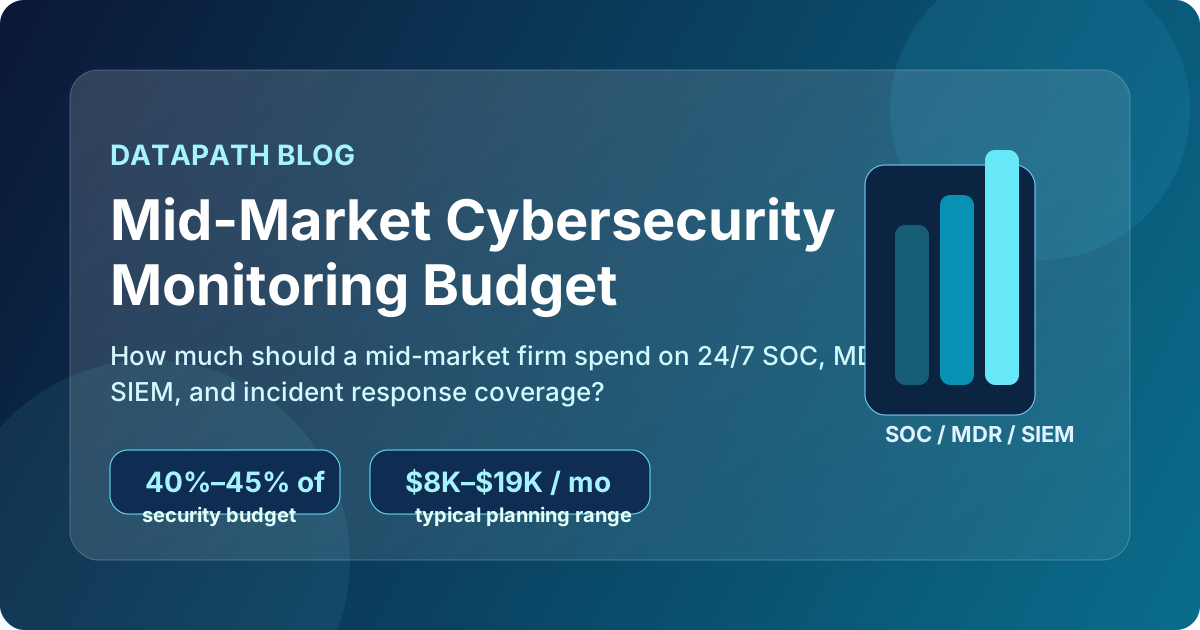
A mid-market firm should usually expect cybersecurity monitoring to consume roughly 40% to 45% of its total cybersecurity budget, with many organizations landing somewhere around $8,000 to $19,000 per month for meaningful 24/7 monitoring and response coverage.123 That range is not universal, but it is a reasonable planning anchor for organizations that need actual detection and response capability rather than basic alert forwarding. At Datapath, we usually tell buyers to budget for monitoring based on risk, operating complexity, and response expectations, not just on seat count.
If you are comparing fully managed cybersecurity proposals, start by normalizing scope. A lower monthly price may exclude after-hours triage, endpoint response, SIEM tuning, vulnerability follow-up, backup validation, compliance reporting, or incident coordination. Those exclusions matter more than the label on the proposal.
| Buyer question | Practical answer | Datapath path |
|---|---|---|
| What does a fully managed cybersecurity program cost for a mid-market company? | For many 200-employee organizations, plan around $8,000 to $19,000 per month for 24/7 monitoring and response, with higher ranges for regulated, multi-site, or high-complexity environments. | Managed cybersecurity services |
| How do monitoring services price by asset, endpoint, or alert volume? | Pricing usually reflects monitored endpoints, log volume, security tools, cloud systems, alert triage, escalation hours, and whether remediation follow-up is included. | Security alert triage services |
| How do different monitoring service offerings affect pricing? | Business-hours review, tool-only monitoring, MDR, co-managed SOC, and fully managed cybersecurity services have very different staffing and response assumptions. | Managed cybersecurity services |
| What does a mid-market cybersecurity stack usually include? | Endpoint protection, identity controls, email security, firewall/network visibility, SIEM or log review, vulnerability management, backups, incident workflows, and executive reporting. | Cybersecurity services |
Why is cybersecurity monitoring such a large budget item?
Cybersecurity monitoring is expensive because it is not one tool. It is an operating capability that blends technology, human review, and response discipline. When businesses say they want “monitoring,” they are usually asking for some combination of:
- SIEM collection and alerting
- MDR or SOC analyst review
- endpoint telemetry and triage
- escalation workflows for suspicious activity
- after-hours response readiness
- documentation that supports leadership, compliance, and insurance review
That stack costs real money because somebody has to tune the alerts, investigate anomalies, and decide what deserves action. A cheap tool that floods your team with noise is not the same thing as a mature monitoring program.
What are realistic cybersecurity budget benchmarks for mid-market firms?
Most published guidance for mid-market organizations places the broader cybersecurity budget at roughly 7% to 15% of total IT spend, with higher ranges possible in regulated or highly exposed environments.124 Several sources also frame the security budget in per-employee terms, commonly around $1,200 to $2,500 per employee annually for mid-market firms.12
Those broad benchmarks matter because monitoring usually sits inside that number, not beside it.
What does that mean in plain budgeting terms?
If a 200-employee company spends around $240,000 to $500,000 per year on cybersecurity overall, and roughly 40% to 45% of that budget goes toward monitoring, the annual monitoring line item could land around $96,000 to $225,000, or roughly $8,000 to $18,750 per month.12
That range will feel high to teams that are still thinking about antivirus and log collection as “good enough.” It will feel more realistic to teams that already know what 24/7 detection, escalation, and recovery support actually require.
What is included in cybersecurity monitoring costs?
Cybersecurity monitoring costs usually reflect the service model, not just the software line items. If you are comparing providers or building a budget request internally, ask what is actually included.
Which services usually sit inside a monitoring budget?
Most mid-market monitoring budgets include some mix of:
| Monitoring element | What it covers | Why it affects cost |
|---|---|---|
| SIEM or log platform | event ingestion, normalization, retention, alerting | data volume and tuning effort add cost |
| MDR or SOC coverage | analyst review, threat hunting, investigation | people are the expensive part |
| EDR/XDR tooling | endpoint telemetry and response actions | broader endpoint scope raises spend |
| Incident escalation | triage, notifications, containment guidance | faster coverage costs more |
| Compliance reporting | evidence, documentation, review support | regulated environments need more rigor |
| After-hours readiness | nights, weekends, holidays | staffing and service commitments raise pricing |
This is why the right budget question is not “How much is monitoring software?” It is “What level of monitoring capability does the business actually need?”
How do monitoring services price by asset, endpoint, or alert volume?
Monitoring services commonly price around a combination of users, endpoints, monitored assets, cloud workloads, log volume, alert volume, and service coverage. Endpoint-heavy environments cost more because every laptop, server, branch device, and remote user adds telemetry, tuning, and response responsibility. Log-heavy environments cost more because SIEM ingestion, retention, normalization, and review all consume platform and analyst capacity.
The pricing model should also say whether the provider is only notifying your team or actually helping triage, escalate, contain, and document issues. Datapath’s managed cybersecurity services are scoped around the operating model behind the monitoring: which systems are watched, who reviews alerts, who owns escalation, how remediation is tracked, and what leadership receives each month.
What does a typical cybersecurity stack look like for a mid-market company?
A practical mid-market stack usually includes MFA and identity controls, endpoint protection or EDR, email security, managed firewall and network visibility, vulnerability management, backup validation, SIEM or log review, alert triage, incident-response workflows, and executive reporting. Regulated organizations often need additional evidence around access reviews, backup tests, remediation status, and incident documentation.
That stack can be assembled internally, delivered by separate vendors, or managed through a single accountable provider. The cost difference depends less on tool names and more on who turns alerts and findings into completed work.
What factors move cybersecurity monitoring costs up or down?
The biggest cost drivers are compliance pressure, infrastructure complexity, response coverage, and internal capability.
Does industry regulation raise the cost?
Yes. Healthcare, financial services, education, and public-sector environments usually require more evidence, tighter controls, and cleaner escalation discipline. A monitoring provider supporting those environments may need to align with HIPAA, GLBA, PCI DSS, CJIS, or related requirements, which usually means more process and more reporting.24
That is one reason buyers in regulated sectors often pair monitoring review with broader operational questions around finance-focused IT governance or healthcare technology accountability.
Does environment complexity matter as much as headcount?
Usually more. A standardized Microsoft 365 environment with one office and modern endpoints is easier to monitor than a multi-site business with cloud workloads, legacy servers, field users, third-party vendor access, and inconsistent documentation. Complexity raises cost because it raises alert volume, exception handling, and the number of places an analyst has to look when something goes wrong.
How much does 24/7 response change the budget?
A lot. Basic business-hours review costs less than continuous monitoring backed by analysts who can investigate and escalate events overnight, on weekends, and during holidays.3 If the business depends on uptime outside standard office hours, the monitoring budget should reflect that reality.
Is it cheaper to outsource cybersecurity monitoring or build it internally?
For most mid-market firms, outsourcing is usually more realistic and more predictable than building an equivalent internal capability. That is especially true if the organization wants 24/7 coverage, access to experienced analysts, and support across multiple security platforms.
Why do internal monitoring programs get expensive fast?
An internal program usually requires:
- hiring and retaining security analysts
- standing up or licensing a SIEM platform
- maintaining endpoint and identity integrations
- building incident-response playbooks
- staffing after-hours escalation or on-call coverage
- training continuously as threats and tools change
The hard part is not buying the tools. The hard part is sustaining the operating rhythm. That is why many mid-market organizations choose a managed model even when they keep some security leadership in-house.
What happens if a mid-market firm underfunds monitoring?
Underfunding monitoring usually shows up as slower detection, weaker investigation, inconsistent escalation, and longer downtime after an incident. In other words, the business saves money on the front end and pays for it later in disruption, confusion, and leadership drag.
What are the common signs the monitoring budget is too low?
Watch for these patterns:
- alerts go unread or get reviewed only after business hours
- too many notifications arrive with no clear triage owner
- security incidents depend on one internal generalist to investigate
- log retention or endpoint visibility is incomplete
- the team cannot explain how after-hours events are handled
- reporting is too vague to support audits, insurers, or executive decisions
When those issues pile up, the question is usually not whether the business has a monitoring program. It is whether the program is actually operational.
Need help sizing cybersecurity monitoring for your environment?
Datapath helps mid-market teams compare monitoring scope, alert triage, response authority, remediation follow-up, and reporting before they commit to a managed cybersecurity program.
How should a mid-market firm set a cybersecurity monitoring budget?
A mid-market firm should set its monitoring budget by starting with business risk, then translating that risk into coverage requirements. We recommend working through the budget in this order:
- Define business exposure — critical systems, regulated data, customer impact, and downtime tolerance.
- Map actual coverage needs — business-hours review, 24/7 triage, endpoint response, cloud monitoring, identity monitoring, and vendor escalation.
- Clarify internal ownership — who investigates, who contains, and who communicates during an incident.
- Separate must-haves from nice-to-haves — not every dashboard or integration deserves equal priority.
- Ask what evidence leadership needs — especially for audits, insurance, and board-level reporting.
That process produces better budgets than starting with a vendor quote and working backward.
What is a good planning range for most mid-market businesses?
For many mid-market businesses, a practical planning range looks like this:
- Entry managed monitoring: roughly $2,000 to $5,000/month for narrower coverage, lighter triage, or smaller environments5
- Typical mid-market continuous monitoring: roughly $8,000 to $19,000/month for more complete 24/7 review, endpoint telemetry, and escalations12
- Higher-complexity or heavily regulated coverage: often above that range once compliance evidence, broader integrations, and tighter service commitments are added
Those ranges are directional. The right budget depends on how much risk the business expects the monitoring program to absorb.
Why Datapath for cybersecurity monitoring planning?
We think mid-market firms should evaluate cybersecurity monitoring the same way they evaluate any other critical operating function: by whether it improves accountability, lowers avoidable risk, and gives leadership clearer visibility into what is happening. Buyers comparing providers should look at more than tool names. They should ask who reviews alerts, how incidents get escalated, what happens after hours, and whether the provider can support the broader operating model behind the service.
If your team is trying to sort through security budget tradeoffs, start with the Datapath homepage, then review how monitoring decisions connect to broader solution planning, financial-services oversight, and related buying questions such as what a managed IT contract SLA usually includes and how to improve Microsoft 365 posture without breaking budgets.
FAQ: Mid-market cybersecurity monitoring budget
What does a fully managed cybersecurity program cost for a mid-market company?
A fully managed cybersecurity program for a mid-market company often lands around $8,000 to $19,000 per month for a 200-employee environment when it includes 24/7 monitoring, triage, response escalation, endpoint visibility, and reporting. The final price depends on endpoint count, monitored systems, alert volume, compliance pressure, and whether remediation follow-up is included.
How do different monitoring service offerings affect cybersecurity pricing?
Tool-only monitoring costs less than MDR, co-managed SOC, or fully managed cybersecurity because it usually excludes sustained analyst review, after-hours escalation, remediation ownership, and leadership reporting. The more a provider is expected to investigate and coordinate response, the more the service depends on people and process rather than software alone.
How do monitoring services price by asset, endpoint, or alert volume?
Monitoring services may price by user, endpoint, server, firewall, cloud workload, data ingestion, alert volume, or coverage tier. Buyers should ask whether the quote includes SIEM tuning, endpoint response, escalation, incident notes, compliance evidence, and monthly reporting.
How much should a 200-employee company spend on cybersecurity monitoring?
A 200-employee company will often land around $96,000 to $225,000 per year on cybersecurity monitoring if it follows common mid-market benchmarks for security budget allocation and monitoring share.12
What percentage of the cybersecurity budget should go to monitoring?
A common planning benchmark is 40% to 45% of the total cybersecurity budget, especially when monitoring includes MDR or SOC support rather than just software licensing.1
Is SIEM enough for a mid-market monitoring program?
Usually no. SIEM can centralize and alert on data, but most mid-market firms also need people, process, and escalation discipline to investigate suspicious activity and decide what happens next.
Should a mid-market business buy monitoring tools or managed monitoring services?
That depends on internal capability. If the business already has security staff and operational discipline, tools may be enough. If it does not have analysts, after-hours coverage, or a mature incident workflow, managed monitoring is usually the safer path.
What does a typical cybersecurity stack look like for a mid-market company?
A typical mid-market cybersecurity stack includes MFA, endpoint protection or EDR, email security, firewall and network visibility, vulnerability management, backup validation, SIEM or log review, alert triage, incident workflows, and executive reporting. Regulated teams also need evidence that those controls are reviewed and maintained.