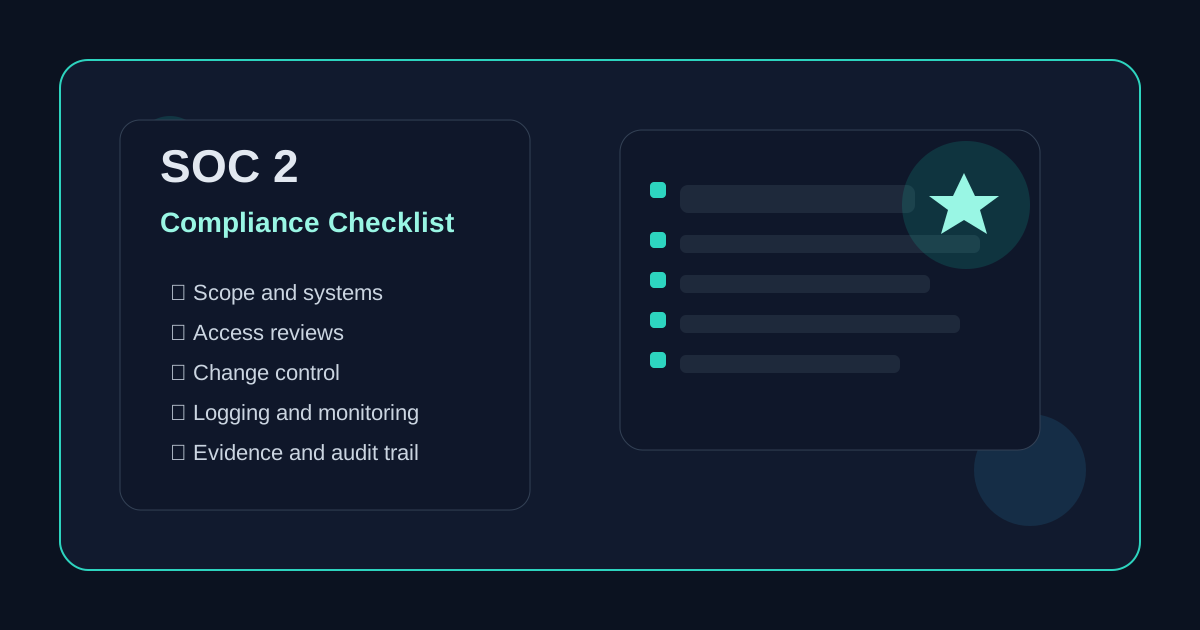

What should IT teams include in a SOC 2 compliance checklist?
A strong SOC 2 compliance checklist should help IT teams prove that security controls are defined, operating, and supported by evidence over time. The essentials usually include scope definition, system inventory, risk assessment, access control, change management, logging and monitoring, vendor oversight, incident response, backup and availability controls, policy maintenance, and recurring evidence collection.123
That matters because SOC 2 is rarely just about having the right tools. Buyers, auditors, and leadership teams want to know whether the organization can operate in a disciplined way under normal conditions and under pressure. If access approvals are inconsistent, logs are incomplete, vendors are not reviewed, or control owners cannot produce evidence quickly, the audit process gets expensive and credibility drops fast.
In our experience, the best SOC 2 readiness work happens when IT teams stop treating the checklist as an abstract compliance artifact and start using it as an operating checklist for real systems, real owners, and real business risk.
How should IT teams structure a practical SOC 2 checklist?
The short answer is that the checklist should follow the way the environment actually runs. AICPA’s SOC 2 framework is built around the Trust Services Criteria, with security as the common criterion and additional criteria available for availability, processing integrity, confidentiality, and privacy depending on scope.1 That means the right checklist is not identical for every company. The core categories stay recognizable, but the control details should match the systems, data flows, and commitments the business actually makes to customers.
A practical checklist usually looks like this:
| Checklist area | What IT should verify | Why it matters |
|---|---|---|
| Scope and boundaries | In-scope systems, data, vendors, environments, and locations are defined | Prevents control gaps and audit confusion |
| Ownership | Each control has a named owner and review cadence | Keeps accountability clear |
| Access control | MFA, provisioning, deprovisioning, privileged access, and reviews are documented | Reduces unauthorized access risk |
| Change management | Changes are approved, tested, and traceable | Shows operational discipline |
| Monitoring and logging | Security events are collected, reviewed, and retained | Supports detection and audit evidence |
| Incident response | Response plans, escalation paths, and testing exist | Improves resilience and trust |
| Vendor oversight | Critical third parties are assessed and tracked | Extends control thinking beyond internal systems |
| Backup and availability | Recovery expectations, testing, and continuity plans are defined | Supports uptime and recoverability |
| Policies and training | Policies are current and employees understand expectations | Connects technical and administrative controls |
| Evidence collection | Screenshots, exports, approvals, reports, and tickets are retained consistently | Makes the audit process smoother |
That table is simple on purpose. The goal is to make sure the IT team can answer basic operational questions clearly before the auditor asks them.
What should happen before the audit window starts?
Before the audit period starts, IT teams should confirm scope, identify control owners, map systems to the applicable Trust Services Criteria, and perform a readiness review. AWS and Google both frame SOC reporting around documented controls, operational consistency, and customer trust, which is why readiness work matters before evidence collection begins.24
How should scope be defined?
Scope should identify the products, infrastructure, cloud services, endpoints, identity systems, repositories, vendors, and data flows that support the customer-facing service. This is one of the most important steps because vague scope tends to create two bad outcomes: either the company audits too much and wastes effort, or it audits too little and leaves obvious gaps.
For most IT teams, good scoping means answering questions like:
- Which production systems support the service being audited?
- Where is customer data stored, processed, and transmitted?
- Which cloud accounts, SaaS platforms, and third-party vendors are in scope?
- Which engineering and IT workflows affect the reliability or security of the service?
- Which environments are excluded, and why?
If those answers are fuzzy, the rest of the checklist usually becomes fuzzy too.
Who should own the checklist?
The checklist should not live with compliance alone. IT, security, engineering, and operations all need named ownership. We recommend assigning an owner for each major control domain and then defining a recurring review cadence for those owners. That makes it easier to track evidence, resolve control failures, and avoid the last-minute scramble that happens when everyone assumes someone else has the screenshot, approval record, or report export.
How should readiness be tested?
A readiness review should walk through the controls as if the auditor were already asking for evidence. That means testing whether access reviews exist, whether ticket approvals are preserved, whether logs can be exported, whether backup testing records can be produced, and whether incident procedures are current. In our experience, a mock evidence review catches more practical issues than another slide deck about compliance ever will.
Which controls belong on every SOC 2 compliance checklist?
Every SOC 2 checklist should include controls around identity, access, change discipline, monitoring, incident handling, and evidence retention. The exact design can differ, but the underlying control themes are consistent across serious environments.135
What should the checklist require for access control?
Access control should cover user provisioning, role-based access, privileged access restrictions, MFA, periodic access reviews, and prompt deprovisioning when responsibilities change or employment ends. This area matters because auditors are not only looking for policy language. They want to see whether the business can show who had access, why they had it, who approved it, and how it is reviewed over time.
A useful access-control checklist includes:
- MFA enforced for critical systems
- documented joiner/mover/leaver workflow
- approval records for new and elevated access
- recurring privileged access review
- separation between admin and standard accounts where appropriate
- periodic validation that disabled users are actually removed
For regulated customers, this is also where SOC 2 starts overlapping with broader security expectations. If the team already struggles with identity discipline, the issue usually shows up in incident response, vendor access, and audit readiness too.
What should the checklist require for change management?
Change management should verify that production changes are requested, reviewed, approved, tested, and traceable. That usually means using ticketing or pull-request workflows that preserve who approved what, when it was implemented, and how it was validated. Microsoft’s compliance guidance consistently emphasizes the value of repeatable administrative controls and traceable operational changes in regulated environments.5
We usually recommend checking for:
- documented change tickets or pull requests
- peer review for production-impacting changes
- emergency-change workflow with after-the-fact review
- rollback planning for higher-risk releases
- separation between development and production access where appropriate
- recurring review of exceptions or failed changes
This is one of the easiest places to lose credibility during a SOC 2 audit. Teams may know changes are “usually reviewed,” but if the records are inconsistent, the control is weaker than leadership thinks.
What should the checklist require for logging, monitoring, and incidents?
The checklist should verify that important systems generate logs, that the logs are retained appropriately, that alerting exists for meaningful events, and that incident response steps are documented and tested. CISA’s guidance on foundational cyber practices and secure operations reinforces the importance of monitoring, centralized visibility, and response discipline.3
A practical monitoring and response checklist often includes:
- centralized logging for critical systems
- alerts for suspicious or high-risk events
- documented review cadence for alerts and exceptions
- incident severity definitions and escalation paths
- post-incident review process
- evidence that tabletop exercises or response tests occurred
If a business wants SOC 2 to strengthen trust, this area cannot be theoretical. Leadership should know exactly how the organization would detect a problem, who gets notified, and what evidence would be available afterward.
What evidence should IT teams collect throughout the year?
IT teams should collect evidence continuously, not just before the auditor asks for it. Good evidence usually includes access review exports, change tickets, approval records, backup test outputs, monitoring screenshots, security awareness reports, vendor review artifacts, policy sign-offs, and incident documentation.13
The key is consistency. A screenshot taken once is not the same as a repeatable control. We recommend creating an evidence map that ties each control to:
- the system of record
- the control owner
- the collection cadence
- the format of acceptable evidence
- the storage location
- the reviewer or approver
That approach reduces confusion and makes Type II readiness much easier because the business is not trying to reconstruct months of operating history after the fact.
This is also where vendor oversight belongs on the checklist. If critical vendors affect hosting, identity, ticketing, security monitoring, or customer data, the company should retain vendor reviews, SOC reports where relevant, and records of how vendor risk is handled. Customers increasingly expect that level of discipline, especially in financial services and other regulated environments. Datapath’s financial services solutions, cybersecurity compliance services guide, and how to evaluate IT outsourcing companies all reflect that same operational expectation.
How can IT teams reduce audit friction and stay ready?
IT teams reduce audit friction when they simplify control ownership, review evidence before it goes stale, and treat compliance reporting as a monthly operating task instead of an annual scramble. That means fewer heroic last-minute efforts and better day-to-day control quality.
A workable 90-day improvement plan often looks like this:
- Confirm scope, systems, and owners.
- Clean up identity workflows and privileged access.
- Standardize change approvals and evidence retention.
- Verify logging, alerting, and incident documentation.
- Test backup and availability procedures.
- Review key vendors and retain the results.
- Build a recurring evidence calendar for the audit period.
That sequence is boring in the best possible way. SOC 2 readiness usually improves when operations become more predictable, not more flashy.
Why Datapath for SOC 2 readiness work?
We approach SOC 2 readiness the same way we approach broader managed IT and security operations: by connecting compliance expectations to how the environment is actually run. The point is not to create audit theater. It is to make control ownership clearer, evidence easier to produce, and leadership more confident that the operating model will hold up under review.
For teams balancing growth, uptime, compliance, and limited internal bandwidth, that means making identity, change management, monitoring, and vendor oversight easier to govern month after month. If your team needs help turning a checklist into an operating discipline, start with the Datapath homepage, review our solutions overview, explore the resources and guides hub, or talk with our team about how to clean up the controls that matter most.
Frequently Asked Questions
What is a SOC 2 compliance checklist?
A SOC 2 compliance checklist is a working list of controls, owners, policies, and evidence requirements used to prepare for and maintain SOC 2 readiness. It helps IT teams confirm that security and related operational controls are actually functioning over time.
What should be included in a SOC 2 checklist for IT teams?
The checklist should cover scope, control ownership, access management, change management, logging, monitoring, incident response, vendor oversight, backup and availability controls, policy maintenance, employee awareness, and evidence retention. The exact details depend on which Trust Services Criteria are in scope.
How often should SOC 2 evidence be reviewed?
Most evidence should be reviewed on a recurring basis throughout the year rather than collected only before the audit. Monthly and quarterly review cycles are common because they make gaps easier to detect before they become audit findings.
Is SOC 2 only a security exercise?
No. Security is the common criterion, but many organizations also scope availability, confidentiality, processing integrity, or privacy depending on customer commitments and business requirements. A realistic checklist has to reflect those broader operational expectations.
What is the biggest mistake IT teams make with SOC 2?
The biggest mistake is treating SOC 2 as a paperwork project instead of an operating discipline. When the team cannot show who owns the control, how the control runs, and where the evidence lives, the audit becomes harder and the trust value of the report drops.
Sources
- AICPA: SOC 2 Overview
- AWS: AWS Compliance Frequently Asked Questions
- CISA Cybersecurity Performance Goals
- Google Cloud compliance resource center
- Microsoft Service Trust Portal and compliance guidance