
Is there an authorized California K-12 IT managed services pilot program?
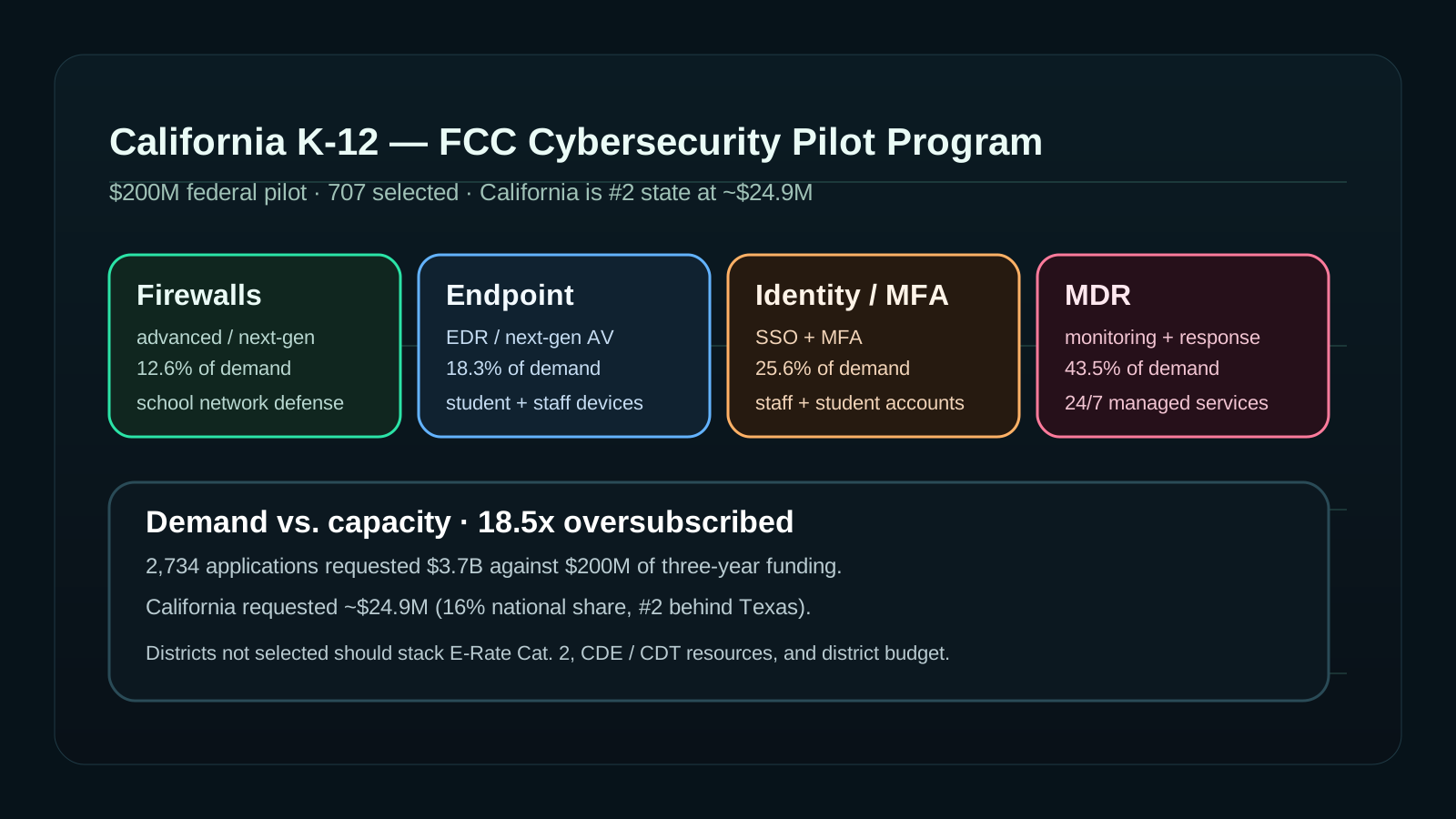
The closest thing to an “authorized” California K-12 IT managed services pilot program is the FCC Schools and Libraries Cybersecurity Pilot Program — a three-year, $200 million federal pilot administered through the Universal Service Fund that funds eligible cybersecurity services and equipment, including managed services, for selected K-12 schools and libraries.12 California is the second-largest state participant, with roughly $24.9 million in requested funding (about 16% of the national total), trailing only Texas.3
A few clarifications worth pinning down before we go further:
- There is no California-specific managed-services “pilot program” with a state-published authorized vendor list. What exists is the federal FCC pilot, the existing E-Rate Category 2 funding mechanism (also federal), and California state-level cybersecurity resources from the California Department of Education (CDE) and California Department of Technology (CDT).45
- The FCC pilot does not prequalify a list of MSPs. Selected districts can purchase eligible services from any service provider with a Service Provider Identification Number (SPIN), so long as the services fall within the pilot’s eligible-services list and the district follows competitive-bidding rules.1
- The FCC announced participants on January 16, 2025, and the first wave of funding commitments — about $18.8 million to 140 applicants — went out in December 2025.36
That is the honest answer to the keyword. The rest of this post walks through what California K-12 leaders actually need to know to plan around it, whether your district was selected or not.
What is the FCC Schools and Libraries Cybersecurity Pilot Program?
The FCC adopted the pilot in mid-2024 to test whether the Universal Service Fund could effectively support cybersecurity services and equipment in K-12 schools and libraries. The structure is straightforward:12
- Total funding: Up to $200 million over three years.
- Selected participants: 707 total — 645 schools and school districts, 50 libraries, and 12 consortia — announced January 16, 2025.7
- Funding per district: Minimum $15,000, maximum $1.5 million, calculated using a formula of roughly $13.60 per student.2
- Application: FCC Form 484 Part 1 was open Sept 17–Nov 1, 2024; Part 2 was due September 15, 2025.2
- Demand: 2,734 applications, requesting $3.7 billion — roughly 18.5x the available funding.6
In other words, the FCC could fund about one in twenty applicants at the funding levels requested. For California K-12 leaders, that has two implications: if you were selected, the program is real money worth careful planning; if you were not, you almost certainly still need a path to cybersecurity managed services because the underlying risk has not changed.
What services are eligible in the FCC K-12 cybersecurity pilot?
The pilot funds four categories of cybersecurity services and equipment:13
- Advanced or next-generation firewalls — about 12.6% of nationally requested funding
- Endpoint protection — about 18.3% of requested funding
- Identity protection and authentication — about 25.6% of requested funding
- Monitoring, detection, and response (MDR) — about 43.5% of requested funding
The lopsided demand for MDR is the most interesting datapoint in the dataset. Roughly 44 cents of every requested dollar went toward ongoing monitoring and response services, not one-time hardware. That is the clearest signal yet that K-12 leaders nationally — and in California — recognize they cannot win this fight with appliances alone. They need a managed operational capability that runs 24/7.
This is also why the pilot pairs naturally with a co-managed or fully managed IT services model. A district running Microsoft 365 or Google Workspace for Education, an SIS, an LMS like Canvas, content filtering, and a fleet of Chromebooks does not have the internal staffing to operate firewall, EDR, identity, and MDR tooling around the clock by itself. The pilot puts dollars behind that operational gap.
For broader context, see our complete guide to K-12 IT managed services in 2026 and our E-Rate cybersecurity eligible services for K-12 in 2026 post.
How much California K-12 funding is in the pilot?
Of the $157.6 million requested nationally on Form 471 (the funding-request form), California districts and libraries requested roughly $24.9 million, about 16% of the national total.3 That puts California a clear second behind Texas at $31.4 million.
A few publicly reported California datapoints:
- Fontana Unified School District received roughly $624,000 in the first funding wave for firewall and identity solutions.3
- Urban applicants nationally requested about 90% of total funding while representing only 74% of participants — meaning California’s urban districts likely captured a disproportionate share of the state’s pilot dollars relative to rural districts, where average requests were closer to $96,000 vs. $314,000 for urban entities.3
For California’s roughly 1,000+ school districts, this means the pilot is meaningful but limited. A district that was not selected — which is the vast majority — should plan as if the pilot does not exist for them in this cycle, and instead build a managed-services budget through other lanes.
What about districts that were not selected?
If your California district was not part of the 707 selected participants, here is the practical funding stack we recommend reviewing.
1. E-Rate Category 2
E-Rate is not a general cybersecurity grant, but Category 2 does fund eligible internal connections, managed internal broadband services, and certain maintenance tied to your school network. Advanced/next-generation firewalls have been recognized as eligible under recent FCC guidance for certain school-network use cases. See our E-Rate Category 2 planning checklist for K-12 IT teams for the specifics.
2. State cybersecurity resources
The California Department of Education publishes free and low-cost cybersecurity tips for local education agencies (LEAs).4 The California Department of Technology (CDT) operates a state Security Operations Center with explicit intent to extend support to K-12 and CSU systems through partnerships and a forthcoming program.5 Neither is a managed-services pilot in the sense of authorized vendors, but both are useful guidance and resource sources to layer into a district plan.
3. CDE compliance funding (CIPA, FERPA, state student data privacy)
California has its own student-data-privacy and online-safety obligations layered on top of federal CIPA and FERPA. Districts should not assume that meeting CIPA web filtering automatically satisfies state student-data requirements. See our CIPA compliance checklist for K-12 school districts and CIPA web filtering requirements for K-12 schools for the operational basics.
4. District general fund and bond funds
Realistically, the bulk of K-12 cybersecurity managed-services spending in California today comes out of the district’s general fund and, for capital items, bond programs. That is also where the procurement scrutiny is heaviest — which is why the next section matters.
What should California districts look for in an “authorized” managed-services partner?
There is no California state list of authorized K-12 MSPs. The pilot does not preselect vendors. What exists instead is a competitive-bidding requirement and a set of operational expectations that separate competent K-12 MSPs from the rest. Based on what we see across district engagements:
1. Real K-12 experience, not adapted enterprise IT
K-12 environments are unique: student data privacy obligations, content filtering, MFA on staff and student accounts, Chromebook fleets, instructional continuity expectations, board-level reporting, and tight bond and grant compliance. An MSP that is “doing K-12 on the side” usually misses something material in the first 90 days.
2. Coverage of all four pilot service categories
Whether or not your district is in the pilot, the four eligible-service categories are a useful baseline for what mature K-12 cybersecurity looks like: next-generation firewall, endpoint protection, identity protection and authentication, and monitoring/detection/response. If your MSP cannot credibly cover all four — directly or through tightly integrated partners — the gap is structural.
3. Documented SLAs aligned to instructional days
K-12 SLAs that are written like a generic commercial agreement tend to underweight instructional impact. We talk through this in our post on assessing MSP SLAs against critical workflows. The K-12 version of that test is straightforward: what happens if a building loses internet during state testing?
4. Procurement and compliance discipline
E-Rate, the cybersecurity pilot, and state student-data-privacy law all carry recordkeeping and reporting obligations. If an MSP cannot speak fluently about Form 471 process, SPIN registration, eligible-services documentation, and California student-data-privacy contract language, that is a meaningful signal.
5. Strategic accountability, not just ticket queues
The reason we built Datapath’s Accountability-as-a-Service model around quarterly business reviews and executive sponsors is that K-12 IT directors are accountable to a school board, a superintendent, and a community. An MSP that only shows up at renewal time creates work for the IT director. An MSP that runs structured account reviews removes it.
For more, our managed IT for K-12 school districts: what to include in your RFP post walks through the procurement-side detail.
What could the federal pilot have done better?
We will end with the same honest read we apply to other public-sector cybersecurity efforts.
The FCC pilot is a clear net positive. It put real money against a real and growing problem in K-12 cybersecurity. But three design choices limit its impact, especially for California:
- Total funding is roughly 5% of demand. $200M against $3.7B of requested funding means most districts that need help do not get pilot dollars. A program that funds 1 in 20 applicants is a research project, not a sector solution.
- It is heavily oriented toward urban districts. With urban applicants requesting 90% of funding,3 California’s rural and small-suburban districts — which often have the least internal IT capacity — are systematically underrepresented.
- There is no permanent eligibility expansion for E-Rate. The pilot is a three-year experiment. Until the FCC formally extends Category 2 eligibility to cover the same cybersecurity services on a permanent basis, every district has to plan as if pilot funding could end on a fixed date.
Those are policy critiques, not reasons to ignore the program. If your district is in the pilot, the planning conversation is about how to spend the dollars in a way that survives the end of the pilot. If your district is not in the pilot, the conversation is about how to build the same operational capability through E-Rate Category 2, state resources, and district budget — at a defensible cost.
How Datapath supports California K-12 districts
We work with California K-12 districts on the same operational gaps the FCC pilot is trying to close: firewall, endpoint, identity, MDR, content filtering, MFA, backup and recovery, and the documentation and reporting layer that makes all of it auditable. We do that as a fully managed or co-managed IT services partner, depending on the district’s internal capacity.
We are not a “pilot vendor” because that designation does not exist. We are an MSP that has done the work, knows the eligibility language, runs procurement-aware engagements, and treats K-12 IT directors as accountable executives, not ticket queues.
If you are a California superintendent, CBO, or technology director planning your next funding cycle, the most useful next step is a conversation. Reach out to Datapath, or start with our complete guide to K-12 IT managed services in 2026 and our solutions overview.
Sources and further reading
- FCC Schools and Libraries Cybersecurity Pilot Program
- FCC — $200M Cybersecurity Pilot Program Adoption Document
- Funds For Learning — Pilot Funding Request Data
- K-12 Dive — Demand vs. Capacity Analysis
- California Department of Education — IT Security Tips
- California Department of Technology — Security
- USAC — Cybersecurity Pilot Program
Footnotes
-
Federal Communications Commission, “Schools and Libraries Cybersecurity Pilot Program,” https://www.fcc.gov/cybersecurity-pilot-program ↩ ↩2 ↩3 ↩4
-
FCC, “$200M Cybersecurity Pilot Program for Schools & Libraries,” https://www.fcc.gov/document/fcc-adopts-200m-cybersecurity-pilot-program-schools-libraries-0 ↩ ↩2 ↩3 ↩4
-
Funds For Learning, “FCC Releases Complete Cybersecurity Pilot Dataset, Issues First Funding Commitments,” https://www.fundsforlearning.com/news/fcc-releases-cybersecurity-pilot-funding-request-data-early-insights/ ↩ ↩2 ↩3 ↩4 ↩5 ↩6 ↩7
-
California Department of Education, “CDE’s Tips for a More Secure IT Environment,” https://www.cde.ca.gov/ls/et/rd/itsecuritytips.asp ↩ ↩2
-
California Department of Technology, “Security,” https://www.cdt.ca.gov/security/ ↩ ↩2
-
K-12 Dive, “Demand for $200M FCC cybersecurity pilot far exceeds capacity,” https://www.k12dive.com/news/how-many-applicants-fcc-cybersecurity-pilot-program/732503/ ↩ ↩2
-
FCC Public Notice announcing pilot participants, January 16, 2025, as summarized in industry coverage. ↩