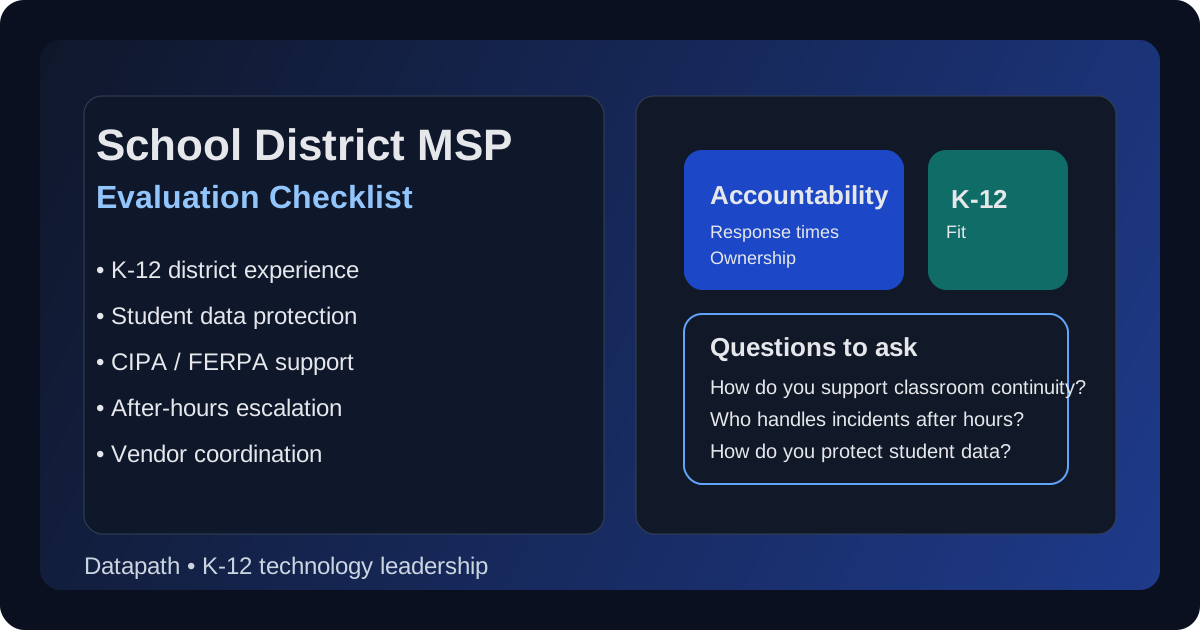

What questions should school districts ask their MSP?
School districts should ask their MSP how they support K-12 environments, protect student and staff data, handle after-hours issues, support compliance obligations, manage vendor coordination, and scale services as district priorities change. The right MSP should be able to explain not just what it sells, but how it operates when classrooms, devices, identity systems, security alerts, and critical workflows are all moving at once.12
We think this matters more in K-12 than many providers admit. A school district is not a generic office network. District technology teams juggle student data, shared devices, special education workflows, internet filtering, instructional continuity, cloud platforms, vendors, E-Rate planning, and limited internal staffing. If an MSP cannot speak clearly about that environment, the district is usually buying a promise instead of a support model.
At Datapath, we recommend using a fixed set of screening questions before you shortlist any provider. That keeps the process consistent and helps district leaders compare MSPs based on accountability rather than sales polish. It also pairs well with broader K-12 planning work like our K-12 Education IT services overview, the K-12 IT managed services guide, our resources and guides library, and practical district-readiness posts like CIPA Compliance Checklist for K-12 School Districts and E-Rate Category Two Planning Checklist for K-12 IT Teams.
Why do school districts need a different MSP evaluation process?
School districts need a different MSP evaluation process because the risk profile, service expectations, and operating calendar are different from those of a standard business environment. A district may support thousands of student accounts, faculty workflows, classroom devices, testing windows, content filtering obligations, and public accountability requirements at the same time. That means even “ordinary” support failures can have outsized instructional and reputational impact.34
We see three common reasons K-12 MSP selection goes sideways:
- the provider understands general IT, but not district operations
- the contract sounds broad, but ownership boundaries stay vague
- leadership compares pricing before comparing accountability
That is why the evaluation process should test whether the provider can actually support the district’s model, not just whether it offers help desk hours and endpoint tools.
What should districts ask about K-12 experience and fit?
The first set of questions should establish whether the MSP actually understands district operations.
Have you supported school districts with similar size, complexity, and staffing constraints?
This is one of the most important questions in the process. A provider that mainly serves private-sector offices may still be capable, but K-12 environments require different instincts. We want to hear whether the MSP has handled Chromebook fleets, shared lab devices, classroom AV dependencies, student onboarding and offboarding, seasonal surges, and the reality that school IT teams often operate with lean headcount.23
A strong answer should explain:
- what kinds of districts they support now
- whether they have experience with multi-school environments
- how they handle summer projects versus in-session support
- what district-specific systems or vendors they work with regularly
If the answer stays generic, that is a useful signal. Districts should not have to educate the MSP about how a school year works.
How do you support instructional continuity when classroom systems fail?
District technology issues are not just “tickets.” If identity systems, Wi-Fi, printing, student devices, filtering, or core SaaS tools fail during instruction, the effect is immediate. We recommend asking the MSP how it prioritizes classroom-impacting incidents, what the escalation model looks like, and how it distinguishes instructional disruption from lower-priority support noise.
That answer tells you whether the provider understands the difference between business inconvenience and educational disruption.
What is your experience with district procurement, budget cycles, and E-Rate-adjacent planning?
Not every MSP handles E-Rate strategy directly, but a K-12-capable provider should understand district budgeting cycles, procurement timing, project planning around academic calendars, and how infrastructure decisions connect to funding windows.5 We like providers that can explain how they plan refreshes, network upgrades, and support transitions around district realities instead of assuming change can happen on a normal corporate timeline.
What should districts ask about security, compliance, and student data?
This is usually where weak MSPs start sounding fuzzy.
How do you protect student, staff, and district data?
A district should ask for clear details on identity controls, MFA, privileged access, endpoint management, logging, backup validation, incident response escalation, and how the provider protects access to district systems.46 We do not think “we take security seriously” is a real answer. We want process.
Good follow-up questions include:
- Do your technicians use named accounts or shared admin credentials?
- How do you review technician access to district systems?
- How do you handle after-hours security events?
- What logging and alerting do you review regularly?
- How do you help districts reduce phishing and account-compromise risk?
District leaders should also compare the answer against related priorities like Microsoft 365 phishing protection best practices for growing companies, Conditional Access Policy Best Practices for Mid-Market Businesses, and the Datapath homepage if they want to see how a provider frames security as an operating discipline rather than an add-on.
How do you support CIPA, FERPA, and district policy obligations?
An MSP may not serve as legal counsel, but it should be able to explain how its services support district compliance responsibilities. For K-12 environments, we usually want to hear about content filtering, student-device controls, access reviews, auditability, data-handling discipline, and coordination with district leadership on policy enforcement.23
A mature provider should know where its role starts and stops. That clarity matters because vague compliance language often turns into finger-pointing later.
What happens during a security incident or major outage?
Districts should ask who triages the event, who communicates with district leadership, what gets escalated immediately, and what parts of containment and recovery the MSP actually owns. We recommend asking for concrete examples: a compromised admin account, a failed backup job, ransomware indicators on endpoints, or a widespread Wi-Fi outage during testing.
If the provider cannot explain incident ownership clearly in a district context, it is probably not ready for a district environment.
What should districts ask about support model, staffing depth, and accountability?
This is where a lot of selection mistakes happen. A provider can sound strong on paper and still fail because its operating model is too thin.
What does your support model actually include?
Districts should ask exactly what the MSP owns every day, what it supports on request, what remains with internal staff, and what falls outside normal scope. We think districts should press on practical scenarios:
- student account provisioning and deprovisioning
- classroom device troubleshooting
- vendor coordination for line-of-business systems
- escalation during state testing windows
- patching and change control for critical infrastructure
- backup monitoring and recovery validation
That forces the provider to explain the real service boundary instead of hiding behind “fully managed” language.67
How many support staff do you have, and how do you prevent overload?
This is a blunt question, but it matters. Districts should ask about staffing depth, technician workload, escalation layers, and whether the MSP has enough bench strength to support schools during surges, absences, or widespread incidents.7 We like this question because it gets past brand language fast. If a provider is thinly staffed, you usually hear it in the answer.
How do you handle after-hours issues and urgent escalations?
District leaders should know who is on call, what triggers immediate response, how major incidents get escalated, and whether there is a difference between overnight monitoring and real after-hours ownership. If a critical outage hits before classes start, or if a major issue appears during an evening event, the district should know exactly how support works.
What reporting do you provide to district leadership?
We recommend asking what metrics the MSP shares and how often. Ticket closure counts are not enough. Leadership should be able to see recurring issues, aging problems, security risks, project status, open recommendations, and operational trends. Good reporting helps the district govern technology. Weak reporting only proves that tickets exist.2
What should districts ask about partnership, planning, and transition?
The best MSP relationships do more than react to incidents.
How do you help districts plan improvements over time?
A district should ask whether the provider offers strategic planning, budgeting guidance, lifecycle planning, network roadmap help, and advice tied to district priorities. We think this is especially important for districts balancing infrastructure refreshes, security improvements, compliance obligations, and limited staffing.
A good MSP should be able to explain how it helps the district move from reactive support toward clearer planning. That often connects naturally to resources like our managed IT services overview, IT consulting and storage services, and the home page.
How flexible is the contract if district needs change?
Districts evolve. Enrollment shifts. Device strategies change. New compliance pressure shows up. Internal staffing may grow or shrink. We recommend asking how the contract flexes, how scope changes are handled, and how project work gets separated from recurring service. A district should not learn the contract is rigid only after priorities change.8
What does onboarding look like in the first 30 to 90 days?
A clean transition matters. Districts should ask what discovery looks like, what documentation the MSP collects, how credentials are handled, how stakeholder communication works, and when risk findings are surfaced.1 Summer transitions are especially sensitive, and the provider should be able to explain a staged onboarding plan with realistic checkpoints.
How do you coordinate with district stakeholders and vendors?
In many districts, the MSP ends up interacting with SIS vendors, filtering vendors, copier vendors, internet providers, cloud platforms, security tooling, and internal leadership across campuses. Ask how the provider handles coordination, who owns communication, and how issues move when the root cause sits outside the MSP’s direct tools. Strong vendors reduce sprawl. Weak ones add another layer of it.
What questions should districts use in every MSP evaluation?
If a district wants a practical starting shortlist, we recommend asking these questions in every first serious conversation:
- What K-12 districts do you support that look like us?
- What services do you fully own, and what stays with us?
- How do you protect student and staff data operationally?
- How do you support CIPA, FERPA, filtering, and district policy needs?
- How do you handle classroom-impacting incidents and after-hours issues?
- What reporting and strategic planning do you provide to leadership?
- How do you coordinate with district vendors and third parties?
- What does onboarding look like in the first 30 to 90 days?
- How flexible is the contract if our district changes?
- Why are districts like ours successful with you after year one?
We like this set because it balances day-to-day service, security, governance, and long-term fit.
Why Datapath for K-12 MSP evaluation support?
At Datapath, we think school districts deserve a selection process that measures operational maturity, not just pricing and promises. K-12 environments need support partners who can handle instructional continuity, security, vendor sprawl, compliance pressure, and strategic planning without creating more confusion for district teams.
That is why we recommend structured MSP evaluation: fixed questions, clearer accountability standards, and evidence-based comparison before the district commits to a contract. If your district is reviewing providers now, start with our K-12 Education IT page, the K-12 IT managed services guide, our resources and guides library, and then pressure-test providers against the questions above.
FAQ
What should school districts ask an MSP first?
School districts should first ask what K-12 environments the MSP already supports, what services it fully owns, and how it protects student and staff data. Those answers reveal whether the provider understands district operations or is speaking in generic managed IT language.
Why is MSP experience with schools so important?
MSP experience with schools matters because districts have different calendars, compliance requirements, device models, classroom dependencies, and public accountability expectations than standard business environments. A provider that understands K-12 usually gives clearer answers about instructional continuity and policy support.
Should a school district ask an MSP about CIPA and FERPA?
Yes. Even if the MSP is not legal counsel, it should be able to explain how its services support filtering, access control, auditability, and disciplined handling of district data in ways that align with K-12 compliance expectations.
How should districts compare multiple MSPs?
Districts should compare MSPs using the same fixed set of questions across every provider. That makes it easier to evaluate service ownership, staffing depth, escalation clarity, security controls, reporting quality, and long-term district fit without getting distracted by different sales styles.
What makes an MSP a good fit for a school district?
A good-fit MSP understands K-12 workflows, communicates clearly, supports district leadership with useful reporting, responds well during high-impact incidents, and can explain exactly how it protects student-facing operations instead of relying on vague marketing terms.
Sources
- Sunburst Workforce Advisors: Switching to a Managed Service Provider: A Guide to Prepare Your School or District
- SHC: How an MSP Helps Schools Meet the Growing Demand for Healthcare and Special Education Professionals
- SCG Midlands: 8 Questions to Ask When Choosing an MSP for Your School
- The Knowledge Academy: Questions to Ask Managed Service Provider Before Signing Up
- USAC Schools and Libraries: E-Rate overview
- Imperium Data: 10 Essential Questions to Ask Your Managed Service Provider
- Reddit / r/sysadmin: Managed Service Providers - Questions to Ask
- RSM US: 12 questions to ask when selecting a managed service provider
Footnotes
-
Sunburst Workforce Advisors: Switching to a Managed Service Provider: A Guide to Prepare Your School or District ↩ ↩2
-
SHC: How an MSP Helps Schools Meet the Growing Demand for Healthcare and Special Education Professionals ↩ ↩2 ↩3 ↩4
-
SCG Midlands: 8 Questions to Ask When Choosing an MSP for Your School ↩ ↩2 ↩3
-
The Knowledge Academy: Questions to Ask Managed Service Provider Before Signing Up ↩ ↩2
-
Imperium Data: 10 Essential Questions to Ask Your Managed Service Provider ↩ ↩2
-
Reddit / r/sysadmin: Managed Service Providers - Questions to Ask ↩ ↩2
-
RSM US: 12 questions to ask when selecting a managed service provider ↩