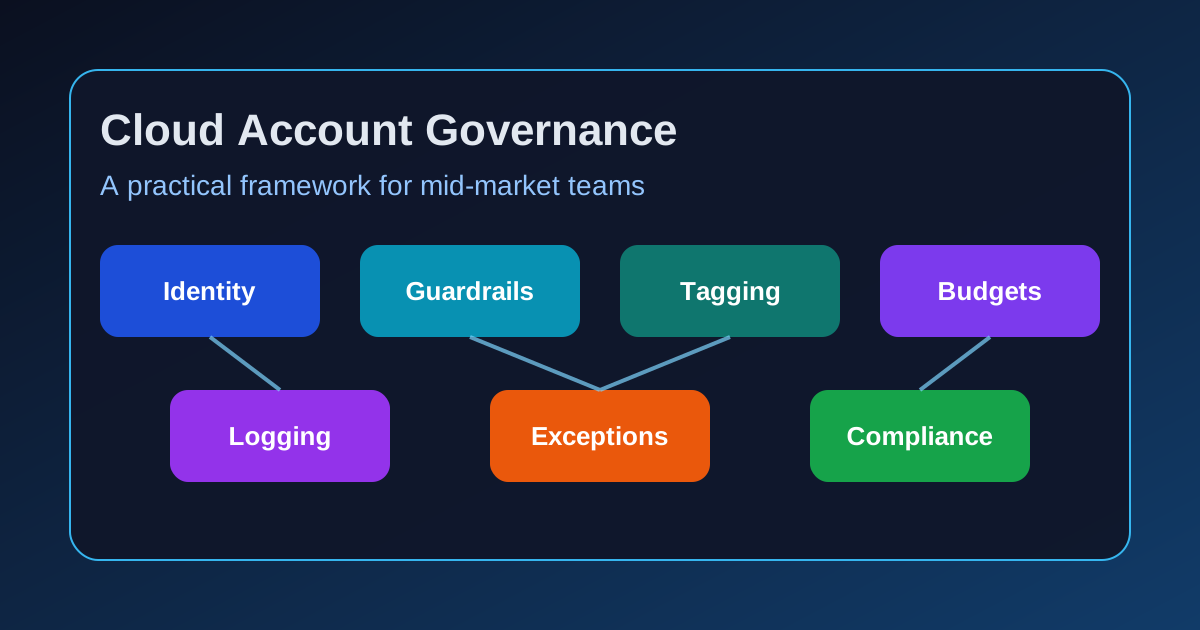

What is a cloud account governance framework, and why does a mid-market team need one?
A cloud account governance framework is the set of rules, ownership models, technical guardrails, and review processes that control how cloud accounts are created, accessed, monitored, and changed. For a mid-market team, it matters because cloud adoption gets messy fast when business units, vendors, and internal admins all start provisioning services without a shared model. The result is usually the same: unclear ownership, rising spend, inconsistent security settings, weak logging, and a lot of confidence that disappears the moment an audit, outage, or billing surprise shows up.12
We think most mid-market organizations do not need an overly complicated governance program. They need a practical one. That means a small number of well-enforced decisions about account structure, access, tagging, budgets, security baselines, and exception handling. If those basics are missing, cloud growth tends to outrun control.
For teams trying to modernize without increasing risk, the question is not just which platform to use. It is whether the business has a repeatable operating model for using the cloud responsibly. That is where a real governance framework earns its keep.
Start with ownership before you start with tooling
A lot of governance failures are really ownership failures. The tooling may be fine. The policies may even exist. But no one is clearly accountable for approving new accounts, reviewing privileged access, enforcing tags, tracking exceptions, or deciding what happens when one department wants to do something outside the standard model.
Microsoft’s Cloud Adoption Framework recommends establishing a dedicated governance team with clear ownership for governance success, cloud architecture, security, compliance, and cost management.1 For mid-market organizations, that does not need to mean a giant committee. In practice, it usually looks more like this:
- IT or infrastructure lead owns account structure and operational standards
- Security lead or outsourced security partner owns baseline security and logging requirements
- Finance or operations lead owns cloud spend visibility, budget thresholds, and chargeback expectations
- Business or application owners own workload-specific risk, data sensitivity, and approval needs
The key is not job titles. It is that everyone knows who decides what.
Keep the governance team small, but cross-functional
The best governance groups are usually small enough to move quickly and broad enough to reflect how the business actually works.1 If governance lives only inside infrastructure, it often ignores cost and compliance realities. If it lives only inside finance, it often becomes disconnected from technical risk. Cross-functional ownership keeps the framework usable.
A simple RACI matrix is often enough. You do not need a glossy program binder. You need clarity around who is responsible, who is accountable, who needs to be consulted, and who should be informed when cloud decisions are made.
Define the account model early
Before cloud usage expands, define what an account or subscription structure should look like. This is one of the highest-leverage governance decisions because it affects security boundaries, billing visibility, logging consistency, and operational cleanup later.
For many mid-market teams, a practical model includes separate accounts or subscriptions by:
- production vs non-production
- business unit or major workload
- regulated vs non-regulated data sets
- shared services vs application-specific resources
This structure helps prevent one environment from turning into a catch-all container for unrelated workloads. It also makes it easier to set budgets, restrict access, isolate incidents, and produce cleaner audit evidence.
A good account model should answer these questions
| Governance question | What your framework should define |
|---|---|
| Who can request a new account? | Approval path, required business purpose, owner assignment |
| What naming standard is required? | Consistent naming for environment, region, function, and owner |
| What baseline controls apply automatically? | Logging, MFA, backup rules, network policies, and alerting |
| How is billing tracked? | Cost center, owner, budget threshold, and review cadence |
| How is the account retired? | Offboarding, archival, and evidence retention steps |
If your team cannot answer those questions cleanly, the environment is probably already drifting.
Build guardrails around identity and privileged access
Identity is usually the first place cloud governance breaks down. Shared admin credentials, stale vendor access, inconsistent MFA enforcement, and excessive privileges can quietly turn the cloud into a high-risk environment even when the workloads themselves are well designed.
Red Hat’s cloud governance guidance emphasizes defining how cloud access is consumed, managed, and monitored.3 We agree. For most mid-market organizations, that means starting with these identity guardrails:
- centralized identity provider integration where possible
- MFA for all privileged and remote administrative access
- separate admin roles from everyday user roles
- time-bound or approval-based privileged access for sensitive changes
- quarterly access reviews for admins, vendors, and dormant accounts
- explicit rules for break-glass access and emergency usage logging
If the business works with outside consultants, MSPs, or application vendors, cloud governance should also define how third-party access is granted, monitored, and removed. Vendor access is often where accountability goes soft.
For organizations under regulatory pressure, this matters even more. Cloud IAM discipline supports both operational security and compliance readiness by centralizing and automating access control.4
Standardize provisioning instead of reviewing every mess later
A practical governance framework should reduce improvisation. If every team provisions resources differently, the governance team ends up cleaning up exceptions forever.
That is why cloud governance works best when baseline standards are built into provisioning workflows. Rather than relying on everyone to remember the rules, define templates, landing zones, and approved patterns for common resource types. Microsoft and AWS both push this idea through landing-zone and guardrail concepts because it is more reliable than policy-by-memory.15
Your baseline should usually include:
- approved regions and providers
- network and firewall defaults
- logging enabled by default
- backup expectations where relevant
- required tags before deployment completes
- allowed instance families or service classes for standard workloads
- escalation path for exceptions
This is where “policy as code” becomes useful. Guardrails written into deployment pipelines or platform controls are far more dependable than a PDF that nobody reads.6
Make tagging and asset inventory mandatory
If you do not know what exists in the cloud, you are not governing it. You are just hoping it behaves.
A centralized, real-time inventory of cloud resources is one of the most useful parts of a governance program because it supports cost control, incident response, compliance reviews, and lifecycle cleanup.2 At a minimum, every governed resource should be tagged with:
- owner
- environment
- cost center
- data sensitivity
- business service or application name
- criticality or recovery tier
This does two things. First, it gives the business visibility into what is running and who owns it. Second, it makes automation possible. Teams can route alerts, track budgets, identify unmanaged assets, and find orphaned resources much faster when metadata is consistent.
Tagging is not a documentation exercise
Too many teams treat tags like optional bookkeeping. They are actually operational controls. If a workload has no owner tag, no cost center, and no sensitivity label, leadership should assume that one or more important decisions were skipped on the way in.
We like to frame this simply: if a cloud resource is important enough to keep, it is important enough to identify.
Add cost governance before cloud bills become a leadership issue
Mid-market teams often feel cloud cost pain before they feel cloud architecture pain. That is because spend can scale quietly. A few experiments become persistent workloads. Temporary test systems stick around. Storage grows. Vendor-managed integrations multiply. Nobody notices until finance asks why monthly spend jumped.
A strong governance framework should include FinOps-style cost visibility and accountability, not just budget alarms.2 That usually means:
- budgets by account, workload, or business unit
- monthly cost review with IT and finance
- tagging requirements tied to cost reporting
- thresholds for unusual growth or idle resources
- approval steps for large recurring commitments
- defined ownership for reserved capacity or discount planning
The goal is not to make engineers or IT admins afraid to build. It is to connect spend to business value. If the organization cannot explain what a cloud cost supports, it will struggle to defend or optimize it.
Tie governance to security and compliance, not just organization
Cloud governance is not only about structure. It is also about reducing business risk. That means the framework should define the baseline controls that every cloud account must inherit, especially for logging, alerting, encryption, backup expectations, and evidence retention.
PwC and other advisory firms consistently frame cloud governance as a risk-and-controls problem as much as an operations problem.7 For regulated or security-conscious mid-market teams, that usually means answering questions like:
- Where are audit logs stored, and how long are they retained?
- Which workloads require stronger encryption or segmentation?
- How are backup and recovery expectations defined?
- What evidence can the team produce for auditors, customers, or insurers?
- Which exceptions require formal sign-off?
This is one reason we often recommend connecting cloud governance to a broader operating model that includes managed IT services, practical IT consulting and storage support, and a more resilient security baseline described in our managed cybersecurity services guide.
If you are trying to scale cloud usage while also keeping auditors, customers, or cyber insurance carriers satisfied, governance cannot be informal.
Create an exception process that is strict enough to matter
No governance framework survives first contact with reality unless it includes a way to handle exceptions. Some application needs will be unusual. Some vendors will demand a different architecture. Some legacy dependencies will not fit the standard model right away.
That does not mean governance failed. It means the framework needs a controlled exception path.
A good exception process should require:
- the business reason for the exception
- the risk created by the exception
- compensating controls, if any
- who approved it
- how long it is allowed to remain open
- when it will be reviewed again
Without that process, temporary deviations become permanent design choices nobody remembers making.
Review the framework on a schedule
Cloud governance is not a “set it and forget it” project. Services change. teams change. Regulations change. Budgets change. Your framework needs a review cadence that keeps it relevant without turning it into constant churn.
Cloud governance guidance consistently recommends scheduled policy reviews and cross-functional updates so controls stay aligned to business and regulatory needs.2 For most mid-market teams, a workable rhythm is:
- monthly: cost review, open exceptions, new-account requests
- quarterly: privileged access review, tag hygiene, logging verification, platform drift review
- semiannual: policy updates, workload classification review, backup and recovery assumptions
- annual: broader governance reset tied to audit, insurance, or strategic planning cycles
The point is not to create meetings for the sake of meetings. It is to create enough repetition that governance becomes an operating discipline rather than a reaction to the last surprise.
What a “good enough” governance framework looks like
A mid-market organization does not need Fortune 100 complexity to govern cloud accounts well. In most cases, a good framework is one that can clearly answer the following:
- Who owns each account and workload?
- How is privileged access granted and reviewed?
- Which baseline controls are automatically enforced?
- How are assets tagged and inventoried?
- How is spend tracked and challenged?
- How are exceptions documented and retired?
- What evidence exists if leadership, an auditor, or a customer asks questions tomorrow?
If those answers are clear, the organization is in much better shape than teams that have more tools but less accountability.
Why Datapath for cloud governance and mid-market IT operations?
We think cloud governance works best when it is practical, measurable, and tied to the way the business actually runs. Mid-market teams do not need abstract cloud theory. They need a framework that improves visibility, controls spend, strengthens security, and reduces the chance that one undocumented decision becomes a major operational problem later.
That is the same lens we bring across the Datapath homepage, our resources and guides, and our work helping organizations connect operations, security, compliance, and accountability. If your team is struggling with cloud sprawl, unclear ownership, or inconsistent controls, talk with us about building a cloud governance model that fits your environment instead of slowing it down.
FAQ: Cloud account governance for mid-market teams
What is the purpose of cloud account governance?
The purpose of cloud account governance is to control how cloud environments are created, accessed, monitored, and changed so the business can scale cloud usage without losing security, compliance, cost visibility, or accountability.
What should a cloud governance framework include?
A cloud governance framework should include ownership, account structure, identity rules, provisioning standards, required tags, cost controls, logging expectations, and an exception process.
Who should own cloud governance in a mid-market company?
Cloud governance should usually be shared across IT, security, finance, and business owners, with one accountable owner for the overall framework and defined responsibility for access, spend, and compliance decisions.
How often should cloud governance be reviewed?
Most mid-market teams should review cost and exceptions monthly, access and control hygiene quarterly, and the broader framework at least annually or whenever regulations and business priorities materially change.
Is cloud governance only for large enterprises?
No. Mid-market organizations often benefit even more because they have less room for uncontrolled sprawl, unclear vendor access, or avoidable cost growth.
Sources
- Microsoft Learn: Build a cloud governance team
- CloudQuery: Cloud Governance Framework Design Guide
- Red Hat: 3 requirements for developing an effective cloud governance strategy
- Solutions Review: How Mid-Market Businesses Can Achieve Security Compliance Efficiently
- AWS Cloud Operations Blog: Your Essential Guide to Cloud Governance
- PwC: Staying above the cloud on risks and controls
Footnotes
-
CloudQuery: Cloud Governance Framework Design Guide ↩ ↩2 ↩3 ↩4
-
Red Hat: 3 requirements for developing an effective cloud governance strategy ↩
-
Solutions Review: How Mid-Market Businesses Can Achieve Security Compliance Efficiently ↩
-
AWS Cloud Operations Blog: Your Essential Guide to Cloud Governance ↩