What should Modesto businesses worry about most in cybersecurity right now?
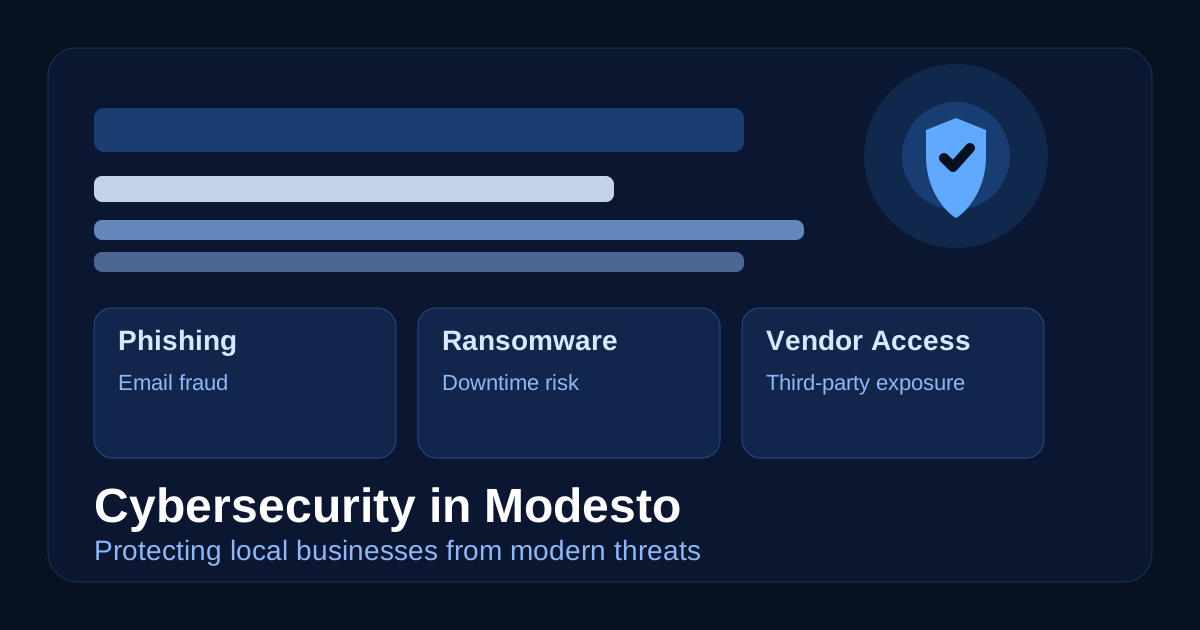
Modesto businesses should worry most about phishing, stolen credentials, ransomware, third-party vendor exposure, and weak backup or recovery discipline. Those threats matter because they do not just create IT problems. They interrupt operations, expose regulated data, delay payroll and billing, and force leadership into expensive decisions under pressure.123
That is why cybersecurity in Modesto should be treated as an operating issue, not a one-time compliance task. In our experience, most growing organizations in the Central Valley already own several security tools. The bigger gap is usually execution: inconsistent MFA, over-permissioned accounts, limited backup testing, unclear incident ownership, or no reliable cadence for reviewing risk.
For local healthcare groups, financial firms, school systems, manufacturers, and other mid-market organizations, the practical goal is not to chase every headline. It is to reduce the threats that are most likely to disrupt the business. Here at Datapath, we think that means building a security program that improves uptime, strengthens accountability, and gives leadership better visibility into what still needs attention.
Which modern cyber threats hit Modesto organizations the hardest?
The threat list is long, but a few patterns continue showing up across business environments like Modesto. Verizon’s latest DBIR still shows that credential abuse, phishing, vulnerability exploitation, and ransomware remain central attack paths, while the FBI’s IC3 reporting continues to document enormous business losses tied to fraud, email compromise, and related cybercrime.12
Why are phishing and business email compromise still such a problem?
Phishing remains dangerous because it attacks people, not just infrastructure. A single convincing email can lead to account compromise, payroll diversion, invoice fraud, malware delivery, or unauthorized access to Microsoft 365. For many organizations, email is the front door to identity, file sharing, vendor communication, and internal approvals.
This is especially important for businesses with lean teams, seasonal staffing, or frequent vendor interactions. When approval workflows are rushed, attackers only need one employee to trust the wrong message. A strong program should combine user training, MFA, conditional access, mailbox protection, and documented escalation paths for suspicious messages.
How does ransomware usually enter a mid-market environment?
Ransomware rarely starts with movie-style hacking. More often, it begins with a compromised account, an exposed remote access path, an unpatched system, or a malicious attachment that slips through. CISA and NIST both continue to emphasize basic controls such as multifactor authentication, asset visibility, patching, and tested backups because those basics still determine whether an event becomes a short disruption or a business crisis.34
For Modesto organizations, the real danger is not just encryption. It is the operational downtime that follows. If staff cannot access line-of-business tools, shared files, email, phones, or cloud apps, the business starts losing time immediately. We cover that broader business impact in our guide on the true cost of IT downtime.
Why does third-party and supply-chain risk keep increasing?
Most businesses now depend on outside vendors for payroll, accounting, cloud software, internet, phone systems, backup platforms, payment processing, and industry-specific applications. That means your risk is partly shaped by vendors you do not fully control. A compromised SaaS account, a weak MSP handoff, or poor third-party access management can create the same operational pain as a direct attack.
That is why cybersecurity Modesto buyers should ask not only how a provider secures endpoints and firewalls, but also how vendor access, privileged accounts, and external integrations are reviewed. In sectors like financial services and healthcare, that kind of discipline is not optional. It is part of maintaining a defensible operating model.
What does practical cybersecurity look like for a Modesto business in 2026?
A practical security strategy is not a giant wish list. It is a prioritized set of controls that meaningfully lowers risk, supports operations, and gives leadership confidence that the environment is being managed with discipline.34
What controls should leadership expect to see first?
For most mid-market environments, the first wave of work should include:
| Priority area | What to implement | Why it matters |
|---|---|---|
| Identity security | MFA everywhere possible, admin account separation, conditional access, stale account cleanup | Stops many common account-takeover paths |
| Endpoint and patching | EDR, operating system updates, software patching, unsupported device removal | Reduces exploitable exposure |
| Email protection | phishing filtering, SPF/DKIM/DMARC review, user reporting process | Lowers phishing and BEC risk |
| Backup and recovery | immutable or segmented backups, restore tests, recovery runbooks | Determines whether downtime becomes catastrophic |
| Privileged access and vendors | least privilege, access reviews, vendor account controls | Shrinks lateral movement and third-party risk |
| Incident readiness | escalation owners, communication plan, tabletop exercise | Improves response quality under pressure |
If these basics are weak, buying more tools usually adds complexity before it adds safety. We see the best results when organizations first tighten identity, backup, endpoint, and reporting discipline, then expand into deeper detection, segmentation, and governance work.
How important are backups and recovery testing really?
They are critical. A backup strategy is not complete just because backup jobs show green. Leadership needs to know whether critical systems can actually be restored within the time the business can tolerate. IBM’s Cost of a Data Breach reporting and CISA’s resilience guidance both reinforce the same underlying point: response readiness and recovery discipline materially affect business outcomes.35
If your team is unsure whether recovery assumptions are realistic, our backup and disaster recovery guide and DRaaS guide are useful next reads.
Where do local businesses usually underinvest?
Most organizations do not underinvest in security products as much as they underinvest in operating discipline. We commonly see gaps in:
- executive-friendly reporting on open risk
- access reviews for former staff and vendors
- backup restore validation
- documentation for key systems and approvals
- incident communication planning
- regular review of recurring security findings
That matters because leadership often thinks the environment is “covered” while the most important assumptions remain untested. A stronger program should make risk easier to explain, easier to prioritize, and easier to act on.
How should Modesto companies evaluate cybersecurity help?
The right provider should make the business calmer, not noisier. Buyers should look for clarity around ownership, scope, reporting, and how the provider turns technical findings into practical decisions.
Should a business look for a local cybersecurity provider?
A local provider is not automatically better, but local context can help. Central Valley organizations often care about on-site coordination, industry-specific realities, distributed locations, and face-to-face accountability during assessments, projects, or incidents. A team that understands the regional business environment may be better positioned to connect security work to actual operating constraints.
That is one reason some businesses compare a broad provider search with a more local approach such as cybersecurity services in Modesto, CA or cybersecurity consulting in Modesto, CA. The right choice depends on whether you need ongoing operational support, advisory help, or both.
What questions should buyers ask before signing?
We recommend asking questions like these:
- Which systems, identities, and locations are in scope?
- How are phishing, ransomware, and vendor-access risks reviewed?
- What reporting will leadership receive each month or quarter?
- How are backups tested and recovery assumptions validated?
- What happens during a high-severity event after hours?
- Which controls are included versus treated as add-ons?
- How will the first 90 days be prioritized and measured?
The strongest providers can answer those questions concretely. They can explain how they review evidence, how they escalate issues, and how they help leadership decide what to fund next.
Why does this matter for regulated industries?
Regulated organizations cannot separate cybersecurity from compliance, uptime, and board-level accountability. Whether the framework is HIPAA, PCI DSS, SOC 2, or internal client requirements, leadership needs more than point solutions. They need evidence that controls are operating and that risk is reviewed in a repeatable way.
That is why we often connect this conversation to our managed cybersecurity services guide, our cybersecurity risk assessment services guide, the Datapath home page, and our resources and guides hub. Good cybersecurity should support the whole operating model, not live in a silo.
Why Datapath for cybersecurity in Modesto?
We work with organizations that need security decisions tied back to uptime, resilience, and accountability. That includes businesses that cannot afford vague ownership, weak recovery planning, or security work that never turns into operational improvement.
Our view is simple: cybersecurity in Modesto should help a business run better, not just feel busier. That means reducing preventable downtime, tightening identity and backup discipline, improving vendor coordination, and giving leadership a clearer picture of open risk. If your organization is trying to strengthen security without drowning in tools or noise, review our solutions overview, explore our finance solution, or talk with our team about what a practical local security roadmap should include.
Frequently Asked Questions
What are the biggest cybersecurity threats for Modesto businesses?
The biggest threats are usually phishing, stolen credentials, ransomware, weak backups, and third-party vendor exposure. Those risks matter because they can interrupt operations, expose sensitive data, and create expensive recovery decisions for leadership.
Why is MFA so important for local businesses?
MFA makes it much harder for attackers to turn stolen passwords into real account access. Because many attacks begin with email or cloud account compromise, strong MFA is one of the highest-value controls a business can implement.
How often should a business test backups?
Backups should be monitored continuously and restore testing should happen on a regular schedule tied to business-critical systems. The right cadence depends on the environment, but leadership should not assume recovery will work without documented validation.
Does a small or mid-sized company in Modesto really need formal cybersecurity planning?
Yes. Smaller organizations are often targeted because they have fewer internal resources and less mature controls. Formal planning helps prioritize the basics, clarify ownership, and reduce the chance that a manageable incident becomes a major business disruption.
What should a cybersecurity provider in Modesto do first?
A strong provider should first baseline identity controls, endpoints, backups, email security, privileged access, and incident readiness. That creates a practical risk picture and helps leadership prioritize the improvements that will matter most.
Sources
- Verizon 2025 Data Breach Investigations Report
- FBI Internet Crime Complaint Center (IC3)
- CISA Cybersecurity Performance Goals
- NIST Cybersecurity Framework 2.0
- IBM Cost of a Data Breach Report