
What is disaster recovery as a service and when does it make sense?
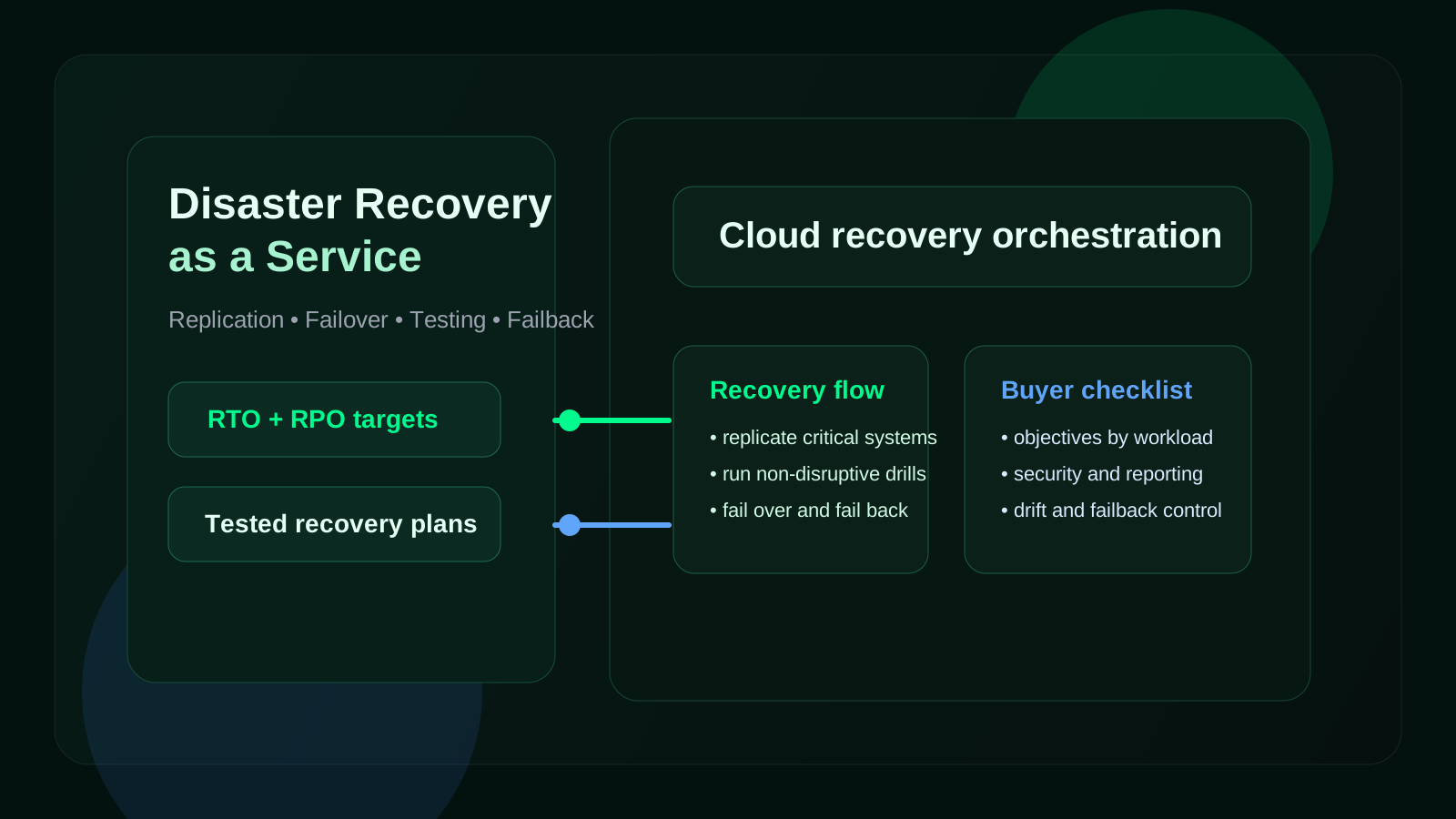
Disaster Recovery as a Service (DRaaS) is a managed disaster recovery model that replicates critical systems to a secondary environment, orchestrates failover and failback, and gives the business a structured way to recover applications after a serious outage. Instead of building and maintaining a full secondary site alone, the organization uses a provider and cloud infrastructure to keep recovery workflows ready, testable, and easier to operate over time.12
That distinction matters because many businesses think they already have disaster recovery when what they actually have is backup. Backup is essential, but backup alone does not guarantee a fast, coordinated return to service. If the business depends on identity systems, file services, ERP, line-of-business apps, cloud workloads, or regulated data, leadership needs more than copies of data. It needs a recoverable operating model with clear recovery objectives, known dependencies, documented runbooks, and evidence that the plan works.34
In our experience, DRaaS starts to make sense when downtime becomes more expensive than the effort required to prepare for it properly. That often happens when a company has multiple sites, limited internal IT bandwidth, compliance pressure, ransomware risk, or workloads that cannot tolerate slow manual rebuilds.
What does a strong DRaaS model actually include?
A strong DRaaS model usually includes continuous or near-continuous replication, a recovery environment in the cloud or a secondary site, failover orchestration, recovery testing, documented recovery plans, and support for failing back after the primary environment is restored. Microsoft describes Azure Site Recovery as a service that helps set up and manage replication, failover, failback, and recovery plans from a single control plane.1 AWS similarly frames cloud-based disaster recovery around maintaining an up-to-date copy of source servers, performing non-disruptive drills, and recovering applications quickly when the primary environment is disrupted.2
That means DRaaS should be broader than “we copy your servers somewhere else.” A serious provider should be able to explain the operating model in plain language.
| DRaaS capability | What it should cover | Why it matters |
|---|---|---|
| Replication | Ongoing synchronization of systems and data to a recovery location | Reduces data loss exposure |
| Recovery objectives | Defined RTO and RPO targets by workload | Keeps recovery aligned to business impact |
| Orchestration | Runbooks, sequencing, and automation for failover | Reduces chaos during real incidents |
| Testing | Scheduled drills without disrupting production | Proves recoverability instead of assuming it |
| Security | Encryption, access control, and isolated recovery workflows | Protects replicated data and recovery paths |
| Reporting | Recovery readiness, open risks, and test results | Gives leadership usable visibility |
| Failback | Procedures to return workloads to the primary environment | Prevents the recovery site from becoming a dead end |
Replication and recovery points are not the whole story
Replication matters, but it is only one layer. AWS notes that disaster recovery is about reestablishing access to applications, data, and IT resources after an outage, while backup is primarily about keeping extra copies of data for restoration and retention.2 A replicated server with no tested dependency map, no clear cutover sequence, and no communications plan is still a fragile recovery design.
AWS Well-Architected guidance emphasizes defining RTO and RPO, using a strategy that meets those objectives, testing implementation, managing configuration drift, and automating recovery where possible.4 In practical terms, the provider should be able to explain which systems recover first, which dependencies must come up together, which steps are manual, and how often the runbooks are reviewed.
Testing is where DRaaS either becomes real or falls apart
Ready.gov recommends documenting the IT disaster recovery plan, prioritizing hardware and software restoration, and testing the plan periodically to make sure it works.3 That sounds obvious, but this is where many programs quietly fail. Teams often buy tooling before they build the habit of testing. They assume replication equals readiness. Then a real outage exposes missing credentials, broken dependencies, stale DNS assumptions, or recovery times that look nothing like the numbers used in planning.
A credible DRaaS provider should support regular drills, preserve evidence of what was tested, and use those drills to improve the recovery model instead of treating them as checkbox exercises.
How should buyers decide whether DRaaS is the right fit?
DRaaS is the right fit when the business needs better recovery speed, better operational coverage, or more predictable recovery execution than internal staff can provide alone. It is especially attractive when the cost and complexity of maintaining a duplicate recovery site do not make sense for the size of the organization.12
That does not mean every workload needs DRaaS. Some systems are fine with standard backup and documented restore procedures. Others justify near-real-time replication and more automated failover. The right answer depends on business impact.
Start with business impact, not provider features
Before comparing providers, leadership should identify:
- which systems are truly business-critical
- how much downtime each one can tolerate
- how much data loss is acceptable
- which dependencies must recover together
- which regulatory, insurance, or customer obligations apply during disruption
Ready.gov explicitly ties IT recovery priorities to the business impact analysis and says the recovery time for an IT resource should match the recovery time objective for the business function or process that depends on it.3 That is the correct sequence. RTO and RPO are business decisions before they are technical settings.
DRaaS is often strongest for mid-market and regulated environments
In regulated industries, the challenge is rarely just restoring one server. The challenge is restoring the operating environment with enough control, evidence, and communication discipline to satisfy customers, auditors, insurers, and leadership. For those teams, DRaaS can be a strong fit because it gives the business a repeatable continuity process instead of a collection of improvised steps.
That is also why this topic connects directly to Datapath resources like Backup and Disaster Recovery: The Complete Guide for Business IT, Managed Cybersecurity Services, and the broader resources and guides hub.
How should buyers evaluate a DRaaS provider?
The easiest mistake is comparing providers only on infrastructure vocabulary. Buyers hear phrases like warm site, pilot light, replication frequency, or orchestration engine and assume the technical language proves readiness. It does not. The real evaluation should focus on recoverability, accountability, and fit.
Ask how they define and prove RTO and RPO
A provider should be able to explain how recovery objectives are set, what assumptions support them, and how those assumptions are validated in testing. Azure Site Recovery highlights recovery time and recovery point objectives as core design targets, and AWS does the same in its disaster recovery guidance.12
Ask how RTO and RPO are set per workload, whether targets are measured during drills or only estimated, what conditions could cause them to be missed, and how application-consistent recovery is handled. If the provider only repeats generic claims like “minutes, not hours” without explaining the conditions behind those numbers, treat that as a warning sign.
Review testing, reporting, and drift control
A recovery design degrades over time if infrastructure changes faster than the recovery plan. AWS explicitly calls out configuration drift management as a disaster recovery best practice.4 That matters because a recovery site that looked clean six months ago may now be missing new servers, changed firewall rules, renamed groups, or application dependencies that were never added to the runbook.
A serious provider should offer:
- scheduled recovery drills
- documented drill results and exceptions
- change review tied to recovery scope
- reporting on recovery readiness and open risks
- a process for updating runbooks after production changes
Evaluate failback and long-tail recovery operations
Some providers are good at talking about failover and vague about everything after it. Buyers should ask how the provider handles failback, reconciliation, user communication, and the transition from crisis mode back to steady-state operations. Failing over is dramatic. Failing back cleanly is where operating discipline shows up.
Check security and access controls around the recovery environment
Recovery environments hold sensitive replicated data and privileged workflows. Microsoft documents encryption in transit and at rest for Site Recovery scenarios, while AWS documents encrypted replication and private connectivity options.25 Buyers should ask how access is controlled, who can initiate failover, how credentials are protected, and how the recovery environment is segmented from ordinary administrative sprawl.
If the recovery plane is not governed tightly, the business may be improving continuity while quietly increasing security risk.
What should businesses expect in the first 90 days of a DRaaS engagement?
In the first 90 days, leadership should expect a clear scope of protected systems, documented recovery objectives, established replication, written runbooks, and at least one meaningful test with results and open issues. Recoverability should become more measurable over time, not more mysterious.
Why Datapath for disaster recovery as a service planning?
We approach DRaaS the same way we approach managed IT and cybersecurity in regulated environments: with accountability, practical operating discipline, and decisions leadership can defend. If your team is trying to tighten recovery objectives, prove recoverability through testing, or connect disaster recovery planning to a broader security and uptime strategy, start with the Datapath homepage, review our IT consulting and storage services, explore the resources and guides hub, or talk to our team about disaster recovery readiness.
Frequently Asked Questions
What is disaster recovery as a service?
Disaster Recovery as a Service is a managed recovery model that replicates critical systems to a secondary environment and provides failover, testing, and recovery operations so a business can restore applications more quickly after a major outage.12
Is DRaaS the same as backup?
No. Backup preserves copies of data for restoration and retention, while DRaaS is designed to restore applications and supporting infrastructure within defined recovery objectives after a disruption.23
When does DRaaS make sense for a business?
DRaaS usually makes sense when downtime has become expensive, internal IT does not have enough bandwidth to maintain a strong recovery site, or the organization has compliance, ransomware, multi-site, or uptime requirements that demand a more disciplined recovery model.
What should we ask a DRaaS provider before signing?
Ask how they define and validate RTO and RPO, how often they test, how they manage drift between production and the recovery environment, how failback works, what security controls protect the recovery plane, and what reporting leadership will receive after drills or incidents.
Can DRaaS help with ransomware recovery?
Yes, but only if the design supports clean recovery points, controlled access, tested restoration workflows, and a realistic plan for recovering business operations after a security incident. DRaaS is helpful for ransomware resilience, but it still needs strong security and backup discipline around it.25
Sources
- Microsoft Learn: About Azure Site Recovery
- AWS Elastic Disaster Recovery FAQs
- Ready.gov: IT Disaster Recovery Plan
- AWS Well-Architected: Plan for Disaster Recovery (DR)
- Microsoft Learn: General questions about the Azure Site Recovery service
