import CTA from ’../../components/CTA.astro’;
What should mid-market healthcare organizations include in disaster recovery cost planning?
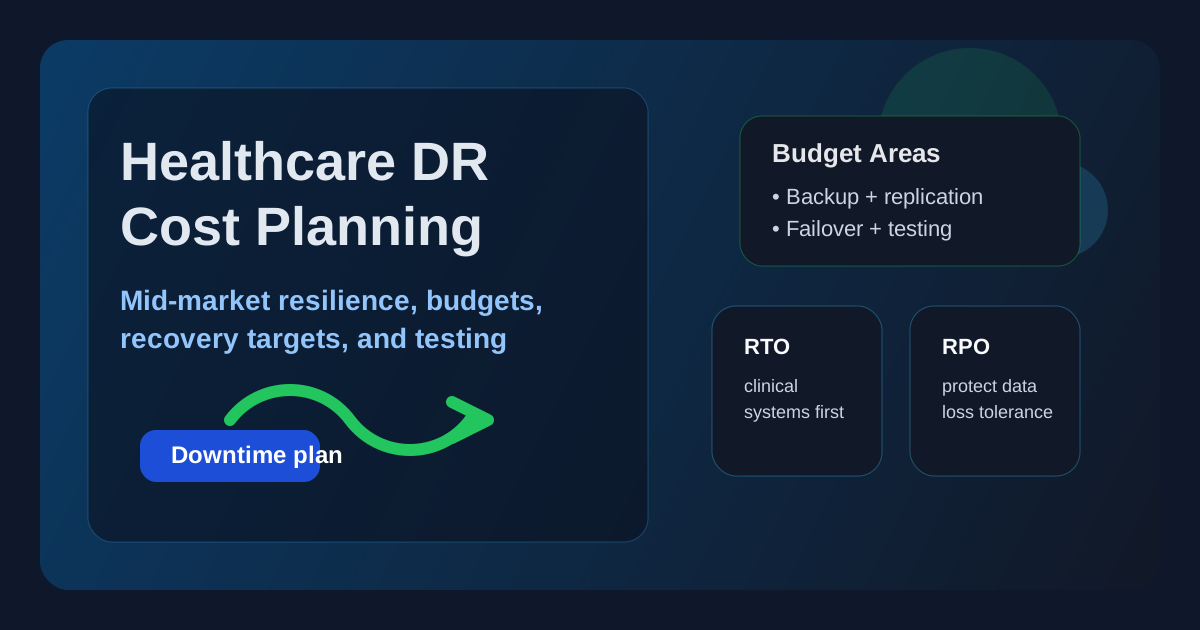
Mid-market healthcare organizations should include downtime risk, recovery objectives, backup and replication design, clinical downtime procedures, testing, compliance support, vendor coordination, and ongoing operating costs in disaster recovery cost planning. The biggest mistake we see is treating disaster recovery like a storage purchase instead of an operational commitment tied to patient care, revenue continuity, and HIPAA-relevant resilience.123
That distinction matters because healthcare downtime is not just a technical inconvenience. If identity systems fail, the EHR becomes unavailable, imaging access slows down, phones break, or a ransomware event forces isolation, the cost shows up everywhere at once: patient access, staff productivity, claims, scheduling, reputational trust, and leadership attention. Mid-market organizations usually feel that pressure even more sharply because they have enterprise-like complexity without enterprise-sized slack in staffing or budgets.
We usually recommend looking at this topic alongside Datapath’s healthcare IT solutions page, our guide on Disaster Recovery Plan for Healthcare Organizations: What to Include, and related posts like HIPAA Disaster Recovery Plan Requirements for Healthcare Organizations, Medical Imaging Backup and Disaster Recovery: What Healthcare IT Teams Need, and EHR Downtime Contingency Plan Checklist for Healthcare Organizations.
Why does disaster recovery cost planning work differently in healthcare?
Healthcare disaster recovery cost planning works differently because the business impact of downtime is tied to clinical workflows, regulated data, and patient-facing operations. A manufacturer may mainly ask how quickly production can resume. A healthcare organization has to ask how charting, scheduling, prescribing, communication, diagnostics, and protected health information hold up during disruption.12
Clinical interruption costs are broader than IT repair costs
A lot of teams start by pricing hardware, backup software, or cloud storage. Those matter, but they are only part of the picture. A realistic cost plan should also account for:
- lost appointment and procedure revenue
- delayed billing and collections
- staff overtime during downtime and recovery
- manual workflow friction during EHR or imaging outages
- patient-safety risk tied to delayed access or incomplete information
- third-party recovery or incident-response costs
- potential compliance and documentation exposure24
In other words, the recovery budget should be informed by what the outage would cost, not just what the tooling costs.
Mid-market healthcare has a specific budgeting problem
Mid-market organizations often sit in the hardest zone. They usually have multiple sites, a real compliance burden, dependency on cloud and on-prem systems, and a growing number of vendors. But they may still rely on lean internal IT staffing and tighter approval cycles than larger hospital systems. That makes it easy to underfund resilience until a real disruption exposes the gap.
What cost categories should be in the disaster recovery budget?
A mid-market healthcare DR budget should include planning, infrastructure, data protection, failover capability, downtime operations, testing, compliance, and vendor management costs. If any of those categories are missing, the budget is probably incomplete.
1. Risk assessment and business impact analysis
The first budget item should be the work required to understand recovery priorities. That means identifying critical applications, mapping dependencies, defining acceptable downtime, and estimating business impact by system and workflow.12
For healthcare, we usually want leaders to know:
- which systems directly affect patient care
- which systems affect intake, scheduling, claims, and operations
- what dependencies exist between identity, networking, EHR, imaging, phones, and cloud apps
- what downtime window becomes materially dangerous or financially disruptive
This planning work is not overhead. It determines where money should go.
2. Backup, replication, and retention
The next layer is data protection. Healthcare organizations often need a mix of backup and faster recovery options rather than a single archive strategy. Cost planning should include:
- backup software and licensing
- storage capacity on-prem, in cloud, or both
- immutable or isolated backup protections where appropriate
- replication for systems that need lower data-loss tolerance
- retention design for operational, legal, and recovery needs
- monitoring and alerting for backup failures35
A common mistake is funding backup capacity but not funding the monitoring, restore validation, and operational review that make the backup trustworthy.
3. Recovery environment and failover capability
If the production environment becomes unavailable, where does the workload run? That answer has real cost implications. Mid-market healthcare teams may choose a secondary site, cloud-based DR, hosted failover for priority workloads, or a hybrid model.56
The budget may need to cover:
- standby compute or reserved cloud capacity
- network connectivity and bandwidth for replication
- infrastructure-as-code or configuration work for recovery builds
- licensing for replicated workloads
- recovery orchestration tooling
- environment hardening and access controls in the recovery platform
The tighter the recovery window, the less likely a low-cost “restore it later” model will be enough.
4. Clinical downtime procedures
A healthcare recovery budget should also include the operational side of outage survival. If the EHR is unavailable, teams need approved downtime workflows, documentation paths, communication steps, and recovery sequencing for patient data re-entry where applicable.27
That means budgeting for things like:
- downtime forms and printed workflows
- staff training on paper or alternate procedures
- communication tools and contact trees
- coordination runbooks for clinical and administrative leaders
- post-incident reconciliation effort
This category is easy to ignore because it does not always look like “IT spend,” but it is essential in healthcare.
5. Testing and validation
A recovery plan without regular testing is just a set of assumptions. Budgeting should include tabletop reviews, technical restore tests, partial failover exercises, and revision work after findings are discovered.28
We prefer a model where organizations fund testing as a recurring operating requirement, not as an occasional extra project. That is usually the difference between recovery confidence and recovery theater.
6. Compliance, documentation, and audit support
Healthcare organizations should also budget for the documentation required to show that resilience controls exist and are maintained. HIPAA contingency planning is not satisfied by saying backups exist somewhere. Teams need evidence around procedures, responsibilities, testing, and recoverability.29
Cost categories here may include:
- policy and runbook maintenance
- risk assessment updates
- documentation cleanup
- audit support or advisory time
- evidence collection for testing and control reviews
7. Outside vendors and recovery partners
A real healthcare outage usually crosses vendors. EHR hosting, imaging systems, Microsoft 365, ISP circuits, backup providers, security responders, and managed IT partners may all play a role. Cost planning should account for that dependency model instead of assuming one internal team can recover everything alone.
Budget holders should ask:
- which vendors have recovery obligations and which do not
- what support tiers or after-hours response costs apply
- whether outside incident-response retainers are needed
- who owns coordination during a multi-vendor event
How do RTO and RPO affect the budget?
Recovery time objective (RTO) and recovery point objective (RPO) are two of the biggest drivers of disaster recovery cost. The shorter the recovery window and the less data loss the organization can tolerate, the more the solution usually costs.3
Lower tolerance means higher spend
If leadership says a clinical application can be down for only a short window, the organization is probably paying for faster recovery infrastructure, more frequent replication, more automation, and stronger testing. If leadership says near-zero data loss is acceptable for a critical workflow, that usually pushes the design away from basic nightly backups and toward more expensive replication or hot/warm recovery models.56
That is not a reason to avoid ambitious targets. It is a reason to set them deliberately.
Not every system needs the same target
One of the cleanest ways to control cost is to stop pretending every system is equally critical. Mid-market healthcare organizations should tier systems by operational importance. For example:
- patient-care-critical platforms
- high-priority operational systems like scheduling or communications
- billing and administrative systems
- lower-priority archival or internal tools
That lets the budget reflect business reality instead of funding premium recovery everywhere.
Should mid-market healthcare use cloud-based disaster recovery?
Cloud-based disaster recovery is often a strong fit for mid-market healthcare because it can reduce capital expense, improve scalability, and provide stronger recovery options than many organizations can build alone. But it still needs governance, testing, and clear ownership to be worth the spend.56
Cloud DR can make sense when an organization wants to avoid maintaining a full secondary data center while still improving resiliency. It can also help lean internal IT teams by shifting some infrastructure burden to a provider model. But the savings only hold up if leadership also budgets for the surrounding work: identity controls, recovery validation, bandwidth, access governance, and vendor coordination.
We usually tell teams not to ask, “Is cloud DR cheaper?” The better question is, “Does this model get us to our required recovery outcome with less operational drag?”
What does a realistic healthcare DR budget process look like?
A realistic budget process should start with workflow criticality, quantify downtime exposure, set recovery tiers, and then map technology and operating costs to those tiers. That sequence helps organizations avoid both overspending and false economy.
A practical process usually looks like this:
- identify critical clinical and business workflows
- estimate the operational and financial impact of downtime
- define tiered RTO and RPO targets
- map application and infrastructure dependencies
- choose recovery methods by tier
- budget for tooling, testing, documentation, and outside support
- review the plan at least annually or after major changes
That last step matters. Recovery budgets age quickly when environments change.
What are the most common budgeting mistakes?
The most common mistake is underbudgeting everything around the technology purchase. Teams buy backup capacity or a DR service, then discover they never funded testing, workflow documentation, vendor coordination, or recovery ownership.
Other common mistakes include:
- using one generic RTO/RPO target for all systems
- ignoring clinical downtime procedures
- assuming vendors own more recovery responsibility than the contract actually says
- failing to account for staff time and overtime during incidents
- treating annual testing as optional
- not updating the budget after acquisitions, new sites, or platform changes
Why Datapath for healthcare resilience planning?
At Datapath, we think disaster recovery cost planning should produce something more useful than a backup invoice and a vague promise. Healthcare leaders need a recovery model they can explain: what gets restored first, what it costs to protect it, what tradeoffs are being accepted, and how the organization will operate if a real event hits.
That is the lens we bring to healthcare IT, managed services, and regulated-environment resilience work. We help organizations connect recovery spending to practical outcomes like clinical continuity, backup confidence, vendor accountability, and more defensible decisions around risk.
FAQ: Disaster recovery cost planning for mid-market healthcare
What should be included in a healthcare disaster recovery budget?
A healthcare DR budget should usually include risk assessment, backup and replication, recovery infrastructure, downtime workflows, testing, documentation, vendor coordination, and compliance support. If the budget covers only storage or software, it is probably incomplete.
What drives disaster recovery cost the most?
The biggest cost drivers are usually downtime tolerance, data-loss tolerance, application criticality, and whether the organization needs fast failover for patient-care systems. Shorter RTOs and lower RPOs generally cost more.
Is cloud disaster recovery cheaper than a secondary site?
It often can be more cost-effective for mid-market organizations, especially when avoiding a full secondary facility. But it still requires budget for identity, networking, testing, governance, and provider management.
How often should mid-market healthcare teams test disaster recovery?
They should test on a recurring schedule, with both tabletop and technical exercises, and update documentation after each meaningful finding. The exact cadence varies, but recovery testing should be treated as an ongoing operating cost rather than a one-time event.28
-
Best Practices in Healthcare IT Disaster Recovery Planning ↩ ↩2 ↩3
-
Disaster Planning and Recovery Toolkit ↩ ↩2 ↩3 ↩4 ↩5 ↩6 ↩7 ↩8
-
Cloud-Based Disaster Recovery for Mid-Market Organizations ↩ ↩2 ↩3 ↩4
-
EHR Downtime Contingency Plan Checklist for Healthcare Organizations ↩
-
HIPAA Disaster Recovery Plan Requirements for Healthcare Organizations ↩
