
What does HIPAA require in a disaster recovery plan?
A practical HIPAA disaster recovery plan should show how a healthcare organization will restore lost data, continue critical operations, protect electronic protected health information, and recover systems in a controlled way after a disruptive event. Under the HIPAA Security Rule’s contingency planning standard, covered entities and business associates are expected to establish procedures for responding to emergencies or other occurrences that damage systems containing ePHI.12 In plain English, that means the plan cannot stop at “we back things up.” It has to explain how the organization keeps care moving, restores systems, and proves the process was thought through before the outage happened.
That matters because healthcare outages are not just inconvenient. When identity systems, EHR access, imaging, scheduling, billing, or communications fail, patient care gets slower and risk rises fast. In our experience, the best disaster recovery plans are the ones that connect compliance language to the systems clinicians and administrators actually rely on every day.
Which HIPAA contingency planning elements have to be covered?
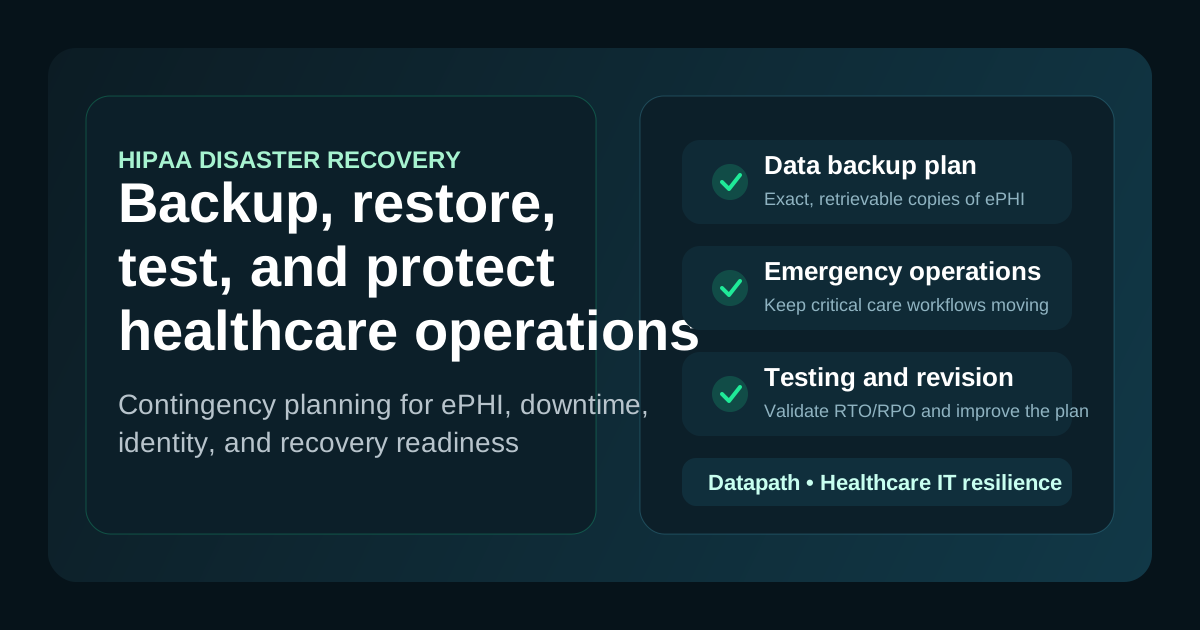
The contingency planning standard is broader than a single recovery document. HIPAA’s framework points healthcare organizations toward five connected elements: a data backup plan, a disaster recovery plan, an emergency mode operation plan, testing and revision procedures, and an applications-and-data criticality analysis.13 A strong program treats those as one operating system for resilience rather than five separate paperwork items.
| Required planning element | What it should answer | Why it matters |
|---|---|---|
| Data backup plan | How exact copies of ePHI are created, protected, and retained | Makes restoration possible |
| Disaster recovery plan | How lost data and systems are restored after disruption | Turns backups into recovery |
| Emergency mode operation plan | How essential functions continue during the outage | Protects care continuity |
| Testing and revision procedures | How the organization proves the plan works and improves it | Prevents false confidence |
| Applications and data criticality analysis | Which systems and data get restored first | Keeps priorities clear under pressure |
If one of those pieces is weak, the rest usually become weaker too. Backups without testing are guesswork. Recovery steps without criticality ranking create confusion. Emergency procedures without identity access or communications planning break down when people are stressed.
What should the backup and restoration parts of the plan include?
The backup and restoration sections should define exactly what is protected, where it is stored, how often it is copied, who can access it, and how the organization will restore it when needed. HIPAA’s data backup and disaster recovery implementation specifications point toward retrievable exact copies of ePHI and procedures to restore data loss.12
A useful backup-and-restore section should verify:
- all systems that create, receive, maintain, or transmit ePHI are in scope, not just the primary EHR
- backups are protected with appropriate encryption and access controls
- offsite or geographically separated recovery copies exist
- backup failures are monitored and escalated
- restore steps are documented for the systems that matter most
- recovery expectations are translated into realistic RTO and RPO targets
This is also where many healthcare organizations underestimate dependencies. A plan may say the EHR is backed up, but if clinicians cannot authenticate because Active Directory, Entra ID, SSO, VPN, or remote access infrastructure is unavailable, the organization is still down in practice. Some of the better recovery guidance in the market explicitly calls out identity infrastructure as critical because it controls access to nearly everything else.3
Healthcare teams that need a broader resilience baseline should compare this against Datapath’s guide to backup and disaster recovery, our article on disaster recovery as a service, and our healthcare solutions page.
How should healthcare organizations handle emergency operations during downtime?
A HIPAA-aligned plan should explain how critical business processes continue while systems are impaired or unavailable. That is the purpose of the emergency mode operation plan: it is not just about restoring technology later, but about protecting the security of ePHI while the organization is operating in emergency mode.14
For most healthcare environments, that means answering questions like:
Which clinical and administrative processes must continue first?
The organization should identify the services that cannot stop without creating patient risk or severe operational damage. That usually includes chart access, medication workflows, scheduling, communications, identity services, intake, and sometimes imaging or lab coordination depending on the environment.
What is the fallback workflow if systems are unavailable?
A real plan should document downtime procedures, not just mention that they exist. Staff should know how to document care, communicate internally, verify patient information, and resume normal workflows once systems return. If the process only works when the IT lead is awake and available, it is not much of a plan.
How is ePHI protected during emergency operations?
Emergency mode often creates temporary workarounds, but HIPAA does not disappear during an outage. Access, communication, and data handling procedures should still protect confidentiality and integrity, even when operations are degraded.24
In our experience, this is where tabletop exercises become especially useful. They show whether the emergency workflow is actually usable by clinicians and operations staff instead of just theoretically compliant.
How often should a HIPAA disaster recovery plan be tested?
It should be tested on a recurring basis and revised when the organization learns something new, changes systems, adds vendors, expands locations, or experiences an incident. HIPAA includes testing and revision procedures in the contingency planning standard because a plan that is never tested is not really a recovery capability.13
A serious testing program should include:
- restore validation for critical systems and data sets
- tabletop exercises covering realistic outage or ransomware scenarios
- documentation of who participated, what failed, and what changed afterward
- comparison of actual recovery performance against stated RTO and RPO targets
- follow-up remediation with named owners and due dates
Many organizations say they “tested backups” when they only confirmed a job ran successfully. That is not enough. The meaningful question is whether the organization can restore the right systems, in the right order, within an acceptable time window, while staff can still authenticate and continue critical operations.
The same discipline shows up in broader healthcare security work. If recovery testing is weak, odds are good that related controls need attention too. Datapath’s guides on HIPAA risk assessments and HIPAA technical safeguards fit naturally alongside disaster recovery review.
How should critical systems and data be prioritized for recovery?
Healthcare organizations should perform an applications-and-data criticality analysis that ranks systems by their impact on patient care, regulatory exposure, and operational continuity. HIPAA explicitly includes this analysis as part of contingency planning because recovery teams need a shared understanding of what comes back first.13
A practical priority model usually groups systems like this:
Tier 1: Immediate care and access systems
These are the systems that directly affect patient care or universal access to systems, such as EHRs, identity services, core network access, communications platforms, and essential integrations.
Tier 2: Near-term business continuity systems
These often include scheduling, billing, imaging support, claims workflows, file storage, and collaboration systems that keep the organization functioning once the immediate crisis is stabilized.
Tier 3: Lower-priority or deferrable systems
These are systems the organization still needs, but not before patient care, access, and core operations are restored.
This exercise sounds simple, but it forces useful decisions. If every system is labeled critical, nothing is truly prioritized. If leadership cannot explain acceptable downtime by system, then recovery expectations are probably being carried around informally rather than managed.
What supporting elements do healthcare organizations usually miss?
The biggest misses are usually communication, vendor coordination, identity dependencies, documentation accessibility, and staff training. Those are not glamorous controls, but they determine whether recovery feels orderly or chaotic.
A stronger plan should cover:
Communication and command structure
Who declares an incident? Who talks to leadership, clinicians, third parties, and staff? Which channels work if email is down? Good plans remove that ambiguity before the outage starts.4
Vendor and partner coordination
Healthcare environments often depend on EHR vendors, cloud providers, telecom providers, security tools, managed service partners, and specialist line-of-business vendors. A recovery plan should include who to contact, what support is expected, and which contracts or business associate relationships matter during an incident.45
Accessible documentation
If the plan only lives on the system that just failed, that is a problem. Staff need to know where the recovery plan, contact lists, downtime procedures, and escalation paths are stored, including alternate or offsite locations.4
Workforce training
Staff should know where the plan is, what their role is, and what the emergency workflow looks like. Recovery costs rise when people are improvising under pressure because they were never trained.5
Identity and access resilience
Authentication is a hidden dependency in many healthcare outages. If users cannot log in, restore teams cannot do their jobs and clinicians cannot reach the systems that were technically recovered. That is why identity systems deserve first-class recovery treatment, not a footnote.3
What does a strong HIPAA disaster recovery plan look like in practice?
A strong plan is documented, tested, role-based, and connected to the real environment instead of a generic template. It should let leadership answer five plain questions with confidence:
- What systems and data are in scope for ePHI recovery?
- What comes back first, and why?
- How do we operate safely while restoration is in progress?
- How do we prove the plan works?
- Who owns each part of recovery, internally and externally?
If those answers are fuzzy, the plan probably needs work.
We recommend treating the plan as an operating document tied to monthly and quarterly review rather than an annual compliance artifact. That means updating it when infrastructure changes, when vendors change, after drills, after incidents, and after lessons learned. Healthcare organizations that do that usually get two benefits at once: better compliance posture and calmer recovery when something actually goes wrong.
Why Datapath for healthcare disaster recovery planning?
We approach healthcare disaster recovery the same way we approach regulated-environment IT overall: by tying compliance requirements to systems, people, recovery priorities, and evidence. The goal is not to produce a binder that looks good in a meeting. It is to help the organization restore patient-facing operations, protect ePHI, and make cleaner decisions under pressure.
If your healthcare organization is trying to validate backups, tighten downtime procedures, clean up identity dependencies, improve ransomware resilience, or turn HIPAA recovery planning into a real operating discipline, start with the Datapath homepage, review our healthcare solutions, explore the resources and guides hub, or talk with our team about where your current recovery model is likely to break first.
Frequently Asked Questions
Does HIPAA explicitly require a disaster recovery plan?
Yes. HIPAA’s contingency planning standard includes a disaster recovery plan implementation specification that requires procedures to restore loss of data, alongside backup and emergency mode planning.1
Is backup alone enough for HIPAA disaster recovery compliance?
No. Backup is only one part of the requirement. HIPAA contingency planning also expects disaster recovery procedures, emergency mode operations, testing and revision, and criticality analysis.13
How often should healthcare organizations test disaster recovery?
HIPAA does not reduce testing to one exact universal interval, but the plan should be tested periodically and updated based on findings. In practice, the right cadence depends on system criticality, change rate, and risk tolerance.13
What systems should be included in a HIPAA disaster recovery plan?
Any system that creates, receives, maintains, or transmits ePHI should be considered, along with the identity, communications, backup, and infrastructure dependencies needed to keep those systems usable during recovery.23
What is the most common healthcare disaster recovery mistake?
Usually it is assuming the EHR is the whole problem. In reality, communication workflows, identity systems, network dependencies, vendors, and downtime procedures often determine whether the organization can actually recover in a controlled way.
Sources
- 45 CFR § 164.308(a)(7) — Contingency plan
- HHS OCR Security Rule guidance
- Cayosoft: HIPAA disaster recovery plan requirements
- Compliancy Group: HIPAA disaster recovery plan
- HIPAA Journal: HIPAA-compliant disaster recovery