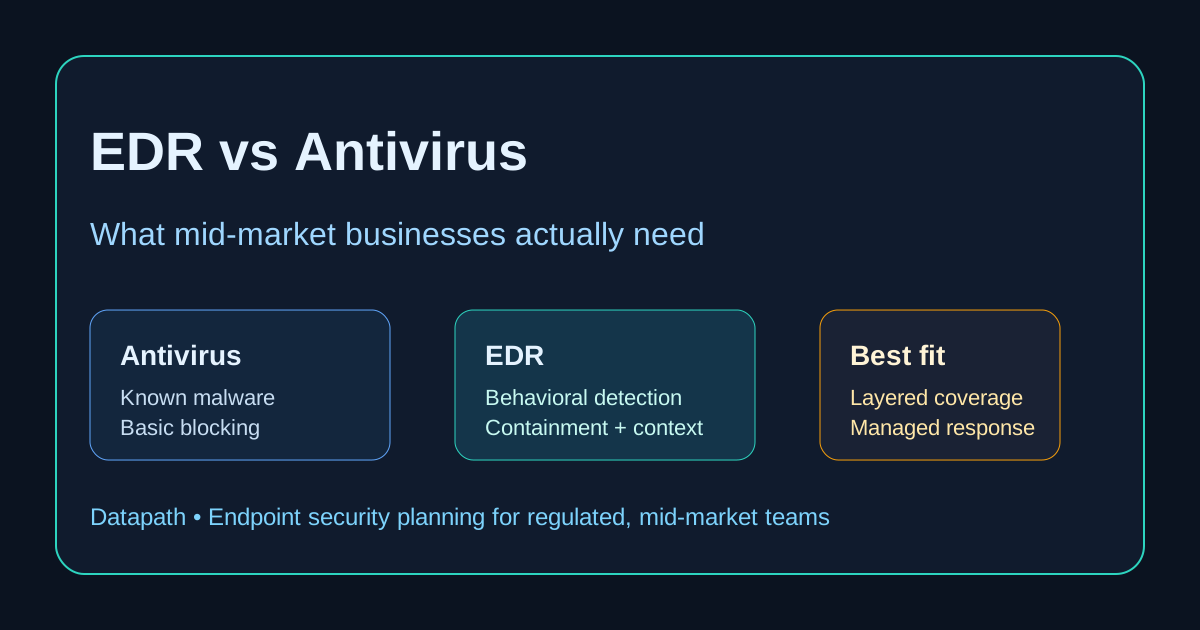
What is the difference between endpoint detection and response vs antivirus for mid-market businesses?
For most mid-market businesses, the practical difference is simple: antivirus helps block known malware, while endpoint detection and response gives your team visibility, investigation context, and containment capability when something suspicious still gets through.123 Antivirus remains an important baseline. It is just not enough on its own for organizations that depend on Microsoft 365, remote access, line-of-business apps, third-party vendors, and distributed users.
We see this confusion a lot. Leadership hears that antivirus is old, EDR is modern, and managed detection is expensive, so the buying conversation turns into a false either-or decision. In practice, that framing misses the real issue. Mid-market businesses usually need a layered endpoint security model that can do three things well:
- stop common threats before they spread
- detect suspicious behavior that does not match an old malware signature
- contain and investigate an incident fast enough to avoid a bigger outage
Here at Datapath, we recommend evaluating endpoint protection the same way you would evaluate any other operational control: by asking what visibility you get, what actions your team can take under pressure, and how quickly you can move when a real incident starts. That is why endpoint tooling should connect naturally to your broader managed IT services, managed cybersecurity services guide, cybersecurity risk assessment checklist for mid-market companies, and Microsoft 365 posture improvement plan.
What does antivirus still do well, and where does it fall short?
Antivirus still does valuable work. It remains one of the fastest and most efficient ways to catch known malware families, malicious attachments, and commodity threats that already have established signatures.14 For many businesses, that basic protection layer removes a lot of routine noise before users even notice a problem.
Where antivirus still helps
Traditional AV is good at:
- scanning files and processes against known threat signatures
- blocking common malware variants before execution
- providing lightweight baseline protection across endpoints
- supporting hygiene requirements that many organizations still expect in policy or procurement reviews
That matters because not every threat is sophisticated. Plenty of attacks still rely on commodity malware, reused payloads, and opportunistic delivery methods. A team that skips basic anti-malware entirely is creating an avoidable gap.14
Where antivirus falls short for modern environments
The problem is not that antivirus is useless. The problem is that signature-based protection does not give mid-market IT leaders enough context when the threat is fileless, credential-driven, script-based, or brand new.123 Modern attacks increasingly use PowerShell, remote management tooling, stolen credentials, browser session theft, and living-off-the-land techniques that do not always look like a traditional malicious file.
That limitation matters more in mid-market environments because those teams rarely have spare capacity. If the tool says only that a file was quarantined, but cannot tell you what else happened on the endpoint, whether lateral movement started, or whether the user account was abused elsewhere, your team is still stuck doing incident triage with incomplete information.
Research from endpoint security vendors and security operators keeps landing on the same conclusion: organizations need behavioral detection and response capability because a meaningful share of modern attacks do not depend on a known malware signature.123
How does EDR change the picture for mid-market businesses?
Endpoint Detection and Response changes the conversation because it focuses less on static signatures and more on continuous endpoint telemetry, suspicious behavior, and response actions.235 Instead of asking only whether a file matches a known bad fingerprint, EDR asks whether the device is acting like an endpoint under attack.
What EDR actually gives your team
A solid EDR platform typically provides:
- continuous monitoring of processes, scripts, registry changes, network connections, and user activity
- behavioral analysis that can spot suspicious patterns even when the payload is new
- centralized visibility across managed endpoints
- incident timelines and forensic context for investigation
- response actions such as process kill, host isolation, or alert escalation
That extra depth is what helps teams make better decisions when something looks wrong. If a user clicks a phishing link and an attacker starts launching PowerShell, disabling controls, moving laterally, or abusing remote admin tools, EDR is far more likely to surface the pattern quickly than legacy AV alone.236
Why that matters specifically for mid-market teams
Mid-market organizations are often in the hardest position. They have enough complexity to be an attractive target, but not always enough internal staffing to run a full security operations center. That means tooling has to do more than log an alert. It has to help a lean team understand scope, prioritize action, and contain the issue before it becomes prolonged downtime or a compliance problem.
We think this is where EDR usually earns its keep. It shortens the distance between detection and action. It also gives leadership a more defensible answer when they ask what happened, how far it spread, and what the team did next.
Should a mid-market business choose antivirus or EDR?
In most cases, the answer should be both, but with EDR carrying the heavier security role.123 We do not recommend treating this as a winner-take-all product comparison. Antivirus and EDR solve different parts of the endpoint security problem.
A practical side-by-side comparison
| Area | Antivirus | EDR |
|---|---|---|
| Primary detection style | Known signatures and basic heuristics | Behavioral analysis plus telemetry |
| Best at | Commodity malware and known bad files | Unknown, fileless, and hands-on-keyboard activity |
| Visibility | Limited per-device context | Cross-endpoint timelines and investigation detail |
| Response depth | Quarantine or remove file | Isolate host, kill process, support investigation |
| Operational value | Baseline protection | Detection, response, containment, and evidence |
For many businesses, the real requirement is not a prettier feature matrix. It is a clear operating model:
- who reviews alerts
- who decides when to isolate a device
- how after-hours incidents get escalated
- how endpoint security connects to Microsoft 365, identity, backups, and vendor access
- how leadership gets confidence that the tool is not just generating unread alerts
That is why endpoint tooling decisions should be tied to broader resilience work such as ransomware incident response planning, managed NGFW and network segmentation for regulated businesses, how to audit third-party access controls in MSP agreements, and how to design secure remote access for healthcare staff.
When is antivirus-only still risky?
Antivirus-only is usually risky when the organization depends on cloud identity, remote work, privileged admin workflows, regulated data, or complex vendor access. In those environments, the cost of delayed detection is often much higher than the cost of a better endpoint security stack.
Warning signs that AV alone is not enough
We recommend moving beyond antivirus-only if any of these are true:
- you have more than a small handful of employees and endpoints
- your users rely heavily on Microsoft 365, SaaS, VPN, or remote access
- you handle regulated, sensitive, or customer-critical data
- your cyber insurance or customer diligence process is getting stricter
- you do not have strong internal incident response depth
- you need to understand what happened after a suspicious event, not just whether a file was blocked
Those are normal conditions for a lot of mid-market companies. That is why EDR adoption has moved from nice-to-have to baseline expectation in many serious environments.278
The operational risk is not just malware
A lot of leadership teams still picture endpoint security as a malware cleanup problem. We think that framing is outdated. The more common challenge is operational uncertainty: an account is compromised, a script runs unexpectedly, remote admin tooling shows up where it should not, or a device starts behaving strangely and nobody knows whether the problem is isolated or spreading.
That is exactly where EDR helps. It gives your team evidence. It gives them a place to investigate. And when configured well, it gives them actions they can take before the situation turns into a business interruption.235
Does EDR mean you also need MDR or managed coverage?
Not always, but many mid-market businesses should at least evaluate managed coverage. The tool itself is only part of the answer. Someone still has to review alerts, decide what matters, and respond consistently.
When managed coverage makes sense
Managed Detection and Response can be the right fit when:
- internal IT is already overloaded with day-to-day support
- the business needs after-hours monitoring or escalation
- there is no dedicated security analyst on staff
- leadership wants faster triage and clearer incident ownership
- regulated or customer-facing operations make delayed response expensive
This does not mean every business needs a large outsourced SOC contract. It does mean the organization should be honest about whether it has the people and process to use EDR well. Buying a strong tool and then ignoring the alerts is not a mature security strategy.
Why Datapath for endpoint security planning?
We think endpoint security should be evaluated as part of an operating system for the business, not as a standalone software checkbox. The right endpoint stack should help you reduce preventable risk, move faster during incidents, and connect endpoint events to the rest of your environment: identity, backup readiness, remote access, network controls, and vendor accountability.
That is especially important for mid-market teams that do not have time for security theater. You need a practical answer to questions like: Which endpoints matter most? How do we contain suspicious activity without creating chaos? What evidence do we keep? What gets escalated after hours? And how do we know our current controls are actually buying us time during an incident?
If your current endpoint protection conversation still sounds like “we already have antivirus, so we should be covered,” it is probably time to raise the bar.
Frequently Asked Questions
Is antivirus still necessary if a business has EDR?
Usually yes. Antivirus still helps block known malware efficiently, while EDR adds behavioral detection, investigation context, and response capability. For most mid-market businesses, the stronger approach is layered coverage rather than replacing one control with the other outright.123
What kinds of threats can EDR detect that antivirus may miss?
EDR is better suited for suspicious behavior such as fileless attacks, living-off-the-land activity, script abuse, unusual process chains, and some credential-driven or hands-on-keyboard attacker behavior because it monitors endpoint activity over time instead of relying only on signatures.235
Do small and mid-market businesses really need EDR?
Many do. Once an organization depends on cloud identity, remote users, regulated data, or customer-facing uptime, antivirus-only protection often leaves too little visibility and too little response capability for real-world incidents.278
Is EDR the same thing as MDR?
No. EDR is the endpoint technology layer. MDR is a managed service model that uses tools such as EDR plus human analysts, monitoring, investigation, and response support.
Sources
- Acronis: Antivirus vs. EDR
- Red Canary: EDR vs. Antivirus
- Huntress: EDR vs. Antivirus
- Fortinet: Antivirus Software Overview
- Microsoft Defender for Business
- Palo Alto Networks: What is EDR vs. Antivirus?
- Heimdal Security: EDR vs. Antivirus
