
What should regulated businesses require from managed NGFW and network segmentation?
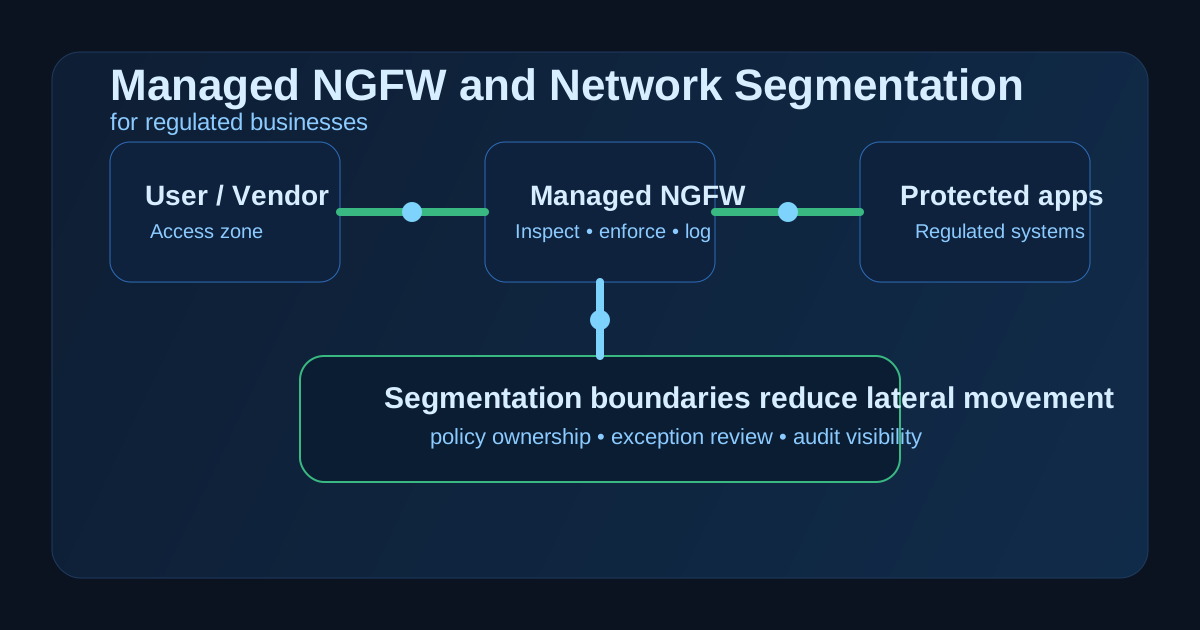
Managed NGFW and network segmentation should give a regulated business enforceable boundaries, clear policy ownership, better east-west visibility, and faster containment when something goes wrong. In practice, that means the firewall service cannot just “manage the box,” and the segmentation strategy cannot just be a diagram that never changes. We recommend treating both as one operating model: segmentation defines where sensitive systems belong, and the managed NGFW stack enforces what traffic is allowed between those zones.123
That matters because regulated organizations usually do not fail security reviews only because they lack tools. They fail because responsibility is fuzzy. A healthcare group may have strong perimeter security but weak separation around systems handling PHI. A financial-services team may collect logs but still allow broad lateral movement between user, server, and vendor-access networks. A school district may have filtering and firewall subscriptions in place, yet no consistent rule-review process or exception tracking. In our experience, the real question is not whether you bought an NGFW. It is whether your team can prove that segmentation policy, logging, and change control actually reduce risk day to day.
If your organization is reviewing options now, this article fits naturally with our managed IT services overview, our managed NGFW service page, and our broader resources and guides library.
Why do managed NGFW and segmentation belong together?
Network segmentation and NGFW policy solve different parts of the same problem. Segmentation divides the environment into security zones based on business function, data sensitivity, and operational need. The NGFW then applies inspection, policy, threat prevention, and logging at the boundaries between those zones.24 Without segmentation, the firewall often becomes a high-cost perimeter tool while internal traffic remains too flat. Without good NGFW policy, segmentation becomes a paper exercise that does not meaningfully control traffic.
We usually explain it this way:
- Segmentation decides what should be isolated
- The NGFW decides what may cross those boundaries
- Logging and review prove whether the design still matches reality
That layered model is especially important for organizations under HIPAA, PCI DSS, GLBA, CJIS, or similar oversight because auditors and insurers increasingly care about containment, privileged access, evidence, and incident response discipline, not just tool inventory.356
What should IT leaders require from a managed NGFW service?
A serious managed NGFW service should include more than firmware updates and ticket-based rule changes. We think regulated businesses should require explicit commitments in five areas.
1. Application-aware policy and threat prevention
A next-generation firewall should identify applications, users, and traffic context rather than relying only on ports and protocols. It should also provide intrusion prevention, malware detection, and ongoing signature or threat-intelligence updates.147 That is table stakes now.
The more important buying question is operational: who tunes those controls over time? If the provider enables IPS but leaves noisy signatures, outdated rules, or broad allowlists in place, the control degrades fast. We prefer managed services that define who reviews blocked traffic, how false positives are handled, and how policy tuning gets prioritized after a real incident.
2. Encrypted-traffic inspection strategy
Regulated environments cannot ignore encrypted traffic. Too much malicious activity and risky application usage now rides inside TLS. But inspection also affects privacy, performance, certificates, and application stability.7 A mature provider should explain:
- which traffic categories are inspected
- which sensitive destinations are exempted
- how certificate trust is handled
- how performance impact is monitored
- how exceptions are documented and reviewed
If the answer is basically “we can turn on SSL inspection if you want,” that is not enough.
3. Logging, retention, and incident visibility
Managed NGFW services should produce usable logs, not just raw noise. We want enough visibility to answer practical questions during an investigation: which policy allowed the traffic, which user or device initiated it, whether the flow was encrypted, and what other controls triggered around the same time.13
For regulated businesses, that also means asking how long logs are retained, whether they feed a SIEM or reporting workflow, and who owns escalation when the firewall sees something suspicious after hours. We have seen too many environments where the firewall generates alerts but no one is clearly responsible for triage.
4. Change control and policy review discipline
Firewall risk often accumulates through exceptions, not through one dramatic failure. Temporary vendor access becomes permanent. Broad “allow any” cleanup never happens. Legacy rules stay because nobody wants to break a workflow. Managed service quality shows up here.
We recommend requiring a documented cadence for:
- rule review and cleanup
- exception approvals
- stale object removal
- vendor-access expiration checks
- emergency change documentation
- quarterly policy validation against business needs
That kind of housekeeping is not glamorous, but it is where accountability lives.8
5. Clear ownership during incidents
A regulated business should know exactly what the managed firewall team will do during an incident. Will they only notify? Will they recommend containment actions? Can they disable risky access paths, isolate sites, or enforce emergency rules quickly? Who approves the change? Those answers should be clear before the first after-hours event, not discovered during it.
What should leaders require from segmentation design?
Segmentation should start with business risk, not with whatever VLAN structure happens to exist today. In practice, we want segmentation decisions tied to asset criticality, compliance scope, and operational dependency mapping.25
Start with high-value zones
Most organizations do not need perfect microsegmentation on day one. They do need stronger boundaries around the systems that would hurt most if compromised. We usually prioritize zones such as:
- identity infrastructure
- domain administration and privileged tooling
- server management networks
- backup and recovery platforms
- line-of-business systems handling regulated data
- remote-access and vendor-access paths
- user networks and guest networks
That approach supports the same discipline we recommend in our vendor-risk guidance, our third-party cyber risk checklist, and our ransomware-readiness content.
Define allowed flows, not just blocked zones
One common mistake is declaring segments without documenting what legitimate traffic should cross them. A zone diagram is useful, but a better control is a defined list of allowed flows by service, source, destination, owner, and business purpose. That is how segmentation becomes auditable and maintainable.
A strong segmentation program should answer questions like:
| Question | What should be defined |
|---|---|
| Which systems are in scope? | Asset owner, business purpose, data sensitivity |
| What traffic is allowed? | Source, destination, service, justification |
| Who approves changes? | Business owner plus IT/security reviewer |
| How are exceptions handled? | Expiration date, compensating control, review cadence |
| How is the segment validated? | Logs, test results, and periodic access review |
Protect east-west traffic, not just north-south traffic
Perimeter controls still matter, but lateral movement inside the network is where flat environments get punished. Segmentation should reduce unnecessary east-west communication and force sensitive systems to traverse inspected boundaries wherever possible.29 That is one reason we think segmentation belongs in the same conversation as managed cybersecurity services and network monitoring: resilience depends on visibility between internal systems, not just internet edges.
What mistakes create the most risk?
Most implementation failures are boring, repeatable, and avoidable.
Flat networks with “temporary” exceptions everywhere
The fastest way to weaken segmentation is to keep broad trust relationships in place because cleanup feels inconvenient. Over time, the environment becomes segmented in theory but flat in practice. When one workstation, admin credential, or vendor session is compromised, the blast radius is much larger than leadership expected.
Trying to segment without asset clarity
If the team cannot confidently identify critical systems, application dependencies, or who owns a workload, segmentation projects stall or create disruption. We think asset classification and dependency mapping should happen before large policy changes, especially in healthcare, finance, and municipal environments where legacy systems often behave unpredictably.
Buying a managed service that stops at monitoring
Some providers market “managed firewall” service as little more than alert forwarding, patching, and ad hoc rule entry. That is better than nothing, but it is not the same as policy ownership, rule hygiene, investigation support, and regular governance. Buyers should be careful not to mistake tool administration for security operations.
Over-segmentation without operational maturity
Microsegmentation can be powerful, but rolling it out too aggressively without visibility, testing, and business-owner buy-in can create outages and resistance.910 We usually prefer a staged model: secure the highest-risk boundaries first, prove value, then get more granular.
No recurring review loop
Even a good design drifts. New SaaS integrations appear. Vendors need access. An acquisition adds systems. Compliance scope changes. If nobody revalidates traffic flows and firewall rules on a schedule, the architecture slowly stops matching the business.
Why Datapath for regulated network security operations?
We think regulated businesses need more than a firewall subscription and a broad claim about “layered security.” They need an operating model that connects policy, segmentation, logging, response, and business accountability. That means knowing which systems matter most, constraining how traffic reaches them, and reviewing those decisions often enough to keep the environment honest.
Our team works with organizations that need security controls tied back to uptime, audit readiness, and practical decision-making. That is why we emphasize service clarity, network boundaries, and measurable operational follow-through across Datapath’s solutions, our IT consulting and storage services, and our industry guidance for healthcare, financial services, and K-12 environments.
FAQ: Managed NGFW and segmentation for regulated businesses
What is the main benefit of combining managed NGFW and network segmentation?
The main benefit is containment with accountability. Segmentation creates controlled boundaries around sensitive systems, and the managed NGFW enforces, inspects, and logs traffic between those boundaries so risky movement is easier to detect and restrict.
Does every regulated business need microsegmentation?
Not necessarily. Most organizations should start by segmenting high-value systems, privileged access paths, backup environments, and compliance-sensitive workloads. Microsegmentation can help later, but it should follow visibility and dependency mapping rather than replace them.
What should a managed firewall provider be able to prove?
A managed firewall provider should be able to show rule-review discipline, documented change control, meaningful logging, escalation ownership, threat-prevention tuning, and a clear process for reviewing exceptions and stale access.
How often should segmentation and firewall policy be reviewed?
We generally recommend at least quarterly review for regulated environments, plus immediate review after major application changes, acquisitions, incidents, or new vendor-access requirements.
Can segmentation help with compliance audits?
Yes. Good segmentation can make audit evidence clearer by showing where sensitive systems live, what traffic is permitted to reach them, how access is restricted, and how exceptions are documented and reviewed.235
Sources
- CDW: Next Generation Firewalls guide
- Palo Alto Networks: Network segmentation best practices for financial services
- Accountable HQ: HIPAA-compliant firewall requirements and segmentation considerations
- Fortinet: NGFW overview and policy alignment guidance
- Palo Alto Networks: What is microsegmentation?
- Zero Networks: Why microsegmentation projects fail
- Infraon: Firewall management best practices
Footnotes
-
Palo Alto Networks: Network segmentation best practices for financial services ↩ ↩2 ↩3 ↩4 ↩5
-
Accountable HQ: HIPAA-compliant firewall requirements and segmentation considerations ↩ ↩2 ↩3 ↩4
-
Cisco Learning Network: Why businesses require next-generation firewalls ↩
-
Firewalls.com: HIPAA compliance automation and NGFW capabilities ↩ ↩2
