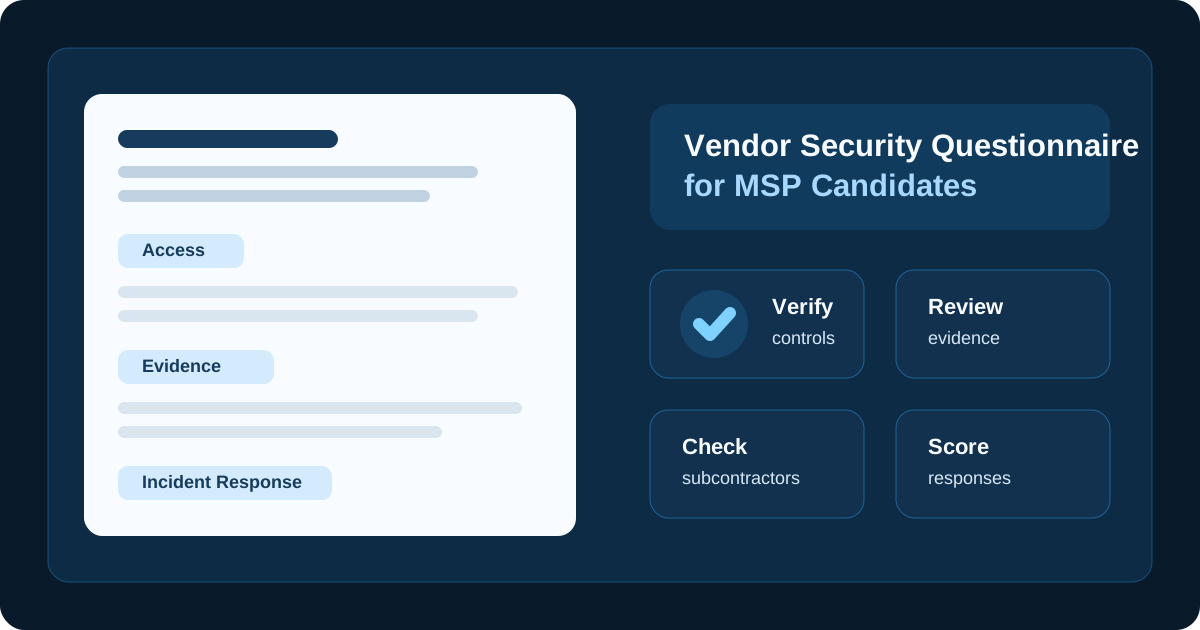

How should you run a vendor security questionnaire for MSP candidates?
You should run a vendor security questionnaire for MSP candidates after shortlisting providers but before signing, then review the answers for specificity, supporting evidence, subcontractor exposure, and operational accountability. The questionnaire should not be treated like a generic procurement form. It should work as a practical screen for whether the MSP can safely hold privileged access, support your recovery requirements, and operate with enough discipline for your environment.12
That matters because most MSP risk does not show up in the sales deck. It shows up later in technician access, undocumented subcontractors, weak incident escalation, vague backup ownership, and hand-wavy claims about compliance. If your business is comparing providers now, this is one of the best points in the process to separate polished language from real operating maturity.
At Datapath, we think a vendor questionnaire should help buyers make a more defensible decision, not just collect paperwork. If your team is already comparing managed IT services, using our MSP evaluation guide, or reviewing a broader vendor risk questionnaire for managed IT providers, this article shows how to run the actual review process.
Why does an MSP vendor security questionnaire matter so much?
An MSP vendor security questionnaire matters because a managed IT provider often receives access that ordinary vendors never get. The provider may be able to administer Microsoft 365, remote monitoring tools, endpoint agents, firewalls, backups, identity systems, and third-party support paths. That makes the MSP part of your security model, not just your support stack.23
A structured questionnaire helps your team do three things early:
- identify control gaps before contracts are signed
- create due-diligence evidence for internal leadership, auditors, or insurers
- compare multiple MSPs against the same operating standard instead of against competing sales language12
We think that consistency matters more than many buyers realize. Without it, the loudest vendor often sounds like the safest vendor.
When should you send the questionnaire?
The best time to send a vendor security questionnaire is after you have narrowed the field to serious MSP candidates but before legal and contract terms are finalized.1 At that stage, the vendor is motivated to answer clearly, and your team still has leverage to push on weak responses or ask for evidence.
In practice, we recommend three checkpoints:
1. Shortlist stage
Send the questionnaire once the provider has passed the initial fit screen on geography, support model, industry fit, and budget. Do not send the full security review to every vendor on day one.
2. Final diligence before signature
Use the answers to shape contract language, security addenda, scope boundaries, and escalation expectations before the agreement is executed.
3. Periodic re-review for strategic vendors
If the MSP becomes a long-term or high-trust partner, the questionnaire should return during annual review, material scope change, or platform expansion.2
That approach keeps security review tied to actual vendor risk rather than to one one-time procurement event.
How should you structure the questionnaire process?
The cleanest process is to treat the questionnaire as a small operating workflow rather than a single document.
Step 1: Tier the MSP by risk before asking questions
Not every vendor needs the same depth of review. An MSP candidate with administrative access to production systems should be reviewed more aggressively than a provider offering a narrow advisory service. A simple risk tier helps:
| Risk tier | Typical MSP access | Review depth |
|---|---|---|
| High | Admin access, backup authority, security tooling, identity, production cloud systems | Full questionnaire, evidence review, deeper validation |
| Medium | Support access to users, endpoints, or limited systems | Full questionnaire with selective evidence checks |
| Low | Limited advisory or scoped project role | Abbreviated review with core security controls |
This keeps the process practical while still focusing attention where the blast radius is highest.12
Step 2: Ask grouped questions, not a random list
Responses are easier to compare when the questionnaire is organized into sections. We recommend grouping questions into:
- company profile and support model
- privileged access and identity controls
- incident response and business continuity
- data protection and retention
- compliance evidence and audit posture
- subcontractors and fourth-party risk
- service scope, SLAs, and after-hours ownership24
A grouped structure also helps you spot where a provider is strong in one area but evasive in another.
Step 3: Require evidence for important claims
The questionnaire should not stop at yes-or-no answers. For critical controls, ask for proof such as:
- SOC 2 Type II or ISO 27001 documentation, where applicable
- penetration test summaries
- incident response plan excerpts
- business continuity or disaster recovery summaries
- sample reporting or ticket escalation workflows
- examples of access review or privileged-account governance2
Strong providers usually answer with specifics. Weak ones often answer with slogans.
Step 4: Score answers for substance, not confidence
We recommend scoring each section based on:
- clarity
- completeness
- evidence provided
- fit for your environment
- unresolved risk
That prevents the review from turning into a subjective conversation about who sounded the most polished on a call.
What questions should your MSP security questionnaire include?
A useful questionnaire should focus on how the provider actually operates, not just what tools it owns.
Access control and administrative discipline
Ask:
- How is privileged technician access approved, logged, and reviewed?
- Is MFA required for all admin workflows?
- How are remote monitoring and management tools protected?
- Are shared admin credentials prohibited or tightly controlled?
- How quickly is access revoked when an engineer changes roles or leaves?23
This is usually the most important section because MSP-related incidents often become dangerous through privileged access paths.
Incident response and recovery readiness
Ask:
- Do you maintain a documented incident response plan?
- Who owns notification and escalation if a client-impacting event occurs?
- How do you distinguish a service outage from a security incident?
- Do you maintain business continuity and disaster recovery plans for your own operations?
- How often are those plans tested?24
An MSP that cannot explain its own recovery model clearly will usually struggle when your environment is under pressure.
Data handling and security controls
Ask:
- How is customer data encrypted in transit and at rest?
- How is customer data segmented from other tenants or client environments?
- What logging and monitoring controls protect administrative activity?
- What is your retention and destruction process for customer data?
- How are endpoint, firewall, email, and cloud security responsibilities divided across your stack?25
This is where a lot of vague “we take security seriously” claims should become operational detail.
Compliance and audit evidence
Ask:
- Which regulatory or audit-heavy environments do you already support?
- What documentation can you share for HIPAA, GLBA, CJIS, CMMC, or similar controls if relevant to our environment?
- Can you provide audit reports, attestations, or policy summaries?
- How is security awareness training handled internally?
- Who owns compliance-related evidence requests during a client review?23
For regulated organizations, the key question is rarely just whether the provider says it supports compliance. The real question is whether the provider can prove it operates in a way that helps your team stay defensible.
Subcontractors and fourth-party dependencies
Ask:
- Do you outsource any portion of support, SOC functions, NOC coverage, or field services?
- Are subcontractors domestic, offshore, or mixed?
- How do you review and monitor your own vendors?
- Do subcontractors have access to customer systems or data?
- Are subcontractors held to the same standards promised in your client agreements?2
This section matters because some of the most important risk is invisible unless you ask directly.
Scope, SLAs, and after-hours ownership
Ask:
- What is included in recurring service and what is out of scope?
- What does after-hours support actually cover?
- How are escalation targets defined for outages and security events?
- Who owns backup monitoring, restore validation, and vendor coordination?
- How are recurring problems tracked and escalated to leadership?
This section connects security review to real operating accountability. It also pairs well with related reviews like MSP SLA metrics and managed IT scope statements.
How do you evaluate the answers once they come back?
The review only becomes useful when your team reads the answers skeptically.
Look for specificity
A strong response usually names controls, people, evidence, or recurring workflows. A weak response says things like “best practice,” “security-first,” or “industry standard” without showing how the work is actually done.
Look for consistency
If the questionnaire says one thing, the sales team says another, and the contract says something softer, trust the inconsistency. It usually means the operating model is not as mature as the pitch.
Look for evidence
The highest-value controls should come with proof. That may be a report, an excerpt, a process description, or a tested example. Confidence without evidence is not due diligence.2
Look for your environment, not a generic environment
A provider may answer well in general and still not be the right fit for healthcare, finance, municipalities, school districts, or multi-site operations. Make sure the answers reflect your actual support, risk, and escalation needs.
What are the most common mistakes buyers make?
We see the same problems repeat in MSP evaluations:
- sending the questionnaire too early to too many vendors
- asking generic questions that do not test real operations
- accepting yes-or-no answers without requesting proof
- ignoring subcontractor and fourth-party exposure
- separating the security review from the contract scope review
- failing to document which answers were accepted, rejected, or escalated
The biggest mistake is treating the questionnaire as a checkbox instead of as part of the selection decision.
Why Datapath recommends this process
We think managed IT selection should reduce ambiguity, not introduce it. The right questionnaire process helps buyers compare providers on security controls, escalation clarity, recovery readiness, and evidence maturity before the relationship becomes hard to unwind.
That is especially important for teams that cannot afford confusion around uptime, compliance, or privileged access. If your organization wants a cleaner MSP review process, we recommend pairing this checklist approach with our vendor risk questionnaire guidance, MSP comparison resources, and broader Datapath managed services overview.
FAQ: vendor security questionnaire for MSP candidates
What is a vendor security questionnaire for MSP candidates?
A vendor security questionnaire for MSP candidates is a structured due-diligence document used to evaluate how a prospective managed IT provider handles privileged access, incident response, data protection, subcontractors, compliance evidence, and service accountability before a contract is signed.
When should you send an MSP security questionnaire?
You should usually send it after shortlisting serious providers but before signing the contract, when the vendor is motivated to answer clearly and your team still has leverage to push on weak responses.1
What matters more: the answers or the evidence?
The evidence matters more. Strong answers should be backed by reports, policy summaries, examples, or tested workflows rather than by generic assurances.2
Should regulated businesses use a different questionnaire?
Regulated businesses should usually expand the questionnaire to cover framework-specific evidence, documented controls, user access governance, incident responsibilities, and audit support expectations for their environment.
Sources
Footnotes
-
Vendor Security Assessment Questionnaire: A Guide for MSPs | MSP Pentesting ↩ ↩2 ↩3 ↩4 ↩5
-
Vendor Security Questionnaire (VRAQ) Best Practices - Safe Security ↩ ↩2 ↩3 ↩4 ↩5 ↩6 ↩7 ↩8 ↩9 ↩10 ↩11 ↩12 ↩13 ↩14
-
Completing a Vendor Risk Management Questionnaire | SecurityScorecard ↩ ↩2 ↩3
-
Vendor risk assessment questionnaire: A complete guide | Optro ↩ ↩2
-
10 Essential Security Questions for Vendor Review | Cloud Security Alliance ↩