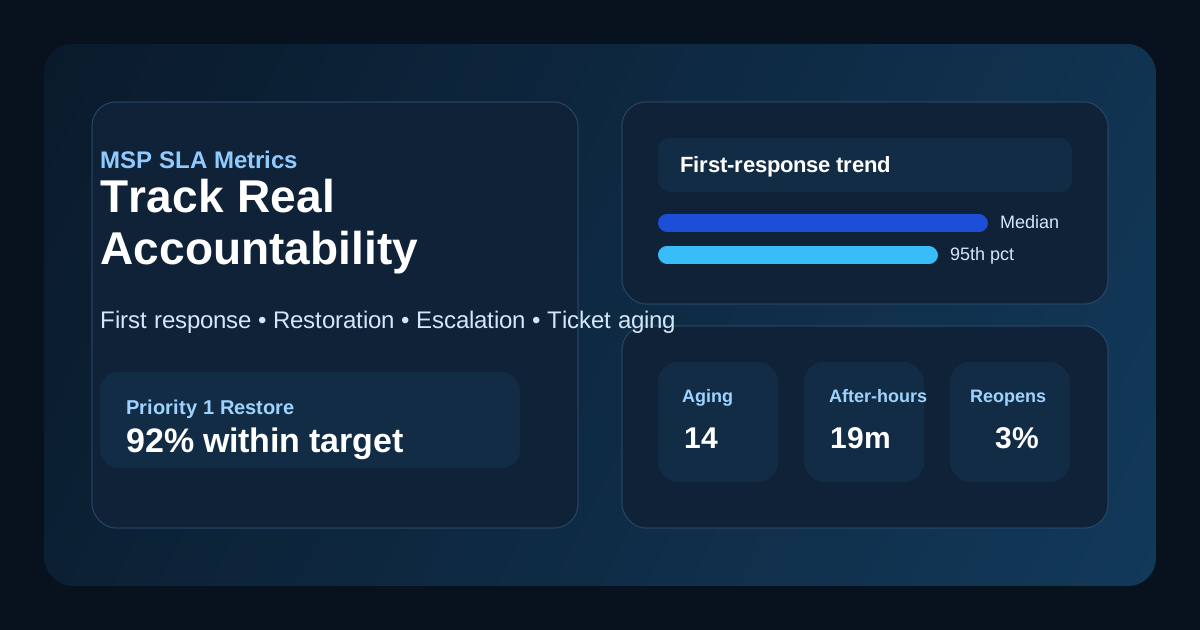

Which MSP SLA metrics actually prove accountability?
The MSP SLA metrics that actually prove accountability are the ones that show how quickly your provider acknowledges issues, restores service, communicates during escalation, resolves root causes, and performs after hours. A single “15-minute response SLA” is not enough. If you want real accountability, you need a small scorecard that measures response quality, restoration speed, ticket health, and repeat-issue prevention together.123
In our experience, companies get into trouble when they buy a managed services agreement based on one attractive promise and never define what success should look like once the contract starts. A provider can technically meet an acknowledgment target while still letting business-critical issues linger, bouncing tickets between engineers, or failing to communicate clearly during an outage. That is why we recommend treating SLAs as an operating system for accountability, not a marketing bullet.
If your team is already comparing providers, this question belongs next to a broader MSP evaluation framework, your expected managed IT services scope, and your long-term vCIO planning model.
Why is one headline SLA number not enough?
A lot of MSP proposals lead with a single metric: usually response time. That metric matters, but it only tells you that someone noticed the issue. It does not tell you whether the provider restored service quickly, escalated correctly, communicated to stakeholders, or prevented the same problem from happening again. NIST incident-handling guidance emphasizes the importance of triage, containment, recovery, and lessons learned, not just initial acknowledgment.1 That same logic applies to managed services performance.
A fast first touch can hide a slow recovery
We have seen support organizations respond to a Priority 1 ticket in under 15 minutes, then take hours to assign the right engineer or involve the right vendor. From the customer side, that does not feel accountable. It feels like the stopwatch started and stopped on the wrong event.
That is why your scorecard should separate:
- first response time
- time to begin meaningful work
- time to restore service
- time to permanent resolution
Those are four different operational moments, and combining them into one “SLA met” label hides a lot of risk.
Business impact matters more than ticket volume
CISA and NIST both frame incident handling around impact, prioritization, and recovery.12 Your MSP should do the same. A password reset and a multi-site outage should never be measured with the same expectations. We recommend defining service levels by business impact tier, such as:
| Priority | Typical example | Metric emphasis |
|---|---|---|
| P1 | Site outage, security incident, line-of-business failure | response, restoration, escalation, communications |
| P2 | Department workflow disruption | response, work start, workaround speed |
| P3 | standard support issue | response, aging, backlog control |
| P4 | request / low urgency task | completion window, communication quality |
Accountability requires trend visibility
A provider may hit monthly SLA targets while still delivering a frustrating support experience. Why? Because averages can hide clusters of bad performance. We prefer to review not just average results, but also:
- percentage of tickets breaching thresholds
- oldest open tickets by age
- repeat incidents by system or site
- after-hours incidents and their handling quality
- escalation paths that were triggered late or not at all
That level of visibility is what turns a managed service relationship into something you can actually govern.
Which MSP SLA metrics should you track every month?
If a client asked us to keep the scorecard simple, we would start with six core metrics and then add one or two environment-specific measures.
1. First-response time by priority
This is still the right opening metric because it shows whether the service desk is actually watching the queue and treating high-impact issues differently. Review it by priority, not as one blended average. A 10-minute average can look great while hiding slow responses on P1 tickets.
What to ask for:
- median and 95th percentile response time by priority
- business-hours versus after-hours performance
- human acknowledgment versus automated reply separation
2. Time to restore service
For most customers, this is the most important metric. When operations are impaired, the question is not just “Did someone reply?” It is “How long until people can work again?” Microsoft, cloud, and infrastructure vendors all distinguish between response and restoration for a reason.3
We recommend measuring:
- median restoration time by incident type
- restoration time for P1 and P2 incidents
- percentage of critical incidents restored within target
- longest restoration events of the month with cause notes
3. Ticket aging and backlog health
Ticket aging tells you whether lower-priority work is being managed or quietly ignored. A provider can look responsive while allowing maintenance, recurring bugs, permissions cleanups, and infrastructure follow-up tasks to pile up. That backlog eventually becomes an outage or a security issue.
Useful aging bands include:
- open more than 7 days
- open more than 14 days
- open more than 30 days
- customer waiting versus provider waiting
If those numbers trend in the wrong direction, your MSP is losing control of execution capacity.
4. Escalation compliance
Escalation performance is where accountability often breaks down. Critical tickets should move predictably from service desk intake to the correct engineer, vendor, or leadership contact. If your provider says they escalate fast, make them show it.
Track:
- percentage of P1 and P2 issues escalated within target
- time from intake to engineering assignment
- time from engineering assignment to stakeholder update
- number of tickets reopened after premature closure
This is especially important for regulated businesses, where communication, approvals, and documented decision-making matter just as much as technical effort.
5. After-hours responsiveness
Many MSPs advertise 24/7 support, but what customers often get is very different: an answering service, a weak on-call path, or delayed overnight action unless the issue is catastrophic. If your business depends on after-hours coverage, make it measurable.
Review:
- first response time after hours
- time to restore after hours
- number of overnight incidents requiring customer chase-ups
- whether notifications and updates followed the expected cadence
If you are actively comparing providers, this pairs well with our guide on how to validate managed service responsiveness after hours.
6. Repeat incidents and root-cause follow-through
Real accountability means the provider helps reduce recurring pain, not just clear the board every week. If the same firewall alert, VPN issue, endpoint instability, or Microsoft 365 permissions problem keeps returning, ticket closure alone is not a win.
A practical monthly review should include:
- top recurring incident categories
- repeat incidents by user, site, or system
- documented root-cause actions completed
- known problems still awaiting permanent remediation
That is where managed support starts looking like strategic IT management instead of a glorified help desk.
How should you use MSP SLA metrics in quarterly reviews?
Metrics help most when they drive decisions, not just dashboards. We recommend using your quarterly review to connect SLA results to business outcomes, service adjustments, and roadmap priorities.
Compare metrics to business-critical expectations
Start by asking whether the current SLA targets match the business you are actually running today. A company with one office and limited compliance exposure may tolerate slower restoration on certain categories. A multi-site finance, healthcare, or public-sector organization usually cannot.
Questions worth asking every quarter:
- Which incidents created the most operational disruption?
- Were the SLA targets themselves strong enough?
- Which systems generate the most repeat tickets?
- Did communication quality hold up during stressful events?
- Does after-hours coverage match what we are paying for?
Tie recurring misses to corrective actions
When a provider misses the same target repeatedly, there should be a named correction plan. That might mean better documentation, automation, vendor management, device replacement planning, security hardening, or a contract adjustment around coverage expectations.
We like review meetings that end with a short action register:
| Problem trend | Evidence | Agreed action |
|---|---|---|
| Slow P1 restoration | 3 incidents exceeded target | revise escalation and on-call path |
| High ticket aging | 14 tickets open over 30 days | add monthly backlog burn-down review |
| Repeat identity issues | same access incidents across sites | standardize Entra ID and role review |
| Weak overnight updates | customer had to chase status twice | define update cadence in SLA addendum |
Do not let averages hide executive risk
A provider may present a monthly score of 98% SLA compliance and still fail where it matters most. Look at the exceptions. One ugly outage, one missed escalation, or one poorly handled security event often matters more than a hundred routine tickets. That is why we recommend pairing dashboards with short narrative reviews of the month’s highest-impact incidents.
Why Datapath treats SLA reporting as an accountability tool, not a vanity report
We think SLA reporting should help leadership answer simple questions: are issues being seen quickly, restored fast enough, communicated clearly, and prevented from repeating? If the report cannot answer those questions, it is probably measuring the wrong things.
That is how we approach managed IT at Datapath. We align service metrics to business impact, regulated-environment expectations, and practical operating risk. We also connect SLA reviews to broader planning, including managed IT service accountability, co-managed service model decisions, and roadmap planning through our vCIO services approach.
Why Datapath for MSP accountability and SLA design
We help organizations turn vague support promises into measurable standards that leadership can actually manage. That includes defining priority tiers, agreeing on restoration targets, tightening escalation paths, reviewing recurring-issue data, and building reporting that reflects business risk rather than vanity averages.
If your current provider reports activity without proving accountability, or if you are evaluating a new MSP and want the SLA language to be harder to game, we can help.
Frequently asked questions about MSP SLA metrics
What is the most important MSP SLA metric?
For most businesses, time to restore service is the most important MSP SLA metric because it reflects how long operations are actually impaired. First-response time still matters, but restoration time tells you whether the provider is solving the problem fast enough to protect uptime and productivity.
Should MSPs report average response time or percentile performance?
They should report both, but percentile performance is usually more useful. Averages can hide outliers and make support look more consistent than it really is. Reviewing median and 95th percentile response times gives a better picture of the customer experience.
How often should SLA metrics be reviewed?
We recommend reviewing core MSP SLA metrics monthly and discussing trend-level changes quarterly. Monthly reviews catch operational drift early, while quarterly reviews are better for adjusting coverage, budget, escalation design, and roadmap priorities.
What is the difference between response time and resolution time?
Response time measures how quickly the provider acknowledges a ticket. Resolution time or restoration time measures how long it takes to fix the issue or return service to a usable state. Both matter, but they answer different questions.
How can you tell if an MSP is gaming its SLA numbers?
Watch for heavy use of automated acknowledgments, vague priority definitions, blended averages, missing restoration metrics, and weak commentary on breached tickets. If the report highlights volume and closure counts but avoids backlog age, repeat incidents, and escalation quality, the scorecard is probably being softened.
Sources
Footnotes
-
NIST. Computer Security Incident Handling Guide (SP 800-61 Rev. 2). https://csrc.nist.gov/pubs/sp/800/61/r2/final ↩ ↩2 ↩3
-
CISA. Incident Response Playbook. https://www.cisa.gov/resources-tools/resources/incident-response-playbook ↩ ↩2
-
Microsoft. Understand service level agreements and service credits. https://learn.microsoft.com/en-us/partner-center/customers/subscription-lifecycle-design#understand-service-level-agreements-and-service-credits ↩ ↩2
