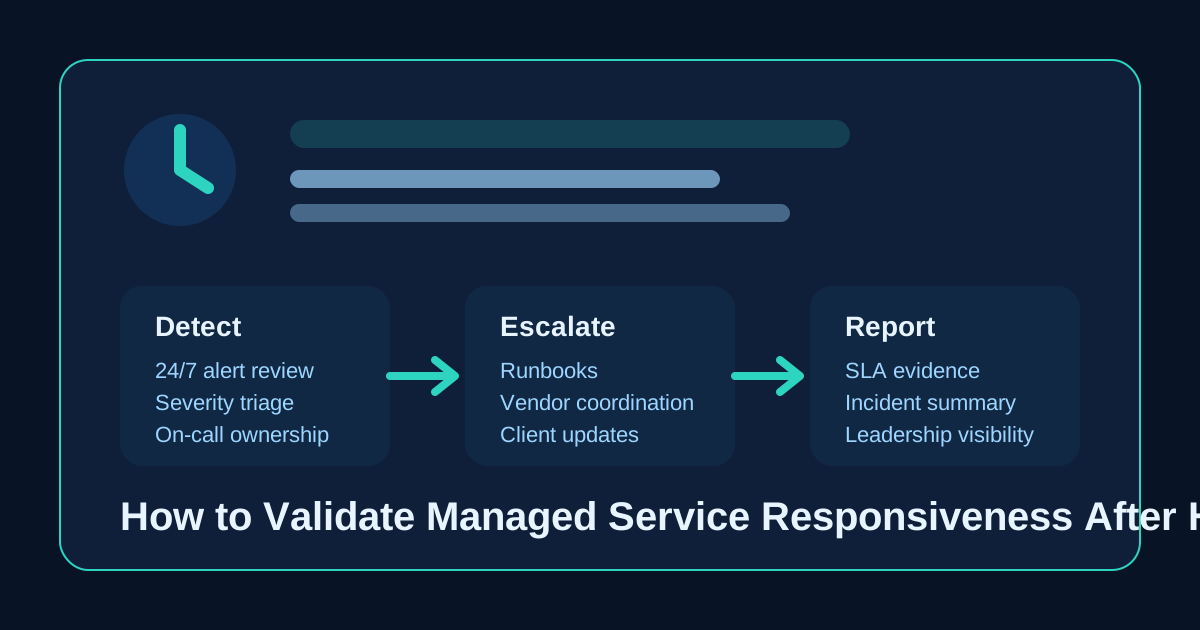

How do you validate managed service responsiveness after hours?
To validate managed service responsiveness after hours, ask the provider to prove five things: who is on call, what qualifies as a high-severity event, how escalation works, what communication standards apply overnight and on weekends, and what evidence exists from real incidents or drills.123 If a provider cannot explain those points clearly, you are not validating responsiveness. You are just trusting marketing.
That distinction matters because a lot of buyers hear phrases like 24/7 support, always available, or rapid response and assume the operating model behind those phrases is mature. Sometimes it is. Often it is not. After-hours responsiveness is less about a slogan and more about whether the provider has named ownership, documented procedures, real staffing, and a habit of communicating clearly when systems are down or risk is rising.
We think the best way to test after-hours support is to treat it like any other operational risk. Ask what happens at 9:30 PM on a Friday when a file server fails, a Microsoft 365 admin account is compromised, or a clinic cannot access a critical application. The quality of the answer will tell you much more than a generic promise about responsiveness.
Why does after-hours responsiveness matter so much?
After-hours support becomes important when downtime, security incidents, or user-impacting outages do not wait for Monday morning. That includes ransomware events, internet outages, failed backups, identity lockouts, firewall problems, cloud-service disruptions, and critical application failures. In those situations, leadership does not just need someone to eventually notice the issue. Leadership needs confidence that someone owns triage, containment, updates, and decision support right away.24
For growing companies and regulated environments, the impact is usually wider than one broken system. After-hours failures can affect customer commitments, payroll timing, regulated data access, remote teams, production schedules, and executive confidence. That is why we recommend evaluating responsiveness as an operating discipline, not a convenience feature.
This also connects to other Datapath topics like What Does a Managed IT Contract SLA Usually Include?, What KPIs Prove Managed IT Is Reducing Downtime?, and How to Build a 30-60-90 Day MSP Onboarding Plan. If after-hours expectations are vague, the relationship usually gets shaky elsewhere too.
What should a provider be able to prove about after-hours coverage?
A serious provider should be able to show more than a help desk phone number. Buyers should expect evidence that the overnight model is real, staffed, and tied to documented decisions.
1. Named on-call ownership
The first question is simple: who is actually responsible when an alert or outage happens after hours? That does not require personal phone numbers, but it does require a clear operating answer. A mature provider should be able to explain:
- whether they use internal on-call staff, an outsourced NOC, or a blended model
- which event types trigger immediate human review
- how incidents are handed off across shifts
- who owns escalation if the first responder cannot resolve the issue
- how client stakeholders are contacted during a critical event
If the answer sounds like “someone monitors that” without naming the workflow, that is a warning sign. Real after-hours coverage has ownership, not vague reassurance.
2. Severity definitions that mean something
A provider should define what counts as Sev1, Sev2, and lower-priority work. Otherwise, every conversation about response times becomes slippery. A total internet outage for a multi-site office is not the same as a single printer issue. A privileged-account compromise is not the same as a low-risk endpoint alert.
Ask for the severity model in plain language. Buyers should understand:
- which incidents trigger immediate response
- which issues can wait until business hours
- what clock starts the response timer
- whether acknowledgement and active remediation are treated differently
- when executive or client leadership is pulled in
This matters because some providers advertise aggressive response times that only apply to acknowledgement, not meaningful action. That may still be useful, but it is not the same thing as responsive incident handling.
3. Escalation paths that survive real stress
After-hours support breaks down when everyone assumes someone else owns the next step. A good MSP should be able to map the escalation path from detection through containment, communication, vendor coordination, and resolution management.13
We recommend asking the provider to walk through one realistic scenario, such as:
- Microsoft 365 outage with conditional access failures
- line-of-business app unavailable before a weekend deadline
- failed overnight backup for a critical system
- ransomware alert on a privileged account
- firewall outage affecting remote workers or multiple sites
The point is not to test theatrical confidence. The point is to see whether the provider can explain the chain of ownership under pressure.
What evidence should buyers ask for?
Promises about responsiveness are cheap. Evidence is harder to fake.
Ask for sample incident communications
A strong provider should be able to show anonymized examples of how they communicate during urgent issues. That might include initial notification, status updates, business-impact summaries, and closure notes. Review those examples for three things:
- clarity about what happened
- clarity about what is being done now
- clarity about what the client should expect next
If the communication is vague, inconsistent, or overloaded with jargon, that problem will probably get worse during a real incident.
Ask for reporting on after-hours activity
If overnight coverage exists, it should leave evidence. Ask whether the provider reports on:
- number of after-hours incidents by severity
- average acknowledgement and response times
- containment timing for security events
- repeated alerts or recurring failure patterns
- open exceptions that were discovered overnight
That reporting matters because leadership needs to know whether the after-hours model is reducing risk or just generating noise. Trends are often more revealing than a single anecdote.
Ask how they test the process
Not every provider runs formal exercises, but mature teams usually have some way to test escalation, handoffs, or incident response readiness.45 Ask how they verify that after-hours contacts are current, that paging works, that runbooks are usable, and that major incidents can move beyond acknowledgement into coordinated action.
A provider does not need to be theatrical about it. They do need to show that the overnight model is maintained instead of assumed.
Which SLA details matter most after hours?
A lot of managed service contracts sound strong at a high level and then get fuzzy in the details. We recommend paying close attention to the operational language around after-hours support.
| SLA area | What to verify | Why it matters |
|---|---|---|
| Coverage window | Exact business-hours vs after-hours coverage | Prevents assumptions about nights, weekends, and holidays |
| Response promise | Whether this means acknowledgement, triage, or active work | Avoids false confidence |
| Included incident types | What is covered automatically vs billed separately | Prevents surprise exclusions |
| Escalation rules | Who gets involved at each severity level | Reduces handoff confusion |
| Communication cadence | How often updates are sent during a live event | Sets expectations under stress |
| Vendor coordination | Whether the MSP works third-party tickets after hours | Matters when ISP, cloud, or software vendors are involved |
| Closure and follow-up | Whether incidents produce notes, RCA, or remediation actions | Improves accountability over time |
One of the most common traps is assuming that 24/7 monitoring means 24/7 response. Monitoring may simply mean alerts are generated at all hours. It does not automatically mean an engineer is actively driving containment, coordinating vendors, and updating your leadership team overnight.
How can buyers pressure-test a provider before signing?
The easiest way to validate after-hours responsiveness is to ask harder questions before the contract is signed.
Useful questions to ask
- What happens after hours during a high-severity outage?
- Which incident types trigger immediate human response?
- Who owns communication to our team overnight?
- What gets escalated to our leadership team vs handled operationally?
- How do you distinguish acknowledgement from active remediation?
- Can you show anonymized examples of overnight incident updates?
- What parts of after-hours response are included, and what is billable extra?
- How do you coordinate with Microsoft, internet providers, or line-of-business vendors during a live event?
- How do you review recurring overnight incidents so they stop repeating?
These questions are useful because they force the provider to describe the operating model, not just the sales promise.
Watch for vague or evasive answers
We would be cautious if the provider:
- leans on general phrases like “we are always here for you”
- cannot explain severity tiers clearly
- cannot distinguish alerting from action
- has no sample communications or reporting
- avoids discussing exclusions, staffing model, or holidays
- treats overnight incidents as an exception instead of a designed workflow
That does not automatically mean the provider is weak. It does mean the buyer is not yet seeing enough evidence to trust the model.
How should leadership think about after-hours responsiveness strategically?
Leadership should not buy after-hours coverage just to feel safer. It should buy it because certain business systems, security risks, or customer commitments justify a faster and more disciplined response model. For some organizations, that means full 24/7 operational coverage. For others, it means structured emergency escalation with clear boundaries.
The right model depends on business impact. A company with a simple daytime office workflow may need less overnight involvement than a healthcare organization, a multi-site team, or a business with customer-facing systems and strict uptime expectations. The important thing is that the support model matches the real cost of delay.
That is one reason we encourage clients to connect after-hours expectations to broader operating decisions around managed firewall services, co-managed IT services, business continuity planning, and the broader Datapath resources and guides hub. Overnight support only works well when scope, ownership, communications, and risk priorities are aligned.
Why Datapath for after-hours managed service evaluation?
We think buyers should expect more than a broad promise of responsiveness. A managed service provider should be able to explain exactly how it handles urgent issues after hours, what evidence supports the process, and how leadership will stay informed during a real event.
At Datapath, we focus on making IT accountability clearer, especially when stress is highest. If your team is comparing providers, tightening SLA language, or trying to decide what level of after-hours support your business actually needs, start with the Datapath homepage, review our services overview, explore our IT consulting and storage services, or talk with our team about building an operating model that holds up outside normal business hours.
Frequently Asked Questions
What does after-hours responsiveness usually mean in managed IT?
After-hours responsiveness usually means the provider has a documented way to detect, triage, escalate, and communicate about urgent incidents during nights, weekends, or holidays. The important detail is whether that means active human response or just monitoring and acknowledgement.
Is 24/7 monitoring the same as 24/7 incident response?
No. Monitoring means alerts may be generated or reviewed at all hours. Incident response means someone owns triage, action, communication, and escalation when an event needs immediate handling.
What proof should we ask for before trusting an MSP’s overnight support?
Ask for severity definitions, escalation workflows, anonymized incident communications, after-hours reporting, and examples of how the provider coordinates vendors or containment during real incidents.
How do we know whether after-hours coverage is worth paying for?
It is usually worth paying for when downtime, security events, or operational failures create meaningful business risk outside normal business hours. The decision should be tied to business impact, not just fear.
Sources
- ACT: 5 Signs Your Business Could Benefit from a vCIO
- BMC: What Is an Incident Response Plan?
- IBM: Incident Response Services
- CISA: Cybersecurity Incident & Vulnerability Response Playbooks
- NIST Computer Security Incident Handling Guide
