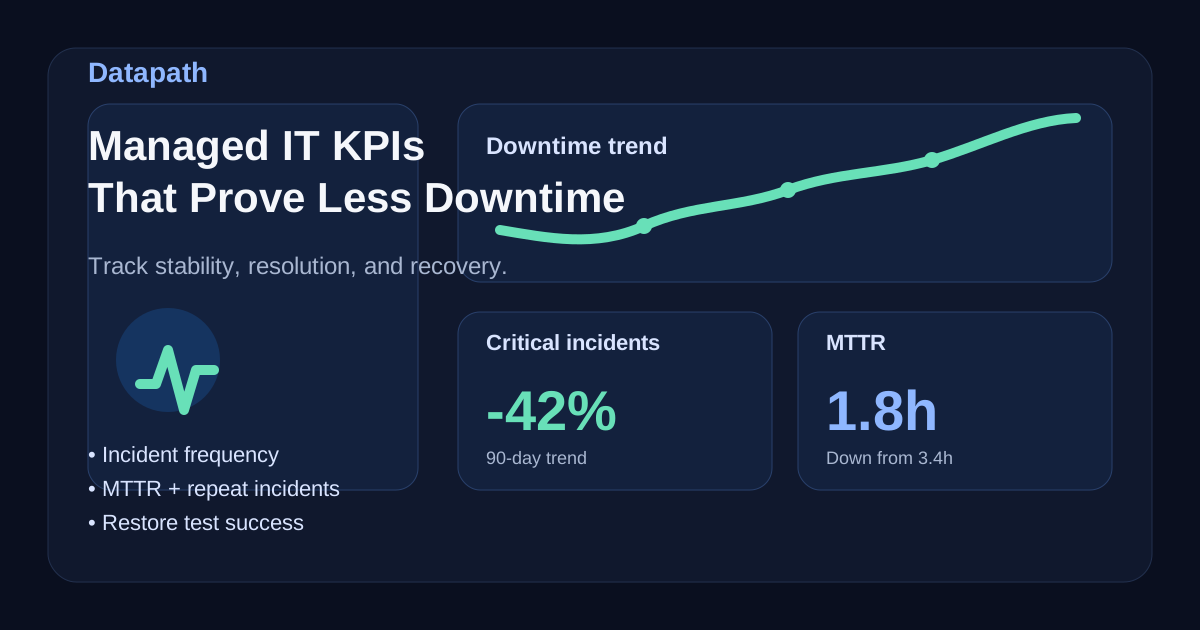

What KPIs prove managed IT is reducing downtime?
The KPIs that best prove managed IT is reducing downtime are the ones that show whether systems are staying available, incidents are happening less often, issues are resolved faster, and repeat failures are being removed instead of merely worked around. In practice, we recommend tracking service availability, incident frequency, mean time to resolve, repeat-incident rate, mean time to detect, and backup or recovery test performance as a core scorecard.123
We do not think a single metric tells the whole story. A provider can post a decent ticket-close time while still allowing recurring outages to continue. Another provider can claim excellent uptime while excluding partial service disruption, slow response, or repeated user-impacting failures from the report. If leadership wants proof that managed IT is doing its job, the KPI set needs to measure both stability and operating discipline.
That is the bigger point. Managed IT should not only make the helpdesk feel busy. It should create an environment where users lose less time, critical systems fail less often, and the business gets clearer visibility into risk, escalation, and recovery readiness.
Why is uptime alone not enough?
Uptime is useful, but it is incomplete.
A provider can say an environment was up 99.9% of the month and still leave users dealing with major friction. Microsoft 365 slowness, VPN instability, wireless failures, print-server problems, identity lockouts, or line-of-business application incidents may not always show up cleanly inside a high-level availability percentage. That is why uptime should be treated as a top-line indicator, not the entire argument.
We prefer a more operational view. If managed IT is truly reducing downtime, you should see improvement in three areas at the same time:
- fewer incidents affecting users and systems
- faster containment and resolution when something breaks
- less recurrence of the same issue after remediation
If those three trends are not visible, a polished uptime number may just be hiding noise.
Which KPI should leadership review first?
The first KPI we usually review is incident frequency by severity.
That means asking a simple question: How many events actually disrupted business operations this month, and how serious were they? A healthy managed IT program should gradually push down the number of high-impact incidents, especially the avoidable ones caused by patching drift, aging hardware, poor alerting, inconsistent backups, or unmanaged vendor dependencies.24
We recommend grouping incident counts into categories such as:
- critical outages
- high-priority service disruptions
- site-specific interruptions
- recurring user-impact incidents
- security-related interruptions
This matters because raw ticket volume is often misleading. More tickets can simply mean users are reporting minor requests more consistently. What leadership actually needs to know is whether the incidents that interrupt work are becoming less common.
What uptime metric should an MSP report?
A managed IT provider should report service availability for the systems that actually matter to the business, not just a generic environment-wide average.
For example, a more useful scorecard might include:
- core internet or WAN availability
- Microsoft 365 or collaboration service health impact
- server or application availability for business-critical systems
- backup success rate for protected workloads
- endpoint compliance for patch or monitoring coverage
We also like to see uptime reported alongside context:
- what counted as downtime
- which systems were included or excluded
- whether planned maintenance was separated from unplanned outages
- whether partial degradation was tracked
The National Institute of Standards and Technology and other operations frameworks consistently push organizations toward measurable resilience and recovery outcomes rather than vague service claims.15 That is the right instinct here too. A KPI is only valuable if the business can tell what it actually means.
How does mean time to resolve help prove downtime reduction?
Mean time to resolve (MTTR) is one of the clearest indicators of operational maturity.
If managed IT is working, the average time to restore service after an incident should trend down over time, especially for recurring categories like workstation failures, network interruptions, identity problems, printer outages, and common line-of-business application incidents. Lower MTTR means the provider is not only answering the phone. It usually means they have better alerting, better documentation, cleaner escalation, and better ownership.
Still, MTTR should never be reviewed in isolation. A provider can improve MTTR by closing only easy tickets quickly while difficult recurring failures continue to hit the same departments. That is why we pair MTTR with:
- incident frequency
- repeat-incident rate
- escalation aging
- first-response time for high-severity issues
When those metrics improve together, the case becomes much stronger.
What is the repeat-incident rate, and why does it matter so much?
We think repeat-incident rate is one of the most underrated managed IT KPIs.
A repeat incident is a failure pattern that returns after the issue was supposedly resolved. Examples include the same wireless dead zone, recurring VPN disconnects, repeated server-storage alerts, the same user group losing access after every sync job, or identical Microsoft 365 security exceptions appearing every month.
A provider that is genuinely reducing downtime should drive repeat incidents down. If they do not, then the business may be paying for symptom treatment instead of root-cause removal.
This is where managed IT becomes different from reactive support. A reactive provider restores service and moves on. A stronger provider documents the pattern, isolates the cause, changes the configuration, replaces the unstable component, or updates the process so the same failure stops draining user time.
We usually advise leadership to ask for:
- top recurring incident categories
- recurrence count over the last 90 days
- root-cause status for unresolved patterns
- the provider’s corrective action plan
That reporting says far more about downtime reduction than a generic “tickets closed” number ever will.
Which early-warning KPI helps prevent downtime before users notice?
A strong early-warning KPI is mean time to detect (MTTD) or a similar alert-to-awareness measure.
If your MSP has monitoring in place, the goal is not just to react after users complain. The goal is to discover a failed backup job, offline server, disk-capacity risk, firewall fault, degraded circuit, or unusual endpoint behavior before it turns into a broader disruption. Faster detection usually means less downtime because the provider gets a head start on containment.25
In practical monthly reporting, this can appear as:
- percentage of incidents detected before user report
- median alert acknowledgment time
- number of high-risk alerts without assigned ownership
- number of silent failures caught through monitoring
That is the sort of evidence that shows a managed service is becoming proactive instead of staying trapped in helpdesk mode.
How do recovery metrics prove resilience instead of just responsiveness?
Downtime is not only about how often something fails. It is also about how well the business recovers when failure happens.
That is why we recommend including recovery metrics in the KPI set, especially for organizations in healthcare, finance, education, government, or other regulated environments. Useful measures include:
- backup success rate
- restore test success rate
- recovery time objective performance
- recovery point objective performance
- percentage of critical systems tested in the last quarter
A provider can promise business continuity, but if restore tests are failing or never happening, that promise is weak. We have written elsewhere about the operational importance of backup and disaster recovery, disaster recovery services, and stronger managed IT services governance because resilience has to be demonstrated, not implied.
This is also where managed IT reporting should connect to business impact. A successful recovery metric means more than green checkmarks on a dashboard. It means leadership can trust that a major incident will not drag into days of avoidable outage.
What KPI mix gives the clearest proof that managed IT is working?
If we had to build a practical executive scorecard, we would start with these six KPIs:
- Service availability for critical systems
- Incident frequency by severity
- Mean time to resolve high-priority incidents
- Repeat-incident rate
- Percentage of incidents detected before user report
- Backup and restore test success rate
Then we would support that scorecard with secondary context such as:
- first-response SLA attainment
- endpoint patch compliance
- unresolved problem tickets over 30 days
- change success rate
- vendor-escalation aging
That mix helps leadership answer the real question: Are we running a more stable environment than we were before? If the answer is yes, the metrics should show fewer interruptions, faster recovery, and better control over the causes of operational drag.
What should a monthly managed IT report look like?
A useful monthly report should be brief enough to read and detailed enough to support decisions.
We like to see:
- a one-page executive summary with trend arrows
- incident totals by severity and category
- uptime and downtime detail for critical systems
- MTTR and first-response trendlines
- top recurring issues and remediation status
- backup and restore test results
- open risks requiring leadership decision
The trendline matters as much as the number. One month of clean performance can be luck. Three to six months of improving KPIs usually signals that the provider is removing operational debt and tightening process discipline.
Why Datapath focuses on KPI reporting that ties back to business impact
We think managed IT reporting should make operations easier to govern, not just easier to market.
That means the scorecard should help leadership see whether systems are getting more stable, whether recurring problems are actually disappearing, and whether the provider is improving both responsiveness and resilience over time. If the report cannot answer those questions, it probably is not measuring the right things.
If your team is trying to determine whether your current provider is truly reducing downtime, compare your scorecard against our broader guidance on what managed IT services include, how managed IT reduces downtime in Modesto, and our article on the true cost of IT downtime. If you want a clearer operating baseline, start with the Datapath homepage or talk with our team.
Frequently Asked Questions
What is the best KPI for proving downtime is improving?
There is no single best KPI. The strongest proof usually comes from a combined scorecard that includes uptime, incident frequency, MTTR, repeat-incident rate, and restore-test success instead of relying on one vanity metric.
Why are repeat incidents such an important managed IT KPI?
Repeat incidents show whether the provider is eliminating root causes or just restoring service temporarily. If the same failure keeps returning, downtime may look controlled in the short term while user productivity keeps being drained.
Should executives review ticket volume as a downtime KPI?
Only with caution. Ticket volume can reflect reporting behavior rather than actual instability. It becomes more useful when paired with severity, recurrence, and business-impact data.
How often should managed IT KPIs be reviewed?
Most organizations should review them monthly, with quarterly trend analysis for bigger decisions around provider performance, service scope, infrastructure investment, and recovery readiness.
Sources
- NIST Computer Security Incident Handling Guide
- IBM: Cost of a Data Breach Report
- Splunk: Mean Time to Detect (MTTD) and Mean Time to Resolve (MTTR)
- Uptime Institute: Annual Outage Analysis
- Microsoft Well-Architected Framework - Reliability