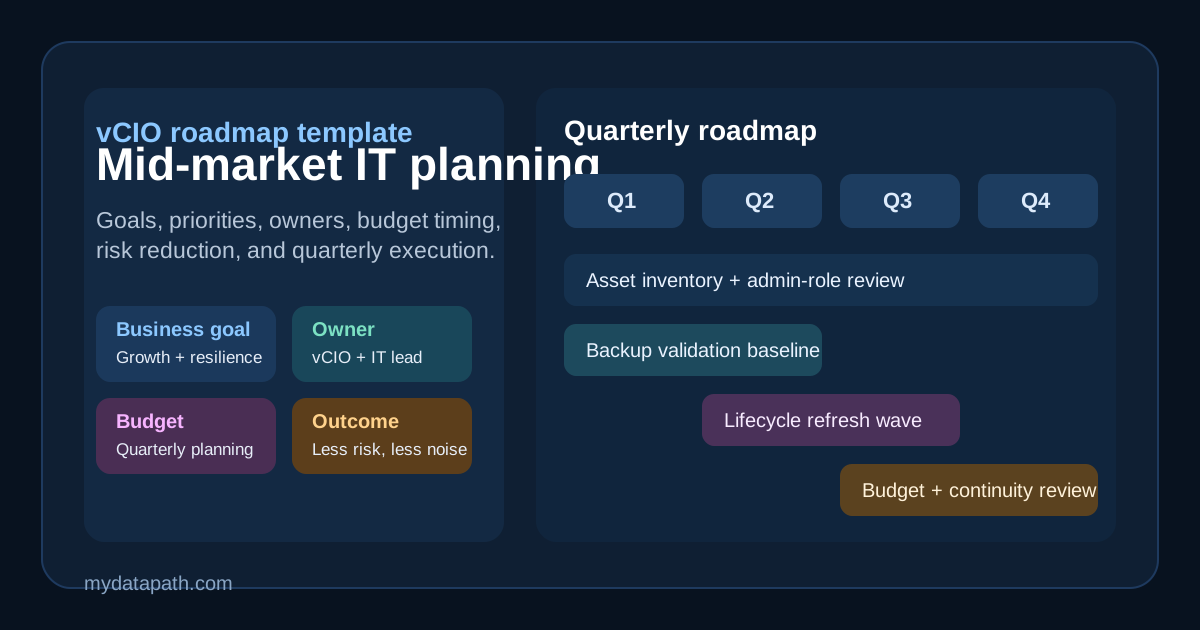

What should a mid-market vCIO roadmap template include?
A mid-market vCIO roadmap template should include business goals, current-state risks, prioritized initiatives, owners, quarterly timing, budget ranges, dependencies, and success metrics. If those elements are missing, the roadmap usually turns into a wish list instead of a planning tool. For growing organizations, the point is not to document every possible project. The point is to create a decision framework leadership can actually use.12
That matters because most mid-market teams do not struggle with a lack of ideas. They struggle with sequencing, ownership, and tradeoffs. Security wants tighter controls. Operations wants fewer interruptions. Finance wants predictability. Internal IT wants time to fix root causes instead of reacting to ticket noise. A solid roadmap gives those competing needs a structure.
At Datapath, we usually treat a roadmap as both a planning artifact and an accountability artifact. It should help leadership answer a few practical questions fast:
- What matters most this quarter?
- Which risks are still open?
- What needs funding now versus later?
- Who owns each initiative?
- What business outcome should improve if the work is done well?
Why do mid-market companies need a vCIO roadmap at all?
Mid-market companies need a vCIO roadmap because technology complexity tends to grow faster than planning discipline. A business may have 100 to 500 employees, multiple vendors, Microsoft 365, line-of-business apps, backup tooling, endpoint protection, compliance pressure, and a lean internal IT team. Without a roadmap, IT investments often become reactive, fragmented, or politically driven.23
A vCIO roadmap helps leadership connect technology decisions to business outcomes such as uptime, compliance readiness, onboarding speed, remote-work resilience, and budget control. It also gives finance and operations a clearer view of when larger upgrades are coming instead of getting surprised by five-figure projects with no planning runway.1
For organizations that already feel stuck between break-fix firefighting and enterprise-level complexity, that structure is usually the difference between “we know what we should do” and “we have a credible plan to do it.”
What are the core sections in a practical vCIO roadmap template?
The most useful roadmap templates are simple enough to review in a leadership meeting but detailed enough to drive execution. A practical template usually contains the sections below.
1. Business objectives
Start with the business, not the tools. A good roadmap should clearly state what the company is trying to improve over the next 12 to 24 months. Typical objectives include:
- support growth into new locations or service lines
- reduce downtime and operational disruption
- improve cybersecurity maturity
- prepare for audits, cyber insurance, or customer diligence
- modernize aging systems without causing user chaos
- gain more predictable IT budgeting
If the roadmap starts with products instead of business goals, it is already drifting off course.34
2. Current-state assessment
A vCIO roadmap should summarize the current environment in plain language. That includes the biggest operational, security, lifecycle, and governance issues. For example:
- unsupported servers or networking hardware
- inconsistent MFA or admin-role control
- weak backup validation or restore testing
- vendor sprawl and overlapping tool spend
- no documented asset lifecycle policy
- poor visibility into after-hours escalation or SLA performance
This section does not need to be long. It just needs to explain why the roadmap exists.
3. Initiatives and workstreams
Instead of one flat project list, group work into initiatives. This makes the roadmap easier to understand and easier to defend in budget conversations. Common mid-market workstreams include:
| Workstream | Typical initiatives | Business impact |
|---|---|---|
| Security | MFA enforcement, conditional access, admin-role review, phishing controls | Reduces avoidable account compromise and audit exposure |
| Infrastructure | server refreshes, network upgrades, Wi-Fi redesign, monitoring cleanup | Improves reliability and lowers support friction |
| Lifecycle | hardware replacement planning, warranty tracking, asset inventory, standards | Makes spend more predictable and reduces emergency purchases |
| Resilience | backup redesign, restore testing, continuity runbooks, outage procedures | Improves recovery confidence and business continuity |
| Governance | vendor reviews, roadmap reviews, budget planning, KPI reporting | Improves decision quality and executive visibility |
Research on virtual CIO planning consistently points to grouping projects into larger initiatives so leadership can understand the roadmap in terms of business themes rather than isolated technical tasks.12
4. Timeline and quarter mapping
A roadmap template should show when work happens. Quarter-based planning is often the right level of detail for mid-market teams because it is specific enough to guide budgeting but flexible enough to adjust as business conditions change.1
A simple timeline format might look like this:
- Q2: asset inventory cleanup, admin-role review, backup validation baseline
- Q3: firewall policy redesign, endpoint standardization, server refresh wave one
- Q4: continuity tabletop, vendor consolidation, budget planning for next year
- Q1 next year: cloud governance improvements, network modernization, compliance documentation update
That format keeps leadership focused on sequence and dependencies instead of debating every task line by line.
5. Budget bands and cost timing
A strong vCIO roadmap does not require perfect estimates on day one, but it should include planning-grade budget ranges. This is one of the most valuable parts of the template because it turns technology planning into something finance can work with.15
For example, each initiative can include:
- rough cost band: low, medium, high
- operating expense versus capital expense
- likely quarter of spend
- recurring versus one-time cost
- whether the initiative offsets other spend
That approach helps leadership prepare for investment instead of reacting to surprises.
6. Ownership and dependencies
Every major initiative should name an owner and any important dependencies. Otherwise work stalls between teams. Common owners include:
- internal IT manager
- operations leader
- finance approver
- outsourced managed service provider
- security lead or compliance stakeholder
- executive sponsor
Dependencies might include contract renewals, staffing constraints, location moves, licensing changes, or project sequencing. A roadmap with no ownership is just a better-formatted backlog.
7. Success metrics
A roadmap should explain how progress will be measured. Useful metrics often include:
- reduction in critical systems running out of support
- percentage of privileged accounts protected by MFA
- restore-test completion rate
- ticket volume tied to repeat device issues
- endpoint compliance rate
- SLA or escalation responsiveness
- vendor consolidation savings
- percentage of roadmap initiatives completed on schedule
These metrics help a vCIO conversation stay grounded in outcomes instead of vibes.
What is a simple vCIO roadmap template mid-market teams can use?
Below is a lightweight structure many teams can adopt immediately.
vCIO roadmap template
1. Business objective
What business problem or strategic goal does this support?
2. Current-state issue
What risk, gap, or inefficiency exists today?
3. Initiative name
How should this workstream be labeled for leadership review?
4. Actions in scope
What specific projects or changes are included?
5. Priority
Is this now, next, or later?
6. Quarter target
Which quarter should planning or execution occur?
7. Owner
Who is accountable for moving this forward?
8. Dependencies
What must happen before this can succeed?
9. Budget range
What level of spend should leadership expect?
10. Success metric
How will the organization know this delivered value?
That template is intentionally simple. A good vCIO should expand it only where necessary, not because complexity feels more impressive.
How should a vCIO prioritize roadmap items for a mid-market business?
A vCIO should prioritize roadmap items by balancing business impact, risk reduction, timing, and organizational readiness. In practice, the first projects are not always the most technically interesting ones. They are usually the ones that remove the most operational drag or reduce the most dangerous exposure fastest.24
A practical prioritization model often asks:
- Does this initiative reduce a meaningful business or security risk?
- Does it unblock other important work?
- Is there a budget or contract timing issue that makes this urgent?
- Will the business actually support the change right now?
- Is the return mainly operational, financial, compliance-related, or strategic?
That means a mid-market roadmap may prioritize asset inventory, identity controls, backup validation, and lifecycle planning before a more ambitious modernization project. Boring does not mean low value.
How often should the roadmap be reviewed and updated?
Most mid-market teams should review the roadmap quarterly and adjust it whenever business conditions materially change. Quarterly review is usually enough cadence to keep leadership aligned without turning roadmap management into a bureaucratic ritual.1
A good quarterly review should answer:
- what got completed
- what slipped and why
- whether priorities changed
- whether budget assumptions still hold
- which new risks appeared
- what leadership needs to approve next
If the roadmap never changes, it is probably disconnected from reality. If it changes every week, it probably was never strategic enough to begin with.
What common mistakes make vCIO roadmaps fail?
The biggest roadmap failures are usually management failures, not formatting failures.
Starting with tools instead of business outcomes
If the roadmap leads with products, vendors, or architecture diagrams before explaining the business objective, executives disengage quickly.
Mixing urgent fixes with long-horizon strategy without labeling them
Not every initiative belongs in the same bucket. A ransomware resilience gap and a future analytics platform may both matter, but they should not compete in the same discussion without context.
Treating the roadmap like a giant project plan
A roadmap is not supposed to replace delivery management. It should guide decisions, sequence work, and show why priorities matter.
Ignoring budgeting detail
Teams often talk about priorities without showing when money will be needed. That usually leads to preventable delays.
Leaving out ownership
If nobody clearly owns an initiative, it becomes everyone’s “important thing” and nobody’s active responsibility.
How does this connect to broader managed IT strategy?
A vCIO roadmap is most effective when it is tied to the operating reality of support, security, and vendor management. That is why it often sits alongside managed services rather than apart from them. Day-to-day service data should inform strategic planning, and roadmap decisions should improve daily operations over time.
For example, if ticket trends show repeated failures around aging devices, that should feed lifecycle planning. If leadership is asking harder questions about accountability, that should shape SLA reporting and after-hours escalation reviews. If cyber insurance or customer diligence is getting stricter, that should influence identity, backup, and vendor-risk initiatives.
That is also where related Datapath guidance can help teams go deeper:
- What Is a vCIO and When Should a Growing Company Hire One?
- IT Asset Lifecycle Management Policy: A Practical Guide for Growing Companies
- How to Validate Managed Service Responsiveness After Hours
- Cloud Readiness Assessment Checklist for Regulated Businesses
What should leadership ask for in the first roadmap review?
Leadership should ask for clarity, tradeoffs, and sequencing rather than a flood of technical details. Good questions include:
- Which three initiatives matter most in the next two quarters?
- Which current risks are unacceptable if nothing changes?
- What will cost more later if we delay now?
- Which initiatives depend on executive sponsorship?
- What KPIs should improve if this roadmap is working?
- Where do we still lack enough information to commit?
Those questions make the roadmap a business tool instead of just an IT presentation.
Final answer
A useful vCIO roadmap template for mid-market IT planning should document business objectives, current-state gaps, prioritized initiatives, quarter-by-quarter timing, budget expectations, owners, dependencies, and measurable outcomes. The best templates are simple enough for executives to review quickly and structured enough for IT leaders to execute against over time. If your roadmap cannot explain why a project matters, when it should happen, who owns it, and what success looks like, it probably is not ready to guide decisions.
FAQ
What is a vCIO roadmap template?
A vCIO roadmap template is a repeatable planning framework used to connect business goals with IT initiatives, budget timing, ownership, and measurable outcomes over the next several quarters.
How long should a mid-market IT roadmap look ahead?
Most mid-market teams should plan in detail for the next two to four quarters and maintain a lighter strategic view for the next 12 to 24 months.
What should be on the first version of a roadmap?
The first version should cover the highest-value issues: major business goals, key security and lifecycle risks, the most important initiatives, expected quarter timing, ownership, and planning-grade budget ranges.
How often should a vCIO roadmap be updated?
Quarterly is the most common review cadence, with additional updates when business growth, compliance demands, outages, or vendor changes materially alter priorities.
Is a roadmap the same thing as a project plan?
No. A roadmap shows priorities, sequence, and business rationale. A project plan handles detailed execution, task tracking, and delivery management.
Footnotes
-
The vCIO guidance and related research gathered through the SEO drafting workflow consistently emphasize that strategic roadmaps work best when they group similar projects into initiatives, assign timing, and include budget planning months or quarters in advance. ↩ ↩2 ↩3 ↩4 ↩5 ↩6
-
TechTarget. “virtual CIO (vCIO).” https://www.techtarget.com/searchcio/definition/virtual-CIO-vCIO ↩ ↩2 ↩3 ↩4
-
Centric Business Systems. “Creating a Technology Roadmap with Your Virtual CIO: Aligning IT with Business Goals.” https://centrictechservices.com/2024/07/10/creating-a-technology-roadmap-with-your-virtual-cio-aligning-it-with-business-goals/ ↩ ↩2
-
EZO. “IT Strategic Planning 2026: A Mid-Market Playbook.” https://ezo.io/assetsonar/blog/it-strategic-planning-mid-market-playbook/ ↩ ↩2
-
GlobalQuest. “2026 IT Planning Roadmap.” https://globalquestinc.com/blog/2026-it-planning-roadmap/ ↩
