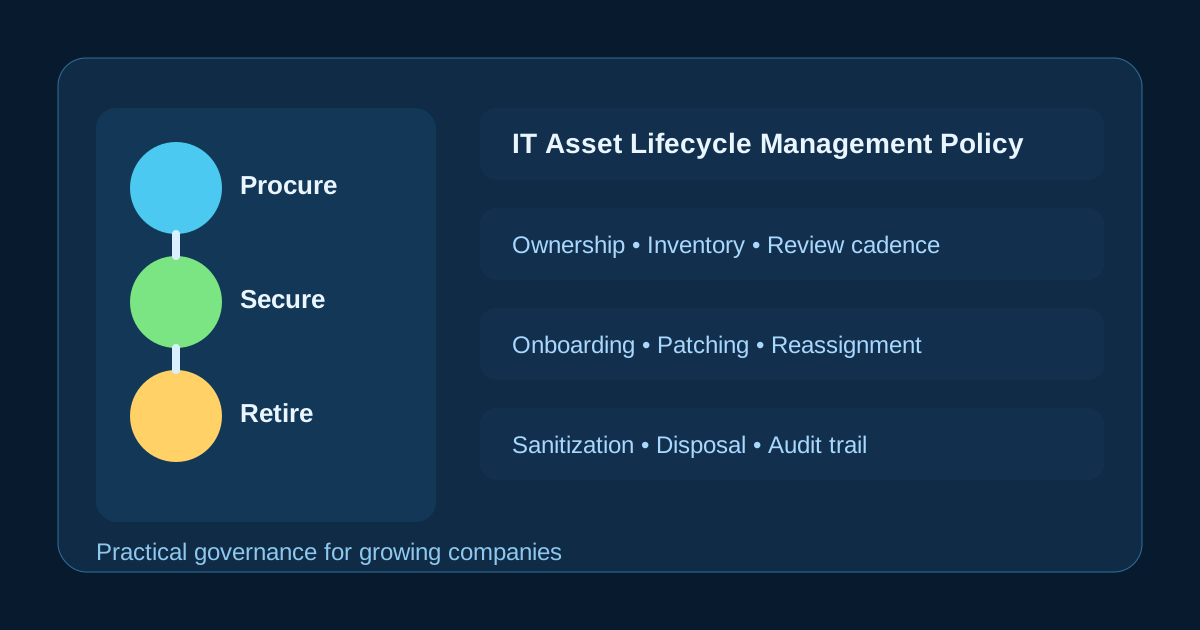
What should an IT asset lifecycle management policy include for a growing company?
A practical IT asset lifecycle management policy should define which assets are in scope, who owns each lifecycle decision, how purchases are approved, how devices and software are deployed securely, how inventory and maintenance are tracked, and how assets are retired without losing data or accountability. For growing companies, the policy should also connect onboarding, offboarding, budgeting, security, and compliance work so the environment stays governable as the business scales.123
That sounds formal, but the underlying problem is simple. Growth usually creates more laptops, SaaS apps, mobile devices, licenses, vendors, and remote users before it creates better process. If nobody owns the lifecycle, the company ends up with duplicate purchases, unclear support obligations, stale admin access, weak records for audits, and expensive surprises when hardware fails or people leave.
We think the policy matters because it turns asset management from a reactive cleanup job into an operating system. Instead of asking, “Who has that laptop?” or “Are we still paying for this tool?” or “Did anyone wipe that retired device?” your team has a repeatable way to answer those questions before they become security, finance, or compliance issues.
Why does asset lifecycle management become more important as a company grows?
Asset lifecycle management becomes more important during growth because the number of technology decisions expands faster than the documentation around them. New hires need devices quickly, departments adopt software independently, remote work adds logistics, and old systems linger longer than expected. Without a policy, the company usually gets more tools but less visibility.14
That loss of visibility creates real business problems:
- inventory records stop matching reality
- unsupported or aging devices stay in production too long
- software renewals continue without clear ownership
- onboarding and offboarding become inconsistent
- security tools are deployed unevenly
- audit and insurance questionnaires take longer to answer
- device disposal creates unnecessary data exposure
NIST’s Cybersecurity Framework and NIST SP 800-53 both make the same underlying point in different ways: organizations need to know what assets they have, what role those assets play, and how they are maintained over time.12 CIS Control 1 reinforces that expectation by calling for active management of enterprise assets across physical, virtual, remote, and cloud environments.3
For a growing company, that is not theory. It affects support speed, recovery readiness, replacement planning, procurement discipline, and executive confidence in the IT environment.
What assets should the policy cover?
An IT asset lifecycle management policy should cover more than laptops and servers. It should include the assets that create operational, security, financial, or compliance responsibility for the business.13
We recommend including at least these categories:
- laptops, desktops, tablets, and mobile devices
- servers, virtual machines, and storage systems
- network hardware, firewalls, and wireless equipment
- SaaS applications and cloud subscriptions
- software licenses and endpoint tools
- backup platforms and security tools
- supplier-managed systems and externally administered services
- specialized devices tied to regulated or critical workflows
That broader scope matters because modern asset risk is not limited to physical equipment. A forgotten SaaS admin account, an unmanaged cloud subscription, or an orphaned backup appliance can create just as much trouble as a lost laptop.
Which fields should be tracked for each asset?
A policy is only useful if it produces usable records. We recommend requiring core fields such as:
| Field | Why it matters |
|---|---|
| Asset type and identifier | Creates a clear record for support and audit use |
| Business owner or custodian | Establishes accountability |
| Assigned user or team | Connects the asset to real operations |
| Purchase date and vendor | Supports budgeting and warranty tracking |
| Support status and lifecycle stage | Helps plan refresh and retirement |
| Data sensitivity or business criticality | Improves risk prioritization |
| Security baseline status | Confirms whether encryption, patching, and protection are in place |
| Disposal or transfer status | Prevents assets from disappearing informally |
If the company cannot answer who owns an asset, what it does, where it lives, and what state it is in, then the lifecycle is not actually being managed.
What stages should the lifecycle policy define?
A strong lifecycle policy should define the full path from planning to disposal. We think five stages are enough for most growing companies: planning and procurement, deployment, maintenance and review, reassignment and offboarding, and retirement and disposal.45
1. Planning and procurement
This stage should define who can request assets, who approves them, what standards apply, and how exceptions are handled. The goal is to avoid one-off buying behavior that makes support, security, and renewal management harder later.
A good procurement section should answer:
- which models or software tiers are standard
- who approves purchases above threshold amounts
- whether security review is required before buying new tools
- how warranties, subscriptions, and renewals are documented
- when a business case or replacement justification is required
2. Deployment and onboarding
Deployment should include asset registration, secure configuration, license assignment, endpoint protection, encryption, MFA where appropriate, and documented handoff to the end user.23
This is also where the policy should tie into onboarding. If new hires receive devices or accounts without asset registration and security baselines, the company accumulates invisible risk on day one.
3. Maintenance and review
This stage should define patching expectations, break-fix escalation, inventory review cadence, warranty tracking, and periodic validation of ownership and usage. It should also define what triggers a lifecycle review, such as repeated incidents, end-of-support notices, audit findings, or rising maintenance cost.
For growing organizations, quarterly review is a practical baseline for critical assets, especially where compliance or business continuity matters.2
4. Reassignment and offboarding
Assets often become risky during transitions, not just during normal use. A reassignment section should cover employee moves, leave, termination, role changes, and handoffs between departments or locations.
That section should require:
- return or reassignment confirmation
- removal of stale local and cloud access
- validation of backup or data transfer needs
- update of the inventory owner and status
- documentation of any exceptions or temporary custody
5. Retirement and disposal
Retirement should never mean “someone put the old devices in a closet.” A formal disposal process should require approval, data sanitization, record updates, and a documented disposition method such as certified recycling, trade-in, or secure destruction.5
This is one of the easiest places for growing companies to lose both equipment and accountability.
Who should own the policy and the day-to-day process?
The policy should have one clear process owner, but asset lifecycle management is usually shared across IT, security, finance, HR, and department leadership. In most growing companies, IT manages the system of record and execution workflow, while finance helps with spend visibility, HR supports onboarding and offboarding triggers, and business leaders stay accountable for the assets their teams use.4
We recommend documenting at least four roles:
- Policy owner — maintains the policy and review cadence
- Process operator — updates records, coordinates deployment, and tracks status
- Business owner — confirms need, use, and accountability for key assets
- Security or compliance reviewer — validates control requirements for regulated or sensitive systems
Without named roles, lifecycle work gets treated like background noise. Then nobody feels responsible for stale subscriptions, ghost devices, or disposal records until something breaks.
What controls should the policy require for security and compliance?
A lifecycle policy should require baseline controls that make assets supportable, auditable, and safer to operate. The exact controls depend on the business, but most growing companies should define requirements for encryption, endpoint protection, patching, admin access discipline, approved software, and secure disposal.123
We also think the policy should connect naturally to related governance work such as How to Build a Compliance-Ready IT Asset Inventory, Third-Party Cyber Risk Assessment Checklist for Regulated Businesses, Managed IT Services, and the broader Datapath resources hub.
Which control questions should the policy answer directly?
A useful policy should make these points explicit:
- What security baseline must every managed endpoint meet?
- Which asset classes require stronger logging, backup, or approval?
- Who approves nonstandard software or hardware?
- How are unsupported systems identified and remediated?
- What evidence is kept for transfers, returns, and disposal?
- How often is the inventory reviewed against reality?
That is the difference between a vague document and an operational policy. If the policy cannot answer those questions, it will not hold up well during audits, incidents, or rapid growth.
What usually goes wrong when there is no lifecycle policy?
Without a lifecycle policy, growing companies usually default to informal workarounds. Purchases happen by email or chat, inventory trails break, replacement cycles become emotional instead of planned, and retired assets disappear into storage closets or unmanaged vendor processes.
The most common failures we see are:
- no single source of truth for assets or subscriptions
- too many purchasing exceptions and no standard catalog
- inconsistent onboarding and offboarding steps
- unknown device age, warranty, or support status
- expired software or duplicate licenses still being paid for
- disposal with no proof of sanitization
- critical systems with no named business owner
Those failures also spill into adjacent work. Backup planning gets weaker. Cyber insurance applications get harder. Vendor risk reviews take longer. Security incidents become more confusing because nobody is fully sure what systems are in scope.
What should a practical IT asset lifecycle management policy template include?
For most growing companies, the policy should be short enough to use and specific enough to enforce. We recommend including these sections:
- purpose and scope
- asset categories in scope
- roles and responsibilities
- procurement and approval rules
- deployment and configuration standards
- inventory and review requirements
- maintenance, patching, and exception handling
- reassignment and offboarding steps
- retirement, sanitization, and disposal rules
- review cadence and policy exceptions
If you want a simple test, ask whether a new manager, a finance lead, and an IT coordinator would all read the policy the same way. If not, it probably needs clearer rules and fewer assumptions.
What is the takeaway for growing companies?
The main takeaway is that an IT asset lifecycle management policy is not just an IT administration document. It is a business control that helps a growing company buy consistently, support assets predictably, secure systems earlier, retire equipment safely, and answer harder questions with less scrambling.1235
We think the best policy is the one that connects daily work across teams. Procurement knows what standards apply. IT knows what must be documented. Security knows which controls are required. Leadership knows which assets are critical and what refresh obligations are coming. That kind of clarity is what keeps growth from turning into operational drift.
If your business is adding users, locations, SaaS platforms, or regulated workflows, now is usually the right time to formalize the lifecycle before the environment gets more expensive and less visible.
FAQ: IT asset lifecycle management policy
What is an IT asset lifecycle management policy?
An IT asset lifecycle management policy is a formal document that defines how a company approves, deploys, tracks, maintains, reassigns, and retires technology assets so they remain secure, supportable, and accountable throughout their useful life.
Why do growing companies need an IT asset lifecycle policy?
Growing companies need one because technology sprawl increases faster than documentation. A lifecycle policy helps control purchases, ownership, support expectations, security baselines, and secure disposal before informal habits create bigger operational and compliance problems.
What assets should be included in lifecycle management?
The policy should usually include endpoints, servers, network gear, SaaS applications, software licenses, cloud services, backup systems, security tools, and supplier-managed systems that create operational or compliance responsibility for the business.
How often should an asset lifecycle policy be reviewed?
Most companies should review the policy at least annually and review critical asset records on a recurring cadence, often quarterly for important systems or faster when the environment changes materially.
Sources
- NIST Cybersecurity Framework 2.0 — ID.AM Asset Management
- NIST SP 800-53 Rev. 5 — CM-8 System Component Inventory
- CIS Control 1 — Inventory and Control of Enterprise Assets
- TechTarget: IT asset lifecycle management phases and best practices
- NIST SP 800-88 Rev. 1 — Media Sanitization