
What should a cloud readiness assessment checklist include for a regulated business?
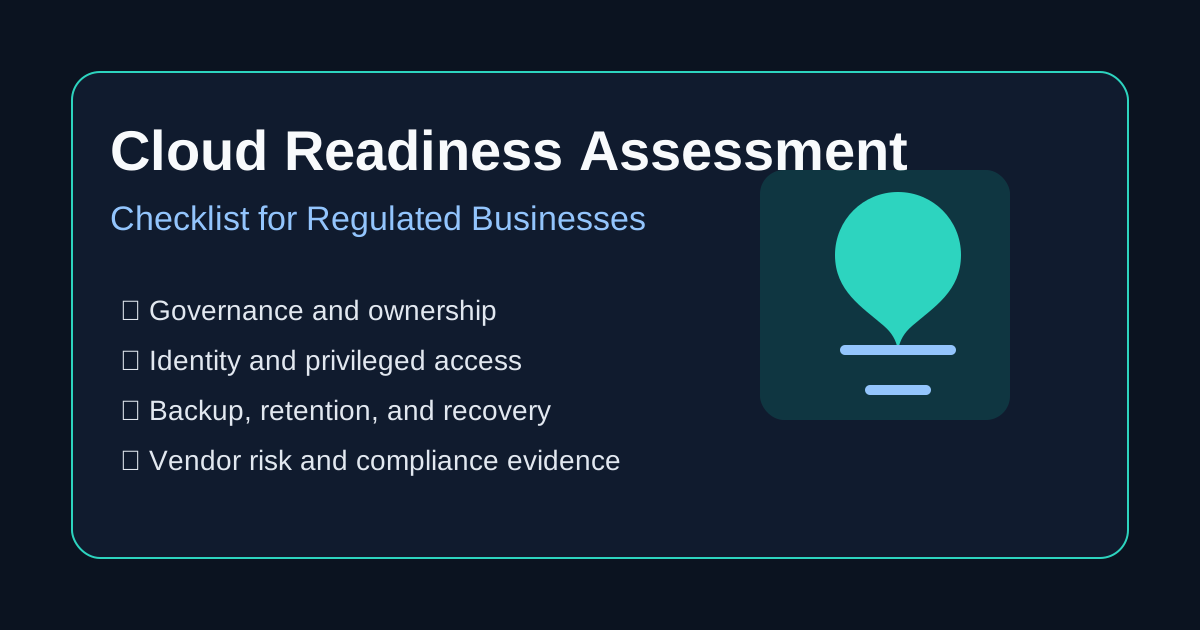
A cloud readiness assessment checklist for regulated businesses should confirm governance, identity controls, backup and recovery, vendor risk, compliance obligations, workload dependencies, and migration sequencing before production systems move. The point is not simply to ask whether a workload can run in the cloud. The point is to verify whether it can move safely, supportably, and with enough evidence to satisfy both operations and compliance reviewers.12
That distinction matters because regulated businesses rarely fail cloud projects for purely technical reasons. They usually run into trouble when application dependencies are poorly documented, identity and access controls are too weak, cost assumptions are unrealistic, or leadership discovers late in the process that evidence retention, logging, data residency, or vendor oversight were never clearly defined. In our experience, a readiness assessment works best when it acts as a decision framework, not a checkbox ritual.
If your team is already reviewing cloud migration services, planning an Azure cloud migration checklist, or tightening Entra ID security, this is the stage where risk should get translated into concrete go or no-go criteria.
Why do regulated businesses need a stricter cloud readiness assessment?
A general cloud migration checklist is not enough when the environment includes protected health information, financial data, student records, contractual control obligations, or public-sector accountability. Regulated teams need to know not only whether the target platform is technically capable, but also whether the operating model around it will stand up under scrutiny.
Compliance follows the workload
Moving a system to the cloud does not eliminate responsibility for access control, auditability, retention, and recovery. Industry guidance from NIST and the CIS Benchmarks keeps pointing back to the same truth: shared responsibility does not mean reduced responsibility.13 If the business still owns the data, identity model, approvals, retention, and vendor oversight, then those controls need to be assessed before migration rather than patched together afterward.
Weak migrations create hidden operational risk
We see this a lot: the team focuses on the migration event, not on the post-migration operating model. A workload goes live, but nobody has clearly assigned responsibility for monitoring, backup validation, exception handling, access reviews, or cost control. The result is a technically completed migration that leaves the business less governable than before.
Regulated environments usually have uneven readiness
Not every workload is equally ready for cloud adoption. Some systems are excellent candidates because they have clean identity boundaries, modern integrations, and defined recovery requirements. Others depend on old protocols, undocumented vendors, shared accounts, or highly sensitive data flows. A good readiness assessment helps leadership distinguish between those cases so the migration sequence is driven by risk and operational fit.
What should be reviewed first in a cloud readiness assessment?
We recommend starting with governance and workload inventory before any architecture decision gets treated as final. If the business does not know what it is moving, who depends on it, and what controls it must preserve, the rest of the project becomes guesswork.
1. Workload inventory and business criticality
Start by listing the systems under consideration and ranking them by:
- business criticality
- data sensitivity
- outage tolerance
- integration complexity
- user population
- vendor dependency
- recovery requirements
This is the baseline for every later decision. A finance workflow with strict retention and approval requirements should not be evaluated the same way as a low-risk internal tool. Likewise, a healthcare application tied to imaging, EHR access, or vendor-managed interfaces needs a more careful migration path than a standalone collaboration platform.
2. Data classification and regulatory exposure
For each workload, identify what kind of data it handles and what obligations travel with that data. That usually includes questions such as:
- Does the system process regulated data such as PHI, financial records, CJIS-related data, or student information?
- Are there contractual controls around retention, encryption, or vendor access?
- Are there regional or customer-specific expectations about residency or handling?
- What evidence must be retained for audits, renewals, or incident review?
Without that step, the business can end up selecting a technically plausible target with the wrong control model.
3. Identity, access, and admin control model
Identity is one of the biggest readiness gates. Before migration, verify:
- whether MFA is enforced consistently
- whether privileged roles are separated and reviewed
- whether shared or generic accounts still exist
- whether access is based on groups and role design rather than ad hoc exceptions
- whether sign-in logging and admin activity review are mature enough for the target state
If identity governance is weak on day one, the cloud just makes that weakness easier to scale. That is why we often connect readiness work to Conditional Access planning or Microsoft 365 admin-role review before broader migration moves forward.
What controls should the checklist validate before migration?
Once the inventory is clear, the assessment should validate the operating controls that make a cloud environment supportable.
Security and baseline hardening
A regulated cloud environment should have clear standards for:
- logging and alerting
- secure configuration baselines
- patching expectations
- vulnerability management
- encryption in transit and at rest
- network segmentation where applicable
- third-party access restrictions
This is where CIS guidance, vendor baseline recommendations, and internal policy should line up.34 The objective is not perfection before migration. It is making sure the business is not migrating into an ungoverned environment.
Backup, recovery, and resilience
Cloud readiness is incomplete without recovery planning. For each system, the assessment should document:
- backup scope
- retention expectations
- restore ownership
- recovery time objective (RTO)
- recovery point objective (RPO)
- dependency on vendor-native recovery versus independent backup
- testing cadence
We recommend being especially careful with SaaS workloads because many teams assume platform availability automatically equals recoverability. It does not. If the business depends on fast restore, long-term retention, or granular recovery, that requirement needs to be explicit. Related planning often overlaps with Microsoft 365 backup vs retention, cloud disaster recovery for hybrid environments, and broader backup and disaster recovery guidance.
Vendor and third-party risk
A surprising number of cloud projects stall because the provider contract or vendor operating model was reviewed too late. A readiness checklist should ask:
- Who administers the platform?
- What support tiers actually exist?
- What subcontractors may access data?
- What logging is available to the customer?
- What security attestations or audit reports exist?
- What happens during offboarding or provider failure?
That is one reason we push teams to pair readiness work with a vendor risk questionnaire for managed IT providers or a third-party cyber risk assessment checklist.
How should workloads be scored for cloud readiness?
A simple scoring model keeps the process grounded. We like using a matrix that rates each workload from low to high concern across the most practical migration variables.
| Assessment area | What to ask | Higher-risk signal |
|---|---|---|
| Identity readiness | Are MFA, roles, and logging mature? | Shared accounts, weak admin control |
| Data sensitivity | What regulated data is involved? | High-sensitivity data with unclear handling |
| Dependency complexity | What breaks if this system moves? | Many undocumented interfaces |
| Recovery maturity | Can the workload be restored predictably? | No tested recovery path |
| Vendor governability | Can support and accountability be verified? | Weak visibility into provider operations |
| Compliance evidence | Can the team prove controls after migration? | Missing logs, policies, or ownership |
This kind of scoring does not replace technical architecture review, but it gives leadership a better way to prioritize. Some workloads should move now. Some should wait until identity, backup, or process maturity improves. Some should stay hybrid for longer.
What common mistakes make a cloud readiness assessment useless?
Most weak assessments fail because they are either too shallow or too disconnected from real operations.
Treating the cloud as a destination instead of an operating model
If the checklist only asks where the servers will run, it misses the real issue. The business also needs to know who owns controls, who approves access, how evidence is retained, and how incidents get escalated.
Ignoring post-migration staffing reality
A design can look excellent on paper and still fail because nobody has time to monitor alerts, review permissions, or maintain policy. Readiness has to reflect the support model the organization actually has, whether that is internal IT, co-managed support, or a fully managed partner.
Assuming regulated workloads all need the same answer
Some regulated systems belong in a modern cloud architecture. Others may need a staged approach, a private component, or stronger contractual protections first. A good checklist should support nuanced sequencing instead of forcing a one-size-fits-all answer.
Skipping executive decision points
Leadership should be able to answer three practical questions before approving the move:
- what risk is reduced by migrating now
- what risk remains after migration
- what controls must be funded or assigned to make the target state sustainable
If the assessment cannot answer those, it is not ready.
Why Datapath recommends a governance-first cloud readiness process
We think regulated businesses get better cloud outcomes when the assessment starts with accountability. That means aligning cloud design with actual business constraints: audit evidence, help desk capacity, privileged-access oversight, recovery expectations, and vendor governance. When those factors are addressed early, the migration plan gets cleaner and the cloud environment is much easier to defend later.
A governance-first readiness process usually includes:
- workload classification by business and compliance impact
- identity and privileged-access review
- backup and disaster recovery validation
- vendor and contract review
- logging and evidence requirements
- migration sequencing tied to operational readiness
That approach usually creates fewer surprises than chasing architecture diagrams before the operating model is stable.
Why Datapath for cloud readiness assessment work
We help regulated organizations evaluate whether a migration is actually supportable, not just technically possible. In practice, that means we look at governance, recovery, identity, vendor accountability, and post-migration operating discipline together.
If your team is trying to move cloud initiatives forward without creating compliance drift or hidden recovery gaps, we can help you turn that planning into a practical readiness checklist with clear decision points.
FAQ: Cloud readiness assessment checklist for regulated businesses
What is the main goal of a cloud readiness assessment?
The main goal is to confirm that a workload can move with the right controls, recovery expectations, and operating ownership in place. It should help the business decide what can migrate now, what needs remediation first, and what should stay staged or hybrid longer.
What makes a cloud readiness assessment different for regulated businesses?
Regulated businesses must evaluate compliance evidence, access governance, vendor accountability, recovery requirements, and data handling obligations alongside the technical design. The checklist has to prove the target state is governable, not just available.
Should every regulated workload move to the cloud at the same pace?
No. The better approach is to rank workloads by sensitivity, dependency complexity, identity maturity, and recovery readiness so migration waves follow risk instead of convenience.
What should leadership review before approving migration?
Leadership should review the workload inventory, readiness score, remaining gaps, required compensating controls, cost and support assumptions, and the evidence the organization expects to retain after cutover.
Sources
- NIST SP 800-207: Zero Trust Architecture
- NIST SP 800-146: Cloud Computing Synopsis and Recommendations
- CIS Microsoft Azure Foundations Benchmark
- Microsoft Learn: Cloud Adoption Framework for Azure
