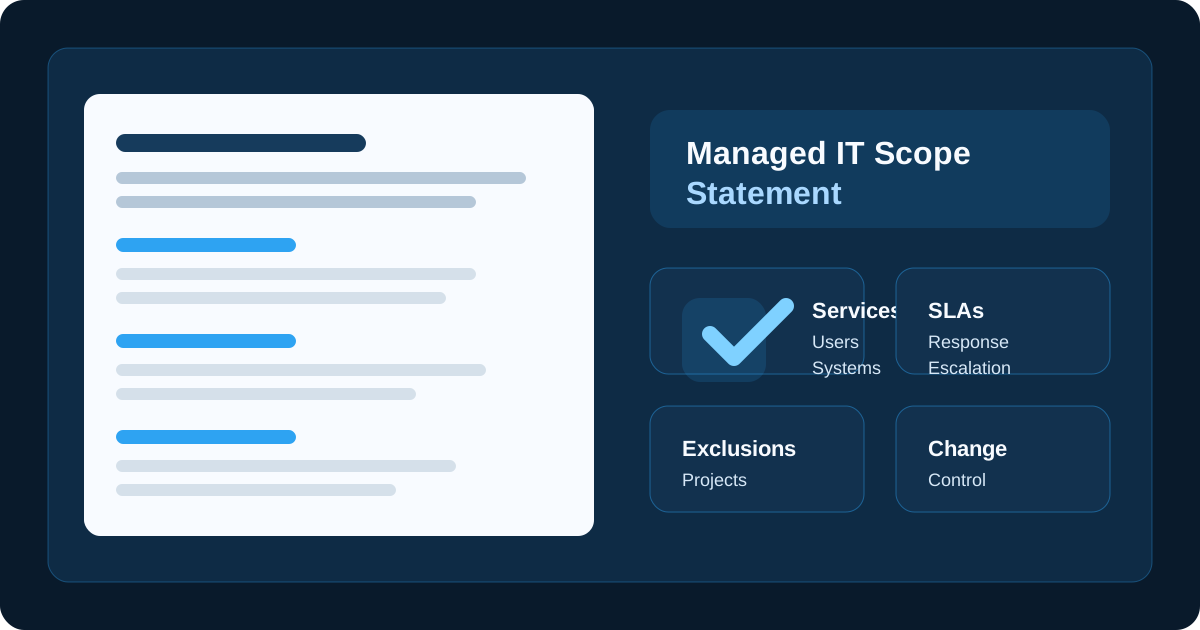

How do you write a managed IT scope statement for a new MSP contract?
A strong managed IT scope statement should clearly define the services being delivered, the systems and locations covered, the service levels attached to those services, the exclusions, the client responsibilities, and the process for approving work that falls outside the agreement. If those items are vague, the contract may look complete on paper while still leaving room for expensive misunderstandings later.12
That matters because most MSP disputes are not really about whether a ticket got closed. They are about unclear ownership. One side assumes patching includes after-hours testing. The other assumes backup monitoring includes restore validation. Someone expects the MSP to coordinate every third-party vendor, while the provider thinks that support ends at the firewall edge. The scope statement is where those assumptions either get resolved or get left behind to cause trouble.34
At Datapath, we think a managed IT contract should make accountability easier, not harder. If a business is evaluating managed IT services, comparing providers, or replacing an underperforming vendor, the scope statement is one of the best places to see whether the relationship will feel clear in month six instead of just sounding impressive in week one.
What should a managed IT scope statement actually include?
A useful scope statement should not read like generic sales copy. It should work like an operating document that leadership, internal IT, and the MSP can all reference when priorities, incidents, or change requests show up.
1. Defined services and deliverables
Start by naming exactly what the MSP is responsible for delivering. That usually includes some combination of help desk support, user onboarding and offboarding, device monitoring, patching, endpoint protection administration, Microsoft 365 administration, backup monitoring, firewall management, vendor coordination, and strategic review. The key is not to list broad categories only. The scope should describe what those services mean in practice.14
For example, instead of saying “security management,” a stronger scope statement explains whether that includes:
- endpoint detection and response administration
- email security policy management
- vulnerability review and remediation coordination
- MFA and identity policy support
- firewall rule changes and review cadence
- incident escalation procedures
That level of specificity reduces confusion and makes the future SLA easier to enforce.
2. Covered assets, users, and locations
A managed IT agreement should also define what is in scope. That may include users, workstations, servers, Microsoft 365 tenants, line-of-business applications, network devices, sites, cloud subscriptions, or backup platforms. If the MSP is supporting only some of those layers, say so directly.45
This is especially important for organizations with multiple offices, field teams, regulated workloads, or hybrid environments. A scope statement should answer questions like:
- Which offices are covered for on-site support?
- Are home offices or remote workers included?
- Which network devices are managed versus merely documented?
- Are Azure or AWS workloads included in the monthly service?
- Does support extend to printers, conference-room systems, or specialty devices?
If the answer is “sometimes,” the contract is probably still too vague.
3. Service levels, assumptions, and success measures
The scope statement and SLA are different documents, but they should reinforce each other. The scope defines what the MSP owns. The SLA defines how reliably those owned services should be delivered. Strong scope language therefore points to service boundaries and measurable expectations such as response windows, business hours, severity definitions, maintenance windows, and escalation rules.16
It should also document assumptions and dependencies. That includes things like client-provided admin access, supported hardware standards, required line-of-business vendor cooperation, or the internal stakeholders needed to approve security changes.27
Without those assumptions on paper, providers and clients often talk past each other. The MSP may be waiting on access or approvals while the client assumes the provider is simply behind.
Where do MSP scope statements usually go wrong?
Weak scope statements usually fail in predictable ways. They are rarely too short by accident. They are usually too soft where precision matters most.
Vague wording that sounds safe but means little
Phrases like “best effort support,” “reasonable security administration,” or “standard monitoring” can sound acceptable until something breaks. Then everyone realizes those words did not define what work would actually happen, how often it would happen, or who would decide whether it was enough.18
A stronger version replaces fuzzy wording with plain operating language. If backups are included, specify whether the MSP is reviewing job status only or also performing scheduled restore tests. If after-hours support is included, define whether it covers emergencies only or routine work as well. If vendor coordination is part of the service, explain whether that means joining troubleshooting calls, opening cases, or owning issue resolution through completion.
Missing exclusions
One of the most important parts of a managed IT scope statement is the list of things the MSP does not provide. That does not make the agreement weaker. It makes it more trustworthy.34
Common exclusions may include:
- hardware replacement costs
- new project labor outside recurring support
- unsupported or end-of-life systems
- custom application development
- third-party software licensing fees
- compliance certification work
- major office moves, cabling, or buildouts
- penetration testing performed by a separate specialist
If exclusions are omitted, they do not disappear. They just come back later as billing disputes, urgent escalations, or resentment.
No change-control process
Scope creep is common in IT relationships because business needs change. New offices open. A cloud migration becomes urgent. A cyber insurance renewal introduces stricter control requirements. None of that is unusual. The mistake is failing to define how scope changes get reviewed, priced, approved, and documented.39
A good scope statement should explain when work triggers a change order, statement of work, or contract amendment. That protects both sides. The client gets visibility into cost and timing before the work begins, and the MSP gets a cleaner way to staff and deliver the extra work responsibly.
Weak division of responsibility
The client also has responsibilities in a managed IT relationship. Those may include approving changes, maintaining vendor contacts, replacing unsupported hardware, enforcing internal policies, or giving the MSP timely access to systems and stakeholders. If the contract describes only what the provider must do, it still leaves a major operational gap.27
That is one reason many organizations also benefit from related planning resources such as how to validate managed service responsiveness after hours, MSP SLA metrics that show real accountability, vendor risk questionnaire guidance, and an MSP evaluation checklist for 100+ employee organizations.
How should you structure the final document before signing?
The best scope statements are practical enough for operations and clean enough for procurement, legal review, and leadership signoff.
Use a simple section-by-section format
We recommend structuring the document in this order:
- purpose of the agreement
- services included
- assets, users, and sites covered
- service levels and support windows
- client responsibilities and assumptions
- exclusions and out-of-scope work
- change-control process
- acceptance, review cadence, and contract references
That sequence makes it easier for each side to answer the questions that matter most before signature. It also makes future reviews easier when the relationship evolves.
Write for the real-world operating model
A scope statement should match how the environment actually runs, not how either side wishes it ran. If the client has internal IT, spell out what stays in-house versus what moves to the MSP. If the environment is regulated, include the control areas that matter: access management, backup validation, logging, patch cadence, escalation, and evidence handling. Organizations in healthcare, finance, education, and public-sector environments usually need a scope statement that is disciplined enough to support audit conversations, not just support tickets.
That is also why businesses reviewing MSP contracts should compare the scope statement against broader guidance like our resources and guides hub, the outsourced IT support guide, the fixed fee IT outsourcing guide, and related blog posts such as How to Create an IT Vendor Exit Strategy Before Signing a Contract and In-House IT vs. Outsourced Cybersecurity for Modesto Businesses.
Include a practical review checklist
Before signing, leadership should be able to answer yes to the questions below:
- Do we know exactly which services are recurring versus project-based?
- Do we know which users, devices, sites, and cloud systems are covered?
- Do we know what is excluded and what would require a separate SOW?
- Do the SLA terms line up with the services being promised?
- Are client responsibilities spelled out clearly enough to avoid finger-pointing?
- Is there a documented path for adding scope later without chaos?
If the answer is no to any of those, the contract probably needs another pass.
Why Datapath for managed IT scope design and contract clarity?
A strong MSP relationship usually starts with cleaner ownership. We help organizations translate high-level IT needs into practical support models that account for operations, security, growth, and accountability. That includes clearer service boundaries, more realistic escalation paths, and scope language that can hold up under pressure instead of collapsing into vague promises.
For organizations comparing providers or replacing a contract that has become too fuzzy to manage, we recommend reviewing our home page, managed IT services overview, IT consulting and storage solutions, and resources for evaluating MSPs before signing the next agreement.
FAQ: managed IT scope statement
What is a managed IT scope statement?
A managed IT scope statement is the part of an MSP agreement that defines which services, systems, users, and locations the provider supports, along with key exclusions, assumptions, and boundaries for future change.
What should be included in an MSP scope statement?
An MSP scope statement should include services provided, covered assets and locations, service windows, SLA references, client responsibilities, exclusions, and a process for handling out-of-scope work or contract changes.
Why do MSP scope statements matter so much?
MSP scope statements matter because they reduce assumptions and make accountability clearer. When scope is vague, disputes usually show up later around support coverage, security ownership, project labor, vendor coordination, or after-hours expectations.
What is the difference between an SLA and a scope statement?
A scope statement defines what the MSP is responsible for, while an SLA defines how the MSP is expected to perform those responsibilities, such as response times, uptime targets, and escalation expectations.
How do you prevent scope creep in a managed IT contract?
You prevent scope creep by documenting exclusions, client responsibilities, covered assets, approval rules, and a formal change-control process before the contract is signed. That way new work can be reviewed and approved intentionally instead of being assumed.
Footnotes
-
LogMeIn, “The Importance of SLA Management for MSPs,” https://www.logmein.com/blog/the-importance-of-sla-management-for-msps ↩ ↩2 ↩3 ↩4
-
ProjectManagement.com, “Project Scope Statement,” https://www.projectmanagement.com/wikis/961606/project-scope-statement ↩ ↩2 ↩3
-
Northeastern University, “Developing a Project Scope Statement in 8 Easy Steps,” https://graduate.northeastern.edu/knowledge-hub/develop-project-scope-statement/ ↩ ↩2 ↩3
-
MSP360, “MSP Contracts Guide,” https://www.msp360.com/resources/blog/msp-contracts ↩ ↩2 ↩3 ↩4
-
Microsoft, “How to Create a Project Scope Document, Step by Step,” https://www.microsoft.com/en-us/microsoft-365-life-hacks/organization/how-to-create-a-project-scope-document-step-by-step ↩
-
Atlassian, “What Is an SLA: SLA Meaning & Examples,” https://www.atlassian.com/itsm/service-request-management/slas ↩
-
ProjectManager, “Project Scope Statement: How to Write One With Examples,” https://www.projectmanager.com/blog/project-scope-statement ↩ ↩2
-
Auvik, “MSP SLA: Service Level Agreement,” https://www.auvik.com/franklyit/blog/msp-sla/ ↩
-
Syncro, “Crafting MSP Contracts: Essential Clauses and Best Practices,” https://syncrosecure.com/blog/msp-contracts/ ↩
