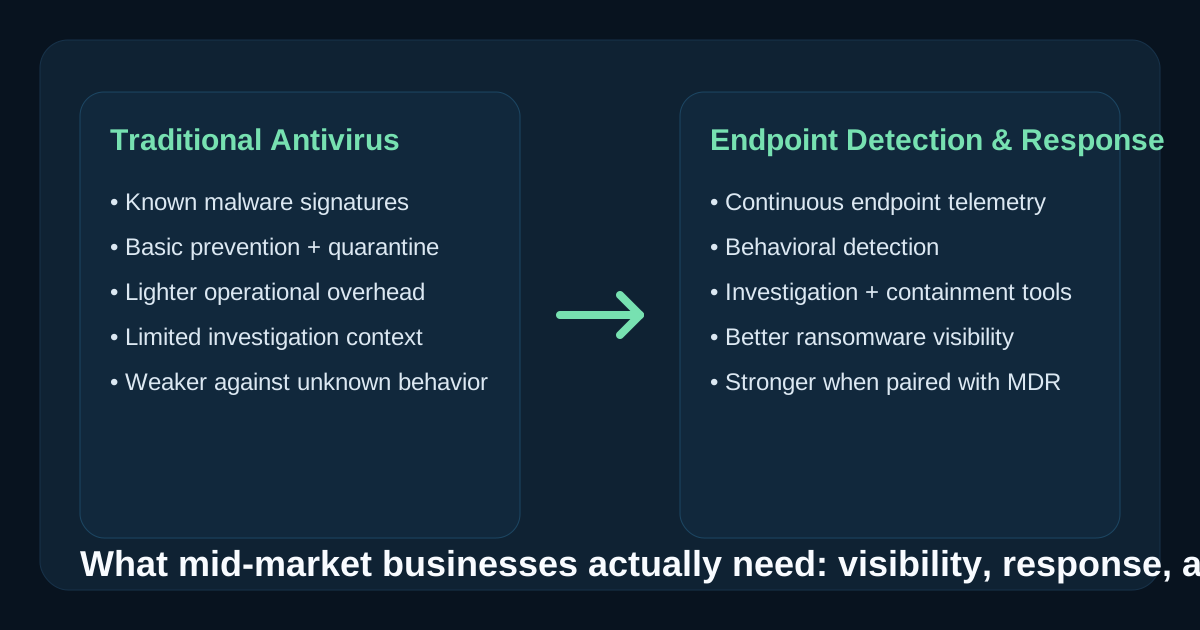

What is the difference between endpoint detection and response and antivirus?
The practical difference between endpoint detection and response vs antivirus is that antivirus is mostly built to prevent and remove known malware, while EDR is built to continuously watch endpoint behavior, detect suspicious activity, and help a team investigate and contain threats that do not look like yesterday’s malware sample.12
That distinction matters because most mid-market businesses are not struggling with whether they have any security software. They are struggling with whether their current stack can actually catch modern attacks early enough to matter. A traditional antivirus agent can still play a useful role in baseline prevention, but it usually does not give your IT team the timeline, telemetry, or containment tools needed when ransomware, credential abuse, suspicious PowerShell use, or lateral movement shows up inside the environment.12
We think the more useful question is not “Which buzzword should we buy?” It is: what level of endpoint visibility, response capability, and staffing support does your business actually need to reduce operational risk?
How traditional antivirus still helps
Traditional antivirus remains good at a narrow but important job. It compares files, processes, and known indicators against signature databases and reputation models, then blocks or quarantines activity that matches known malicious patterns.2
That still helps with:
- commodity malware and known malicious executables
- basic prevention at the endpoint layer
- lightweight security coverage for low-risk devices
- simple compliance expectations where a baseline agent is required
For some organizations, that baseline is better than nothing. But mid-market companies usually need to think beyond whether a threat is known already. Attackers increasingly rely on fileless techniques, credential theft, living-off-the-land tools, remote admin abuse, and ransomware stages that are harder to catch with signature-heavy controls alone.12
In other words, antivirus is often a prevention layer. It is rarely a complete endpoint security operating model.
What EDR adds that antivirus usually does not
EDR changes the job from simple prevention to prevention plus visibility, detection, investigation, and containment. Instead of checking only whether a file looks malicious, EDR records and analyzes endpoint behaviors such as process execution, registry changes, network connections, persistence activity, and unusual parent-child process chains.2
That broader telemetry matters because it helps teams answer questions antivirus often cannot answer well on its own:
- What exactly ran on the endpoint?
- When did suspicious behavior start?
- Which user account was involved?
- Did the process reach out to a malicious domain or move laterally?
- Can we isolate the device before the rest of the environment is affected?
That is why EDR is generally better suited for:
Detecting suspicious behavior earlier
Behavioral detections can catch activity that does not yet have a neat malware signature attached to it. If a script suddenly starts dumping credentials, modifying autoruns, or encrypting large numbers of files, EDR platforms are more likely to flag the behavior pattern before the incident spreads.12
Giving responders real investigation context
During an incident, teams need more than a red banner that says “threat blocked.” They need event context, timelines, related process trees, device history, and enough forensic detail to understand whether the issue was isolated or part of a bigger compromise. EDR produces far more of that evidence than traditional antivirus does.12
Containing an incident quickly
Many EDR platforms can isolate a host, terminate a process, quarantine files, or support guided remediation once suspicious activity is confirmed. That is a huge operational difference when the alternative is waiting for an overloaded internal team to manually remote in and guess what happened.2
Why this matters so much for mid-market businesses
Mid-market companies sit in an awkward spot. They are large enough to be worthwhile targets, but they often do not have a full internal SOC, round-the-clock analyst coverage, or enough spare engineering capacity to tune and monitor a complex stack continuously.13
We see three recurring problems in that segment.
1. Security tooling outpaces staffing
A business may buy an advanced endpoint product and still get limited value if nobody has time to tune detections, review noisy alerts, and investigate suspicious activity promptly. EDR is powerful, but it works best when someone owns the workflow behind it.24
2. Alert fatigue hides the real problem
If your team already feels buried by Microsoft 365, firewall, backup, and helpdesk noise, adding endpoint alerts without a response process can create another dashboard instead of a safer environment. Tooling alone does not close the operational gap.
3. Incident response is often under-defined
The real question is not whether the platform can isolate a device. It is whether your organization knows when to isolate, who approves it, how finance or operations gets notified, and what the fallback is if a clinical workstation, line-of-business device, or remote executive laptop is affected.
That is why the right answer for many organizations is not simply “buy EDR.” It is “build an endpoint security plan that includes EDR, ownership, escalation, and response support.”
Should a mid-market business replace antivirus with EDR?
Usually, the better answer is not a clean replacement decision. It is a layered approach.
Antivirus still has value as a first-pass prevention control. EDR adds the visibility and response depth needed when prevention is bypassed. Used together, they can create a more resilient endpoint stack than either one by itself.2
A mid-market organization should usually lean toward EDR or a modern managed endpoint platform when:
- ransomware exposure is a serious business risk
- remote and hybrid work have expanded the endpoint attack surface
- the business handles regulated or sensitive data
- leadership expects faster containment and cleaner incident evidence
- the current team cannot confidently investigate endpoint activity today
That is especially true for businesses already investing in managed cybersecurity services, security awareness training, or a broader cyber incident tabletop exercise checklist. Endpoint coverage works better when it is part of an overall response model rather than a stand-alone license.
What does a practical endpoint security model look like?
For most mid-market teams, a practical endpoint security model includes five pieces:
A prevention layer
Use antivirus or endpoint protection to stop known bad activity quickly and consistently.
An EDR layer
Capture the telemetry and behavioral detections you need for suspicious activity, deeper investigations, and host-level containment.
A triage workflow
Define who reviews alerts, what severity levels mean, how after-hours alerts are handled, and when outside help is pulled in.
A response playbook
Document when to isolate devices, reset credentials, preserve evidence, notify leadership, and escalate to legal, compliance, or cyber insurance partners.
The right operating support
If your internal team is lean, pair EDR with MDR or another managed monitoring model so someone is actually watching for suspicious activity after 5 PM, on weekends, and during vacations.13
That last point is the part many businesses miss. If no one is watching or responding, an advanced tool can still underperform badly.
EDR vs antivirus: what should leadership actually budget for?
Leadership teams should budget for more than software. The real cost drivers are usually:
- licensing and endpoint coverage scope
- implementation and policy tuning
- alert review and response labor
- MDR or outside monitoring support
- device remediation and cleanup time during incidents
- user disruption when a host needs to be isolated or rebuilt
A lot of buying mistakes happen when a business compares a basic antivirus subscription to an EDR platform and decides the EDR cost looks high in isolation. That is the wrong frame. The better comparison is whether the business can afford a ransomware event, prolonged endpoint dwell time, or a major investigation without the visibility to understand what happened.
That is also why we often steer clients back to business-risk questions first: what systems matter most, what evidence would you need during an incident, and how much downtime can the organization tolerate before the endpoint tooling decision stops being academic?
What Datapath recommends for mid-market teams
We generally recommend that mid-market organizations treat antivirus as baseline hygiene and evaluate EDR based on the realities of their environment: remote users, privileged access sprawl, regulatory obligations, cyber insurance expectations, and internal response maturity.
If your internal team is small, the best-fit answer is often EDR plus managed monitoring and a clear response workflow, not EDR by itself. That combination gives you a stronger chance of catching suspicious activity early and doing something useful with the signal when it appears.
If you are already trying to reduce downtime, clarify ownership, and improve your response posture, this discussion usually ties into broader work around Microsoft 365 security best practices for mid-market businesses, ransomware incident response planning, and your overall managed IT services strategy.
Frequently Asked Questions
Is EDR better than antivirus?
EDR is generally better than traditional antivirus for detecting suspicious behavior, supporting investigations, and containing modern attacks. Antivirus is still useful for blocking known malware, but it usually does not provide the same visibility or response depth.12
Do mid-market businesses still need antivirus if they have EDR?
Usually yes. Antivirus still helps with baseline prevention, while EDR adds behavioral detection and response capability. Many organizations benefit from using both as part of a layered endpoint defense.2
Does EDR require more staff than antivirus?
Yes. EDR typically requires more tuning, monitoring, and investigative follow-through than antivirus. That is one reason many mid-market businesses pair EDR with MDR or outside security support.13
What is the biggest mistake when comparing EDR vs antivirus?
The biggest mistake is treating it as a pure software feature comparison instead of an operating-model decision. The real issue is whether your business can detect, investigate, and respond to endpoint threats fast enough when prevention fails.
Sources
- Meriplex: Endpoint Management Best Practices for Mid-Market IT Teams
- Palo Alto Networks: What is EDR vs. Antivirus?
- Red Canary: EDR vs. MDR vs. XDR
- The Hacker News: How to Secure Your Mid-Market Business Across …
- SentinelOne: EDR vs. XDR vs. Antivirus