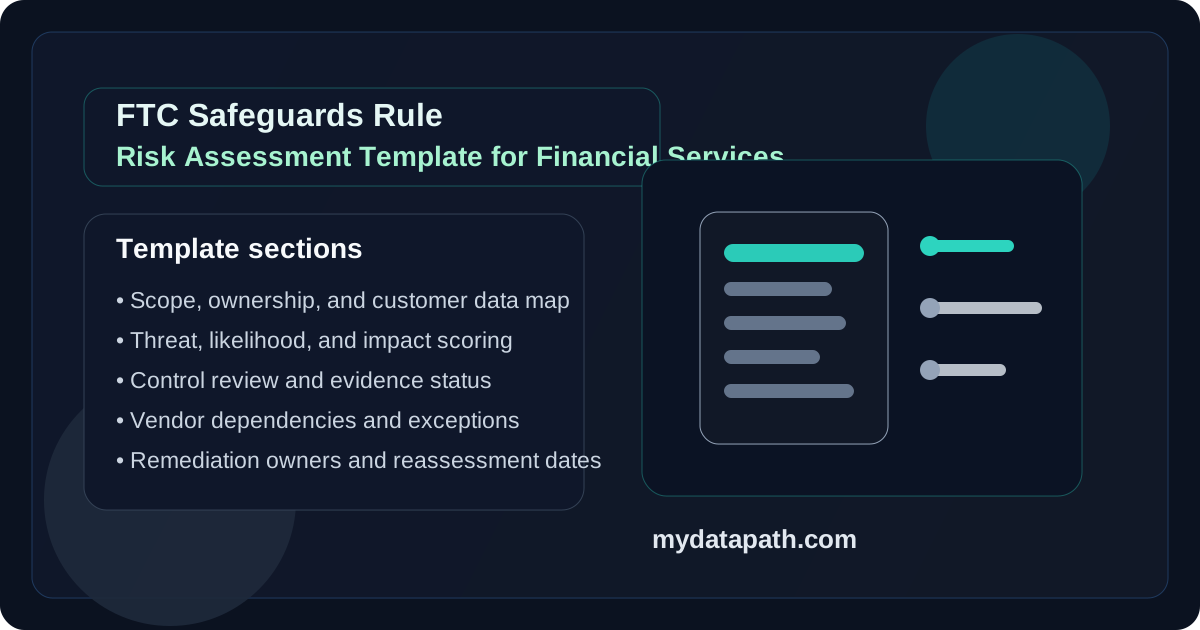

What should an FTC Safeguards Rule risk assessment template include?
An effective FTC Safeguards Rule risk assessment template should document scope, customer-information inventory, data flows, internal and external threats, vulnerability review, risk-scoring criteria, existing safeguards, remediation priorities, vendor dependencies, and reassessment triggers. The template should help a financial services team prove not only that it identified risk, but also that it can explain ownership, evidence, and next actions clearly.12
That matters because the Safeguards Rule is not asking teams to buy random security tools and call it compliance. It requires covered financial institutions to develop, implement, and maintain a written information security program that is appropriate to the size and complexity of the business and the sensitivity of the customer information involved.1 If the risk assessment is weak, the rest of the program is usually weak too.
For Datapath’s audience, the practical question is not “Do we have a template somewhere?” It is “Does our template help leadership understand where customer information lives, what could go wrong, which controls are actually working, and what gets fixed next?”
Why does the FTC Safeguards Rule put so much weight on the risk assessment?
Because the risk assessment is the foundation for the rest of the information security program. The FTC explains that an institution cannot formulate an effective program until it knows what customer information it has, where it is stored, and what foreseeable risks threaten its confidentiality, integrity, and availability.1
A lot of financial services teams already have security tooling in place. They may have MFA, backups, endpoint controls, email filtering, logging, or vendor questionnaires. But if those controls are not tied back to a written risk assessment, the environment becomes harder to govern. Controls drift. Exceptions accumulate. Ownership gets fuzzy. Audit prep turns into a scramble.
That is why we recommend treating the template as an operating document, not a one-time worksheet. It should connect compliance, security operations, and executive accountability.
If your organization is reviewing broader support and governance gaps around regulated-industry IT, our financial services solutions page and managed IT services overview can help frame the bigger operating model around those controls.
What should the template define before risk scoring starts?
The first section should establish scope and governance before anyone starts listing threats. That means documenting:
- which legal entities and business units are in scope
- which systems handle customer information
- which categories of nonpublic personal information are involved
- who owns the assessment
- who reviews it
- what business or technology changes trigger an update
This sounds basic, but it is where many assessments go wrong. Teams often jump directly into technical findings without defining whether the assessment covers one line of business, an affiliate, a branch environment, a cloud stack, or the whole institution. A vague scope statement leads to vague risk decisions.
We also recommend identifying the Qualified Individual or equivalent security owner up front, even if outside support helps run the program. The Rule makes clear that responsibility stays with the covered institution.1
What customer-information and asset inventory should the template capture?
The template should require a clear inventory of customer information, systems, applications, storage locations, transmission paths, backup locations, and vendors that touch or materially affect that information. The FTC’s own guidance emphasizes that you need to know what information you have and where it is stored before you can build an effective program.1
A practical inventory section should answer:
- What customer information do we collect?
- Where is it created, transmitted, stored, archived, and destroyed?
- Which users, teams, vendors, and service accounts can access it?
- Which locations, cloud platforms, and SaaS tools are involved?
- Which systems are most critical to secure operations and customer trust?
For financial services teams, this usually includes more than the core line-of-business platform. Customer information often touches Microsoft 365, shared file repositories, cloud backups, endpoint devices, CRM systems, loan or advisory platforms, secure messaging tools, tax workflows, document-signing systems, and vendor-managed support paths.
That is one reason this post pairs well with our existing resources on GLBA Safeguards Rule checklist, PCI DSS compliance checklist, and FINRA cybersecurity checklist. The same operational blind spots tend to show up across all of them.
How should the template evaluate foreseeable risks and threats?
The template should include written criteria for evaluating and categorizing foreseeable internal and external threats, along with a consistent way to assess likelihood and impact. The FTC specifically says the written risk assessment must include criteria for evaluating risks and threats.13
A useful threat-evaluation section should look at categories such as:
| Risk area | What the template should ask | Why it matters |
|---|---|---|
| Unauthorized access | Where could credentials, sessions, or privilege paths be abused? | Customer information is often exposed through account misuse before malware is involved |
| Data exposure | Where could information be misused, altered, or disclosed improperly? | Regulatory, legal, and reputational damage can follow quickly |
| Vendor risk | Which third parties could introduce or expand customer-information risk? | Financial firms depend heavily on outside platforms and support providers |
| Resilience gaps | What failures would disrupt access, recovery, or secure operations? | Availability issues can create both business and compliance problems |
| Process weaknesses | Where do approvals, reviews, or exception handling break down? | Weak governance turns technical gaps into recurring risk |
This is where a template becomes genuinely useful. It forces the team to move beyond generic statements like “phishing is a risk” and instead define the specific pathways that matter in that environment: privileged Microsoft 365 access, stale admin accounts, unreviewed vendor access, inconsistent encryption, untested restore paths, or shadow IT.
What should the template require for control review and vulnerability analysis?
It should require the team to assess whether existing safeguards are actually sufficient for the risks identified. The Rule is not just about spotting threats. It is also about evaluating the safeguards in place to control those risks and adjusting the program when they are not enough.14
A strong template should prompt review of:
- identity and access control
- MFA coverage and exceptions
- encryption at rest and in transit
- endpoint and server protection
- email security and phishing controls
- logging, alerting, and event review
- vulnerability and patch management
- secure disposal and retention practices
- incident response readiness
- backup, recovery, and resilience validation
The key is evidence. “We have MFA” is not the same as documenting which systems enforce it, where exceptions exist, who approved them, and how the team reviews drift. “We have backups” is not the same as documenting which systems are backed up, whether customer information is included, how immutable or isolated copies are handled, and whether restores are tested.
How should the template turn findings into action?
The best FTC Safeguards Rule risk assessment template does not stop at a score. It creates a remediation plan with owners, timelines, dependencies, and reporting. If the output is just a risk register with no operating follow-through, teams tend to repeat the same findings every review cycle.
We recommend a remediation section with these fields:
- risk statement
- affected systems or data classes
- current safeguard status
- residual risk rating
- required action
- business owner
- technical owner
- target date
- evidence required for closure
- escalation path if the item remains open
This is also where leadership visibility matters. A template should support short executive reporting, not just technical notes. For example, financial services leaders usually want to understand:
- which risks materially affect customer information
- which items depend on vendors or budget approval
- which control gaps are creating audit exposure
- which open exceptions have been accepted and by whom
That kind of reporting is what separates a compliance exercise from a security program that management can actually steer.
What should the template include for vendors and service providers?
The template should identify service providers that handle customer information or can materially affect its security, then document the risk they introduce, the controls they own, and how oversight is performed. The FTC expects institutions to oversee service providers as part of the broader program.1
For most financial services teams, this section should capture:
- provider name and business function
- systems or data involved
- access pathways and privilege level
- contract or security requirement references
- due-diligence status
- review cadence
- incident-notification expectations
- known gaps or dependencies
This is one of the most common places where accountability breaks down. A provider may be “handling security” in some areas while internal teams assume coverage exists somewhere else. The template should make those boundaries explicit.
How often should the assessment be updated?
It should be reviewed periodically and refreshed whenever material business, system, personnel, vendor, or threat changes occur. The FTC guidance specifically calls for periodic reassessment as operations and threats evolve.1
In practice, reassessment should be triggered by events such as:
- major system migrations or cloud changes
- mergers, acquisitions, or branch expansion
- new third-party platforms or outsourced support models
- serious incidents or near misses
- changes in customer-information handling
- material audit findings
- major workforce or access model changes
An annual review may satisfy the minimum rhythm for some organizations, but a static once-a-year approach is rarely enough for teams moving fast or managing multiple platforms and providers.
Why Datapath for FTC Safeguards Rule risk assessment support?
We think the most effective risk assessment work makes security easier to run, not just easier to defend in a meeting. For financial services organizations, that usually means clearer ownership, cleaner documentation, stronger vendor accountability, and a more realistic view of where customer-information risk actually sits.
If your team is trying to move from scattered controls to a program with governance and follow-through, start with the Datapath homepage, explore our financial services solutions, review our resources and guides hub, or talk with our team about where your current model is creating the most compliance and operational friction.
Frequently Asked Questions
Does the FTC Safeguards Rule require the risk assessment to be written?
Yes. The FTC states that the risk assessment must be written and must include criteria for evaluating risks and threats to customer information.1
What is the biggest mistake teams make with an FTC Safeguards Rule risk assessment template?
Usually it is treating the template like static paperwork. A useful template should drive inventories, control review, remediation ownership, vendor oversight, and reassessment triggers instead of stopping at a generic list of threats.
Should the template include vendor risk?
Yes. If service providers handle customer information or materially affect its security, the assessment should capture their role, access, obligations, review cadence, and incident responsibilities.1
How is this different from a general cybersecurity risk assessment?
A general cybersecurity assessment may focus broadly on technical risk. An FTC Safeguards Rule risk assessment is narrower and more explicit about protecting customer information, documenting criteria, and supporting a written information security program for covered financial institutions.12
Sources
- FTC Safeguards Rule: What Your Business Needs to Know
- 16 CFR Part 314 — Standards for Safeguarding Customer Information
- Federal Register: Standards for Safeguarding Customer Information
- CSBS FTC Safeguards Rule Compliance Checklist
