
What should financial services firms include in a PCI DSS compliance checklist?
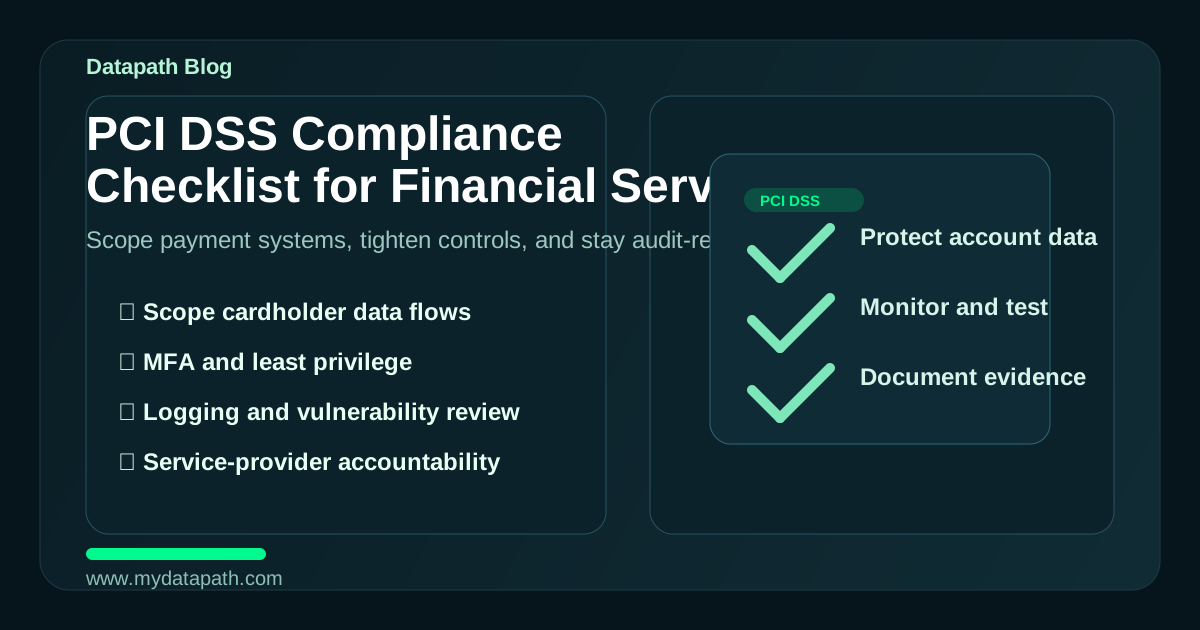
A strong PCI DSS compliance checklist for financial services should cover scope, cardholder data flows, access control, MFA, system hardening, vulnerability management, logging, testing, service-provider oversight, and evidence collection. The point is to make sure payment systems and the people around them can protect cardholder data consistently.12
That matters because PCI DSS applies broadly to entities that store, process, or transmit cardholder data and to systems that could impact the security of the cardholder data environment. In practice, the biggest problems usually start before the audit: unclear scope, weak ownership, incomplete logging, or undocumented third-party dependencies.
In our experience, financial services teams get better outcomes when they treat PCI DSS as an operating model for payment security.
Why does scoping come first in a PCI DSS checklist?
Scoping comes first because a PCI program gets expensive, messy, and hard to defend when the business does not know exactly which systems, applications, vendors, and connections can affect cardholder data security. The PCI Security Standards Council describes PCI DSS as a baseline of technical and operational requirements designed to protect payment account data, and it applies not only to systems holding card data directly but also to systems that could impact the security of the cardholder data environment.1
The first checklist item should not be “run scans.” It should be “map the environment.” Start with:
- payment flows from intake through authorization, storage, transmission, and settlement
- in-scope applications, databases, endpoints, and network segments
- administrative jump points and remote-access paths
- cloud workloads and SaaS platforms tied to payment operations
- third-party service providers with access to payment systems
- backup, logging, and support systems that can affect the cardholder data environment
Ready.gov makes the same broader planning point for recovery programs: build an inventory of hardware, applications, and data, then prioritize restoration around business needs.3 PCI work benefits from the same discipline. If the environment is not mapped cleanly, the controls that follow are usually weaker than leadership realizes.
What are the main control areas every PCI DSS checklist should cover?
Every practical PCI DSS compliance checklist should be organized around the major control themes that keep payment environments defensible: network security, secure configuration, protection of account data, access management, monitoring, security testing, and governance. The exact validation path may differ by merchant level, service-provider obligations, or acquiring-bank requirements, but the control logic is consistent.14
A working checklist should include:
| Checklist area | What the team should verify | Why it matters |
|---|---|---|
| Scope and segmentation | In-scope systems, connections, and trusted paths are documented | Reduces surprise exposure and unnecessary audit sprawl |
| Account data protection | Storage, transmission, retention, and masking rules are defined | Limits unnecessary exposure of payment data |
| Access control | MFA, least privilege, unique IDs, and prompt deprovisioning are enforced | Reduces unauthorized access risk |
| Secure configuration | Default settings are removed and systems are hardened | Prevents easy exploitation |
| Vulnerability management | Patching, anti-malware, scanning, and remediation workflows are running | Keeps known weaknesses from piling up |
| Logging and monitoring | Security events are captured, reviewed, and retained | Makes detection and evidence collection possible |
| Testing | Internal review, segmentation validation, scans, and other required testing are scheduled | Proves controls work in practice |
| Service-provider oversight | Providers are identified, reviewed, and contractually accountable | Prevents inherited third-party gaps |
| Policies and evidence | Owners, procedures, approvals, and proof of operation are current | Makes validation and ongoing governance realistic |
What should the checklist require for cardholder data protection and segmentation?
The checklist should require the business to minimize where account data is stored, document where it moves, protect it during transmission, and review whether segmentation actually reduces scope the way leadership thinks it does. PCI DSS is built around protecting payment account data, so the safest environment is usually the one that stores less of it and exposes fewer connected systems.14
For most financial services environments, we recommend verifying:
- whether cardholder data is stored at all, and if so, where and why
- which systems transmit payment data internally or to processors
- whether strong encryption is used where required
- whether PAN display and retention are limited by role and business need
- whether segmentation boundaries are documented, tested, and still accurate after infrastructure changes
- whether vendor remote access crosses into the cardholder data environment
This is also where a lot of false confidence shows up. Teams may assume a payment platform is outsourced, so PCI scope must be tiny. Sometimes that is true. Sometimes supporting identity systems, administrative access paths, logging platforms, or endpoint tools still matter. That is why we tie PCI work back to Datapath’s financial services page and our SOC 2 compliance checklist.
What should the checklist require for access control, MFA, and user accountability?
The checklist should require unique user identification, role-based access, least privilege, MFA for administrative and remote access, prompt deprovisioning, and recurring review of privileged accounts. In financial services, weak identity discipline is one of the fastest ways to turn a contained payment environment into a much larger security problem.
A useful access checklist includes:
- unique IDs for anyone with access to in-scope systems
- MFA enforced for administrators, remote access, and other high-risk access paths
- approvals for new access and privilege changes
- recurring review of privileged accounts
- separation of duties where payment operations and administration intersect
- immediate removal or change of access when roles change or employment ends
NIST’s Cybersecurity Framework 2.0 reinforces the same operational idea: cybersecurity should be managed through repeatable governance, identity, protection, detection, and improvement practices rather than one-off fixes.5 For PCI, that means user accountability cannot live only in policy text. It has to show up in workflows, logs, and approvals.
What should the checklist require for vulnerability management, logging, and testing?
The checklist should require a real operating rhythm for patching, anti-malware where applicable, authenticated or otherwise appropriate scanning, security-event logging, alert review, and recurring testing of the environment. If scoping defines the environment, this section proves whether the environment is actually being maintained.
We usually recommend verifying that the program has:
- documented patching timelines based on severity and exposure
- anti-malware or equivalent protections where relevant
- internal and external vulnerability scanning aligned to PCI obligations
- log collection for critical in-scope systems and security tooling
- alert review procedures with named owners
- file-integrity or change-monitoring controls where required
- periodic verification that segmentation and remote-access assumptions still hold
- evidence that failed findings are tracked through remediation, not just acknowledged
The best monitoring programs are not built to impress an assessor. They are built to help the business catch misuse, compromise, drift, and control failure early enough to do something about it.
How should financial services firms handle service providers, validation, and evidence?
Financial services firms should treat service-provider management as part of the PCI checklist, not a separate procurement issue. Many environments rely on payment platforms, cloud providers, MSSPs, managed IT partners, and software vendors that can affect the security of the cardholder data environment. If responsibilities are blurry, controls get missed.
A practical checklist should confirm:
- which providers can access, store, process, or influence payment systems
- which controls the provider owns versus which controls remain internal
- whether contracts and onboarding documents reflect those responsibilities
- whether the provider can supply current compliance or security documentation when needed
- whether incident escalation paths and after-hours contacts are documented
- whether the business has a process for reviewing provider changes over time
This is also the right place to confirm the validation path. Depending on transaction profile and program requirements, the organization may need self-assessment, external scanning, a Qualified Security Assessor, or a fuller Report on Compliance process.14 The team should know what validation model applies, who owns it, what evidence is needed, and when it has to be delivered.
Evidence collection should be continuous. We recommend tying each checklist item to:
- the control owner
- the system of record
- the review cadence
- the evidence format
- the storage location
- the escalation path if the control fails
That simple map reduces audit friction dramatically.
What should the first 90 days of a stronger PCI DSS program look like?
In the first 30 days, the team should inventory payment flows, define scope, identify system owners, and confirm the validation path. In days 31 through 60, the focus should shift to access cleanup, logging review, vulnerability-management discipline, and service-provider responsibility mapping. In days 61 through 90, the organization should test key controls, close obvious gaps, and produce leadership-ready reporting on what remains exposed.
A practical 90-day plan:
- Map cardholder data flows and connected systems.
- Confirm which systems are actually in scope.
- Review privileged access, MFA, and remote administration.
- Validate patching, scanning, and logging coverage.
- Review service-provider responsibilities and supporting evidence.
- Test recovery and incident procedures tied to payment operations.
- Build a recurring evidence calendar instead of waiting for the next assessment window.
Ready.gov recommends testing recovery plans periodically to confirm they work.3 PCI programs benefit from the same mindset. Recovery capability, incident response, and control documentation should all be part of one operating discipline rather than separate projects.
Why Datapath for PCI DSS readiness in financial services?
We approach PCI DSS readiness the same way we approach broader compliance and managed IT work: by connecting control requirements to how the environment is actually run. The goal is not to create audit theater. It is to reduce scope where appropriate, tighten the controls that matter, make evidence easier to produce, and give leadership a clearer view of operational risk.
For financial services teams juggling uptime, compliance, third-party risk, and limited internal bandwidth, that usually means building a stronger operating rhythm around payment systems instead of trying to patch everything together right before validation. If your team needs help tightening your control model, clarifying provider responsibilities, or preparing for the next assessment cycle, start with the Datapath homepage, review our financial services solutions, or talk with our team about what a realistic PCI roadmap should look like.
Frequently Asked Questions
What is a PCI DSS compliance checklist?
A PCI DSS compliance checklist is a working list of technical, administrative, and operational controls used to protect cardholder data and prepare for validation. It usually covers scope, access control, encryption, monitoring, testing, vendor oversight, and evidence collection.
Who needs to follow PCI DSS?
PCI DSS applies to entities that store, process, or transmit cardholder data, as well as systems that can impact the security of the cardholder data environment. That can include merchants, processors, service providers, and supporting platforms connected to payment workflows.1
Is PCI DSS only about firewalls and scans?
No. Network security and scanning matter, but PCI DSS also depends on identity controls, secure configuration, account-data protection, logging, testing, policy discipline, and service-provider accountability. A narrow technical checklist usually misses the operating gaps that create audit trouble.
How often should PCI controls be reviewed?
Review cadence depends on the control, but high-impact controls such as access, patching, logging, scanning, and service-provider oversight should be reviewed on a recurring schedule throughout the year. Teams that wait until right before validation usually create more remediation work and more audit friction.
What is the biggest mistake financial services firms make with PCI DSS?
The biggest mistake is poor scoping. When the business does not understand where payment data flows, which systems can affect the environment, and which providers own which controls, every other part of the checklist gets harder and less reliable.
Sources
- PCI Security Standards Council: PCI DSS overview
- PCI SSC Document Library
- Ready.gov: IT Disaster Recovery Plan
- NIST Cybersecurity Framework 2.0
- Datapath Financial Services IT Solutions