
What should a municipal IT continuity plan include?
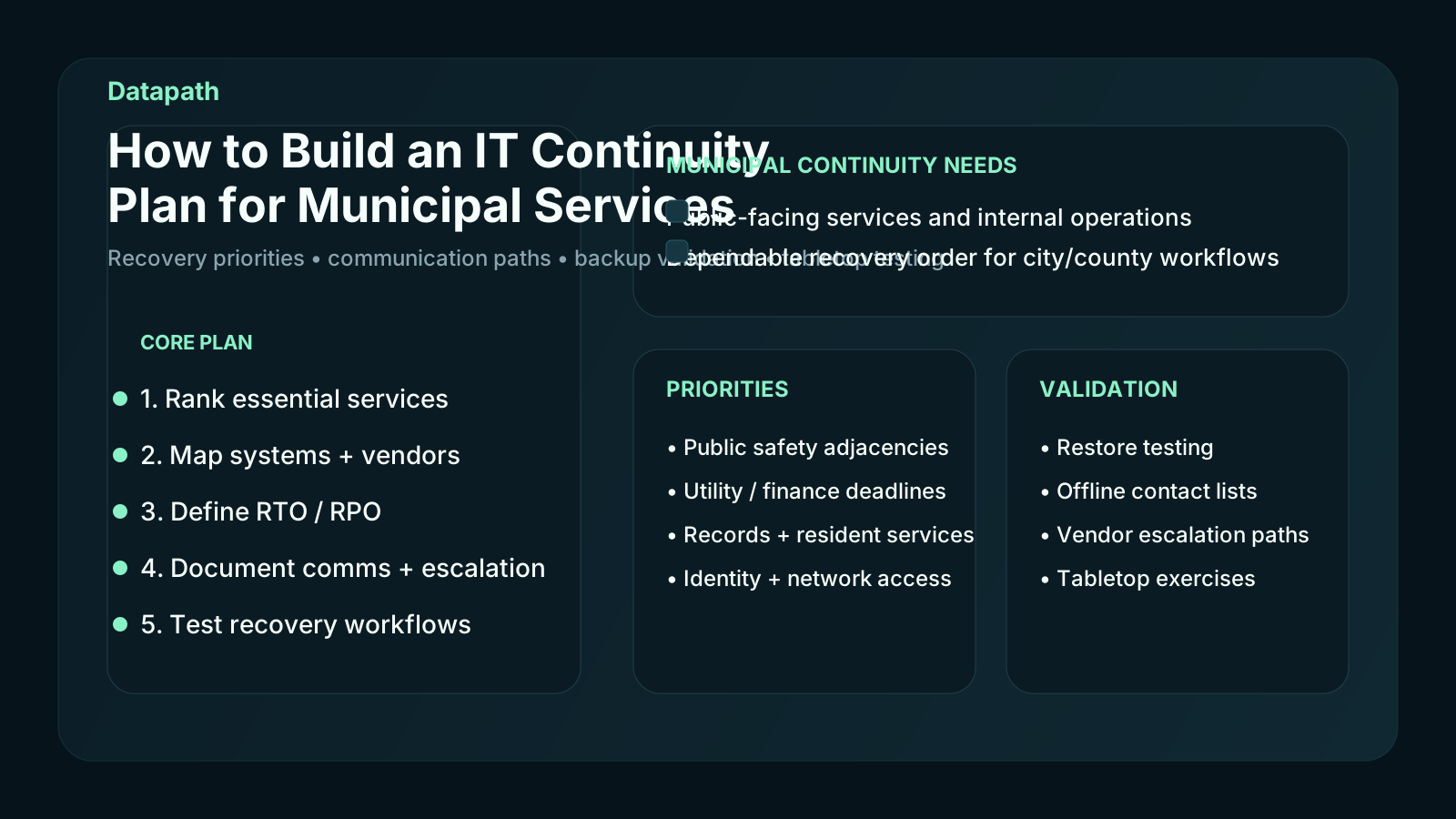
You build an IT continuity plan for municipal services by ranking essential public services, mapping the systems and vendors that support them, defining recovery objectives, documenting response and communication workflows, and testing the plan before a real disruption forces improvisation. For city and county teams, the goal is not just restoring servers. The goal is keeping public-facing operations moving when a cyberattack, outage, hardware failure, or regional emergency disrupts normal conditions.12
That distinction matters because municipal continuity planning sits at the intersection of technology, public accountability, and operational resilience. If email goes down at a private company, the damage may be mostly internal. If identity systems, dispatch-adjacent workflows, utility billing, permitting, remote access, or records systems fail at a municipality, the disruption can affect residents, staff, elected leadership, and third-party agencies all at once. In our experience, the strongest plans are not the longest plans. They are the clearest ones.
At Datapath, we recommend treating continuity planning as a practical operating framework for public-sector IT. That means aligning your managed IT services, city government IT guidance, municipal modernization priorities, CJIS planning work, and ransomware recovery planning into one usable playbook instead of a stack of disconnected documents.
Need a municipal continuity plan that can be tested?
Datapath helps city, county, public works, special district, and public-agency teams connect service priorities, backups, vendors, communications, tabletop exercises, and recovery evidence.
Which municipal continuity need maps to a Datapath service?
Searches for municipal IT continuity plans usually mean one of three things: the agency needs official planning structure, the IT team needs a disaster recovery operating model, or leadership needs proof that citizen-facing services can keep moving during disruption.
| Search intent | What the team needs | Datapath path |
|---|---|---|
| Municipal IT continuity plan checklist | A practical plan for essential services, RTO/RPO, vendors, backups, communications, and exercises | Government IT services |
| Disaster recovery business continuity planning for local government | A recovery model that connects backup validation, service priority, vendor escalation, and leadership reporting | Disaster recovery services |
| Public sector workflow interruption | Degraded-mode procedures for permitting, utilities, finance, records, communications, and public works | Managed IT services |
| CISA local government backup and tabletop guidance | Official-source planning translated into restore tests, offline communications, and exercise follow-up | Incident response retainer services |
| CJIS or public-safety continuity dependencies | Access, audit, response, and recovery planning for law-enforcement-adjacent systems | CJIS compliance services |
NIST SP 800-34 frames contingency planning as a structured way to evaluate information systems, operations, requirements, and priorities.2 CISA’s public-sector resources add the practical ransomware lens: protect government data with regular backups, keep recovery evidence current, and exercise the plan before a disruption makes the decisions harder.34
Why does municipal IT continuity planning need a different approach?
Municipal IT continuity planning needs a different approach because public-sector environments usually support a wider mix of critical services, legacy systems, external agencies, and public expectations than a standard office network. A city or county may be managing finance, public works, council operations, records retention, utility processes, law-enforcement-adjacent platforms, GIS, payment systems, and citizen-facing portals at the same time. That creates more dependencies and less room for confusion during disruption.15
Municipal continuity is about essential services, not just infrastructure
A lot of organizations accidentally write an infrastructure recovery document and call it a continuity plan. The document explains backups, servers, and failover steps, but it never answers the more important municipal questions:
- Which public services must stay available first?
- Which departments can operate manually for a day, and which cannot?
- Who communicates with department heads, vendors, elected leadership, and residents?
- Which systems have legal, regulatory, or public-safety implications if recovery is delayed?
- What workarounds are acceptable while systems are being restored?
That is why we recommend starting with service continuity rather than technology inventory alone. Public-sector planning guidance consistently reinforces that continuity depends on identifying critical functions, dependencies, backup and recovery principles, and alternative processing paths before an incident occurs.125
Municipal systems often depend on a web of vendors and legacy workflows
City and county IT teams rarely control every system end to end. Critical operations may depend on cloud platforms, line-of-business vendors, telecom carriers, backup providers, managed service partners, and outsourced security tooling. In older environments, recovery can also hinge on undocumented integrations, long-tenured staff knowledge, or manual workarounds that only a few people understand.
That is exactly why a continuity plan should include vendor coordination, contract contacts, alternate processing options, and fallback communication methods. If the plan only covers what the internal IT team touches directly, it will probably fail during the first serious multi-vendor incident. We see the best results when municipalities define ownership across internal staff and outside providers in advance instead of discovering the escalation path under pressure.
Public trust raises the cost of confusion
Municipal disruptions are operational events, but they are also trust events. Residents do not care whether the root cause was ransomware, a failed switch, a cloud outage, or an ISP problem. They care whether services are available, whether leaders appear in control, and whether communication is timely and credible.
That is why we recommend continuity plans that tie technical recovery to decision-making and communications. Ready.gov, NIST, and state continuity frameworks all point toward the same idea: continuity planning should reduce reactive decision-making, not just improve restoration mechanics.125
What should an IT continuity plan for municipal services include?
An IT continuity plan for municipal services should include critical-service prioritization, a business impact analysis, system and vendor dependencies, RTO and RPO targets, backup and recovery expectations, communication workflows, emergency roles, and a testing schedule. If those elements are missing, the municipality may have technical notes, but it does not yet have a reliable continuity plan.123
1. A ranked list of essential municipal services
Start by listing the services that matter most to the continuity of government and resident operations. We usually recommend sorting them into tiers such as:
| Priority tier | Typical municipal examples | Continuity question |
|---|---|---|
| Tier 1 | emergency communications support, utility operations, payroll deadlines, core records access, cybersecurity response coordination | What must recover first to avoid major public or operational harm? |
| Tier 2 | permitting, citizen request systems, finance workflows, council support, email-dependent departmental workflows | What can pause briefly but not for long? |
| Tier 3 | lower-urgency internal tools, archival access, noncritical convenience systems | What can wait until core services stabilize? |
This exercise is where continuity planning becomes real. It forces the municipality to decide what is truly essential rather than assuming every system has equal recovery priority.
2. Business impact analysis with realistic RTO and RPO targets
Once services are ranked, define the business impact of disruption and assign recovery objectives. Two of the most important measurements are:
- RTO (Recovery Time Objective): the maximum tolerable downtime for a service or system
- RPO (Recovery Point Objective): the maximum acceptable amount of data loss between the last usable recovery point and the disruption3
Municipal teams should not set these numbers in a vacuum. They should be tied to real service outcomes. If a finance platform misses payroll, if a records system blocks statutory work, or if a public-works workflow stalls, the impact is operational and reputational. In our experience, municipalities get better RTO and RPO decisions when department leaders help define what “too long” and “too much data loss” actually mean in business terms.
3. Dependency mapping for systems, people, sites, and vendors
A continuity plan should identify not just critical systems, but what those systems depend on. That includes:
- identity and authentication
- internet and network connectivity
- cloud platforms and SaaS vendors
- endpoint access and secure remote access
- backups and restoration tooling
- key staff roles and alternates
- telecom, hosting, and infrastructure partners
- physical site access, power, and environmental dependencies
Many recovery failures happen because a municipality restores the application but forgets the dependency chain around it. A line-of-business tool may be technically online, but if authentication, DNS, internet access, or a key vendor contact path is broken, the service is still effectively down.
4. Communication and escalation workflows
Every continuity plan should answer who declares the incident, who approves failover or emergency workarounds, who notifies department leadership, and how outside parties are engaged. We recommend documenting:
- incident severity thresholds
- internal notification paths
- executive and department-head contact lists
- vendor escalation contacts
- resident communication ownership where applicable
- alternate communications if email or collaboration tools are unavailable
This is especially important in municipal environments where multiple departments may be affected differently by the same outage. A continuity plan should create a shared response language, not leave each team guessing.
How should municipal IT teams build and maintain the plan?
Municipal IT teams should build the plan through a repeatable process: assess risk, define priorities, document recovery workflows, validate backups, test assumptions, and update the plan whenever systems or services materially change. The plan should behave like an operating document, not a shelf document.254
Start with the systems most likely to create public or regulatory pain
We usually recommend building around the highest-consequence workflows first. That often means focusing on the systems that support public operations, regulated data, financial deadlines, identity, and recovery coordination. If the team tries to perfect every workflow before documenting any of them, the project may stall.
A practical starting sequence often looks like this:
- list critical services and service owners
- identify the systems and vendors each service depends on
- define minimum acceptable service levels during disruption
- set RTO and RPO targets
- document manual workarounds and emergency contact paths
- map backup, restore, and alternate-access procedures
- run a tabletop exercise and revise the plan
That staged approach is usually more sustainable than trying to produce one giant continuity binder in a single pass.
Validate backups, restoration paths, and offsite resilience
Backup status is not the same thing as recovery readiness. A municipal continuity plan should specify what is backed up, where it is stored, how often restore tests are performed, and which systems can recover from an offsite or cloud-based copy if the primary site is impaired. Public guidance for local governments regularly emphasizes backup reliability, independent access, and recovery validation because onsite-only recovery strategies can fail during ransomware or regional events.13
We think this is one of the most common municipal blind spots. Teams assume the backup platform is healthy because jobs are green, but they have not validated restore order, credentials, application consistency, or the time required to bring a critical workflow back online. The right question is not “Do we have backups?” It is “Can we restore the service within the tolerance we documented?”
Plan for manual operations and degraded service modes
A continuity plan is not only about restoring normal state. It should also define how departments keep operating while normal state is unavailable. For example, the plan may need to document:
- temporary manual intake for service requests
- offline contact rosters for leadership and vendors
- approved fallback channels for coordination
- paper or alternate workflows for time-sensitive approvals
- temporary public messaging for delayed online services
That degraded-mode thinking matters because municipal services often need a bridge between disruption and full restoration. Without it, staff are forced to invent workarounds independently, which usually increases confusion and inconsistency.
Test with tabletop exercises, not just technical drills
A good continuity plan should be tested regularly through both recovery exercises and cross-functional tabletop sessions. Technical recovery tests are important, but they do not answer whether department leaders know who owns communications, whether vendor contacts are current, or whether the municipality can operate under degraded conditions for a realistic period of time.124
We recommend at least one scenario-based exercise that walks through a municipal-specific event such as a ransomware containment event, prolonged SaaS outage, internet failure affecting public offices, or regional emergency that disrupts both on-site access and normal staffing. Those exercises usually reveal the gaps that static documentation hides.
What mistakes make municipal continuity plans fail?
Municipal continuity plans usually fail because they are too generic, too technical, too outdated, or too disconnected from how departments actually operate. A plan may look thorough on paper and still fail if it does not match real ownership, current systems, and actual service priorities.
Mistake 1: treating disaster recovery as the whole continuity plan
Disaster recovery is critical, but it is only one part of continuity. If the plan covers server restoration but ignores communications, manual workarounds, department priorities, vendor coordination, and leadership decisions, the municipality will still struggle during a real event.
Mistake 2: relying on undocumented institutional knowledge
Many municipal environments still depend on a few key people who know which vendor to call, which system has a hidden dependency, or which workaround helps a department limp through an outage. That may work until those people are unavailable. We strongly recommend documenting those assumptions while the knowledge is still accessible.
Mistake 3: never updating the plan after change
Continuity plans drift fast. New SaaS tools, identity changes, endpoint refreshes, vendor turnover, and reorganized departments can all invalidate parts of the plan. The document should be reviewed after significant system or vendor changes and at a minimum on a defined recurring schedule.
Mistake 4: skipping executive and department involvement
IT should drive the technical framework, but departmental leadership has to help define impact, manual alternatives, and service priorities. Continuity planning becomes much more credible when it is shared across the municipality rather than owned only by infrastructure staff.
Why Datapath for municipal IT continuity planning?
We help public-sector IT teams connect continuity planning to the real operating conditions inside municipal environments. That means identifying service priorities, clarifying ownership, validating recovery assumptions, improving communication paths, and turning backup and disaster recovery decisions into a more practical public-service resilience model.
If your municipality is modernizing infrastructure, tightening CJIS or public-sector security practices, or trying to reduce the risk of a confusing response during the next outage, we can help you build a continuity plan that your team can actually use.
Need a more practical IT continuity plan for municipal services?
Datapath helps city and county IT teams map service priorities, define recovery workflows, and build a tested continuity plan that holds up under pressure.
FAQ: How to build an IT continuity plan for municipal services
What is the difference between a municipal IT continuity plan and a disaster recovery plan?
A municipal IT continuity plan is the broader operating plan for keeping essential services running during disruption, while a disaster recovery plan focuses on restoring systems, infrastructure, and data. Municipal teams need both because service continuity depends on decisions, communications, workarounds, and technical recovery working together.
What should be in a municipal IT continuity plan first?
Start with a ranked list of critical services, the systems and vendors those services depend on, and the RTO and RPO targets that define acceptable recovery. That gives the municipality a practical baseline for deciding what needs to recover first and how much interruption is tolerable.
How does municipal IT continuity connect to disaster recovery?
Municipal IT continuity defines how essential public services keep operating during disruption. Disaster recovery defines how systems, data, identity, networks, and applications are restored. Cities and counties need both because service continuity depends on technical recovery, communications, vendors, and department workarounds working together.
How often should municipal continuity plans be tested?
They should be reviewed regularly and tested at a defined cadence, typically through at least annual tabletop or recovery exercises, plus updates after major technology, vendor, or service changes. The right schedule depends on complexity, but an untested plan should not be treated as reliable.
Should municipal departments be involved in continuity planning or just IT?
Departments should absolutely be involved. IT can define the technical framework, but department leaders need to help identify critical services, acceptable downtime, manual workarounds, and communication needs so the plan reflects real municipal operations.
Sources
- Ready.gov IT Disaster Recovery Plan
- NIST SP 800-34 Rev. 1: Contingency Planning Guide for Federal Information Systems
- Georgia Technology Authority IT Continuity Framework
- CISA: Back Up Government Data
- CISA Tabletop Exercise Packages
