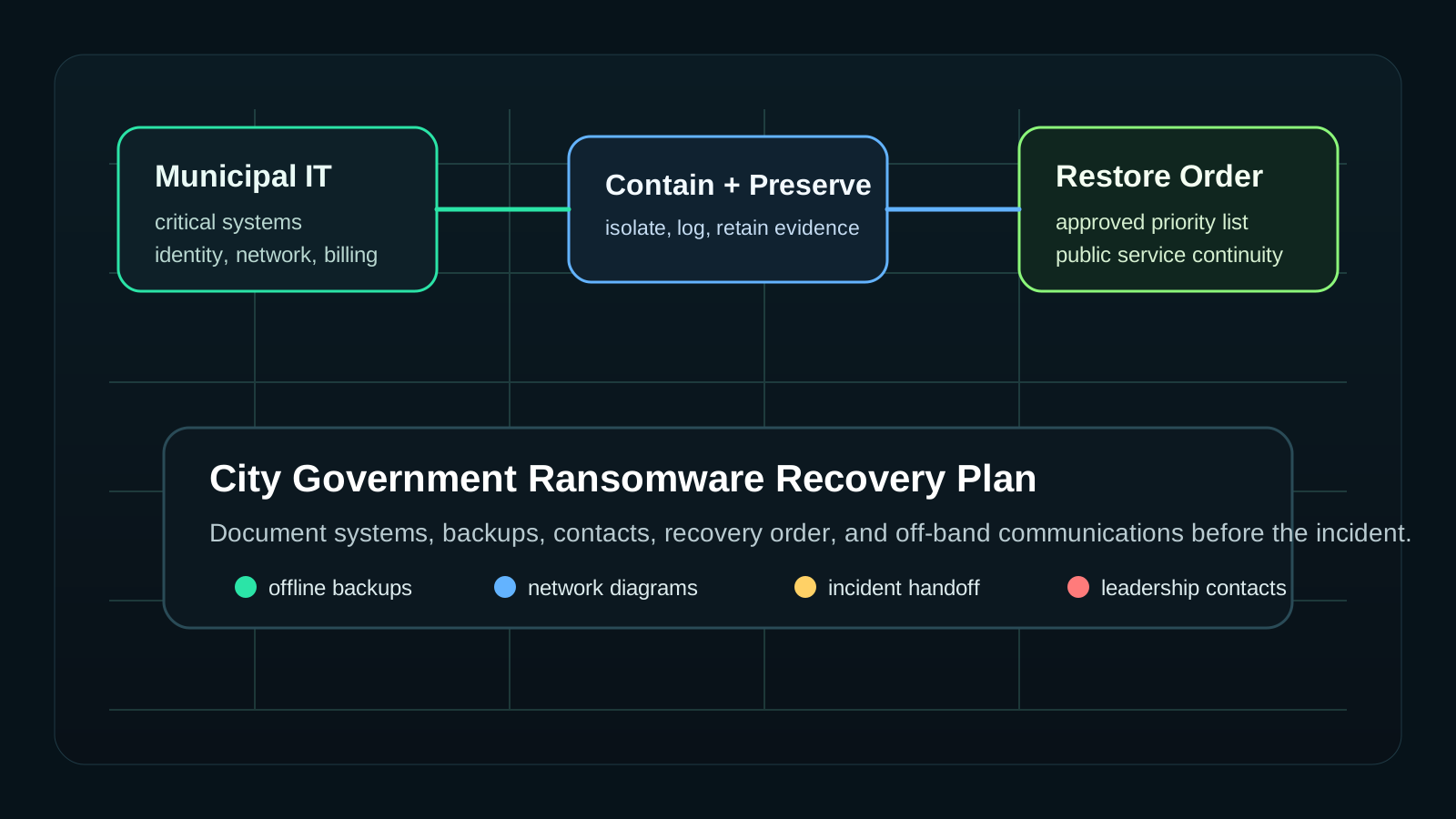

What should a city government ransomware recovery plan include?
A city government ransomware recovery plan should define how the municipality will contain the attack, preserve evidence, restore critical systems in the right order, communicate with leadership and the public, and resume essential services without improvising every major decision under pressure. For municipal teams, the plan has to cover more than file restoration. It has to protect continuity for police, public works, finance, permitting, communications, and citizen-facing systems at the same time.12
That distinction matters because local governments are not recovering a single department. They are recovering an operating environment that citizens depend on every day. When a city loses email, ERP access, utility billing, GIS, 911-adjacent coordination systems, or remote access for field teams, the damage is operational and public. A useful recovery plan therefore needs governance, technical sequencing, and communication discipline, not just a backup product and good intentions.
If you are building that plan now, start with the same principle Datapath uses in other regulated environments: define what must stay available, what can wait, who owns each decision, and how you will prove recovery is safe before reconnecting systems.
Why are municipal ransomware recovery plans different from private-sector plans?
Municipal recovery plans are different because the business impact is broader and more visible. A manufacturer may lose production time. A city may lose public trust, payment processing, permit access, public records workflows, internal coordination, or response support for time-sensitive services. Guidance from state and municipal cybersecurity programs consistently emphasizes continuity of government operations, documented reporting paths, and formal recovery procedures because municipalities cannot afford leadership confusion during an incident.13
There is also a procurement and accountability difference. City IT leaders often work across legacy infrastructure, fixed budget cycles, elected leadership, outside counsel, insurers, managed service providers, and third-party line-of-business vendors. That means a real ransomware recovery plan must answer practical questions in advance:
- Which systems come back first?
- Who authorizes isolation or shutdown decisions?
- Which external responders get called and in what order?
- What evidence must be preserved before reimaging?
- Which departments can run manually for 24 to 72 hours?
- How will the city communicate status without relying on compromised systems?
If the plan cannot answer those questions clearly, it is still a draft.
What systems should a city restore first after ransomware?
A city should restore systems based on service criticality, operational dependency, and public impact, not by whichever department shouts first. Ransomware recovery guidance repeatedly recommends predefining a restoration sequence before an incident because the time to debate priorities is not during a live outage.24
For most municipalities, the first-wave priorities usually include:
- identity and access systems needed to authenticate administrators and essential users
- core network and security tooling required to monitor, segment, and safely reconnect systems
- backup infrastructure and recovery platforms
- communications systems that support incident coordination
- public-safety-adjacent or mission-critical operational systems
- finance, payment, and citizen-service platforms with immediate service impact
- lower-priority departmental applications and archives
The exact order will vary by city, but the recovery logic should be documented in writing and approved by leadership. A municipality with utility billing exposure, public safety integrations, or court-related systems may have a different sequence than a small city focused on council operations and public works. The point is not to create a generic list. The point is to create a defensible municipal list.
That is also why city teams should pair this work with broader modernization planning. If your environment is still heavily dependent on legacy infrastructure, this is a good moment to review city government IT modernization alongside recovery readiness.
What documentation should municipal IT leaders prepare before an incident?
Municipal IT leaders should prepare the documentation that outside responders, internal admins, insurers, and executives will need when normal systems are unavailable. A recovery plan is only as usable as the documentation behind it.23
At minimum, document these items before an incident occurs:
1. Current asset inventory
Maintain a usable inventory of servers, endpoints, hypervisors, cloud tenants, network devices, backup systems, critical applications, privileged accounts, and external dependencies. If you do not know what exists, you cannot scope the incident or stage the recovery reliably.
2. Network diagrams and trust boundaries
Document core network paths, VLANs, firewall boundaries, remote-access methods, internet egress points, and interconnections to public-safety, utility, or third-party systems. Responders need to know where to isolate and where reinfection risk may still exist.2
3. Recovery priority list
Create a leadership-approved restoration order with recovery objectives for each major platform. This should identify what must be restored first, what can run manually, and what can remain offline while investigation continues.
4. Backup architecture and test results
Document backup locations, retention, offline or immutable copies, encryption status, credential protection, restoration procedures, and the date and result of recent recovery tests. State guidance has repeatedly warned that many local governments fail not because backups do not exist, but because they are not securely stored or regularly tested.3
5. Incident contacts and off-band communications
Keep updated phone numbers and secondary communication methods for leadership, IT, legal, cyber insurance, digital forensics, managed service providers, major application vendors, and law enforcement contacts. If your email and collaboration systems are down, you still need a coordination path.2
6. Evidence preservation and escalation steps
Define who captures logs, who authorizes imaging or rebuilds, how legal hold decisions are made, and when the incident transitions from containment to recovery. Good plans spell out the handoff between incident response and disaster recovery instead of blending both into one vague activity.2
7. Reporting and regulatory obligations
Document breach-notification requirements, records-retention constraints, cyber-insurance notice requirements, CJIS or other applicable public-sector controls, and any external reporting thresholds that may apply. If your city supports criminal justice workflows, related planning should align with posts like CJIS incident response plan requirements for public sector IT teams.
What should happen during the first few hours of recovery?
During the first hours of recovery, the city should avoid rushing straight into blanket restoration. The first objective is to stabilize the incident, confirm scope, protect evidence, and verify that the team is restoring into a controlled environment. Recovery guidance from ransomware-focused responders and disaster-recovery frameworks is consistent on this point: restoration order and handoff criteria should be documented before the event so the team does not improvise under stress.24
A practical municipal flow usually looks like this:
Confirm containment status
Before restoring anything, confirm that affected systems are isolated, privileged credentials are being rotated where needed, and the team has enough evidence to support investigation.
Validate clean recovery sources
Do not assume the nearest backup is safe. Validate the restore point, confirm that backup infrastructure itself was not compromised, and verify which systems can be restored without reintroducing the attacker.
Stand up the minimum viable operations set
Restore the systems required for safe administration, coordination, and service continuity first. That may include identity, core infrastructure, remote admin jump points, backup consoles, and internal communications.
Reconnect in phases
Bring systems back online in a controlled order with segmentation, monitoring, and approval gates. Do not reconnect broad network segments because a single application team is pressuring for speed.
Log every major action
Document what was restored, from which source, by whom, at what time, with what validation checks. That record matters for post-incident review, insurance, compliance, and future auditability.13
What mistakes make municipal ransomware recovery harder?
The biggest recovery mistake is assuming the plan is the same thing as the backup system. Backups matter, but a city government ransomware recovery plan also needs restoration order, incident command, vendor coordination, legal review, and department-level continuity procedures.
Other common failures include:
- unclear ownership between city IT, MSPs, and outside incident responders
- incomplete asset inventories
- stale network diagrams
- no tested offline backup procedure
- no preapproved restoration priority list
- no manual workaround plan for citizen services
- no off-band communication method
- no clear threshold for public notice or leadership escalation
We also see teams underestimate operational debt. If your city is already carrying aging infrastructure, weak identity hygiene, or inconsistent patching, ransomware recovery will expose that immediately. That is why recovery planning works best when paired with upstream controls such as cybersecurity risk assessments and stronger governance around admin access, change control, and vendor accountability.
How should city leaders measure whether the plan is actually ready?
A plan is ready when it has been tested, updated, and made usable by people other than the person who wrote it. Municipal teams should be able to answer these questions without guesswork:
- When was the last successful restore test for each critical platform?
- Can we recover core services if primary admin systems are unavailable?
- Do we have current phone-based contact paths for all critical responders?
- Is our recovery order approved by executive leadership?
- Can an outside responder use our diagrams and inventories without starting from scratch?
- Have we documented when incident response ends and recovery begins?
- Have we practiced communications for council, staff, and the public?
If those answers are vague, the plan is not ready yet.
Final takeaway for municipal IT leaders
The best city government ransomware recovery plan is not the thickest document. It is the one that lets your city restore essential services in a controlled order, with clean evidence, clear ownership, and fewer leadership surprises. Municipal IT leaders need documented recovery priorities, tested backups, usable diagrams, off-band contacts, and a disciplined handoff from incident response into restoration before the incident starts.123
That preparation reduces downtime, protects public trust, and gives leadership a clearer path through a bad day. If the plan still depends on tribal knowledge, shared assumptions, or a single admin remembering where everything lives, it needs more work.
Related resources and next steps
For a broader view of how Datapath approaches accountable IT operations, start with the Datapath homepage. If you are comparing modernization priorities across public-sector environments, review our solutions overview and related guidance on city government IT modernization.
For external reference points, these resources are worth keeping in the planning packet:
- MassCyberCenter municipal incident response workshop materials
- Ransomware.org guidance on incident response and disaster recovery planning
- New York State Comptroller cybersecurity guide for local governments
- NIST ransomware preparation guidance
Footnotes
-
MassCyberCenter, “Cybersecurity Incident Response Plan Workshops For Municipalities,” 2020, https://masscybercenter.org/sites/default/files/2022-04/Cyber%20Incident%20Response%20Plan%20Workshop%201%20Presentation.pdf ↩ ↩2 ↩3 ↩4
-
Ransomware.org, “Creating Disaster Recovery and Incident Response Plans,” https://ransomware.org/how-to-prevent-ransomware/creating-disaster-recovery-and-incident-response-plans/ ↩ ↩2 ↩3 ↩4 ↩5 ↩6 ↩7 ↩8
-
New York State Office of the State Comptroller, “Protecting Sensitive Data and Other Local Government Assets,” https://www.osc.ny.gov/files/local-government/publications/pdf/cyber-security-guide.pdf ↩ ↩2 ↩3 ↩4 ↩5
-
VC3, “IT Disaster Recovery Blueprint for Municipal Leaders,” https://www.vc3.com/guide/it-disaster-recovery-blueprint-for-municipal-leaders ↩ ↩2
