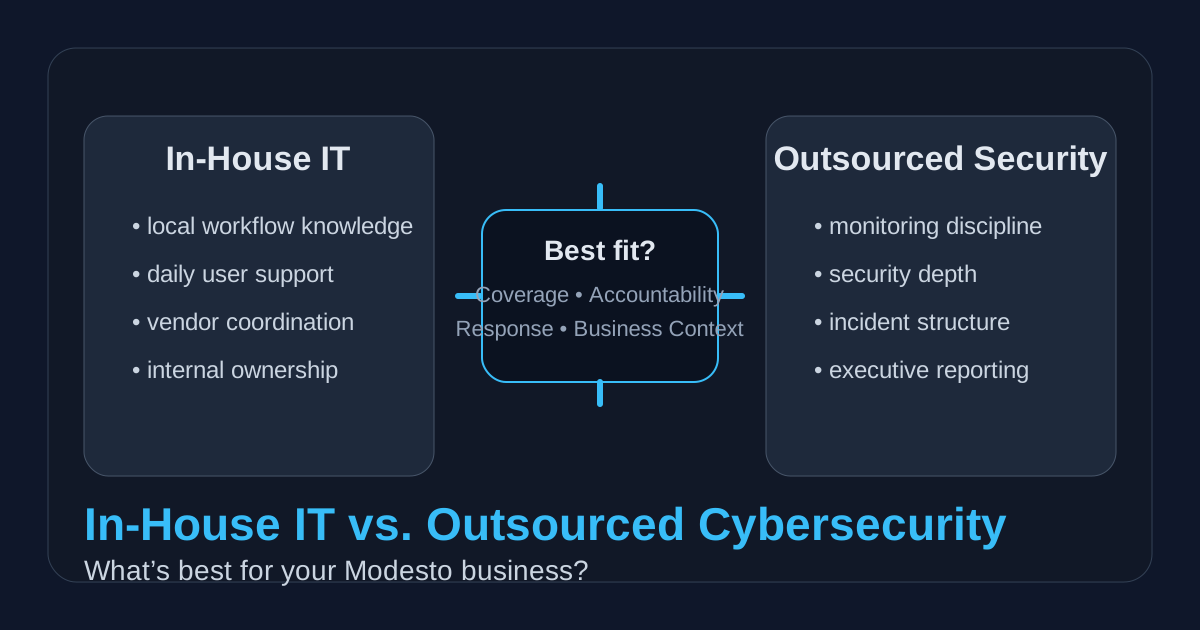

Should a Modesto business keep cybersecurity in-house or outsource it?
For many Modesto businesses, the right choice is not purely in-house IT or purely outsourced cybersecurity. It is the model that gives leadership the best mix of coverage, accountability, speed, and specialized security depth for the environment they actually run. In practice, that often means internal IT keeps ownership of business systems, user relationships, and operational priorities while an outside cybersecurity partner adds monitoring, hardening, incident discipline, and executive reporting that would be difficult to sustain alone.123
That distinction matters because day-to-day IT support and cybersecurity operations are not the same job. A small or mid-sized internal IT team may be excellent at vendor coordination, workstation support, Microsoft 365 administration, network troubleshooting, and keeping the business moving. That does not automatically mean the same team has the time to maintain around-the-clock alert review, formal remediation tracking, identity hardening, firewall governance, incident playbooks, and recovery validation at the level modern risk demands.24
In our experience, businesses get into trouble when they frame this as a pride question instead of an operating-model question. The better question is simpler: who can reliably reduce risk, respond quickly, and show leadership what is improving over time? That is the lens we recommend using alongside our broader guidance on cybersecurity services in Modesto, managed cybersecurity services, questions to ask a cybersecurity provider in Modesto, and our main Datapath site.
When does in-house IT make sense for cybersecurity?
In-house IT can be the right foundation when the organization has enough staffing depth, mature processes, and executive support to treat security as a continuing operating discipline instead of an extra duty.
Where internal teams usually have the advantage
Internal teams often know the business better than anyone else. They understand the history behind odd workflows, the personalities involved in approvals, the systems that absolutely cannot go down during month-end or patient hours, and the vendor relationships that make the environment function. That context matters. It can improve change management, reduce miscommunication, and help security decisions fit how the business actually works.
Internal ownership is especially valuable when the organization has:
- multiple dedicated IT staff with clear role separation
- documented standards for identity, patching, backups, and access control
- leadership time for regular risk reviews
- budget for tooling, training, and after-hours coverage
- enough operational maturity to handle incidents without improvising
For some organizations, especially larger or more centralized teams, that investment makes sense. NIST frames cybersecurity as an enterprise risk management issue, not just a tool decision, which is a useful reminder that internal ownership only works when the organization treats it as a management system rather than an ad hoc technical burden.4
Where in-house models usually start to strain
The pressure point shows up when internal IT is already overloaded. If the same people are resetting passwords, onboarding employees, troubleshooting printers, coordinating vendors, maintaining network gear, and putting out daily fires, security work often gets pushed into the gaps between urgent tickets. That leads to drift.
The symptoms are familiar:
- alerts get acknowledged slowly or not at all
- backups are assumed healthy instead of restore-tested
- firewall rules stay in place long after their business purpose is gone
- MFA exceptions linger because no one has time to clean them up
- vulnerability remediation depends on whichever issue feels loudest this week
That is not a competence problem. It is a capacity problem.
When is outsourced cybersecurity the better fit?
Outsourced cybersecurity is often the better fit when leadership needs more specialized coverage, more disciplined reporting, or faster operational maturity than an internal team can reasonably build on its own.
What a strong outside partner should add
A strong partner should not just install tools and vanish. They should bring structure. That includes clearer monitoring ownership, documented escalation, recurring review cadences, stronger control validation, and an operating model leadership can understand.
We usually expect outsourced cybersecurity support to strengthen areas such as:
- endpoint detection and response oversight
- firewall and remote-access governance
- identity and Microsoft 365 hardening
- vulnerability prioritization and remediation tracking
- security awareness and phishing-readiness support
- incident response coordination
- executive reporting and compliance-oriented documentation
That is where outsourcing can create real leverage. IBM’s 2025 Cost of a Data Breach findings point again to the financial importance of faster identification and containment, with the report citing a global average breach cost of $4.4 million and savings associated with more mature security operations.5 The point for a Modesto business is not the exact global average. It is that response speed and operational discipline matter materially.
Why outsourced does not mean hands-off
The best outsourced model is not a handoff where leadership assumes security is now someone else’s problem. Outsourced cybersecurity still needs internal sponsorship, business context, and decision-making. Someone inside the company must still approve risk decisions, support policy changes, and make sure operations, HR, compliance, and finance are aligned.
That is why we usually caution against viewing outsourced cybersecurity as a substitute for ownership. It is a way to strengthen ownership.
How should Modesto businesses compare the two models?
The most useful comparison is not headcount versus vendor fee. It is whether the model can produce consistent protection, usable reporting, and dependable response.
1. Coverage: who is watching, and when?
An internal team may know the environment better, but if no one is watching alerts after hours or reviewing risky changes consistently, that context does not close the gap. Businesses should ask:
- who reviews security alerts after hours?
- who owns firewall, VPN, and identity changes?
- who validates backups and restore readiness?
- who coordinates when multiple vendors are involved in an incident?
For many mid-market environments, outsourced cybersecurity improves this layer first because it formalizes who is on point and what happens next.
2. Depth: can the team handle modern security work?
Cybersecurity now touches identity, cloud apps, vendor risk, logging, remote access, endpoint controls, and recovery planning. Internal IT may be strong in infrastructure and user support but still be stretched thin on these disciplines. We see this especially often in regulated or multi-site environments.
If your environment depends on Microsoft 365, hybrid identity, remote access, or distributed vendors, compare the models based on whether they can support:
- conditional access and MFA enforcement
- privileged access review
- security telemetry review
- recurring remediation meetings
- documentation for audits, insurance, or board reporting
3. Accountability: can leadership tell what is improving?
This is one of the biggest differentiators. A strong model should give leadership regular answers to questions like:
- what are our highest-risk unresolved issues?
- what got remediated this month?
- which problems keep recurring?
- where are we still too dependent on one vendor or one person?
- what should we budget for next?
That is one reason we recommend comparing options against what we look for in Modesto cybersecurity providers and in managed IT KPI reporting. Security without reporting usually turns into assumption.
Is a hybrid model usually the best answer?
For many organizations, yes.
A hybrid model often gives the business the best of both worlds: internal IT retains local knowledge, business context, and day-to-day operational ownership, while an outside cybersecurity partner provides focused security depth, process rigor, and recurring oversight.
What a healthy hybrid split usually looks like
A practical division of responsibilities often looks like this:
| Responsibility | Internal IT | Outsourced cybersecurity |
|---|---|---|
| business application context | primary | support |
| user onboarding and daily support | primary | support |
| Microsoft 365 and identity hardening | shared | primary |
| firewall review and remote-access governance | shared | primary |
| endpoint monitoring and response workflow | support | primary |
| incident escalation and vendor coordination | shared | shared |
| executive risk reporting | support | primary |
| recovery testing and resilience review | shared | shared |
That split is rarely perfect on day one, but it gives leadership a better chance of building accountability instead of creating turf friction.
When hybrid works especially well
We find hybrid models work best when the business:
- has a capable internal IT lead but limited security specialization
- needs stronger reporting for leadership, insurers, or compliance work
- wants to improve monitoring and response without replacing internal staff
- operates across multiple offices, vendors, or regulated workflows
- needs a cleaner line between routine IT support and security operations
This is also the model we see most often when organizations are trying to move away from reactive support and toward more stable governance across managed firewall operations, managed IT services, related resources and guides, and contact with our team for planning.
What are the common mistakes when making this decision?
The first mistake is treating cost as the whole decision. A cheaper in-house model can become expensive fast if critical controls drift, incidents escalate slowly, or no one can prove whether risk is improving.
The second mistake is assuming outsourced cybersecurity automatically fixes weak internal ownership. It does not. If leadership is disengaged, no one is tracking remediation, and basic governance never gets airtime, even a strong outside partner will struggle.
The third mistake is ignoring recovery and vendor coordination. Many incidents are not solved by one team alone. They require internal IT, security support, cloud vendors, line-of-business vendors, backup platforms, and leadership communication to work together. If your chosen model cannot coordinate that cleanly, the business will feel it when an incident hits.
Why Datapath recommends deciding based on operating maturity, not ideology
We think Modesto businesses should choose the model that best matches their current maturity, risk tolerance, and leadership expectations. If your internal team has the capacity and process discipline to run security as an ongoing program, keeping more work in-house may be reasonable. If your team is already overloaded or you need stronger monitoring, reporting, and remediation discipline, outsourced cybersecurity usually becomes the better answer. For many teams, the most resilient path is a hybrid model that keeps internal business ownership while adding outside depth and accountability.
That is the standard we try to apply at Datapath: not “what sounds impressive,” but what actually makes the environment easier to govern, easier to secure, and easier to explain. If your team is weighing the tradeoffs now, start with our homepage, compare your needs against our Modesto cybersecurity guidance, review our managed cybersecurity services guide, and talk with our team about the right model for your environment.
Frequently Asked Questions
Is outsourced cybersecurity cheaper than hiring in-house?
Sometimes, but cost alone is the wrong measure. The better comparison is whether outsourced support gives the business stronger coverage, faster response, and clearer accountability than it could sustain with the same budget internally.
Can a small internal IT team still own cybersecurity?
Yes, but only if the team has enough time, process discipline, and leadership support to treat cybersecurity as an operating function rather than leftover work after user support is done.
What is the biggest advantage of a hybrid model?
The biggest advantage is that it preserves internal business context while adding specialized security depth, recurring oversight, and stronger reporting than many lean internal teams can maintain alone.
What should Modesto businesses ask before outsourcing cybersecurity?
They should ask who monitors alerts, how incidents are escalated, how reporting works, what controls are included, who touches their systems, and how the provider proves that risk is actually being reduced over time.