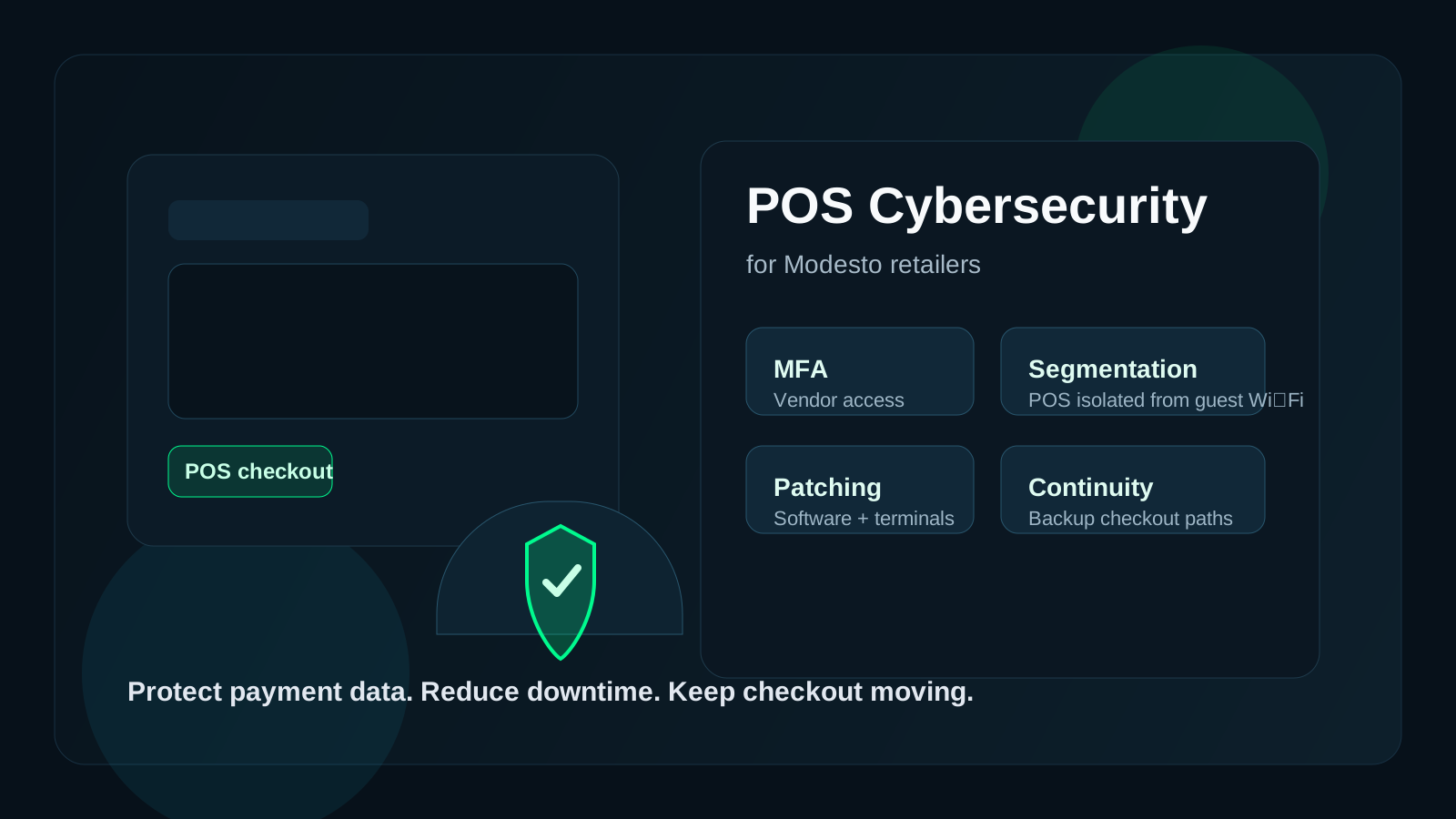

Why do local Modesto retailers need point-of-sale POS cybersecurity?
Local Modesto retailers need point-of-sale POS cybersecurity because the checkout environment is one of the fastest ways an attacker can reach payment data, disrupt revenue, and damage customer trust. Modern POS risk is not limited to the payment terminal itself. It includes the store network, back-office systems, remote support tools, vendor access, wireless connections, employee accounts, and any device or service that touches transactions.123
That matters more than many retailers expect. A single security incident can interrupt card processing, expose customer data, trigger PCI headaches, and force the business into expensive recovery work while sales are still supposed to continue. For most local retailers, the real issue is not whether cybersecurity sounds important. It is whether the business can keep taking payments safely when something goes wrong.
At Datapath, we think POS security should be treated as a business continuity issue, not just a compliance issue. If the checkout flow fails, the business feels it immediately.
Why are Modesto retailers realistic targets instead of edge cases?
Retailers sometimes assume attackers only go after massive chains. That is not how this works in practice.
Why do attackers like smaller and mid-sized retail environments?
Smaller organizations are often targeted because attackers expect weaker defenses, less internal security oversight, and a better chance of finding old software, shared credentials, exposed remote access, or lightly monitored vendor connections.14 Retail is especially attractive because transactions happen constantly and the environment depends on uptime. That mix of payment data and operational urgency gives attackers leverage.2
In Modesto, many retailers also run lean. One person may handle operations, vendor coordination, and basic technology decisions on top of everything else. That does not mean the business is careless. It means there is less slack for reviewing logs, hardening systems, validating backups, or tightening access rules across every store device.
Why does local context matter?
Modesto businesses often rely on practical, mixed environments: a POS platform, vendor-managed payment tools, cameras, Wi-Fi, Microsoft 365, shared office machines, printers, and maybe a few legacy devices that still “just work.” That kind of environment can be fine operationally, but it can also create security sprawl if nobody is clearly responsible for segmentation, updates, MFA, vendor access, and recovery planning.
Datapath’s broader cybersecurity guidance for Modesto businesses makes the same point in a wider context: local organizations are attractive targets because attackers assume mid-market defenses are thinner than enterprise ones.1 Retail adds payment systems and customer-facing downtime pressure to that equation.
What actually makes a POS environment vulnerable?
A lot of businesses still think POS security means “the card reader is encrypted, so we are fine.” That is not enough.
POS security is bigger than the terminal
A POS environment usually includes:
- payment terminals and checkout devices
- back-office computers and admin consoles
- store Wi-Fi and local switching
- payment processors and SaaS integrations
- remote access used by vendors or support teams
- employee credentials and permission settings
- receipt printers, scanners, and connected peripherals
That is why security researchers keep emphasizing that POS risk includes the terminal, the management plane, support routes, and third-party dependencies rather than only the hardware at the counter.2
What attack paths show up most often?
Common paths include:
- phishing or password theft that compromises a staff or admin account2
- unpatched systems that leave known weaknesses exposed3
- remote support access without strong MFA or tight restriction2
- flat networks where attackers can move from one system to another after initial access2
- third-party compromise affecting software, updates, or service-provider access2
- physical tampering with terminals or store devices5
The important point is that attackers do not need a dramatic movie-style exploit. They usually look for ordinary weaknesses that have been left in place too long.
What happens when POS cybersecurity is weak?
The first concern is usually stolen card data. That is real, but it is not the only consequence.
Checkout disruption can become the main business problem
If a retailer cannot process transactions reliably, the impact is immediate. Sales slow down or stop. Staff get pulled into manual workarounds. Customers lose confidence. Managers scramble to coordinate with vendors, banks, and outside support. In some cases the most expensive part of the incident is not the forensics bill. It is the interruption to the business while everyone tries to keep the doors open.
POS security guidance consistently notes that attacks on data availability, including ransomware or broader operational disruption, can be catastrophic for retail operations.3 That is why secure fallback options matter so much.
Trust and compliance can get hit at the same time
A payment-related breach can also create:
- reputational damage with customers
- card brand or PCI scrutiny
- legal and notification costs
- emergency response and recovery expense
- longer-term friction with insurers, auditors, or payment partners
For a local retailer, customer trust is not abstract. If shoppers stop feeling comfortable using cards or sharing data, the business loses more than one day of revenue.
What should Modesto retailers actually do to secure POS systems?
We recommend a layered approach instead of a single “POS security product” mindset.
1. Segment the POS environment from the rest of the network
One of the most useful controls is keeping payment-related systems separate from general-purpose business devices, guest Wi-Fi, and anything that does not need to touch the cardholder data environment.2 Segmentation reduces the blast radius if a device or account is compromised.
2. Tighten vendor and remote access
Retailers often need support vendors, payment partners, or integrators to access systems remotely. That access should be restricted, reviewed, and protected with MFA. Default credentials, broad always-on access, or undocumented vendor pathways create avoidable risk.25
3. Patch POS and supporting systems on purpose
Keeping software current matters because attackers actively exploit old vulnerabilities. That includes the POS application, operating systems, remote support tools, firewalls, and any connected infrastructure around the store.3
4. Use strong access control and role discipline
Not every employee needs the same level of access. Shared admin logins, generic passwords, and over-permissioned accounts make incidents harder to contain and investigate. Individual accounts, stronger password hygiene, and MFA where supported all help reduce risk.3
5. Train staff on the boring attacks that still work
Most incidents still start with ordinary mistakes: clicking the wrong link, reusing a password, trusting a fake vendor message, or approving access too quickly. Staff do not need abstract security lectures. They need short, realistic training on phishing, payment fraud patterns, escalation steps, and how to report something suspicious quickly.
6. Prepare for continuity, not just prevention
Retailers should ask a blunt question: if our primary checkout path is disrupted, how do we keep selling? POS security sources now recommend alternative checkout options such as mobile POS, offline workflows, or backup transaction methods so the business is not fully dependent on one brittle path.3
7. Validate the environment with testing
Periodic vulnerability review and penetration testing can help confirm whether segmentation, remote access, permissions, and internet-facing exposures are actually working as intended.2
How does this relate to PCI and broader business security?
PCI DSS is not the whole answer, but it is still an important anchor.
PCI compliance helps, but it is not enough by itself
Retailers should absolutely use PCI-compliant devices and follow payment security expectations.35 But passing a questionnaire or deploying compliant hardware does not automatically mean the full environment is secure. If a business has weak remote access, poor segmentation, or stale credentials, it can still end up in trouble.
We usually think of PCI as part of a larger operating model that also includes endpoint protection, identity security, network review, incident response, and vendor governance. That broader model lines up with the way we talk about managed cybersecurity services, vulnerability management, and business continuity across the rest of the Datapath site.
When should a retailer get outside help?
Usually before there is a visible incident.
Signs the current setup is too loose
A retailer should get help if any of these sound familiar:
- nobody is sure which systems are inside PCI scope
- vendor remote access exists but is not reviewed regularly
- the POS environment shares a network with general office or guest devices
- updates happen ad hoc instead of on a defined cadence
- employee access is shared or loosely controlled
- there is no tested fallback for taking payments during an outage
- leadership wants accountability but not a full in-house security team
That is where a local IT and cybersecurity partner can help bring structure to the environment. The goal is not to add complexity. It is to reduce fragility.
Why Datapath for POS cybersecurity in Modesto?
We think local retailers need practical security, not enterprise theater. That means reducing the chance of payment disruption, tightening the weak spots around vendor access and store networks, and making sure the business can still operate if something fails.
If your team wants a clearer view of POS risk, start with our services overview, review our Modesto cybersecurity guidance, or talk with Datapath about tightening checkout security without turning daily operations into a mess.
Frequently Asked Questions
Why is POS cybersecurity important for local retailers in Modesto?
Because POS systems touch payment data and revenue directly. A security incident can expose customer information, interrupt card processing, create PCI problems, and damage customer trust all at once.
Is POS security only about the card terminal?
No. POS security also includes the store network, back-office systems, vendor remote access, employee accounts, connected devices, and any software or service used to process transactions.2
What is the fastest way to reduce POS cyber risk?
For many retailers, the highest-impact steps are network segmentation, MFA for vendor and admin access, disciplined patching, tighter permissions, employee phishing awareness, and a backup checkout plan.235
Can a small retailer really be a target?
Yes. Attackers often prefer smaller and mid-sized organizations because they expect weaker defenses, lighter monitoring, and more pressure to restore operations quickly after disruption.14
Sources
- Datapath: Cybersecurity Services in Modesto, CA: What Local Businesses Need to Know
- GRC Solutions: How Cyber Criminals Target POS Systems and E-Commerce Sites
- Extenda Retail: 10 Tips for Ensuring Secure POS Systems
- BizTechConsult: Small Business Cybersecurity Modesto
- Erply: Essential Steps to Securing Your POS System
Footnotes
-
Datapath: Cybersecurity Services in Modesto, CA: What Local Businesses Need to Know ↩ ↩2 ↩3 ↩4
-
GRC Solutions: How Cyber Criminals Target POS Systems and E-Commerce Sites ↩ ↩2 ↩3 ↩4 ↩5 ↩6 ↩7 ↩8 ↩9 ↩10 ↩11 ↩12
-
Extenda Retail: 10 Tips for Ensuring Secure POS Systems ↩ ↩2 ↩3 ↩4 ↩5 ↩6 ↩7 ↩8
-
Erply: Essential Steps to Securing Your POS System ↩ ↩2 ↩3 ↩4
