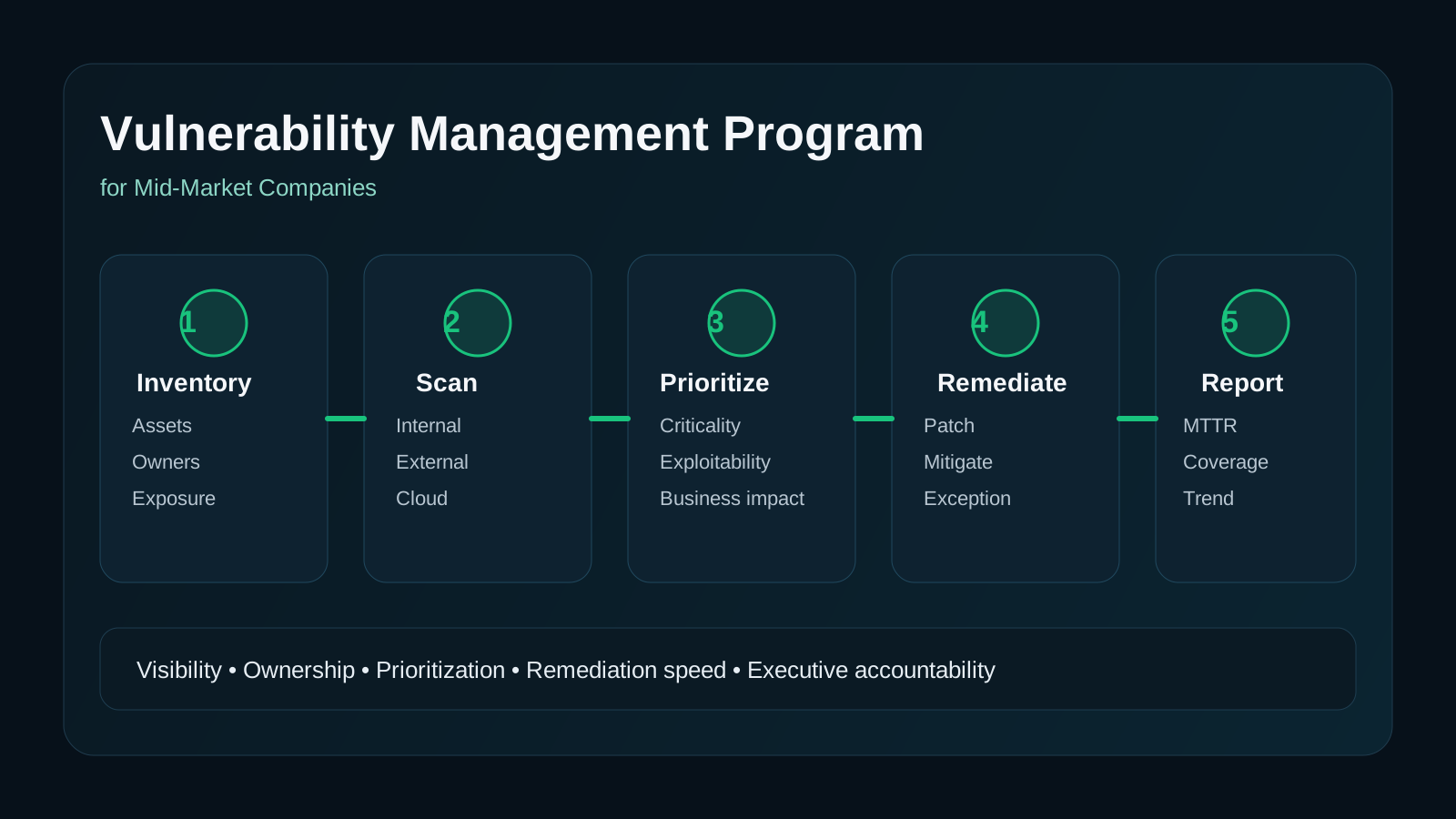
What should a vulnerability management program for mid-market companies actually include?
A practical vulnerability management program for mid-market companies should include asset visibility, routine scanning, business-aware prioritization, clearly assigned remediation ownership, compensating controls for issues that cannot be patched immediately, and leadership reporting that tracks risk reduction over time.12 The goal is not to produce a giant list of findings. The goal is to reduce the likelihood that an exploitable weakness turns into downtime, data loss, or a compliance problem.
That distinction matters because many mid-market organizations are not struggling to find vulnerabilities. They are struggling to decide which issues matter first, how quickly they need to act, and who is accountable when the same problems keep resurfacing. We see this constantly in growing environments where cloud services, Microsoft 365, remote access, third-party tools, and legacy infrastructure all evolve faster than documentation or patch discipline.
We think the most effective program is the one that makes risk easier to see and easier to govern. That means vulnerability management should connect naturally to broader Datapath priorities like managed cybersecurity services, cybersecurity risk assessments, and Microsoft 365 security best practices. If the process lives only inside a scanner dashboard, it usually stays reactive.
Why do mid-market companies need a formal vulnerability management program?
Mid-market companies usually sit in the uncomfortable middle. They are large enough to have real attack surface, meaningful vendor sprawl, and sensitive business systems, but not always large enough to dedicate separate teams to infrastructure, security operations, governance, and compliance. That gap is where vulnerability management either becomes disciplined or turns into permanent backlog.
A growing environment creates more exposure than most teams expect
As organizations add cloud workloads, SaaS applications, remote users, branch offices, and external vendors, the number of assets that need to be inventoried and monitored climbs quickly. Research on attack surface management keeps landing on the same point: organizations cannot reduce exposure consistently if they do not know what is internet-facing, what is business-critical, and what has drifted outside standard controls.13
That is especially true for businesses balancing growth with regulated operations. A vulnerability in a marketing microsite matters less than a vulnerability affecting identity infrastructure, EHR access, financial systems, line-of-business applications, or backup administration. A formal program creates a structured way to separate those risks instead of treating every scanner alert the same.
Counting findings is less useful than fixing the right issues fast
One of the more useful shifts in modern vulnerability management is the move away from vanity metrics. Teams can close thousands of low-value findings and still leave the most dangerous exposures untouched. Dark Reading summarized this well through a mid-market security lens: the important measure is often not how many vulnerabilities exist, but how quickly critical ones are being addressed.4
We agree with that. For leadership, the better question is not “How many findings did the scan produce?” It is “Are we reducing exploitable risk on the systems that matter most to the business?”
What is the foundation of a strong vulnerability management program?
The foundation is visibility. If the inventory is weak, the rest of the program becomes guesswork.
Start with asset inventory and attack surface visibility
A vulnerability program should begin with a maintained inventory of:
- endpoints and servers
- cloud workloads and SaaS platforms
- firewalls, switches, and network appliances
- identity systems and privileged admin accounts
- internet-facing applications and remote access services
- backup infrastructure and recovery platforms
- third-party-managed systems that still affect your risk posture
This is where attack surface management and vulnerability management overlap. You cannot scan what you have not identified, and you cannot prioritize what you have not classified.13
For mid-market teams, we recommend tagging assets by business criticality at minimum:
| Asset tier | Typical examples | Why it matters |
|---|---|---|
| Tier 1 | Identity systems, production servers, backup admin systems, public-facing apps | Compromise creates immediate business or security impact |
| Tier 2 | Internal business apps, department systems, standard cloud workloads | Important but usually not existential |
| Tier 3 | Low-impact devices, test systems, temporary or isolated assets | Still matters, but not first in line |
That tiering helps the team focus first on internet-exposed systems, privileged infrastructure, and assets that support regulated or revenue-critical workflows.
Define ownership before you define tooling
A surprising amount of vulnerability backlog exists because nobody is sure who owns remediation. Security flags the issue, infrastructure says the application team owns it, the application owner says the vendor manages it, and the vendor says the system is outside scope.
A healthy program should define:
- who runs scans
- who validates findings
- who approves remediation timelines
- who owns patching or configuration changes
- who accepts documented exceptions
- who reports unresolved risk to leadership
We would rather see a simple ownership matrix than an overengineered workflow nobody follows.
How should mid-market teams scan and prioritize vulnerabilities?
Scanning matters, but prioritization is what turns data into action.
Use recurring scans, not occasional cleanups
Automated vulnerability scanning should run on a defined cadence across endpoints, servers, cloud assets, and internet-facing systems.1 The exact frequency varies by environment, but the principle should stay consistent: recurring visibility beats occasional cleanup projects.
Most teams should at least separate their cadence into three buckets:
- internet-facing and high-risk assets: frequent scanning and rapid review
- internal production systems: routine scheduled scanning
- low-impact or transient systems: lighter but still documented cadence
Automated tools are useful, but they are not enough on their own. False positives, incomplete coverage, and context gaps are common. That is why scanner output needs human review and should be paired with configuration baselines, external exposure review, and periodic deeper assessment.12
Prioritize by business impact, exploitability, and exposure
A useful risk model should combine at least these factors:
- whether the asset is internet-facing
- whether active exploitation is known or likely
- whether privileged access is involved
- whether sensitive or regulated data is exposed
- whether the issue affects a Tier 1 system
- whether compensating controls already reduce practical risk
Vendor severity and CVSS scores are helpful inputs, but they are not the whole answer.2 A medium-severity issue on a public-facing identity system can deserve faster action than a high-severity issue buried in an isolated lab environment.
That is also why we recommend linking vulnerability review to broader resilience planning. If your team is already working through backup and disaster recovery priorities, ransomware response planning, or business continuity vs disaster recovery, vulnerability prioritization should reflect those same business-critical dependencies.
What should remediation and exception handling look like?
A scanner does not reduce risk. Remediation does.
Build a realistic remediation workflow
Once vulnerabilities are validated and prioritized, the program should drive one of a few actions:
- patch the affected software or operating system
- change configuration to reduce exposure
- remove or isolate the vulnerable service
- add compensating controls such as segmentation, tighter access, or monitoring
- formally document and time-box a justified exception
The workflow should be boring in the best way. Findings should move through a repeatable sequence: discovery, validation, ownership assignment, remediation target date, verification, and closure. If the same issue keeps reopening, the process should identify whether the root problem is patch discipline, asset sprawl, unsupported systems, vendor constraints, or change-management friction.
Treat unsupported systems and exceptions as leadership issues
Mid-market organizations often carry risk that cannot be fixed immediately. That may include legacy software, operational technology, vendor-hosted platforms, or business-critical systems with upgrade constraints. In those cases, the answer should not be silence. It should be documented exception handling.
A useful exception record should capture:
- the asset and business owner
- the vulnerability or condition
- why immediate remediation is not possible
- compensating controls in place
- target review date
- who accepted the risk
That approach turns vague exposure into explicit accountability. It is also much easier to defend during audits, cyber insurance reviews, or post-incident discussions than an undocumented backlog.
How should leadership measure whether the program is working?
The best programs produce cleaner decisions, not just cleaner dashboards.
Track metrics that reflect risk reduction
We recommend tracking a short set of metrics leadership can actually interpret:
- mean time to remediate critical and high-risk findings
- percentage of Tier 1 assets covered by scanning
- number of internet-facing critical findings older than policy allows
- number of exceptions by business unit and age
- repeat findings caused by failed patch or configuration processes
- percentage of assets with known owner and criticality rating
Those metrics are more useful than dumping raw counts into a monthly report. They show whether visibility is improving, whether teams are acting on the most important problems, and whether the same operational failures keep creating new exposure.
Review vulnerability management as an operating cadence
A mature vulnerability management program should have a regular review rhythm. For many mid-market companies, that means:
- weekly operational review for critical findings
- monthly trend reporting for leadership
- quarterly review of exceptions, tooling, and policy thresholds
That cadence helps keep vulnerability management connected to business decisions. If a team repeatedly misses remediation targets, leadership can address staffing, change windows, vendor accountability, or technology debt before the issue becomes a larger security event.
Why Datapath for vulnerability management planning?
We think vulnerability management works best when it is tied to operating reality. The job is not to impress anyone with scan volume. The job is to help your team see risk earlier, prioritize it more intelligently, and reduce it with enough consistency that leadership can trust the process.
For mid-market organizations, that usually means connecting vulnerability management to identity control, backup resilience, cloud governance, endpoint operations, vendor accountability, and regulated-industry expectations. If your team is trying to move from sporadic scanning to an actual program, start with the Datapath homepage, review our managed IT services overview, compare our managed cybersecurity services guide, and talk with our team about where your current process is breaking down.
Frequently Asked Questions
What is a vulnerability management program?
A vulnerability management program is a repeatable process for identifying, validating, prioritizing, remediating, and reporting security weaknesses across systems, applications, and infrastructure.
How often should mid-market companies run vulnerability scans?
It depends on exposure and criticality, but internet-facing and high-risk assets should be reviewed more frequently than low-impact internal systems. The key is maintaining a recurring cadence instead of running occasional one-off scans.1
What is the most important vulnerability management metric?
For most teams, one of the most useful metrics is remediation speed for critical and high-risk issues. Raw vulnerability counts matter less if the organization is not reducing the findings that create the most business risk.4
What if a vulnerability cannot be patched immediately?
If a vulnerability cannot be patched immediately, the team should document an exception, add compensating controls where possible, assign a business owner, and set a review date rather than leaving the issue untracked.
Sources
- CyCognito: Building Your Vulnerability Management Program
- Appalachia Technologies: Vulnerability Management for Mid-Market Companies
- IANS Research: How to Formalize Your Vulnerability Management Program
- Dark Reading: Rethinking Vulnerability Management Strategies
