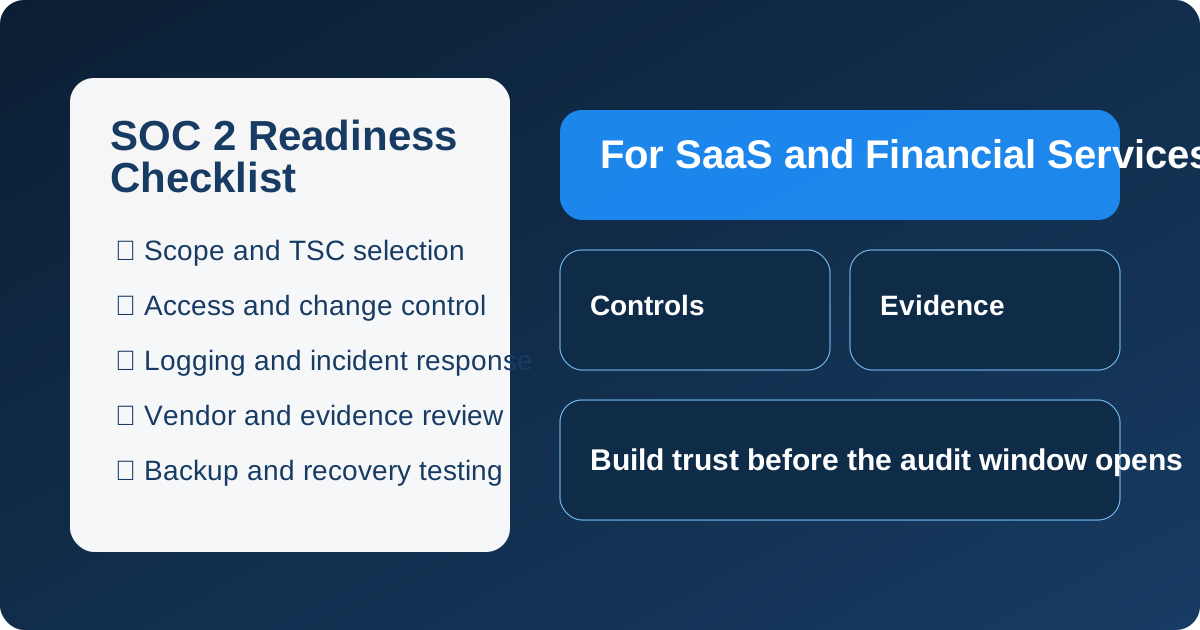

What should SaaS and financial services companies include in a SOC 2 readiness checklist?
A strong SOC 2 readiness checklist should cover scope, Trust Services Criteria selection, control ownership, policy documentation, evidence collection, vendor oversight, incident response, backup validation, and final testing before the audit window starts. For SaaS and financial-services teams, the point is to prove that controls are not just written down, but operating consistently enough to survive customer diligence and auditor review.12
That matters because readiness work is where most organizations discover the real problem is not missing software. It is unclear ownership, weak evidence, inconsistent access reviews, or too much manual work around changes, incidents, and third-party risk. Here at Datapath, we usually frame SOC 2 readiness as an operational cleanup project first and an audit project second. That same operating-discipline mindset shows up across our homepage, our managed IT services page, and our work supporting financial-services IT environments.
Why does SOC 2 readiness matter before the actual audit?
SOC 2 readiness matters because it lets a company find evidence gaps, scope mistakes, and weak controls before paying for a formal examination. The AICPA defines SOC reporting as a way to provide users with information needed to assess risks associated with outsourced services, which means auditors and customers both care whether your controls are credible, not just whether your policy folder exists.1
For SaaS companies, that usually shows up in enterprise procurement, security questionnaires, and renewal pressure. For financial-services firms, it shows up in customer due diligence, partner oversight, and regulatory expectations around secure operations. We see readiness work become especially important when a team is already juggling vendor reviews, cloud changes, investor diligence, and growth targets at the same time. If you are already working through broader cybersecurity compliance services or comparing frameworks in SOC 2 vs ISO 27001, readiness is the bridge between strategy and audit reality.
How should companies scope a SOC 2 readiness assessment?
A good readiness assessment starts by defining what systems, people, vendors, and commitments actually fall inside scope. That sounds basic, but it is where many teams lose time. If scope is fuzzy, every control conversation becomes fuzzy too.
Which Trust Services Criteria belong in scope?
Security is mandatory in every SOC 2 engagement, while Availability, Processing Integrity, Confidentiality, and Privacy should be selected based on what the business actually promises customers and how data moves through the environment.3 In practice, many SaaS teams start with Security and then add Availability or Confidentiality when uptime and sensitive customer data are core parts of the service.4
Financial-services organizations often need to pressure-test Processing Integrity and Confidentiality more carefully because transaction accuracy, access restrictions, and third-party handling expectations carry more weight. We recommend asking three direct questions:
- What customer commitments are already in contracts or security questionnaires?
- Which systems store or process sensitive data?
- Which criteria would an auditor expect based on how the business actually operates?
If those answers do not line up, scope is probably still too loose.
What should the system boundary include?
The system boundary should cover the production environment, supporting infrastructure, identity systems, key vendors, code and deployment paths, monitoring, backup processes, and the people who operate those controls. AWS notes that SOC 2 reporting is built around a defined scope and a specific reporting period, which is exactly why boundary discipline matters.5
A practical scoping checklist should identify:
| Scope area | What to document | Why it matters |
|---|---|---|
| Applications and services | Customer-facing products, APIs, internal admin tools | Auditors need to know what the system actually is |
| Infrastructure | Cloud accounts, networks, endpoints, production assets | Security controls depend on where the system runs |
| Identity and access | SSO, MFA, privileged roles, provisioning flows | Access is one of the fastest ways audits go sideways |
| Vendors | Critical subprocessors and service providers | Third-party risk often sits inside the same control story |
| Data flows | Where sensitive data is created, stored, transmitted, and deleted | Helps determine confidentiality and privacy obligations |
What controls belong on a SOC 2 readiness checklist?
The best SOC 2 readiness checklist does not try to list every control in the universe. It focuses on the control families most likely to create audit pain if they are immature, undocumented, or inconsistently operated.
Access control and identity management
A readiness review should verify that access is role-based, privileged access is limited, MFA is enforced where appropriate, and joiner-mover-leaver processes are documented. Auditors care about who can reach production systems, how that access was approved, and whether it gets reviewed on a repeatable basis.23
For SaaS companies, that often means proving SSO, MFA, least privilege, and periodic access reviews are operating cleanly across cloud infrastructure, source control, ticketing, and support tools. For financial-services environments, it usually also means tighter evidence around shared accounts, segregation of duties, and sensitive-data restrictions.
Change management and secure operations
SOC 2 readiness should confirm that production changes are approved, tested, traceable, and recoverable. That includes code review, deployment logging, rollback paths, ticket linkage, and evidence that emergency changes are handled intentionally instead of informally.
A few practical checks matter here:
- Can you connect a production change to a ticket, approval, and deployment record?
- Is there a repeatable process for urgent changes?
- Are monitoring and logging strong enough to detect bad outcomes after a release?
This is one reason teams often benefit from reviewing adjacent guidance like managed cybersecurity services and cybersecurity risk assessment services, because readiness problems often reflect larger operations problems rather than a narrow compliance issue.
Logging, monitoring, and incident response
SOC 2 readiness should include evidence that security events are logged, reviewed, escalated, and retained consistently. CISA’s Cyber Essentials guidance emphasizes reducing risk through foundational practices like multifactor authentication, phishing-resistant operations, and the ability to detect and respond to threats in a disciplined way.6
A useful readiness checklist asks whether the company can show:
- centralized or well-defined log collection for critical systems
- alerting and monitoring coverage for meaningful security events
- a documented incident-response plan
- tested incident roles, communication paths, and post-incident follow-up
If incident response exists only as a template document, readiness is not done yet.
Backups, availability, and recovery testing
Availability controls matter whenever customers rely on uptime, recovery, and business continuity commitments. That means readiness work should look beyond whether backups exist and confirm whether they are monitored, retained, and tested. AWS publicly notes that SOC reports are tied to a reporting period and operating controls, which means unsupported assumptions about recovery do not help much unless the organization can show the process works in practice.5
For that reason, we like pairing SOC 2 readiness with the same operational questions we raise in backup and disaster recovery planning and disaster recovery services:
- What is being backed up?
- How often is recovery tested?
- Who reviews failures or exceptions?
- How are restore results documented?
Vendor management and third-party risk
Both SaaS and financial-services teams depend on vendors, subprocessors, cloud platforms, and security tooling. A SOC 2 readiness checklist should confirm that critical vendors are inventoried, reviewed, contractually understood, and reassessed on a schedule that matches risk.
This does not need to become bureaucratic theater. It does need to answer practical questions about which vendors touch sensitive data, which ones are operationally critical, and whether the business has current security documentation for them. In regulated environments, that same discipline supports broader resources and guides and stronger customer trust during diligence cycles.
What evidence should companies collect before the audit period starts?
A readiness checklist should define evidence as early as possible because weak evidence, not weak intent, is what usually slows down the audit. The goal is to collect proof that controls were designed sensibly and operated consistently over time.
Policy and procedure evidence
At minimum, readiness should confirm current versions of:
- information security policy
- access control policy
- change management procedure
- incident response plan
- vendor management process
- backup and business continuity documentation
- risk assessment and remediation tracking
These do not need to be bloated. They do need clear ownership, approval, and alignment with actual practice.
Operational evidence
Operational evidence is what turns the story into something auditable. That usually includes access review records, onboarding and offboarding tickets, change approvals, deployment logs, vulnerability remediation tracking, incident tickets, backup test results, and board or leadership review artifacts where relevant.24
A simple way to test readiness is this: if an auditor picked a sample today, could the team produce the supporting evidence without a week of archaeology?
How should leadership use a SOC 2 readiness checklist?
Leadership should use the checklist to make decisions about ownership, risk tolerance, timing, and resourcing. If the company treats readiness as a compliance side quest, it usually stays messy longer than it should.
We recommend leadership use the checklist to answer:
- Which gaps create the most audit or customer risk?
- Which controls are still too dependent on one person?
- Which evidence collection tasks should be automated?
- Which vendors or systems create the biggest trust exposure?
- Are we actually ready for a Type 1 or Type 2 timeline?
That operating-model view is also why readiness work often overlaps with broader Datapath services such as managed IT services and support for financial-services organizations. The useful outcome is not a prettier spreadsheet. It is a calmer, more accountable security and compliance program.
Why Datapath for SOC 2 readiness planning?
We think the best SOC 2 readiness work is direct, evidence-driven, and tied to how the business actually runs. That means helping teams define scope cleanly, strengthen weak controls, collect proof early, and avoid spending months polishing documentation that does not match reality.
For SaaS and financial-services teams, the bigger goal is trust under pressure: cleaner customer diligence, clearer ownership, better security operations, and fewer last-minute surprises when the audit window opens. If that is what you need, talk with our team, review the resources and guides hub, or explore how Datapath approaches cybersecurity compliance services for organizations that need both operational discipline and audit readiness.
FAQ: SOC 2 readiness checklist
What is a SOC 2 readiness checklist?
A SOC 2 readiness checklist is a pre-audit framework used to verify scope, controls, policies, evidence, and ownership before a formal SOC 2 examination begins. Its job is to expose gaps early enough that the company can remediate them before the audit period or testing window becomes expensive.
Which Trust Services Criteria should most SaaS companies choose?
Most SaaS companies start with Security because it is required, then add criteria like Availability or Confidentiality when customer uptime commitments or sensitive data handling make them materially relevant. The right choice depends on what the service promises and how the environment actually operates.34
What usually delays a SOC 2 readiness project?
The most common delays are unclear scope, inconsistent evidence, weak access-review processes, undocumented vendor oversight, and control owners who are too overloaded to keep operating records clean. The tooling is rarely the whole problem; messy operations usually are.
Do financial-services companies need anything different in SOC 2 readiness?
Yes. Financial-services firms often need stronger evidence around transaction-related processes, confidentiality, third-party oversight, and governance because customer diligence and regulatory expectations are usually higher. The control families may look familiar, but the scrutiny and documentation burden are often heavier.
Sources
- AICPA SOC suite of services
- KLR guide to SOC 2 compliance for SaaS companies
- Scytale overview of the SOC 2 trust services criteria
- Scrut guide to SOC 2 readiness assessments
- AWS SOC compliance FAQ
- CISA Cyber Essentials