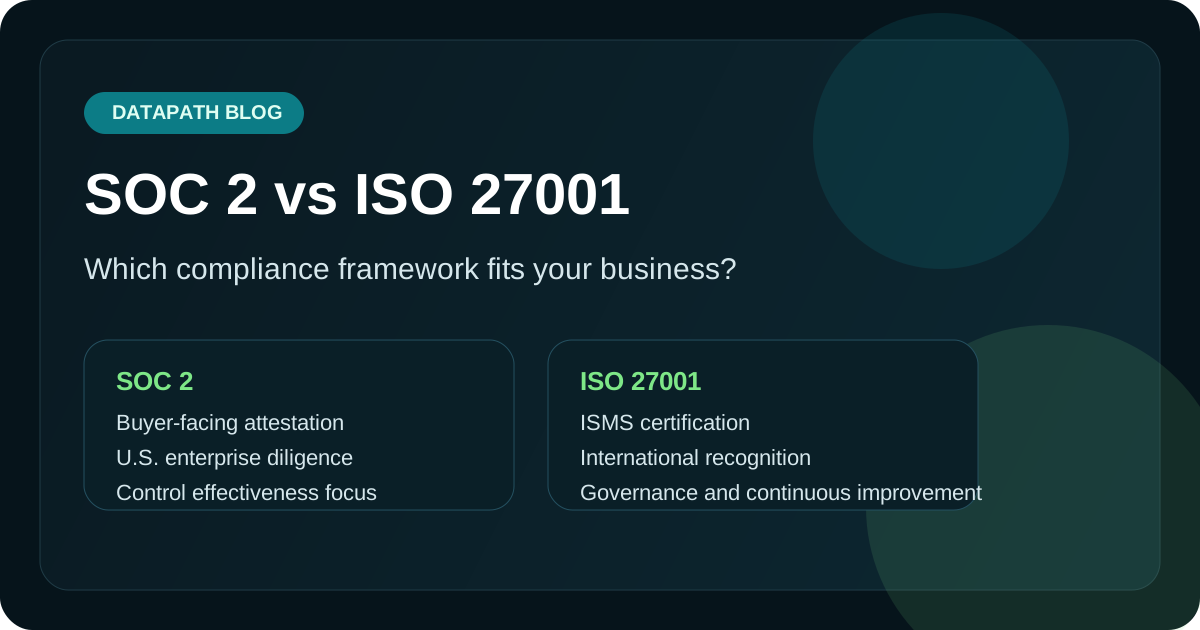

Which is better for most businesses: SOC 2 or ISO 27001?
For most businesses, the better choice depends less on abstract security theory and more on who is buying from you, where those buyers operate, and how mature your internal security program already is. In our experience, SOC 2 is often the more practical first move for U.S.-centric SaaS and service organizations because procurement teams ask for it directly and the reporting format is familiar. ISO 27001 is often the stronger fit when the company needs a formal information security management system, broader international credibility, or a more structured governance model.12
The important point is that this is not really a “good framework versus bad framework” decision. Both are respected. Both can help you reduce risk and build customer trust. The real question is whether your business needs a market-facing attestation, a program-level security certification, or both.
What does SOC 2 actually measure, and what does ISO 27001 actually certify?
A clear comparison starts with what each framework is designed to prove. They overlap in many control areas, but they answer different business questions.
What is SOC 2?
SOC 2 is an attestation framework created by the AICPA for service organizations that handle customer data. It evaluates whether your controls are designed appropriately and, in a Type 2 report, whether they operate effectively over a period of time. The framework is organized around the Trust Services Criteria: security, availability, processing integrity, confidentiality, and privacy.13
That makes SOC 2 especially useful when your buyers want evidence that your current security controls are real, documented, and independently reviewed. We usually see this matter most when a company is selling into:
- U.S.-based mid-market or enterprise customers
- procurement teams with standard vendor-risk questionnaires
- industries that expect due diligence before sharing data
- partnerships where customer trust is tied to operational discipline
SOC 2 is not a certification. It results in an auditor attestation report. That distinction matters because the output is meant to help a prospective customer or partner understand how your controls were reviewed, what scope was included, and how the auditor evaluated them.24
What is ISO 27001?
ISO 27001 is an international standard for creating, operating, and continually improving an information security management system, or ISMS. Instead of centering only on whether a specific control exists, ISO 27001 asks whether the organization has a repeatable system for identifying risk, assigning ownership, documenting policies, operating controls, reviewing performance, and improving over time.25
That tends to make ISO 27001 broader and more management-system oriented than SOC 2. It is often a good fit when a business needs to show that security is not just a collection of tools and point controls, but a company-wide program with governance behind it. We see that resonate especially with:
- organizations selling outside the United States
- businesses aligning to multiple frameworks over time
- leadership teams that want stronger security governance
- companies in regulated or audit-heavy operating environments
The output is a certification issued after an accredited audit process, which tends to carry strong weight in international markets.26
Where do they overlap?
The overlap is real. Multiple industry sources estimate that a large share of the underlying controls can map between the two frameworks.14 In practice, both expect serious work around:
- access control and identity management
- asset inventory and configuration discipline
- vendor risk awareness
- incident response planning
- logging and monitoring
- policy documentation
- security awareness and accountability
That is why many companies do not treat this as an either-or decision forever. They start with the one that best fits the current revenue motion, then use that work to reduce lift for the other later.
How should a business choose between SOC 2 and ISO 27001?
The fastest way to choose well is to anchor the decision to buyer expectations, operating footprint, and internal maturity instead of chasing whichever acronym sounds more impressive.
Choose SOC 2 first if your buyers are mostly in the U.S.
If your sales team keeps hearing some version of “send the SOC 2” during diligence, that is usually your answer. SOC 2 is deeply familiar to North American procurement, legal, and security-review teams, especially for SaaS vendors, MSPs, cloud providers, and other service businesses trusted with customer data.13
A SOC 2-first path often makes sense when:
| Signal | Why it points to SOC 2 |
|---|---|
| Most customers are U.S.-based | Buyer familiarity is high and diligence is faster |
| Sales cycles are being slowed by security review | The report directly supports vendor due diligence |
| You already have controls but need formal proof | SOC 2 helps validate control design and operation |
| You need a practical near-term trust signal | SOC 2 is often the more commercial first milestone |
For many businesses, SOC 2 is not just a compliance exercise. It is a revenue-enablement project. If the business cannot get through procurement cleanly, growth friction shows up fast.
Choose ISO 27001 first if you need stronger governance or international recognition
ISO 27001 often becomes the better starting point when the business is operating globally, expects multinational customers, or needs a more structured operating model around risk and policy management. Because ISO 27001 is built around an ISMS, it can create more discipline across leadership review, policy ownership, internal audit rhythm, corrective action, and continuous improvement.25
An ISO 27001-first path often makes sense when:
- your customer base is spread across multiple countries
- prospects or partners expect an internationally recognized certification
- leadership wants a durable governance structure, not only an attestation
- security obligations are expanding across vendors, locations, and business units
- you expect to align with other standards over time
That does not automatically mean ISO 27001 is “better.” It means it may be more aligned to the shape of the business.
Choose both if your business is scaling into complex markets
For companies with U.S. enterprise demand and international or highly regulated growth plans, the strongest answer is often both. SOC 2 can satisfy customer diligence in the U.S., while ISO 27001 can establish a broader management-system backbone that supports repeatability and cross-border credibility.46
We usually recommend a both-framework mindset when the business is dealing with:
- large or security-conscious buyers in multiple regions
- recurring audits and questionnaires from different stakeholders
- internal complexity across tools, teams, and third parties
- executive pressure to show security maturity, not just checkboxes
That approach typically works best when the company sequences the work deliberately instead of trying to brute-force two separate programs with duplicate effort.
What operational differences matter once you get past the acronym?
This is where a lot of teams get tripped up. The comparison is not only about market recognition. It is about how each framework changes the way the organization works.
SOC 2 is often more buyer-facing
SOC 2 is usually the framework that shows up in procurement conversations first. The report helps external stakeholders understand whether your controls were reviewed and how the auditor reached an opinion. That makes it directly useful in sales, vendor review, and customer confidence workflows.13
ISO 27001 is often more program-facing
ISO 27001 usually forces more rigor into the operating model itself. That includes defined risk treatment, internal audit expectations, management review, corrective actions, scope discipline, and continuous improvement. For some organizations, that structure is exactly what is missing. For others, it can feel heavier than what the immediate market actually requires.25
Cost, timeline, and effort depend on starting maturity
There is no honest universal answer to which one is cheaper or faster because the real variable is starting maturity. A company with scattered policies, weak ownership, and inconsistent evidence can struggle with either framework. A company with solid controls, clean documentation, and disciplined review cycles will have a much easier time with both.
In our experience, the more useful planning question is not “Which one is easier?” It is:
- where are our biggest evidence gaps today?
- who owns security governance internally?
- how consistently do we review access, incidents, backups, and vendors?
- which framework will reduce the most commercial or operational friction first?
Those answers usually point to the right sequencing.
What should leadership do before picking a framework?
Before committing budget and time, leadership should define the business case in concrete terms. That means getting specific about:
- the customers or contracts driving the need
- whether the business needs U.S. buyer trust, international recognition, or both
- current control maturity across identity, endpoints, backups, logging, and vendor risk
- who will own policy management, evidence gathering, and audit coordination
- whether the company is ready to maintain the program after the audit window closes
We also recommend pressure-testing the current environment against the broader security operating model. A framework project tends to expose the same weak points over and over: unclear ownership, inconsistent documentation, over-permissioned accounts, untested backups, vague incident paths, and vendor dependencies nobody has mapped well. If those problems are still floating around, no acronym fixes them by itself.
For teams thinking through that maturity question, our Datapath homepage gives a broader view of how we approach accountable IT operations. We also recommend reviewing our posts on SOC 2 compliance checklists and cybersecurity compliance services, plus service pages like managed IT services and financial services IT when the compliance discussion touches uptime, vendor accountability, and regulated environments.
Why Datapath for SOC 2 and ISO 27001 readiness planning?
We do not think most businesses need more abstract compliance advice. They need a realistic view of how frameworks affect operations, customer trust, and leadership decision-making. The useful work is usually in the translation layer: turning framework language into actual ownership, evidence, security reviews, vendor controls, and a roadmap the business can maintain.
That matters because compliance pressure rarely appears in isolation. It usually lands alongside growth targets, staffing constraints, customer diligence, cyber insurance requirements, and uptime expectations. If your team is weighing SOC 2 versus ISO 27001, the right next step is not guessing which acronym sounds stronger. It is understanding which framework best matches your buyers, your footprint, and your current operating maturity.
If you want help mapping that decision to your real environment, talk with our team, review our resources and guides hub, or explore how Datapath supports regulated-industry IT operations.
FAQ: SOC 2 vs ISO 27001
Is SOC 2 the same as ISO 27001?
No. SOC 2 is an attestation framework focused on Trust Services Criteria and auditor reporting, while ISO 27001 is an international certification standard centered on building and maintaining an information security management system.12
Is SOC 2 or ISO 27001 better for SaaS companies?
For many SaaS companies selling primarily in the United States, SOC 2 is the more common first requirement because enterprise buyers ask for it directly during vendor review. ISO 27001 may be the stronger addition when the business has international growth plans or wants a more formal ISMS.16
Can a company do both SOC 2 and ISO 27001?
Yes. Many organizations pursue both because the underlying controls overlap and each framework solves a different business problem. SOC 2 helps with customer diligence, while ISO 27001 can strengthen governance and global credibility.46
Does ISO 27001 carry more weight internationally?
Generally, yes. ISO 27001 is widely recognized outside the U.S. and is often the more familiar benchmark for international customers, partners, and supply-chain stakeholders.26
What should a business evaluate before choosing one?
Leadership should look at customer geography, buyer expectations, internal control maturity, ownership of security governance, and whether the business needs a commercial trust signal, a broader management system, or both.
Sources
- Secureframe: SOC 2 vs ISO 27001
- StrongDM: ISO 27001 vs. SOC 2
- TrustCloud: SOC 2 vs ISO 27001
- Strike Graph: SOC 2 vs. ISO 27001
- ISO: ISO/IEC 27001 information security management
- Thoropass: The difference between SOC 2 and ISO 27001
