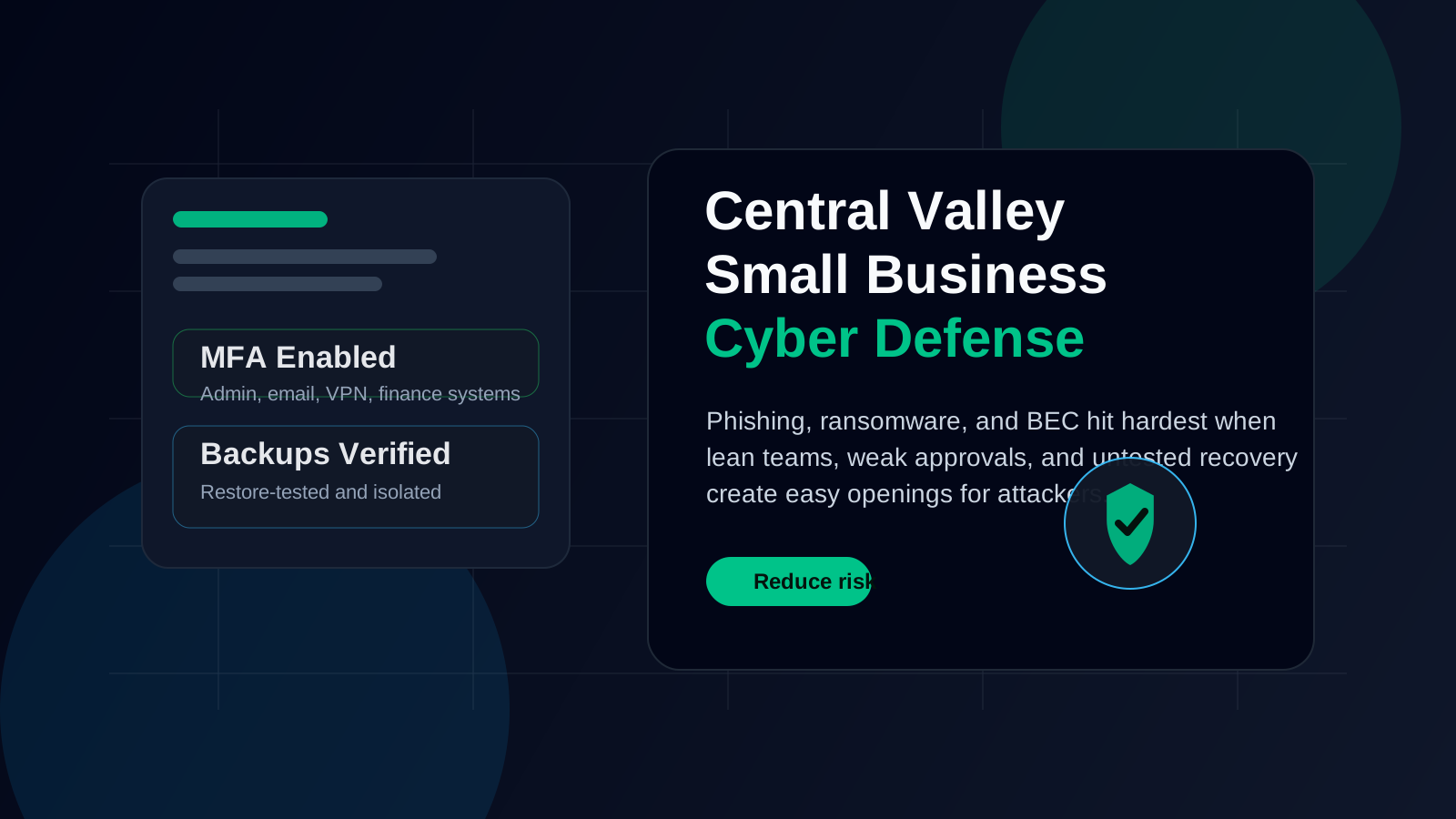
Why are Central Valley small businesses getting targeted more often?
Central Valley small businesses are getting targeted because they often sit in the exact middle ground attackers prefer: valuable enough to monetize, but not always staffed or structured like an enterprise security program. Many local organizations depend on a handful of key people, a few critical systems, and vendor relationships that have to keep working every day. That makes the impact of one compromised mailbox, one exposed remote-access tool, or one bad payment approval much bigger than leadership expects.12
The pattern is not unique to one industry. We see the same pressure across healthcare groups, school environments, professional services firms, manufacturers, logistics operators, and growth-stage businesses throughout the Central Valley. These teams usually do not think of themselves as “soft targets.” But attackers are not grading companies on prestige. They are looking for reachable credentials, weak verification steps, stale systems, under-tested backups, and busy employees who can be rushed into one bad click or one bad reply.13
Why do attackers prefer small and mid-sized organizations?
Attackers often prefer smaller organizations because the economics work in their favor. A business does not need Fortune 500 revenue to be worth attacking. It only needs bank workflows, Microsoft 365 accounts, payroll access, customer information, operational files, or privileged logins that can be sold, abused, or held hostage.1
For many smaller organizations, security responsibility is also fragmented. One internal IT generalist may be covering support, vendors, and infrastructure. Finance may own payment approvals without a formal fraud-control process. Executives may assume cyber insurance closes the gap. In practice, that leaves fewer review layers and more room for phishing, impersonation, and credential abuse to work.24
Lean resources raise the payoff for attackers
California emergency-preparedness guidance notes that many small businesses lack the time or resources to devote to cybersecurity and are therefore more vulnerable to attack.2 That is exactly why the model works for criminals. They do not need perfect access. They need an environment where preventive controls are inconsistent and recovery pressure is high.
In the Central Valley, that pressure is often operational. If email goes down, invoices may stop. If a file share gets encrypted, scheduling or fulfillment may stall. If a privileged account is hijacked, a small internal team may have limited options for fast containment. Attackers know many regional businesses cannot tolerate downtime for long, which increases the odds of hurried decisions during an incident.1
What attacks hit Central Valley businesses most often?
The most common attack paths are still familiar. What has changed is the speed and realism of the lures.
Phishing and business email compromise still work because they target normal behavior
Phishing remains one of the fastest ways into a business because it does not require a sophisticated exploit. It only requires a believable message and a busy human being.1 Business email compromise is especially dangerous for smaller organizations because it may involve no malware at all. Attackers can impersonate an executive, a vendor, or a customer and push for a wire transfer change, invoice reroute, payroll update, or urgent document release.14
When finance and operations teams are moving quickly, weak verification can turn one email into a direct loss. That is why approval discipline matters as much as technical controls.
Credential theft creates access that looks legitimate
Small-business attack chains often begin with stolen credentials from phishing, reused passwords, malware, or keylogging.5 Once attackers have a real username and password, they may not need to “hack” anything dramatic. They can log in as the employee, move through cloud apps, search mailboxes, reset rules, and expand access from there.
That is also why administrator accounts matter so much. CISA emphasizes that system administrators are valuable targets and that MFA should be enabled for all admin accounts.3 If privileged access is weak, the blast radius grows fast.
Ransomware turns control gaps into business shutdowns
Ransomware remains a major risk because it converts weak cyber hygiene into immediate operational pain. File access, email continuity, scheduling, customer communications, and accounting workflows can all be disrupted at once.1 If backups have not been isolated and restore-tested, recovery becomes slower and far more expensive than most teams planned for.
This is where many organizations discover the difference between “we have backups” and “we know we can restore the business under pressure.”
AI is making scams better, faster, and cheaper to run
AI-assisted impersonation is raising the quality of phishing, spoofed messages, and social engineering. Recent reporting on the small-business threat landscape highlights that AI-powered scams and email impersonation are making attacks more sophisticated, while experts still point to MFA and employee training as the most essential defenses.4 In plain English: the messages are getting better, so the operating discipline around verification has to get better too.
Why does the Central Valley environment make this worse?
The Central Valley has a lot of organizations that are operationally busy, growing, and highly dependent on uptime. That profile shows up in Datapath’s own regional guidance: smaller businesses often have lean IT resources, inconsistent patching, weaker vendor controls, and less formal security processes than larger enterprises.1
That matters for three reasons:
- A small number of people often hold a lot of operational knowledge. If one inbox or identity is compromised, the damage can spread quickly.
- Vendor and cloud dependence is high. A bad approval, weak shared credential, or exposed remote access path can ripple across multiple systems.
- Downtime tolerance is low. Attackers understand that businesses under pressure are more likely to make rushed payment or recovery decisions.
The result is not that Central Valley businesses are uniquely careless. It is that the region contains many organizations with meaningful operational value and limited margin for security mistakes.
What should a small business do first to lower risk?
The right answer is not “buy every security tool.” It is to fix the few controls that reduce the most risk fastest.
1. Enforce MFA everywhere that matters
CISA’s small-business guidance is blunt: ensure MFA is mandated using technical controls, not faith, and enable it for all system administrator accounts.3 That means core email, VPN, remote support, line-of-business admin portals, and anything tied to money or privilege.
If MFA is optional, inconsistently enforced, or bypassed for convenience, attackers will find the gap.
2. Tighten patching and remote-access hygiene
Unpatched devices, outdated servers, and exposed remote-access tools create avoidable openings. Basic cyber hygiene guidance continues to emphasize updates, firewalls, and malware protection because those controls still matter.6 A business does not need a bleeding-edge stack to improve security. It needs disciplined maintenance.
3. Verify backups by testing restores
Backups are only valuable if the business can actually recover from them. That means keeping backups isolated where possible and running restore tests on a schedule leadership understands. If recovery expectations are vague, ransomware pressure gets worse.
4. Create finance and vendor verification rules that survive urgency
If a payment change request, invoice update, or executive ask can be approved by email alone, the process is too weak. Build a second-channel verification habit for money movement and sensitive changes. The goal is not bureaucracy. The goal is preventing one spoofed message from becoming a real financial event.4
5. Train employees to verify before they act
User education still matters because attackers keep targeting trust, not just technology. Experts quoted in current small-business cyber reporting describe MFA as the single most valuable investment and user education as the next critical layer for building a “zero trust culture.”4 Teams should know how to spot suspicious requests, slow down high-pressure messages, and escalate when something feels off.
6. Write an incident-response path before you need it
A practical incident path should answer a few questions clearly:
- who decides containment steps
- who owns outside coordination
- how privileged access gets locked down
- how finance, operations, and leadership communicate during a live event
- how recovery gets prioritized if multiple systems are affected
If those answers only live in one person’s head, the business is more exposed than it looks.
What does “good enough” security look like for a regional business?
For most Central Valley small businesses, good security does not mean building an enterprise SOC from scratch. It means making sure the fundamentals are real, enforced, and reviewed.
A reasonable baseline usually includes:
- MFA on core business systems and admin accounts3
- documented patching ownership and review cadence6
- tested backups with clear recovery expectations1
- stronger approval controls for vendor and payment changes4
- employee training tied to phishing and impersonation risk4
- clear responsibility for incident escalation and communication
That baseline is not glamorous, but it closes a large percentage of the gaps attackers typically exploit first.
Final take: why this matters now
Hackers are targeting Central Valley small businesses because the region has exactly the mix many attackers want: lean teams, valuable operations, and limited tolerance for disruption. The strongest response is not panic. It is operating discipline.
If your business can enforce MFA, clean up privileged access, patch consistently, test restores, tighten approval workflows, and train employees to verify before acting, you become dramatically harder to compromise. That does not eliminate risk, but it changes the economics for the attacker—and that is the point.
If your team wants to strengthen that baseline, start with Datapath’s managed IT services overview, review our managed cybersecurity services guide, and talk with our team about where your current operating model is most exposed.
Footnotes
-
Why Hackers Are Targeting Central Valley Small Businesses (And How to Stop Them) - Datapath Blog ↩ ↩2 ↩3 ↩4 ↩5 ↩6 ↩7 ↩8 ↩9
-
How can I prepare my business for potential cybersecurity threats? | Outsmart Disaster ↩ ↩2 ↩3
-
Cyberattacks surge as hackers target small businesses - NJBIZ ↩ ↩2 ↩3 ↩4 ↩5 ↩6 ↩7
-
What All Businesses Should Know About Cyber Hygiene | Tulane School of Professional Advancement ↩ ↩2
