
Was there a Modesto Bee data breach in 2025 or 2026?
If you searched for “Modesto Bee data breach” and landed here, the short answer is: based on public reporting through May 2026, there is no widely confirmed data breach of the Modesto Bee newspaper itself in 2025 or 2026. The breach you are almost certainly reading about is the City of Modesto Police Department ransomware attack the Modesto Bee covered extensively beginning in February 2023, plus the 2025 City of Modesto risk assessment the Bee surfaced in later reporting.123
That distinction matters for two reasons. First, anyone Googling this term deserves a straight answer, not a vague “it’s complicated” page. Second, the actual story underneath the search — what the Modesto Bee’s reporting exposed about Modesto’s information-security posture — is more important than the question of whether the newspaper itself was breached.
A separate point worth noting: McClatchy Media Network, the Modesto Bee’s parent company, did experience a cyber incident in June 2024 that disrupted internal publishing systems across its 30 daily newspapers, but no subscriber-data exposure has been publicly confirmed in connection with that event as of this writing.4 If that situation changes, California’s SB-446 (signed into law in October 2025) now requires breach notification to affected California residents within 30 days of discovery, which would make any confirmed exposure publicly trackable through the California Attorney General’s data-breach database.5
For the rest of this post, we are going to focus on what the Modesto Bee’s coverage actually revealed — because that is the story that matters for residents, mid-market businesses, and other Central Valley organizations.
What did the Modesto Bee’s reporting on the City of Modesto breach reveal?
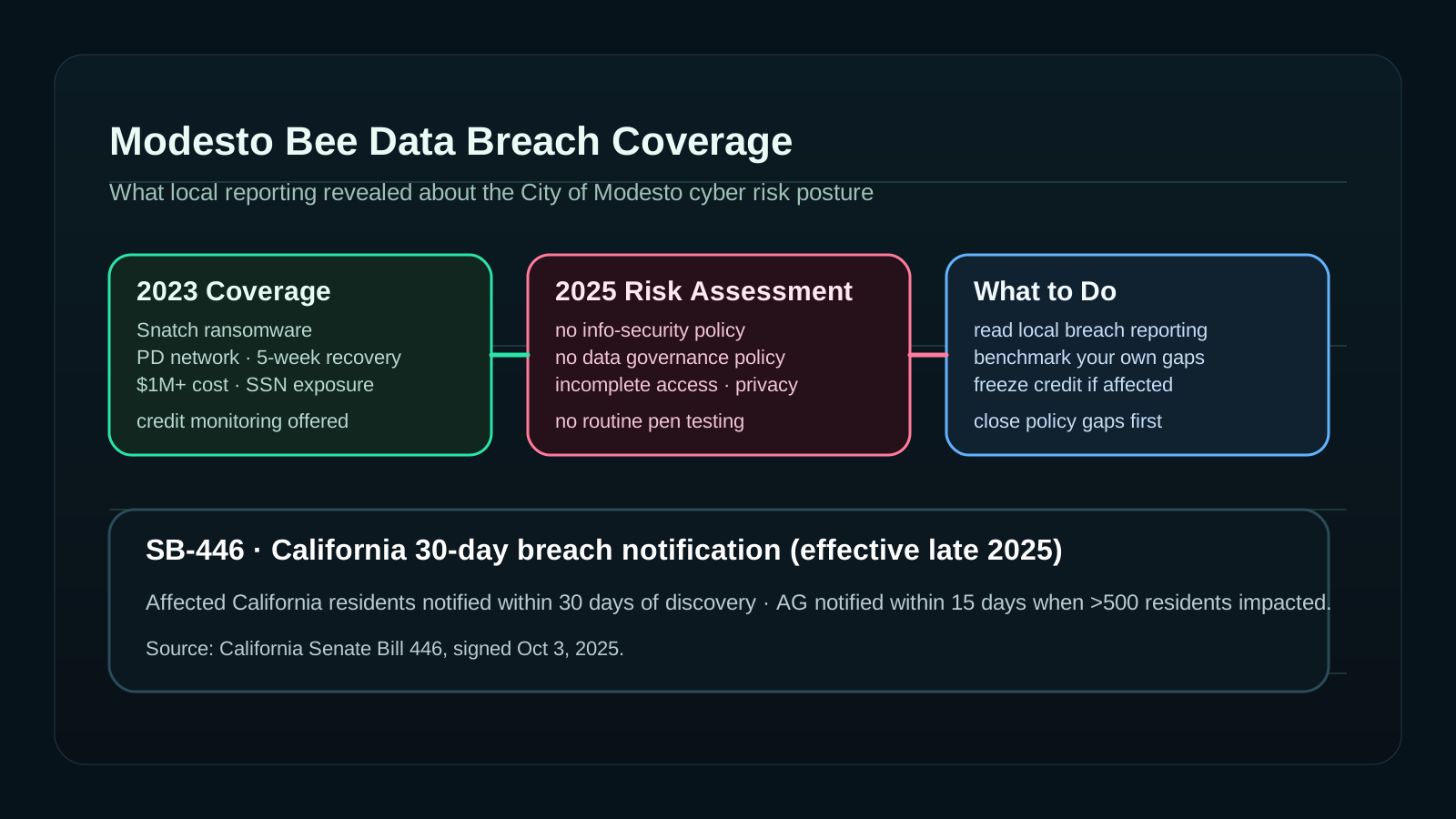
The Modesto Bee was the primary local outlet covering the February 3, 2023 ransomware attack on the Modesto Police Department. Its reporting, combined with follow-up coverage by national outlets such as Government Technology, established several public facts:126
- The intrusion likely began January 31, 2023 and was detected on February 3, 2023.
- The Snatch ransomware group claimed responsibility and posted 15 files on its leak site.
- Exposed data included names, addresses, Social Security numbers, and driver’s license numbers, primarily for Police Department employees.
- Recovery took roughly five weeks and cost the city more than $1 million in outside response work, new tooling, and an insurance deductible.
- 911 call-taking and emergency response stayed operational throughout.
Our companion post on the City of Modesto ransomware attack walks through that timeline in more detail and breaks down what could have been done differently. For this post, the part of the Bee’s reporting that matters most is what came after the incident.
What did the 2025 City of Modesto risk assessment find?
The Modesto Bee’s later reporting surfaced findings from a 2025 City of Modesto risk assessment that, by any reasonable read, should concern residents and businesses in the city. According to that reporting, the assessment found that the city — two years after the Police Department ransomware event — still:37
- did not have a formal information security policy
- did not have a formal data governance policy
- had incomplete policies for access control and data privacy
- did not conduct regular penetration testing of its systems
Read those gaps carefully. They are not exotic. They are the foundational scaffolding of any modern information-security program. The city spent more than $1 million on incident response and new tooling after the 2023 attack, and the 2025 assessment shows that essential governance work — written policy, defined data ownership, tested access control, and routine external testing — still needed to be completed.
That is the actual story underneath the search term “Modesto Bee data breach.” It is not that the newspaper was breached. It is that the newspaper’s reporting documented a measurable, ongoing governance gap in the city it covers — and that gap directly increases the probability of a future breach.
Why does this matter for Central Valley residents and businesses?
For residents, the reporting matters because city systems hold meaningful personal data — police records, citation data, utility-billing information, permits, and HR files. If those systems are protected by ad-hoc rather than policy-backed controls, the probability of a future incident affecting residents is not theoretical.
For businesses, the reporting matters because the same gaps show up across mid-market organizations in the region. We see them routinely when we run cybersecurity risk assessments and cyber insurance readiness reviews for Central Valley clients:
- no written information security policy approved by leadership
- no data governance policy that identifies which data is sensitive and who owns it
- access-control practices that exist in people’s heads, not in a documented standard
- penetration testing that happens once for an insurance form and not on a defined cadence
The good news is that closing these gaps is not a tooling problem. It is a discipline and ownership problem. Tools cost money; policies cost attention and leadership endorsement. The cheapest dollar in your security budget is almost always the one you spend on writing things down so the rest of the program can be enforced consistently.
How should you read local breach coverage as a security signal?
Local journalism — including the Modesto Bee’s continued coverage of city cybersecurity — is one of the most underused free risk-intelligence feeds available to IT and business leaders in the Central Valley. Here is how we recommend reading it.
1. Treat the incident as a baseline, not an anomaly
When a local government, school district, hospital, or municipal utility is hit, the same threat actors are running the same playbooks against private-sector organizations in the same region. Snatch, LockBit, BlackSuit, and their successors have repeatedly targeted mid-market U.S. organizations with similar profiles. If you are a Central Valley business with 100 to 1,000 employees, you are squarely in scope.
2. Look for follow-up reporting on audits and assessments
The 2025 City of Modesto risk assessment is a perfect example: the most useful security intelligence often arrives months or years after the original incident, when auditors finally publish their findings or when a public-records request surfaces something specific. Set a calendar reminder to revisit local incident coverage 12 to 18 months out.
3. Compare the public findings to your own environment
If a public-sector neighbor was flagged for “no information security policy” and “no regular penetration testing,” ask the same two questions internally. If the answers are uncomfortable, you have just received a free benchmark.
4. Use the timeline as a planning tool
The Modesto Bee’s reporting shows roughly five weeks from incident to operational recovery for the Police Department.2 That is a useful number for any leadership team writing or refreshing a business continuity vs. disaster recovery plan. If your own recovery objective is significantly faster than that, the plan needs to be tested. If it is significantly slower, that is its own problem.
What should residents do if they are concerned about their data?
For Modesto residents who are concerned that their personal information could have been touched by the original city incident or by any other regional breach:
- Watch for notification letters. Under California law, organizations must notify affected California residents in writing when their unencrypted personal information has been exposed. SB-446 tightened the timeline to 30 days from discovery in late 2025.5
- Use the credit monitoring you were offered. The City of Modesto offered one year of complimentary credit monitoring to affected individuals.1 If you were offered similar coverage after any other incident, enroll.
- Place a credit freeze, not just a fraud alert. A freeze is free, reversible, and far more effective than a 90-day alert at preventing new accounts from being opened in your name.
- Watch the California Attorney General’s breach database. California’s data breach reporting portal publishes notifications for any breach affecting more than 500 California residents.
If you are a business owner or IT leader, the practical follow-up is to make sure your own organization has, at minimum, the policy and testing foundations the 2025 risk assessment flagged: written information security policy, data governance policy, completed access-control and data-privacy standards, and an external penetration test on a defined cadence.
How Datapath supports Central Valley organizations after coverage like this
We are headquartered in Modesto. We work with K-12 districts, healthcare groups, county agencies, financial-services firms, and mid-market businesses across the Central Valley. We did not work on the City of Modesto incident, and nothing here is informed by non-public information — everything is from public reporting and city statements.
We write about it because the patterns translate. When our team runs a cybersecurity risk assessment, a cybersecurity remediation plan, or a CCPA / CPRA compliance review for Modesto businesses, we are essentially asking the same questions the 2025 city risk assessment asked — and helping leaders fix the answers before the headline rather than after it.
If you want to compare your current posture to the gaps the Modesto Bee surfaced, the most useful first step is a structured conversation. Reach out to Datapath, or browse our Modesto cybersecurity services and solutions overview for context.
Sources and further reading
- Government Technology — Personal Data Exposed in Cyber Attack on Modesto, Calif., PD
- Government Technology — Ransomware Attack Could Cost Modesto, Calif., $1M
- Government Technology — Hackers Behind Modesto PD Attack Begin Releasing Data
- California Attorney General Data Breach Notification List
- Norton Rose Fulbright — California SB-446 30-Day Breach Notification
Footnotes
-
Government Technology, “Personal Data Exposed in Cyber Attack on Modesto, Calif., PD,” https://www.govtech.com/security/personal-data-exposed-in-cyber-attack-on-modesto-calif-pd ↩ ↩2 ↩3
-
Government Technology, “Ransomware Attack Could Cost Modesto, Calif., $1M,” https://www.govtech.com/security/ransomware-attack-could-cost-modesto-calif-1m ↩ ↩2 ↩3
-
Modesto Bee coverage of the 2025 City of Modesto risk assessment, summarized via secondary reporting (information security policy, data governance, access control, penetration testing gaps). ↩ ↩2
-
Public reporting on the June 2024 McClatchy Media Network cyber incident; no subscriber data exposure publicly confirmed as of May 2026. ↩
-
Norton Rose Fulbright Data Protection Report, “California tightens data breach notification timelines, imposes 30-day notice requirement,” November 2025, https://www.dataprotectionreport.com/2025/11/california-tightens-data-breach-notification-timelines-imposes-30-day-notice-requirement/ ↩ ↩2
-
Government Technology, “Hackers Behind Modesto PD Attack Begin Releasing Data,” https://www.govtech.com/security/hackers-behind-modesto-pd-attack-begin-releasing-data ↩
-
Government Technology, “Cyber Incident Disrupts Modesto, Calif., Police Department,” https://www.govtech.com/security/cyber-incident-disrupts-modesto-calif-police-department ↩