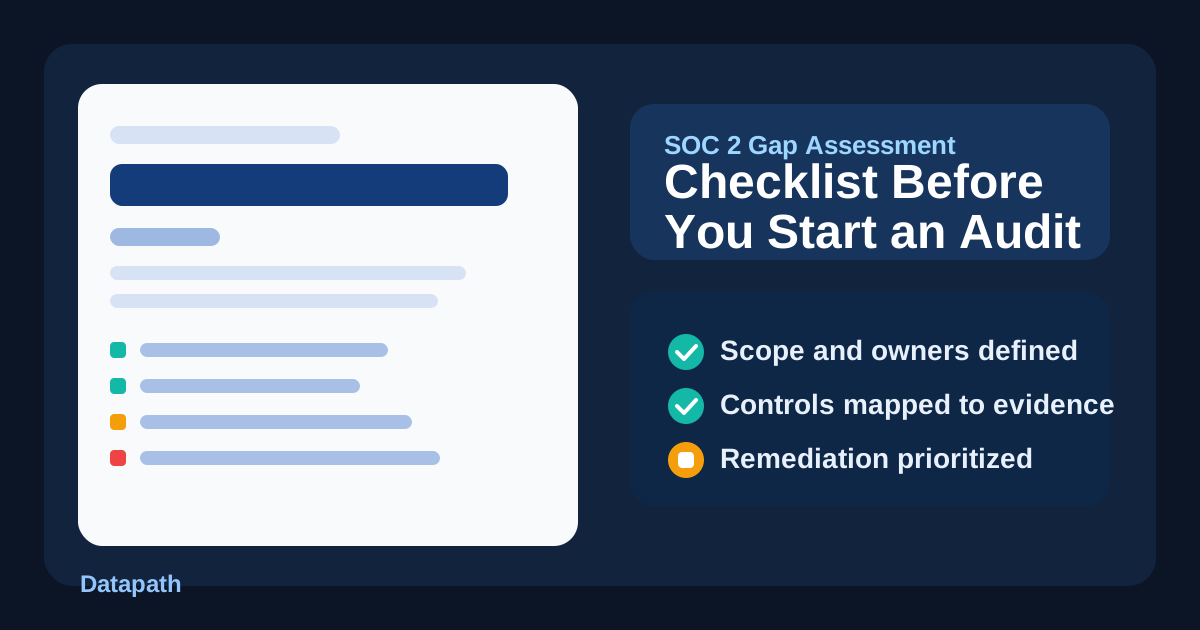
What should a SOC 2 gap assessment checklist include before an audit?
A strong SOC 2 gap assessment checklist should define scope, identify in-scope systems and vendors, map controls to the relevant Trust Services Criteria, verify evidence sources, assign owners, test whether controls actually operate as described, and prioritize remediation before the audit starts.12 The goal is not to create a prettier spreadsheet. The goal is to find the gaps early enough that your team can fix them before those gaps become expensive audit delays.
That distinction matters because a lot of organizations think they are “mostly ready” for SOC 2 when what they really have is a mix of policies, good intentions, and scattered technical controls. In our experience, the painful part usually is not writing the policy set. It is proving that access reviews happened, vendor oversight is documented, changes were approved, incidents are handled consistently, and recovery controls are tested in a way an auditor can follow.
A pre-audit gap assessment should answer one practical question: if an auditor asks how this control works, who owns it, and what proof exists, can we answer quickly and confidently? If not, the checklist is already doing its job.
At Datapath, we think the best readiness work makes compliance easier to run, not just easier to talk about. That is the same mindset behind our managed IT services, our cybersecurity compliance services guide, and our SOC 2 evidence collection checklist.
Why do teams need a gap assessment before a SOC 2 audit?
Because SOC 2 audits reward operating discipline, not optimism. The AICPA’s SOC framework is built around whether controls are suitably designed and, for Type II reporting, whether they operated effectively over time.1 A gap assessment gives the team a chance to find weak points before fieldwork starts, when fixes are still manageable.
Without that step, teams often discover the same problems too late:
- systems are in scope, but ownership is unclear
- policies exist, but technical enforcement is inconsistent
- evidence is spread across tickets, chat, screenshots, exports, and shared drives
- vendors are critical to the environment, but their oversight is lightly documented
- access, change, backup, and incident controls exist informally rather than repeatably
That is why we recommend treating the gap assessment as an operational checkpoint rather than a pure compliance exercise. If your team already knows SOC 2 is coming, waiting until the auditor starts asking for samples is the expensive version of preparation.
For organizations still deciding how broadly to structure readiness, our SOC 2 readiness checklist for SaaS and financial services companies is a useful companion. For teams comparing broader security governance models, our SOC 2 vs ISO 27001 guide helps frame where each approach fits.
What should you define first in a SOC 2 gap assessment?
Before you score any gaps, define the operating boundary. A checklist that skips scope tends to produce false confidence.
Clarify which report and period you are targeting
The checklist should state whether the organization is preparing for SOC 2 Type I or Type II, which trust categories are in scope, and what period the team expects the auditor to examine.1 A Type I effort tests design at a point in time. A Type II effort requires stronger evidence discipline because the auditor is evaluating whether controls operated over a defined review period.
That sounds basic, but it changes the work immediately. If a team is targeting Type II but still collecting one-time screenshots for recurring controls, the gap assessment should flag that early.
Inventory the systems, applications, and data that matter
A useful checklist should require a real inventory of:
- production systems and cloud platforms
- identity providers and admin surfaces
- endpoints, servers, and backup systems
- logging, alerting, and ticketing tools
- vendors with access to production systems or sensitive data
- sensitive data flows and critical assets
NIST CSF 2.0 and CISA both reinforce the same starting point: you need to know what systems, users, and data are in play before cybersecurity risk can be governed sensibly.34
Identify owners before you identify findings
We prefer to make ownership explicit at the top of the checklist, not at the end. Every major control area should have a named owner, a backup owner when needed, and a clear evidence location. If a control has no owner, it usually has no durable evidence habit either.
Which control areas belong on a practical SOC 2 gap assessment checklist?
The best checklist does not try to be abstract. It should walk through the control areas that commonly create readiness friction and force the team to prove whether those controls are real, enforced, and evidenced.
Access management and user lifecycle
Access controls deserve a hard look because they affect nearly every environment and often reveal whether governance is genuinely working. The checklist should verify:
- SSO and MFA coverage, especially for privileged access
- onboarding approvals and role-based provisioning
- timely offboarding and access removal
- periodic access reviews with retained sign-off
- shared account, break-glass, and exception handling
- admin privilege assignment and review cadence
CISA’s Cyber Essentials guidance is blunt on this point: organizations should know who is on the network, use MFA, enforce least privilege, and maintain procedures for changes in user status.4 If your environment depends on those controls but cannot show when they were reviewed, that is a readiness gap.
Change management and system administration
The checklist should also test whether production changes are governed in a way an auditor can follow. In practice, teams often have good engineers and decent release habits, but weak documentation discipline.
A pre-audit review should ask:
- Are production changes tied to requests or tickets?
- Is approval retained in a durable system?
- Can the team connect a change request to testing, deployment, and rollback considerations?
- Are emergency changes documented and reviewed afterward?
This is not red tape for its own sake. It is how the organization shows that system changes are controlled rather than improvised.
Logging, monitoring, and incident response
A SOC 2 gap assessment checklist should verify not just whether monitoring tools exist, but whether monitoring creates a retrievable operating trail. Teams should be able to point to:
- log coverage for key systems
- alert routing and review processes
- incident escalation paths and response records
- post-incident review or remediation tracking
- evidence that critical events are investigated, not merely collected
CISA and NIST both frame response planning and operational visibility as foundational, not optional extras.34 If the organization cannot show who investigates alerts, how incidents are escalated, or what changed after a material event, those are real pre-audit gaps.
Backup, recovery, and resilience controls
Backup claims are another area where teams sound stronger than the evidence actually is. A useful checklist should test whether the organization can document:
- which systems are backed up
- whether restore testing occurs
- how frequently backups run and are validated
- who reviews failed jobs or missed backup windows
- which systems are prioritized for recovery
This control area matters operationally well beyond the audit. It also overlaps with the planning questions in our disaster recovery testing checklist and business continuity vs disaster recovery guide.
Vendor oversight and third-party risk
SOC 2 readiness gets messy fast when the organization relies on SaaS providers, outsourced support, cloud infrastructure, or outside security vendors but has thin documentation around those dependencies.
A good checklist should capture:
| Checklist item | What to confirm | Why it matters |
|---|---|---|
| Vendor inventory | Which providers are in scope or materially support in-scope systems | Auditors will care about critical dependencies |
| Security documentation | SOC reports, security summaries, DPAs, or due diligence records | Shows oversight is active, not assumed |
| Access pathways | How vendors reach systems or data | Clarifies trust boundaries and shared responsibility |
| Review cadence | How often the organization reassesses critical vendors | Prevents one-time vendor reviews from going stale |
| Open risks | Exceptions, limitations, or unresolved concerns | Helps leadership understand residual exposure |
That is especially important for growing teams that depend on outside providers to move quickly. When accountability is split across vendors and internal staff, documentation becomes the thing that keeps the trust model coherent.
How should the checklist test evidence instead of just control intent?
This is the part teams most often underestimate. A policy may show control design, but it does not prove the control operated the way the organization said it did.2
We recommend structuring the checklist so each control area includes five validation questions:
- What is the control?
- Who owns it?
- What system or process enforces it?
- What evidence proves it ran?
- What gap still exists between policy, practice, and proof?
That format forces the team to separate theoretical readiness from operating readiness.
For example, the checklist should not stop at “quarterly access reviews are required.” It should ask:
- where are the last two review records?
- who signed them?
- how were exceptions documented?
- were any removed users or overprivileged accounts corrected?
- can those actions be shown in the system of record?
The same approach should apply to change approvals, security awareness activities, backup testing, vulnerability remediation, and vendor reviews. If the evidence trail is weak, the gap assessment should record that weakness directly.
How should teams prioritize findings from the gap assessment?
Not every gap deserves the same urgency. A strong checklist should end with a remediation model that helps leadership decide what gets fixed first.
We recommend categorizing findings by:
- audit impact
- security impact
- implementation effort
- dependency on vendors or budget
- likelihood of recurring failure during the audit period
A simple prioritization table usually works well:
| Priority | Characteristics | Typical examples |
|---|---|---|
| High | Likely to block readiness or create major control failure | missing MFA for privileged access, no retained evidence for recurring controls, undefined incident response ownership |
| Medium | Control exists but is inconsistently documented or enforced | informal access reviews, incomplete vendor review records, weak change documentation |
| Low | Improvement opportunity with limited immediate audit risk | naming cleanup, evidence storage optimization, dashboard refinement |
That gives leadership something they can actually steer. It also prevents the common mistake of spending weeks polishing lower-value artifacts while major operational gaps remain open.
Why Datapath for SOC 2 gap assessment planning?
We think a good SOC 2 gap assessment should leave the team with fewer surprises, clearer owners, and a much more honest picture of how controls operate day to day. If the readiness process only produces nicer paperwork, it is not doing enough. It should produce decisions.
For lean and mid-market IT teams, that usually means tightening evidence collection, reducing ambiguity around access and change management, documenting vendor responsibilities more clearly, and aligning leadership around what has to be fixed before an audit window opens.
If you are trying to get ahead of SOC 2 without turning the whole process into a fire drill, start from the Datapath homepage, review our resources and guides, and talk with our team about where your current controls and accountability model still feel too loose.
FAQ: SOC 2 gap assessment checklist
What is a SOC 2 gap assessment checklist?
A SOC 2 gap assessment checklist is a working review tool that helps an organization compare its current controls, evidence, and operating practices against the requirements and expectations for a planned SOC 2 audit.
When should we run a SOC 2 gap assessment?
Ideally, before the audit period begins or as early as possible before fieldwork. The earlier the assessment happens, the easier it is to fix ownership, evidence, and control-design issues before they become audit blockers.
What are the most common SOC 2 readiness gaps?
The most common gaps are unclear scope, weak access review evidence, inconsistent change management records, thin vendor oversight documentation, and controls that are written in policy but not enforced consistently in practice.
Does a gap assessment replace the audit?
No. A gap assessment is an internal readiness step. It helps the organization identify and remediate weaknesses before an independent auditor performs the formal SOC 2 examination.
Should smaller IT teams do a formal gap assessment too?
Yes. Smaller teams usually benefit even more because control ownership, evidence collection, and process discipline are often concentrated in a few people. A checklist helps make that work repeatable and easier to defend.
Sources
- AICPA SOC suite of services
- NIST Cybersecurity Framework 2.0
- CISA Cyber Essentials
- Konfirmity: SOC 2 Evidence Collection Templates