
What should IT leaders know about managed firewall services?
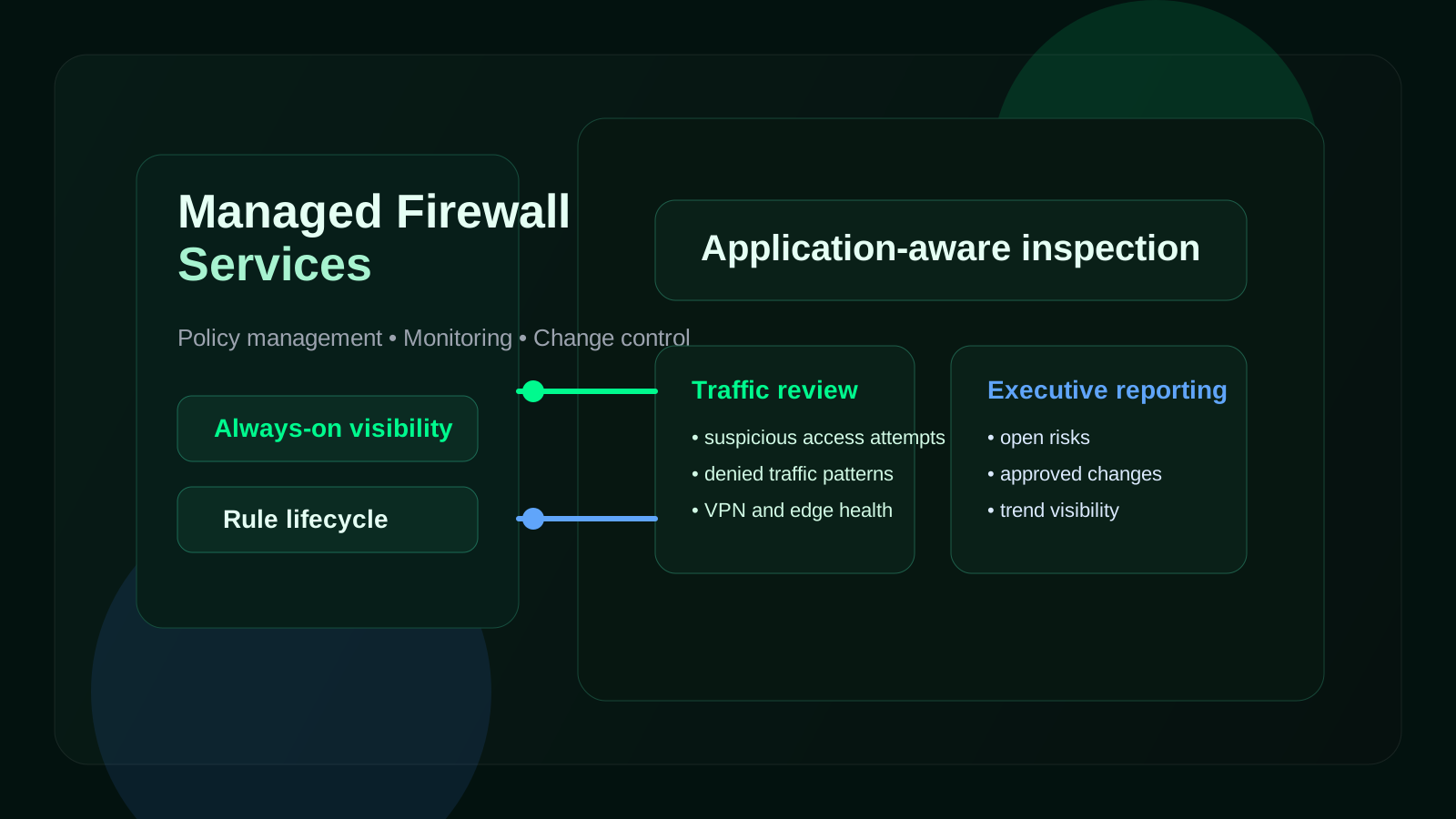
Managed firewall services give organizations more than a firewall appliance or cloud subscription. They provide the people, process, and operating discipline needed to keep firewall policy current, monitor suspicious activity, review changes, and respond when network risk increases. In practice, the value is not just blocking traffic. It is having a provider continuously manage a critical security control that too often gets configured once and then ignored.12
That matters because firewalls sit in the middle of a problem many internal IT teams know well: they are essential, but they are rarely the only thing competing for time. The same staff handling user issues, Microsoft 365 changes, vendor coordination, and infrastructure projects may also be expected to manage rule sprawl, firmware updates, VPN changes, logging, and alert review. Over time, that creates drift. Policies get harder to understand. Exceptions accumulate. Visibility gets worse.
In our experience, the strongest managed firewall model reduces that drift. It makes firewall policy more intentional, makes monitoring more consistent, and gives leadership a clearer picture of how perimeter and edge security are actually being operated.
What do managed firewall services actually include?
At a minimum, managed firewall services should include firewall administration, policy management, change control, monitoring, alert triage, firmware and platform maintenance, reporting, and escalation support. Cisco notes that modern firewalls now go well beyond basic packet filtering and often include features like intrusion prevention, URL filtering, and deeper application inspection.1 Palo Alto Networks makes a similar point about next-generation firewalls: modern enforcement depends on understanding applications, users, and content, not just ports and protocols.2
That means the service is usually broader than “someone manages the box.” A serious provider should be responsible for a repeatable operating workflow like this:
| Service area | What the provider should do | Why it matters |
|---|---|---|
| Policy administration | Create, review, and document rules and objects | Keeps access decisions understandable and defensible |
| Monitoring and triage | Review logs, alerts, and suspicious traffic patterns | Reduces blind spots and speeds up response |
| Change management | Control and document rule changes, VPN changes, and exceptions | Limits accidental exposure and configuration drift |
| Maintenance | Handle firmware updates, backups, and health checks | Improves resilience and reduces neglected risk |
| Reporting | Summarize activity, trends, open risks, and needed decisions | Gives leadership usable visibility |
Policy design and rule lifecycle management
One of the most valuable parts of a managed service is rule hygiene. Over time, many environments accumulate temporary exceptions, overly broad allow rules, stale network objects, and undocumented dependencies. The problem is not only security exposure. It is operational confusion. When rule intent is unclear, every future change becomes slower and riskier.
A good provider should help clean that up by standardizing naming, documenting business purpose, reviewing unused or risky rules, and building a more reliable approval path for changes. This is where managed firewall services often earn their value long before a major incident happens.
Monitoring, alert review, and incident support
Firewalls generate telemetry, but telemetry is not the same thing as understanding. Managed services should include someone reviewing health status, blocked traffic patterns, unusual access attempts, VPN issues, and threat-related events with enough context to tell normal noise from something worth escalating.
CISA emphasizes that firewalls are most effective when properly configured and used with other protections, not treated as a complete security strategy by themselves.3 That is the right framing. A managed provider should help the firewall operate as part of a broader security model rather than as an isolated control with nobody watching it closely.
Support for NGFW, cloud firewall, and FWaaS models
Many buyers also need clarity on deployment models. Some providers manage on-premises next-generation firewalls. Others manage virtual or cloud-native firewalls in Azure, AWS, or hybrid environments. Some offer firewall-as-a-service, where inspection and policy management are delivered through cloud infrastructure. Microsoft describes Azure Firewall as a fully stateful firewall-as-a-service for cloud workloads, while Fortinet frames FWaaS as a way to centralize application-aware security policy across distributed sites and users.45
For IT leaders, the main issue is not which acronym sounds modern. It is whether the service model matches the environment you actually operate.
When do managed firewall services make sense?
Managed firewall services usually make sense when the firewall has become business-critical but the organization does not have enough internal bandwidth to manage it with consistency. That shows up in a few common situations.
Your internal team is overloaded
This is the most common reason. The firewall may be in place, but changes are reactive, documentation is incomplete, and log review happens only when something breaks. In that situation, the technology exists, but the operating discipline does not.
Managed services help by giving the firewall a defined owner and process instead of leaving it in the category of “important, but we will get to it later.”
You have multiple sites, remote users, or cloud workloads
The more distributed the environment becomes, the more firewall operations tend to get complicated. Branch locations, VPNs, public cloud networks, third-party access, and hybrid traffic patterns all increase the number of policies that must be maintained carefully.
That is why managed firewall services are often more valuable for mid-market organizations than for very small environments. Complexity grows faster than most teams expect.
You need stronger change control and accountability
If leadership has ever asked, “Who approved this rule?” or “Why is this vendor still allowed into the network?” then you already understand the problem. A strong provider should be able to answer those questions with records, ownership, and business context rather than guesswork.
In regulated or audit-sensitive environments, that discipline matters even more. Firewall policy is often part of a larger control story involving segmentation, least privilege, incident response, and evidence of administrative review.
You need meaningful coverage after hours
Threats and outages do not respect office hours. If the organization depends on VPN availability, secure edge access, or clean escalation of suspicious traffic outside the workday, managed coverage becomes more attractive. Even when the provider is not acting as a full SOC, it should still provide clearer after-hours visibility and escalation than an overloaded generalist IT team can provide alone.
How should buyers evaluate a managed firewall provider?
The best way to evaluate a provider is to focus on operational maturity instead of hardware brands alone. Buyers often spend too much time comparing firewall feature lists and too little time asking how the service is actually run.
Start with scope and ownership
Ask exactly what the provider manages. Does the service include rule review, firmware updates, VPN support, policy documentation, alert triage, and monthly reporting? Or does it only cover break-fix support on the appliance itself?
Those are very different services. A provider should also explain what remains with your internal team, what requires joint approval, and what response commitments apply when an urgent change is needed.
Review how they handle policy changes
Firewall changes are where a lot of risk enters the environment. You want to know:
- how requests are submitted and approved
- whether changes are documented with business purpose
- how emergency changes are handled
- how rollback works if a change causes disruption
- whether old or temporary rules are reviewed later for cleanup
If the answer is vague, the service may be more reactive than managed.
Ask how they reduce noise and improve decisions
A provider should not just forward alerts. They should help explain what matters, what can wait, and what requires leadership attention. That includes translating firewall activity into things the business can act on, such as risky exposure, repeated denied access attempts, vendor access patterns, aging VPN configurations, or needed segmentation improvements.
At Datapath, we think that reporting layer matters almost as much as the technical layer. Executive teams do not need pages of log output. They need clear summaries, open risks, and recommended next steps.
Check for environment fit
The right provider should fit the environment you actually run. For example, if your business has strong Microsoft cloud dependencies, hybrid networking, or location-based operations, the provider should be able to support those realities directly. If you operate in healthcare, finance, K-12, or other regulated environments, the firewall service should also fit the compliance and evidence expectations around your broader security program.
That is also why this topic connects naturally to other Datapath resources like Managed Cybersecurity Services, Cybersecurity Compliance Services, our managed NGFW page, and the broader solutions overview.
What outcomes should IT leaders expect from managed firewall services?
The right service should improve both security posture and operating clarity. Buyers should expect better visibility into policy, cleaner change control, more reliable maintenance, and faster escalation of real issues. They should not expect the firewall alone to solve every security problem.
Better policy quality and less drift
This is often the first real win. When rules are reviewed consistently, old exceptions are cleaned up, and changes are documented, the environment becomes easier to secure and easier to operate.
More usable visibility
Good reporting makes it easier to see what the firewall is doing, where unusual patterns are emerging, and which issues deserve follow-up. That helps leadership make better security and budgeting decisions instead of operating from intuition.
Stronger resilience across edge and cloud security
As infrastructure spreads across offices, homes, SaaS, and cloud workloads, firewall administration becomes harder to treat as a side task. Managed services can help bring those layers into a more coherent operating model, especially when paired with broader monitoring and security governance.
More time for internal IT to focus on higher-value work
One of the most practical benefits is simply giving internal IT time back. When firewall changes, firmware maintenance, health checks, and alert review are handled with discipline, internal teams can focus more on business systems, modernization, user experience, and strategic planning.
Why Datapath for managed firewall services?
We approach managed firewall services the same way we approach broader regulated-industry IT: with accountability, documented process, and a bias toward decisions leadership can actually defend. The goal is not to pile on complexity. It is to make a critical control easier to operate, easier to review, and easier to align with the rest of your security program.
For organizations that need better perimeter visibility, cleaner rule management, and stronger operational discipline, that means connecting firewall management to bigger priorities like uptime, incident readiness, compliance, and executive reporting. If that is what your team is trying to improve, explore our managed NGFW services, review the resources and guides hub, or talk to our team about managed firewall operations.
FAQ: Managed firewall services
What are managed firewall services?
Managed firewall services are outsourced firewall operations that typically include policy administration, monitoring, alert review, maintenance, reporting, and support for rule or VPN changes. The service is meant to keep firewall controls current and actively managed rather than left in a set-it-and-forget-it state.
Are managed firewall services the same as buying a firewall?
No. Buying a firewall gives you the technology. Managed firewall services add the people and process needed to operate that technology consistently. The difference is similar to owning a system versus having a team accountable for keeping it effective over time.
Do managed firewall services only apply to on-premises firewalls?
No. Providers may manage physical firewalls, virtual firewalls, cloud-native firewall platforms, or firewall-as-a-service deployments. The right model depends on whether your environment is mostly on-premises, hybrid, cloud-first, or spread across many sites and remote users.
What should we ask before signing with a provider?
Ask what is included in scope, how policy changes are approved, how alerts are reviewed, what reporting looks like, what response commitments apply, and how the provider handles documentation and cleanup of stale rules. Specific operational answers are usually a good sign.
Do managed firewall services replace a full cybersecurity program?
No. Firewalls are one important control, but they work best alongside endpoint security, identity controls, backup strategy, user awareness, vulnerability management, and incident response planning. Managed firewall services should strengthen that broader program, not replace it.3
Sources
- Cisco: What Is a Firewall?
- Palo Alto Networks: What Is a Next-Generation Firewall (NGFW)?
- CISA: Understanding Firewalls for Home and Small Office Use
- Microsoft Learn: What Is Azure Firewall?
- Fortinet: What Is Firewall as a Service (FWaaS)?
