What should managed IT services in Fresno do for franchise and multi-location businesses?
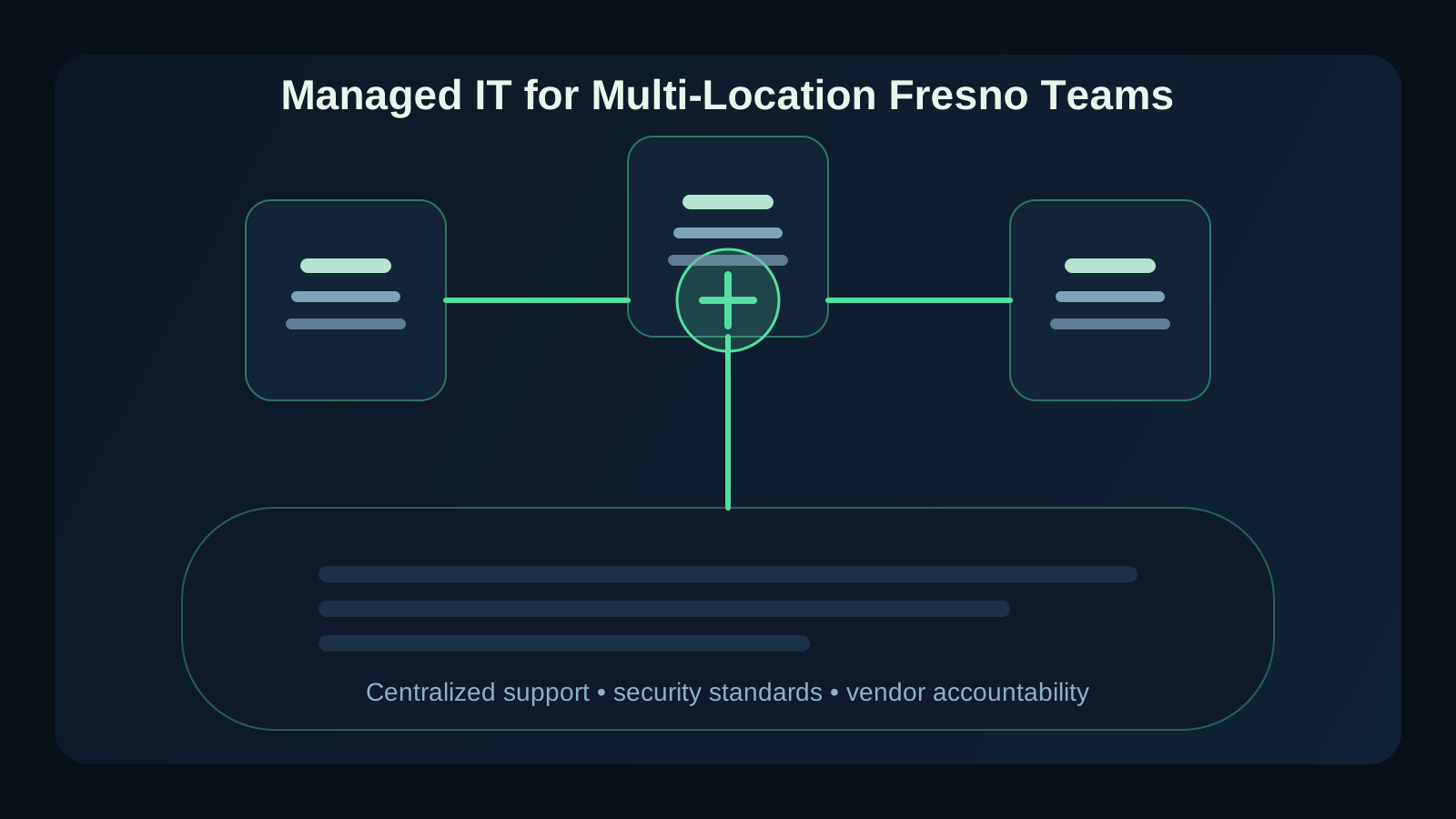
Managed IT services in Fresno for franchise and multi-location businesses should create one accountable operating model across every site without forcing every location to work exactly the same way. In practice, that means centralized monitoring, standardized security controls, consistent onboarding and offboarding, vendor coordination, backup oversight, and a clear escalation path when a store, clinic, office, or branch has an issue.123
For multi-location organizations, the problem is rarely just “we need help desk support.” The harder problem is that each location accumulates its own workarounds: different internet circuits, different printer vendors, different Wi-Fi coverage, different line-of-business systems, and different habits around access approvals. Over time, those differences create support delays, security gaps, and finger-pointing during outages.
In our experience, the best Fresno managed IT relationship is the one that gives leadership a single view of risk and performance while still respecting what each location actually needs. A restaurant group has different operational dependencies than a healthcare practice network, a franchise back office, or a field-services business. Datapath’s managed IT services in Fresno are built around that balance: local execution, centralized accountability, and service reporting leadership can use.
Why do franchise and multi-location businesses outgrow ad hoc IT support?
Many multi-site companies start with a practical patchwork: a local cable provider here, a copier vendor there, a software reseller somewhere else, and one internal generalist trying to keep it all together. That can work for a while. It usually breaks down once the business has enough sites, enough cloud apps, or enough compliance pressure that small inconsistencies start causing recurring operational drag.
Why does inconsistency become such an expensive problem?
A multi-location business pays for inconsistency in time, not just in invoices. If user onboarding takes a different form at every site, ticket routing changes from location to location, and nobody can say which devices are under warranty or whether backups are restorable, leadership ends up spending energy on avoidable surprises.
CISA’s Cybersecurity Performance Goals emphasize secure configuration, asset visibility, identity management, and recoverability because those baseline controls reduce exactly this kind of operational chaos.1 NIST CSF 2.0 makes the same point at a broader level: resilient operations depend on governance, asset management, protection, detection, response, and recovery working together instead of living in disconnected silos.2
For Fresno-area organizations with multiple branches, common inconsistency costs include:
- different laptop standards and replacement cycles by location
- local admins retaining more access than they should
- backup coverage that varies by site or vendor
- location managers escalating issues through personal contacts instead of a shared process
- internet outages that expose a total lack of failover planning
- separate SaaS purchases with no central ownership or security review
That is one reason we encourage teams to compare providers against a disciplined Fresno managed IT services model instead of a loose collection of support agreements.
Why is Fresno a meaningful operating context for multi-site IT?
Fresno is not just a map pin. For many regional businesses, it functions as an operational hub for Central Valley offices, clinics, warehouses, agriculture-adjacent operations, and franchise footprints that stretch across multiple cities. That creates a mix of needs: reliable local support when hands-on work matters, but also centralized governance when leadership wants consistency across sites.
We think that balance matters. A provider serving the Fresno market should be able to support site-level realities like ISP coordination, hardware failures, wireless dead zones, and office moves while also helping leadership standardize reporting, cybersecurity expectations, and service accountability across the entire organization. Our Fresno location page and broader Datapath homepage reflect that same operating philosophy: local responsiveness backed by a more structured managed-services model.
What should a Fresno MSP include for franchise and multi-location support?
A credible MSP for franchise and multi-location businesses should do much more than answer tickets. The provider should make it easier to run a distributed environment with fewer exceptions, clearer ownership, and stronger resilience.
How should support and escalation work across multiple locations?
Support needs to be easy for each site and governable for leadership. We recommend a single service desk process with role-based escalation, location tagging, documented contacts, and defined severity levels. A branch manager should know exactly how to report an outage. Corporate leadership should know exactly how major incidents are escalated after hours.
A practical multi-location support model usually includes:
- one primary support intake process for every location
- documented location contacts and site-specific notes
- consistent onboarding and offboarding workflows
- after-hours escalation for business-critical incidents
- vendor coordination with ISPs, phone providers, software vendors, and security platforms
- reporting that distinguishes local recurring issues from enterprise-wide patterns
That operating discipline matters even more when the business has a mix of local systems and cloud platforms. We often recommend pairing support review with guides like our outsourced IT support resource and related articles such as Switching MSPs: A Practical Checklist to Avoid Downtime and Surprises.
What security controls matter most in a multi-location environment?
The security baseline should be consistent even when local operations vary. That usually means standardized identity controls, endpoint protection, patching, email security, privileged access review, backup monitoring, and incident-response coordination.124
We generally expect a Fresno MSP supporting multiple sites to own or co-own these areas:
| Area | What the MSP should standardize | Why it matters |
|---|---|---|
| Identity | MFA, joiner-mover-leaver workflows, admin role reviews | Reduces preventable account compromise across locations |
| Endpoints | EDR policy, patch cadence, encryption, remote management | Creates a consistent workstation security baseline |
| Networks | Firewall policy review, guest vs internal segmentation, Wi-Fi standards | Limits lateral movement and location-level sprawl |
| Backup and recovery | Backup alert review, restore validation, recovery priorities | Prevents false confidence when a location goes down |
| Vendor access | Documentation of third-party admin access and support paths | Keeps accountability clear during outages and incidents |
| Reporting | Shared dashboards for open risks, aging hardware, recurring issues | Gives leadership decision-ready visibility |
For buyers evaluating network and perimeter needs, our managed NGFW page and related post on how to evaluate managed firewall coverage for multi-site teams are useful comparison points.
How important are backup, continuity, and internet-failover planning?
They are usually more important than teams expect. A single-site outage is annoying. A multi-location outage exposes whether the business actually understands operational dependency. If one location loses internet, can critical work continue? If a POS, scheduling, or file-access system goes down, do teams know who owns recovery? If a location server fails, is there a tested restore path?
The National Cyber Security Centre and CISA both emphasize recoverability and continuity planning because organizations routinely overestimate what their backups actually guarantee.34 In our experience, multi-location teams should ask direct questions about recovery priorities, not just whether backups “exist.”
That is why we often connect this conversation to related Datapath content on Microsoft 365 outage business continuity planning, data backup retention policies, and our fixed-fee IT outsourcing guide.
How should franchise and multi-location businesses evaluate Fresno managed IT providers?
The right MSP should reduce variance, not just increase vendor count. Buyers should look for a provider that can explain how they run distributed environments in the real world.
What questions should leadership ask before signing?
We recommend asking questions that expose process, not just promises:
- How do you document each location’s users, systems, circuits, vendors, and escalation contacts?
- How do you handle onboarding and offboarding when different managers request changes from different sites?
- What is your after-hours process for a location-wide outage or security incident?
- How do you standardize patching, MFA, and endpoint controls across every location?
- How do you report recurring issues that affect one site versus the whole business?
- How do you test recovery assumptions for file servers, cloud apps, and local line-of-business systems?
- Which responsibilities stay with our internal team, and which ones do you own?
Those questions are especially important for regulated businesses or organizations with sensitive data. If a provider cannot explain ownership cleanly, that lack of clarity tends to get worse after onboarding, not better.
What signals show an MSP is built for multi-site accountability?
We look for evidence of operating maturity rather than broad marketing language. Positive signals include:
- standardized onboarding templates and location documentation
- named service review cadence with leadership reporting
- clear distinction between help desk response and incident escalation
- experience coordinating with multiple ISPs and third-party vendors
- a repeatable process for hardware lifecycle planning
- clear backup and restore governance
- practical support for regulated-industry controls where needed
If the provider only talks about “being responsive,” that is not enough. Multi-location organizations need clarity on governance, change control, resilience, and accountability. For a second lens on provider evaluation, teams can compare this topic with our MSP evaluation guide for 100-employee organizations and our Fresno cloud-solutions evaluation article.
Why Datapath for managed IT services in Fresno for franchise and multi-location businesses?
We work with organizations that need IT to feel more coordinated, more secure, and easier to govern across multiple sites. That means helping leadership standardize the fundamentals, reduce avoidable variance, and get clearer visibility into what is happening across the environment.
For franchise and multi-location businesses, we focus on the things that actually change outcomes: support workflows people will use, documentation that survives staffing changes, recovery planning that reflects operational reality, and security standards that do not depend on each location improvising its own approach. If you want a partner that can help you align local execution with centralized accountability, review our managed IT services in Fresno, explore our Fresno services footprint, and talk with our team about what a cleaner multi-location IT operating model could look like.
FAQ
What is the biggest IT risk for franchise and multi-location businesses?
The biggest IT risk is usually operational inconsistency rather than one dramatic technology choice. When each location handles onboarding, vendors, backup assumptions, and access differently, the business accumulates hidden security gaps and support delays that become obvious only during outages, audits, or staff turnover.
Should every location use the same exact IT setup?
Not always. We recommend standardizing the controls that drive security, supportability, and reporting, while allowing limited local variation where workflows genuinely differ. The goal is controlled consistency, not rigid uniformity that ignores how each site operates.
How do managed IT services help multi-location businesses reduce downtime?
Managed IT services reduce downtime by centralizing monitoring, standardizing patching and endpoint policies, clarifying escalation paths, and coordinating third-party vendors before small issues turn into bigger disruptions. They also improve backup oversight and recovery planning so site-level failures are easier to contain.
What should a Fresno MSP report to leadership each month?
A Fresno MSP should report recurring issues by location, aging assets, backup and patch exceptions, security incidents, open risks, service trends, and progress against agreed priorities. Leadership needs enough visibility to spot whether one location is drifting or whether a broader pattern needs correction.
When should a growing company move from local ad hoc support to a managed model?
A growing company should usually move to a managed model when multiple locations share core systems, vendor sprawl is increasing, support requests are becoming repetitive, or leadership can no longer get a reliable answer about ownership, security posture, or recoverability across the environment.