
What is the difference between managed SIEM, MDR, and MSSP?
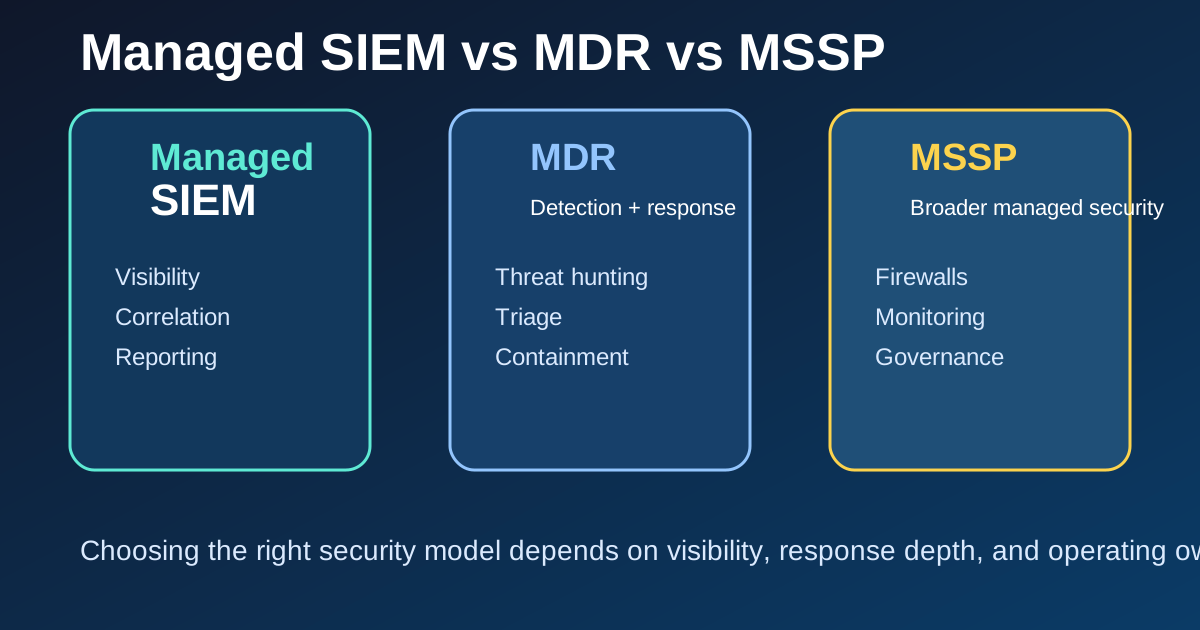
Managed SIEM, MDR, and MSSP are different security operating models, not interchangeable product labels. A managed SIEM usually centers on log collection, normalization, correlation, dashboards, and alert review. MDR is more focused on threat detection and hands-on response across endpoints, identities, cloud platforms, and related telemetry. MSSP is the broadest category and can include multiple managed security services such as firewall management, email security, vulnerability management, SIEM oversight, and monitoring delivered as an outsourced security function.123
That distinction matters because many buyers are not actually choosing a tool. They are choosing an operating model.
For most organizations, the practical question is not which acronym sounds strongest. It is which model will improve visibility, reduce response time, support compliance, and create clearer ownership when something goes wrong. Here at Datapath, we think the right answer starts with how your team will operate the service day to day, after hours, and during a real incident.
When should a business choose managed SIEM, MDR, or an MSSP?
The best choice depends on what your internal team already does well, what coverage gaps exist today, and how much security responsibility you want to outsource.124
When does managed SIEM make sense?
Managed SIEM is usually the right fit when a business wants stronger log visibility and centralized alerting but still plans to keep meaningful security analysis or incident ownership in-house. A SIEM can collect telemetry from firewalls, Microsoft 365, identity systems, servers, endpoints, cloud platforms, and business applications. That makes it valuable for investigations, detection engineering, audit support, and security reporting.14
Managed SIEM tends to fit teams that already have at least some internal capability around:
- security or infrastructure engineering
- incident coordination
- log source tuning and onboarding
- compliance reporting
- vendor escalation management
The upside is visibility and flexibility. The downside is that SIEM value depends heavily on tuning, triage, and follow-through. If your team cannot consistently review alerts, refine detections, and investigate suspicious activity, the SIEM can become an expensive dashboard rather than a meaningful control. We see this especially often when organizations buy for compliance first and operations second.
When is MDR the better model?
MDR is usually stronger when the business needs actual detection-and-response depth but does not want to build a 24/7 internal security operations capability. Most MDR services emphasize threat hunting, escalation, and hands-on response guidance rather than just showing alerts in a console. Depending on the provider, MDR may also include containment actions on endpoints, identity response steps, cloud investigation support, or curated detections tied to attacker behavior.25
For mid-market teams, that often makes MDR the highest-value option when:
- there is no internal SOC
- after-hours coverage is weak
- leadership wants faster triage and escalation
- the business depends heavily on Microsoft 365, identity, and endpoints
- ransomware response readiness matters more than broad tool sprawl
MDR is not a magic shield, though. Buyers still need to ask who owns containment approval, how alerts are escalated, whether cloud and identity telemetry are in scope, and what the first hour of an incident looks like. If those answers are vague, the service may be less mature than it sounds.
What is an MSSP really best for?
MSSP is the umbrella. Some MSSPs deliver monitoring plus firewall administration, email security, vulnerability scanning, policy support, and compliance-oriented reporting. Others are effectively managed SIEM providers with a wider service catalog. Others act more like a long-term outsourced security team for organizations that want one partner handling multiple security layers.36
That makes MSSP a good fit when a business wants breadth more than a single specialized capability. A business with lean internal IT may also prefer the simplicity of a broader provider relationship rather than stitching together separate vendors for firewalls, endpoint security, and monitoring.
The caution is that MSSP can mean almost anything in the market. Buyers should not assume two MSSPs offer the same depth of response, staffing model, or service boundaries. The label is broad enough that scope clarity matters more than the acronym itself.
How do managed SIEM, MDR, and MSSP compare on operations, visibility, and response?
The cleanest way to compare these models is by asking who owns visibility, who owns response, and how much of the operating burden sits on your team.
| Model | Primary strength | Best for | Common limitation |
|---|---|---|---|
| Managed SIEM | Log visibility, correlation, reporting | Teams with some internal security maturity | Requires tuning and analyst follow-through |
| MDR | Threat detection and response support | Mid-market companies needing stronger incident coverage | Scope can be narrower than buyers expect |
| MSSP | Broad outsourced security services | Organizations wanting one partner across multiple controls | Quality varies widely by provider and scope |
Which model gives leadership better visibility?
Managed SIEM usually produces the richest raw visibility because it is built to ingest and correlate logs from many systems. That can be powerful for investigations, board-level reporting, and compliance evidence.14 But visibility is not the same thing as clarity. If the service generates too much noise without prioritization, leadership still will not know what matters.
Which model handles response best?
MDR generally wins on response depth for organizations without an internal SOC. Good MDR services are built around investigating suspicious activity, reducing false positives, and accelerating containment decisions.25 Managed SIEM can support strong response, but it usually needs more internal analyst time. MSSP response quality varies widely by provider.
Which model is usually best for compliance-heavy environments?
Compliance-heavy environments often need audit-friendly logging, documented controls, recurring reporting, and predictable response processes. In those cases, the right answer may be a managed SIEM with strong process support, or an MSSP that can cover several control families under one governance model.346 That is why our managed cybersecurity services guide and cybersecurity risk assessment services guide are useful before vendor selection.
What should buyers ask before choosing one of these models?
The strongest buying process focuses on service boundaries, operating assumptions, and evidence of execution. We recommend asking questions like these:
What telemetry is actually included?
Do not assume the service automatically covers endpoints, cloud workloads, Microsoft 365, identity providers, firewalls, SaaS logs, and network traffic. Ask which data sources are included on day one and which require extra onboarding work.
Who acts first during an incident?
Ask who triages alerts, who declares severity, who calls your team after hours, who can isolate an endpoint, and what approvals are needed before containment.
How is noise reduced over time?
Security services should get sharper with context. Ask how the provider tunes detections, handles repeat false positives, and reviews incidents for lessons learned.
What does leadership reporting look like?
A serious service should provide more than counts of blocked events. Leadership needs trendlines, open risks, incident summaries, and recommended actions tied to business impact across Datapath’s solutions, finance organizations, or healthcare environments.
Why Datapath for managed security model decisions?
We work with organizations that need security decisions tied back to uptime, accountability, and operational maturity rather than acronyms alone. In practice, the right model is the one your team can actually run well.
Our view is simple: buyers should choose the security model that improves execution, not just coverage diagrams. If your team is comparing service models right now, start with a realistic assessment of internal capacity, reporting needs, and incident ownership. Then review our resource library, our guide on how to choose an incident response retainer, our explainer on security awareness training, or talk with our team about what the right security operating model should look like in your environment.
Frequently Asked Questions
Is MDR better than managed SIEM?
Not automatically. MDR is usually better for organizations that need stronger threat detection and incident response without building an internal SOC. Managed SIEM can be better when the business needs deeper log visibility, flexible reporting, and more control over security analytics.
What is the difference between MDR and MSSP?
MDR is typically a more focused detection-and-response service, while MSSP is a broader category that can include firewall management, monitoring, vulnerability management, email security, SIEM oversight, and related services. The exact difference depends on provider scope.
Do regulated businesses need managed SIEM?
Some do, especially when logging, reporting, and audit evidence are central requirements. But many regulated organizations need a combination of controls and process support rather than a SIEM alone. The right answer depends on internal maturity and compliance demands.
Can an MSSP include MDR?
Yes. Some MSSPs bundle MDR-like capabilities into a broader service stack. Buyers should confirm whether the provider actually offers hands-on detection and response depth or mainly monitoring and notification.
What should a mid-market company choose first?
Most mid-market companies should first choose the model that closes their biggest operating gap. If response coverage is weak, MDR is often the best first move. If reporting and centralized visibility are the bigger challenge, managed SIEM or a broader MSSP model may be a better fit.
Sources
- Microsoft Sentinel documentation
- Microsoft Defender Experts for XDR
- CISA Cybersecurity Performance Goals
- NIST Cybersecurity Framework 2.0
- CrowdStrike MDR overview
- Palo Alto Networks: What is an MSSP?
