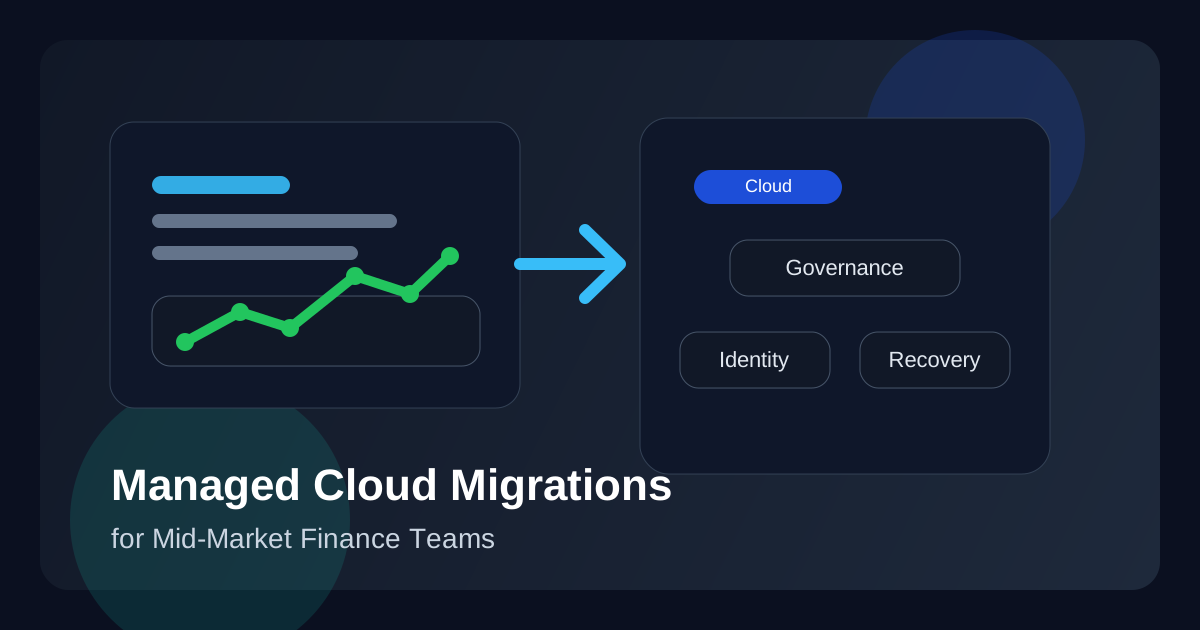

What should finance teams require from a managed cloud migration partner?
Mid-market finance teams should require a managed cloud migration partner to deliver security governance, identity discipline, data classification, rollback planning, backup validation, vendor accountability, and practical support for regulated workflows before anything is moved. In our experience, finance organizations get in trouble when a migration is framed as a lift-and-shift infrastructure project instead of an operating-model change that affects client data, access control, recovery expectations, and third-party oversight.123
That matters because a finance team rarely migrates “just servers.” It migrates email, file shares, line-of-business applications, integrations, document workflows, privileged access paths, and the daily habits people rely on to serve clients and stay compliant. If the migration partner cannot explain how those pieces will be inventoried, secured, tested, and supported after cutover, leadership is taking on more risk than the proposal usually shows.
If your team is evaluating options now, we recommend reviewing this topic alongside the Datapath homepage, our managed IT services overview, our financial services solutions page, and related guides like Secure File Transfer for Financial Services Firms: What to Require From IT, GLBA Safeguards Rule Checklist for Financial Services IT Teams, and Cloud Readiness Assessment Checklist for Regulated Businesses.
Why are cloud migrations different for mid-market finance teams?
Cloud migrations are different for mid-market finance teams because the environment usually combines regulated data, audit pressure, third-party dependence, and a small internal team that still has to keep the business moving during the transition. The hardest part is often not the destination platform. It is the governance around who can access what, how controls map to business processes, and whether the team can still prove accountability after the move.145
Finance teams usually carry more third-party and data-handling risk than they expect
A mid-market finance organization may depend on portfolio systems, client document exchanges, accounting platforms, reporting tools, Microsoft 365, identity providers, and a handful of specialized vendors that all touch sensitive information. Once migration starts, those dependencies become harder to ignore. Shared folders expose stale permissions. Old service accounts surface. Vendor-owned integrations turn out to be undocumented. Recovery assumptions do not line up with business expectations.
We usually advise leadership to treat migration planning as a due-diligence exercise on the current environment. If the team does not know which workloads are critical, which datasets are regulated, which integrations are fragile, and which vendors own which pieces of support, the cloud project will inherit that ambiguity and make it harder to unwind later.
The cloud does not remove shared-responsibility problems
A common mistake is assuming that moving to Azure, Microsoft 365, or another major cloud platform automatically reduces operational risk. Good platforms help, but they do not replace governance. NIST has been consistent that organizations need to weigh both the opportunities and risks of cloud computing, including security, architecture, and operational responsibilities.4 Microsoft’s Cloud Adoption Framework makes the same point in more modern language: secure cloud adoption requires a structured approach, not just provisioning resources and hoping controls catch up later.2
For finance teams, that means somebody still needs to own:
- identity and privileged access design
- data classification and retention alignment
- backup and recovery expectations
- vendor access and integration review
- configuration standards and change control
- logging, monitoring, and escalation paths
If those ownership lines are vague, the migration may finish technically while making the environment harder to govern.
What should be included in a managed cloud migration for finance teams?
A serious managed cloud migration for finance teams should include discovery, dependency mapping, identity and security design, data handling controls, phased cutover planning, validation testing, and post-migration operational ownership. We think buyers should push for clarity in five specific areas.
1. Discovery and workload classification before the move
Before anyone discusses migration waves, the provider should identify what is actually being moved and what business risk it carries. That usually means classifying:
- client and customer data stores
- regulated financial records
- shared file repositories and archive content
- email and collaboration workloads
- line-of-business systems and related integrations
- admin accounts, service accounts, and vendor access paths
- backup, retention, and recovery dependencies
We prefer providers that create a realistic application and dependency map instead of a simplistic server list. Finance environments often look small on paper and complex in practice.
2. Identity, access, and admin design should be part of the baseline
In most modern migrations, identity becomes the real control plane. If the migration partner focuses on compute and storage without designing stronger admin boundaries, MFA enforcement, conditional access, and role hygiene, the team is leaving too much risk in place. CISA continues to frame cyber readiness around leadership, staff, systems, and resilience, which is a useful reminder that cloud security is as much about disciplined control ownership as it is about tooling.3
We usually want to see the migration partner define:
- user and administrator MFA expectations
- privileged-role separation
- onboarding, offboarding, and role-change workflow impacts
- break-glass and emergency admin standards
- vendor and contractor access restrictions
- logging expectations for high-risk changes
That is especially important for finance teams where a compromise can affect confidential records, client trust, and regulatory response obligations.
3. Migration sequencing should protect critical workflows
Not every workload should move first. We recommend sequencing around business criticality, dependency clarity, and rollback feasibility. In many mid-market finance environments, the safest order is not “largest to smallest” or “easiest to hardest.” It is usually closer to:
- establish landing-zone and identity controls
- validate backup and restore methods
- migrate low-risk or noncritical dependencies first
- test operational runbooks and vendor support paths
- move business-critical workloads only after controls and support are proven
That pacing is less flashy than a fast transformation story, but it usually creates fewer expensive surprises.
4. Backup, retention, and resilience need to be proven, not assumed
We see this mistake constantly: teams assume a cloud platform or SaaS workload is inherently recoverable in the way the business expects. It often is not. Recovery objectives, retention, legal hold needs, restore granularity, and cross-vendor responsibility all need to be clarified before migration. That is one reason we often pair cloud planning with adjacent Datapath guidance on Microsoft 365 Backup vs Retention and Microsoft 365 Outage Business Continuity Planning.
A migration plan should answer:
- what is backed up versus simply replicated
- who owns restore testing
- how often recovery validation occurs
- what the rollback trigger is during cutover
- which systems are needed to restore finance-critical operations first
If the provider cannot explain that cleanly, leadership should slow the project down.
5. Post-migration operating ownership should be defined before cutover
A lot of projects look organized until the week after go-live. Then tickets bounce between the migration vendor, internal IT, application support, and the cloud platform. We think a managed migration should include an explicit handoff model covering support ownership, monitoring, incident escalation, optimization, and documentation updates.
For finance teams, that usually means agreeing in advance on who owns:
- platform administration
- identity and policy changes
- vendor coordination
- security alert triage
- monthly review and reporting
- remediation of discovered configuration gaps
Without that handoff, the migration may technically complete while the operating model gets worse.
How should finance leaders evaluate a migration provider before signing?
Finance leaders should evaluate a migration provider by looking for control maturity, sequencing discipline, and post-cutover accountability rather than broad promises about speed, modernization, or savings. We think the best diligence questions are operational, not aspirational.125
Ask for the risk model, not just the project plan
A good provider should be able to explain where migration risk is highest and how it will be reduced. That includes business-process risk, not just technical dependencies. Useful questions include:
- Which workloads or data classes do you consider highest risk in our environment?
- What identity and access changes do you expect before migration?
- How do you validate backup and rollback readiness?
- How will vendor-owned integrations be tested and documented?
- What changes happen to logging, alerting, and response ownership after cutover?
- What does a failed cutover look like, and what is the recovery path?
The answers usually tell you whether the provider is thinking like an operator or like a sales team.
Look for evidence of governance, not just tooling familiarity
A provider might know Azure, Microsoft 365, or another platform well and still be weak at governance. We generally trust migration partners more when they can talk clearly about change control, admin separation, business-owner approvals, documentation discipline, and executive reporting. Those habits matter a lot in finance because regulators, auditors, insurers, and leadership do not care only that the migration succeeded. They care that the environment remains controlled afterward.
Make sure the provider understands financial-services realities
Finance organizations often need more than generic cloud expertise. They need a partner that understands confidentiality-heavy workflows, secure file exchange, approval chains, vendor due diligence, and the practical tension between user convenience and control rigor. We do not think every provider has to specialize exclusively in finance, but the provider should be able to explain how it handles regulated data, third-party risk, and evidence generation in a way that fits a mid-market team.
Why Datapath for managed cloud migrations in finance?
We think finance teams need a migration partner that treats cloud work as an accountability project, not just a hosting project. That means starting with governance, identifying what really matters, sequencing changes carefully, and making sure the operating model after go-live is stronger than the one you started with.
That is how Datapath approaches managed IT, cybersecurity, and cloud modernization work for regulated organizations. We help teams connect architecture decisions to resilience, compliance, and day-to-day support reality instead of chasing a migration milestone that leaves ownership fuzzy afterward. If your finance team is evaluating cloud moves now, review our financial services solutions, our managed IT services, our broader resources and guides, or talk with our team about what the transition should really include.
FAQ: managed cloud migrations for mid-market finance teams
What is the biggest cloud migration mistake finance teams make?
The biggest mistake is treating migration as a pure infrastructure move. Finance teams usually need stronger planning around identity, data handling, vendor dependencies, backup validation, and post-cutover ownership than a standard lift-and-shift project provides.
Should finance teams move everything at once?
Usually no. We recommend phased migration based on business criticality, dependency clarity, and rollback readiness. Moving lower-risk workloads first often exposes governance and support gaps before they affect finance-critical systems.
Does moving to the cloud automatically improve compliance?
No. Cloud platforms can support stronger controls, but compliance still depends on how identity, logging, vendor access, retention, and recovery are designed and managed after migration.
What should a migration provider prove before cutover?
A migration provider should prove that workloads are inventoried, dependencies are understood, identity and security controls are in place, backup and rollback paths are tested, and support ownership is clear for the period immediately after go-live.
How do mid-market finance teams compare cloud migration partners fairly?
Compare them on governance maturity, risk identification, migration sequencing, recovery planning, vendor coordination, and post-migration operating ownership. Those factors usually matter more than who promises the fastest timeline.
Sources
- Datapath Financial Services Solutions
- Datapath Cloud Readiness Assessment Checklist for Regulated Businesses
- CISA Cyber Essentials
- Microsoft Cloud Adoption Framework: Secure Overview
- NIST SP 800-146: Cloud Computing Synopsis and Recommendations
- Datapath Secure File Transfer for Financial Services Firms: What to Require From IT
- Datapath GLBA Safeguards Rule Checklist for Financial Services IT Teams
