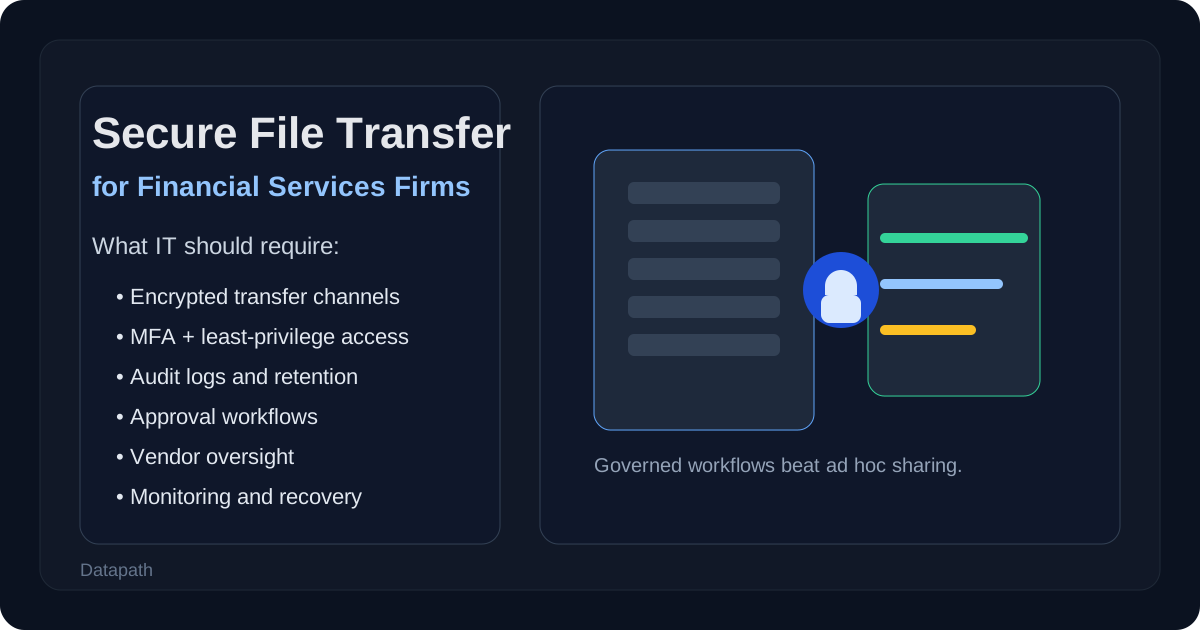

What should financial services firms require from IT for secure file transfer?
Financial services firms should require secure file transfer controls that protect data in transit and at rest, verify who is sending and receiving files, log every meaningful action, and support compliance evidence without slowing business to a crawl. In practice, that means approved transfer methods, strong encryption, least-privilege access, retention controls, alerting, vendor oversight, and a recovery plan when a transfer fails or a file is questioned.123
We think this topic gets underestimated because “sending a file securely” sounds narrower than it really is. In a finance environment, file transfer often touches customer records, statements, settlements, ACH or payment-related data, tax forms, audit packages, M&A documents, loan files, and regulator requests. The transfer method is not just a convenience decision. It is part of the firm’s control environment.
If your team is already reviewing broader managed IT services, your financial services IT operating model, or Datapath’s other resources and guides, secure file transfer belongs on that same shortlist of controls leadership should evaluate deliberately.
Why is secure file transfer a bigger issue for financial services firms?
Financial services teams rarely move “just files.” They move regulated information that can trigger customer harm, examination findings, contractual exposure, and reputational damage if it is mishandled. GLBA, SEC and FINRA expectations, PCI DSS where payment data is involved, state privacy rules, and internal audit requirements all push in the same direction: sensitive information must be shared in a way that is controlled, reviewable, and defensible.134
Ordinary collaboration tools can create hidden risk
A lot of firms inherit file-sharing habits rather than designing them. Someone starts with email attachments, then moves to ad hoc cloud links, then adds exceptions for vendors, outside counsel, auditors, or portfolio companies. Over time, nobody can answer basic control questions with confidence:
- Which transfer methods are approved?
- Which data types are allowed through each method?
- Who can create external shares?
- How are expirations, downloads, and revocations enforced?
- What evidence exists if compliance or legal asks what happened?
That gap matters because secure transfer is not only about blocking attackers. It is also about preventing accidental overexposure, weak vendor handling, and silent process drift.
Regulators care about process, not just tools
In our experience, regulated firms get in trouble when they treat secure transfer as a product purchase instead of an operating policy. Buying a managed file transfer platform or secure portal helps, but auditors and examiners usually want more than a brand name. They want to see how the firm controls access, documents exceptions, reviews logs, and proves that sensitive information was handled in line with policy.25
That is why this question overlaps with broader governance topics like our GLBA Safeguards Rule checklist for financial services IT teams, vendor risk management for financial services IT teams, and the Datapath home page, where we frame IT controls as business-accountability controls first.
What technical and operational controls should IT provide?
We recommend judging secure file transfer against a short control stack rather than one headline promise. If a provider or internal IT team cannot explain these clearly, the solution is probably weaker than it looks.
1. Approved protocols, encryption, and data-handling standards
At minimum, IT should define which transfer methods are approved for which kinds of data. That usually means avoiding ordinary email attachments for highly sensitive files and using secure portals, managed file transfer workflows, SFTP, HTTPS-based delivery, or similarly controlled methods depending on the use case.12
The requirement should cover:
| Control area | What to require | Why it matters |
|---|---|---|
| Data in transit | TLS / HTTPS or SFTP with modern cipher support | Reduces interception risk during transfer |
| Data at rest | Encryption for stored files and temporary staging locations | Protects data if a platform, device, or backup is exposed |
| Key management | Clear ownership of certificates, keys, rotation, and revocation | Prevents “secure on paper” controls from drifting |
| File integrity | Hashing or integrity validation where appropriate | Helps confirm the file received is the file sent |
| Data classification | Rules for what data can move through what channel | Prevents overuse of weak methods |
We would also require explicit policy on whether files can be downloaded locally, forwarded, synced to unmanaged endpoints, or shared onward by recipients. Too many teams secure the transfer itself and then lose control immediately afterward.
2. Identity verification and least-privilege access
A “secure link” is not much of a control if identity is weak. Financial services firms should require multifactor authentication for privileged users, role-based access, and a clear process for granting, reviewing, and removing external collaboration access.36
What good looks like:
- named users instead of shared accounts
- MFA for administrators and high-risk transfer workflows
- role-based permissions for upload, download, approve, and administer actions
- expiration dates on external access
- downloadable-file restrictions where the business case justifies it
- periodic access reviews for vendors, auditors, and outside partners
This is especially important for firms already tightening controls around third-party cyber risk assessments and conditional access policy best practices. File transfer should follow the same identity discipline as the rest of the environment.
3. Audit logs, monitoring, and evidence retention
If the firm cannot reconstruct who sent which file, to whom, when, from where, whether it was opened, and whether an error or exception occurred, the transfer process is not mature enough for a regulated environment. Detailed logging is a core requirement, not a premium feature.25
We recommend requiring logs that capture:
- sender and recipient identity
- timestamps for upload, release, access, download, expiration, and deletion
- IP address, device, or session context where available
- policy exceptions or overrides
- failed login and failed transfer attempts
- administrative changes to permissions or workflow rules
Just as important, IT should define how long logs are retained, who reviews them, what alerts trigger escalation, and how evidence is preserved for audits, disputes, or incident response.
4. Workflow controls for approvals, exception handling, and vendor use
This is where secure file transfer becomes an operating model instead of a feature list. A strong process should define when a transfer requires approval, when encryption-only is not enough, and how exceptions are documented.
Examples of workflow controls we like:
- approval gates for unusually sensitive outbound transfers
- pre-approved recipient domains or vendor destinations
- malware scanning or content inspection before release
- documented exception handling for urgent transfers
- separate workflows for auditors, clients, counterparties, and internal teams
- automatic expiration and revocation for one-time transfers
For many firms, this is also where managed file transfer platforms earn their keep. They can enforce routing, approvals, logging, and automation more reliably than a loose mix of email and consumer-style file-sharing behavior.27
How should financial services firms evaluate vendors or internal IT solutions?
The simplest test is whether the provider can explain secure file transfer as a control framework rather than a storage feature. We would ask direct questions about ownership, evidence, and failure handling.
Ask how the platform handles regulated reality
Useful evaluation questions include:
- How do you separate internal users, external users, and administrators?
- What audit fields are logged by default?
- Can external shares be disabled, approved, or time-limited by policy?
- How do you enforce MFA and least privilege?
- What happens if a transfer fails halfway through or the wrong recipient is selected?
- How are retention, deletion, and legal-hold requirements handled?
- What reporting exists for compliance reviews or investigations?
- How do you monitor for unusual download behavior or bulk exfiltration?
If the answers are vague, the product may be fine for generic collaboration but weak for financial controls.
Look for integration, resilience, and recovery discipline
Secure transfer does not live alone. We prefer solutions that integrate with identity providers, SIEM or log-monitoring workflows, DLP where relevant, and the firm’s incident-response process. The platform should also support business continuity: queueing, retry handling, backup, and clear recovery procedures if the service is unavailable.57
That resilience lens matters just as much as security. If critical transfers stop during a platform outage, month-end close, a lending workflow, treasury activity, or an audit response can stall quickly. Firms already thinking about broader resilience should view this alongside posts like Microsoft 365 outage business continuity planning and cloud disaster recovery for hybrid environments.
Why Datapath treats secure file transfer as a governance issue, not just a file-sharing issue
We think strong secure transfer programs look boring in the best possible way: clear approved methods, documented responsibilities, fewer exceptions, better evidence, and less reliance on heroics when an auditor or customer asks hard questions. That is the kind of operational discipline Datapath helps regulated organizations build.
For financial services firms, that usually means connecting secure transfer to broader controls around identity, vendor access, incident response, and accountability. It is rarely the only gap in the environment, but it is often one of the places where weak habits reveal themselves fastest.
Why Datapath for secure file transfer and financial-services IT controls
We help teams move from improvised file-sharing habits to a more defensible operating model. That includes reviewing transfer methods, clarifying data-handling rules, tightening access and logging expectations, and aligning vendors or internal IT teams to standards leadership can actually govern.
If your firm wants a more accountable approach to secure transfer, start with our financial services solutions, review the Datapath resources and guides library, compare it against your broader managed IT services approach, or talk with us about the control gaps that still depend too much on trust and workarounds.
Frequently asked questions about secure file transfer for financial services firms
What is the safest way for a financial services firm to send sensitive files?
The safest method is usually a controlled secure portal, managed file transfer workflow, or similarly governed encrypted channel tied to identity verification, logging, and expiration controls. The right answer depends on the data type and business process, but ordinary email attachments are usually too weak for highly sensitive or regulated transfers.
Is SFTP enough for financial services compliance?
Not by itself. SFTP can be part of a secure approach, but compliance usually also requires identity controls, access reviews, audit logs, retention rules, monitoring, and documented procedures. A secure protocol is useful, but it is not the whole control environment.
What should firms log for secure file transfers?
They should log who sent and received the file, when the transfer occurred, whether it was accessed or downloaded, what permissions applied, and whether any exceptions or failures occurred. Administrative changes and suspicious behavior should also be recorded and reviewable.
Should external vendors get direct file-sharing access?
Sometimes, but only with clear business justification, limited permissions, time-bound access, and periodic review. Vendor access should follow the same accountability standard as any other third-party access to regulated systems or data.
How often should secure file transfer controls be reviewed?
We recommend reviewing them at least quarterly for access and workflow drift, and immediately after major process changes, incidents, new vendor onboarding, or compliance findings. Annual policy review alone is usually not enough in a fast-changing environment.
Sources
Footnotes
-
Kiteworks. Top 5 Secure File Transfer Standards for Regulatory Compliance in 2025. https://www.kiteworks.com/secure-file-transfer/file-transfer-standards-uses/ ↩ ↩2 ↩3
-
Kiteworks. Secure File Transfer for Financial Services: Best Practices for MFT and Automated File Transfer. https://www.kiteworks.com/secure-file-transfer/secure-file-transfer-for-financial-services/ ↩ ↩2 ↩3 ↩4 ↩5
-
Egnyte. File Sharing for Financial Services & Banking Firms. https://www.egnyte.com/guides/financial-services/file-sharing-for-financial-services ↩ ↩2 ↩3
-
FTC. Financial Institutions and Customer Information: Complying with the Safeguards Rule. https://www.ftc.gov/business-guidance/resources/financial-institutions-customer-information-complying-safeguards-rule ↩
-
Progress. Secure File Transfer for Banks and Financial Services. https://www.progress.com/resources/papers/secure-file-transfer-for-banks-and-financial-services ↩ ↩2 ↩3
-
CISA. Implementing Phishing-Resistant MFA. https://www.cisa.gov/resources-tools/resources/implementing-phishing-resistant-mfa ↩
-
GoAnywhere. PCI-Compliant File Transfers for Banking and Finance. https://www.goanywhere.com/resources/datasheets/pci-compliant-file-transfers-banking-finance ↩ ↩2
