
What should a business look for in a managed IT service provider in Ripon, CA?
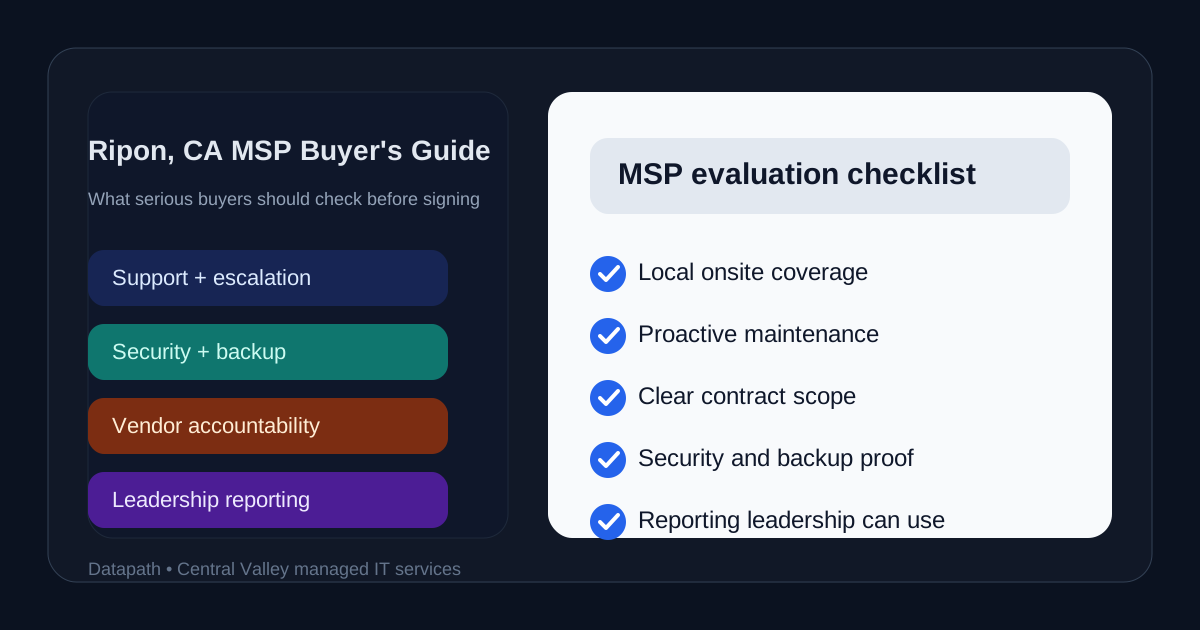
A business in Ripon, CA should look for a managed IT service provider that can combine responsive support, proactive maintenance, security oversight, backup accountability, vendor coordination, and clear reporting into one accountable operating model. The right MSP should make IT feel calmer, less reactive, and easier for leadership to understand over time.123
That matters because most growing businesses in and around Ripon are not running simple environments anymore. Even a modest operation may depend on Microsoft 365, line-of-business cloud apps, wireless networks, remote access, endpoint protection, backups, cyber insurance questionnaires, and third-party software vendors all at once. When those systems are supported inconsistently, the business feels it through recurring downtime, unclear ownership, and management time that gets burned on preventable issues.
In our experience, the best managed IT relationship does not feel flashy after the first few months. It feels steadier. Problems repeat less often. Backup failures get noticed sooner. Vendors stop pointing fingers at each other. Leadership gets cleaner answers about what is actually happening. That is the standard we think Ripon businesses should use when comparing providers.
If your team is also reviewing managed IT services, the broader Central Valley support footprint, and practical selection guides like What Is Managed IT Services?, this page should help you ask better questions before you sign.
What should managed IT services in Ripon actually include?
A serious managed IT service provider should cover the recurring operational work that keeps your environment stable, secure, and supportable. Datapath’s own service model, NIST’s Cybersecurity Framework 2.0, and CISA’s Cyber Essentials all reinforce the same point: resilient operations come from repeatable fundamentals across governance, protection, detection, response, and recovery.145
Help desk and day-to-day user support
For most businesses, managed IT shows up first through everyday support. That includes user troubleshooting, workstation setup, onboarding and offboarding, Microsoft 365 administration, printer issues, wireless troubleshooting, and escalation with third-party software vendors.
Good support matters, but ticket closure alone is not enough. A better MSP should also notice patterns. If the same VPN issue, mailbox problem, application slowdown, or workstation failure keeps coming back, the provider should explain what is being fixed systemically instead of just resetting the symptom again.
Monitoring, maintenance, and infrastructure discipline
A stronger Ripon MSP should also own the less visible work that prevents instability from piling up:
- endpoint and server monitoring
- operating system and application patching
- backup-job review and failure escalation
- wireless and network health checks
- hardware inventory and lifecycle planning
- documentation that survives staff turnover
- recurring review of alerts, aging systems, and open risks
This is the work that sounds ordinary in a proposal but matters most when the business gets busy. When maintenance is disciplined, teams spend less time reacting to avoidable noise and more time moving the business forward.
Security baseline, backup oversight, and vendor coordination
A managed IT service provider in Ripon should also be able to explain how the security baseline is actually run. Buyers should expect clarity around identity controls, endpoint protection, email security, admin access, backup accountability, and incident escalation.
| Managed IT area | What should be included | Why it matters |
|---|---|---|
| Identity and access | MFA enforcement, onboarding/offboarding, privilege review, admin controls | Reduces preventable account compromise |
| Endpoint protection | EDR oversight, response coordination, policy management | Improves detection and containment |
| Backup and recovery | Backup checks, restore escalation, retention review, accountability | Supports continuity during outages or ransomware |
| Vendor coordination | Escalation with Microsoft, ISPs, cloud vendors, and app providers | Keeps ownership clearer during incidents |
| Reporting and planning | Service reviews, risk summaries, roadmap guidance | Gives leadership decision-ready visibility |
For buyers with distributed teams, customer diligence pressure, or regulated workflows, this operating model matters much more than generic claims about being proactive. It is also worth comparing related posts like How Managed IT Services in Modesto Can Prevent Costly Cyber Attacks and Vendor Risk Questionnaire: What to Ask a Managed IT Provider Before Signing while you build your shortlist.
Why do Ripon businesses switch to a managed IT provider?
Most companies do not start shopping for an MSP because everything is running perfectly. They usually start because the current support model is creating friction leadership can no longer ignore.
Internal IT bandwidth is too thin
This is one of the most common triggers. One internal IT generalist, operations lead, or office manager can only absorb so much help desk work, Microsoft 365 administration, patching, vendor coordination, backup follow-up, and security cleanup before something important starts slipping.
Managed IT gives the business a way to spread that operational load without waiting to hire a full internal team. In some environments that means full outsourcing. In others it means keeping internal IT leadership while the MSP handles recurring support coverage, monitoring, and escalation.
Downtime and recurring friction are becoming more expensive
As environments become more dependent on cloud tools and connected workflows, even small issues create larger business consequences. A mailbox outage, identity problem, backup alert, wireless failure, or ERP slowdown can affect scheduling, accounting, customer response time, and executive attention. IBM’s Cost of a Data Breach research reinforces the broader point that operational instability and security disruption become expensive quickly once they affect day-to-day work.6
That is why many organizations start evaluating MSPs after repeated friction instead of during a neat annual planning cycle. Once preventable interruptions show up every week, leadership usually wants a more accountable operating model.
Security and customer expectations keep rising
The other major trigger is outside pressure. Cyber insurance applications ask harder questions. Customers want better answers about backup readiness, access control, and incident handling. Leadership wants more confidence that protections are real rather than assumed.
A strong MSP should improve clarity here, not add vagueness. Buyers should expect the provider to explain what is in scope, how after-hours incidents are handled, how exceptions are tracked, and what evidence exists when leadership needs quick answers.
How should businesses compare local MSPs in Ripon?
The easiest mistake is comparing providers on slogans alone. Nearly every MSP says it is proactive, strategic, responsive, and security-focused. The better test is whether the provider can explain exactly how it operates and how that operating model improves outcomes for your business.
Start with scope, ownership, and after-hours expectations
Before comparing proposals, define what you expect the MSP to own. That usually includes support, monitoring, patching, backup oversight, baseline cybersecurity administration, vendor coordination, reporting, and planning. If those responsibilities stay fuzzy during the sales process, they usually stay fuzzy after the agreement is signed.
We recommend asking questions like:
- Which users, systems, locations, and vendors are in scope?
- What happens after hours or during a high-severity incident?
- Which cybersecurity functions are included versus sold separately?
- Who owns recurring issue review and vendor escalation?
- How are backup failures, patch exceptions, and aging devices tracked?
- What reporting cadence does leadership receive?
Those questions usually tell you more than a vague all-inclusive support promise ever will.
Ask how the provider uses process, not just tools
Most MSPs can list the same categories of tools: RMM, EDR, backups, documentation, Microsoft 365, and ticketing. That is not what separates strong providers. Buyers should ask how those tools create discipline.
A stronger provider should be able to explain:
- how patch exceptions are approved and remediated
- how backup failures are escalated and verified
- how privileged access is reviewed
- how recurring incidents are analyzed for root cause
- how leadership sees trends instead of isolated ticket counts
That level of specificity is usually a better predictor of long-term fit than a longer software list.
Local reach still matters in Ripon and the Central Valley
Remote support resolves many issues efficiently, but local availability still matters for projects, hardware failures, firewall replacements, wireless remediation, and situations where a hands-on visit shortens recovery time. Ripon buyers should ask whether the provider can support the surrounding Central Valley consistently instead of treating every onsite visit as an exception.23
Local reach alone is not enough, though. The strongest fit is usually a provider that combines regional onsite coverage with stronger process maturity. A nearby office does not help much if ownership is sloppy. On the other hand, a highly organized provider with weak field support may struggle during physical infrastructure problems. Ripon businesses typically need both.
What should regulated or growth-stage businesses ask first?
Regulated and fast-growing businesses should expect managed IT to support resilience and governance, not just user support. A healthcare practice, financial firm, logistics operation, manufacturer, or multi-site business usually needs stronger control over access, vendor accountability, backup readiness, and documentation than a generic support contract provides.
The provider should understand evidence and accountability
It is not enough for an MSP to say backups are running or patches are applied. The provider should be able to show how the work is reviewed, which exceptions are still open, who owns remediation, and how leadership receives updates. That same discipline matters for admin access, endpoint risk, vendor permissions, and incident communication.
The provider should connect technical work to business risk
A strong managed IT partner should also translate technical findings into business language. An unresolved backup alert is not just a backup issue. It may affect recovery readiness, customer obligations, or cyber insurance posture. A poorly governed admin account is not just an identity problem. It can become an operational trust problem.
That business-risk framing is part of how we think good managed IT should work. It is also why many buyers compare broader topics like managed cybersecurity services, cybersecurity risk assessments, and resource guides alongside local MSP selection.
Why Datapath for a managed IT service provider in Ripon, CA?
We think managed IT should help leadership run a calmer, more accountable environment. That means reducing recurring friction, tightening the security baseline, improving backup and vendor discipline, and giving decision-makers a clearer picture of what matters now and what needs attention next.
For Ripon-area businesses, that usually means combining Central Valley support reach with stronger process maturity. Our view is simple: the right MSP is not the one that talks the most about technology. It is the one that creates clearer ownership, steadier operations, and fewer preventable surprises. If you want a partner that can support growth without letting risk, vendor sprawl, and technical debt pile up, start with the Datapath homepage, review our managed IT services overview, explore our resource library, or talk with our team.
FAQ: managed IT service provider in Ripon, CA
What should a managed IT service provider in Ripon include?
A managed IT service provider in Ripon should usually include help desk support, monitoring, patching, cybersecurity administration, backup oversight, vendor coordination, and leadership reporting. The exact scope can vary, but accountability across those areas is what keeps support from becoming purely reactive.
How do you compare Ripon managed IT providers?
Start by defining scope, ownership, reporting expectations, after-hours support, and security needs before reviewing proposals. Then compare providers on process maturity, escalation clarity, local support fit, and whether they can support growth without creating more ambiguity.
Are managed IT services worth it for mid-sized businesses in Ripon?
They often are when internal bandwidth is stretched thin, downtime is becoming more expensive, or leadership needs better visibility into risk and vendor accountability. The value usually comes from stronger operating discipline, fewer recurring issues, and clearer planning.
Does a local Ripon-area MSP matter if most support is remote?
Yes, but mostly when local reach is paired with strong process. Remote support solves many issues efficiently, but local availability still matters for projects, hardware failures, network troubleshooting, and situations where hands-on coordination helps the business recover faster.
Sources
- Datapath Managed IT Services
- Managed IT Services in Modesto: Why Local Businesses Choose Datapath
- Expert Microsoft Premier Computer Support for Stockton, Tracy, Escalon, and Ripon Small and Midsize Business
- NIST Cybersecurity Framework 2.0
- CISA Cyber Essentials
- IBM Cost of a Data Breach Report
