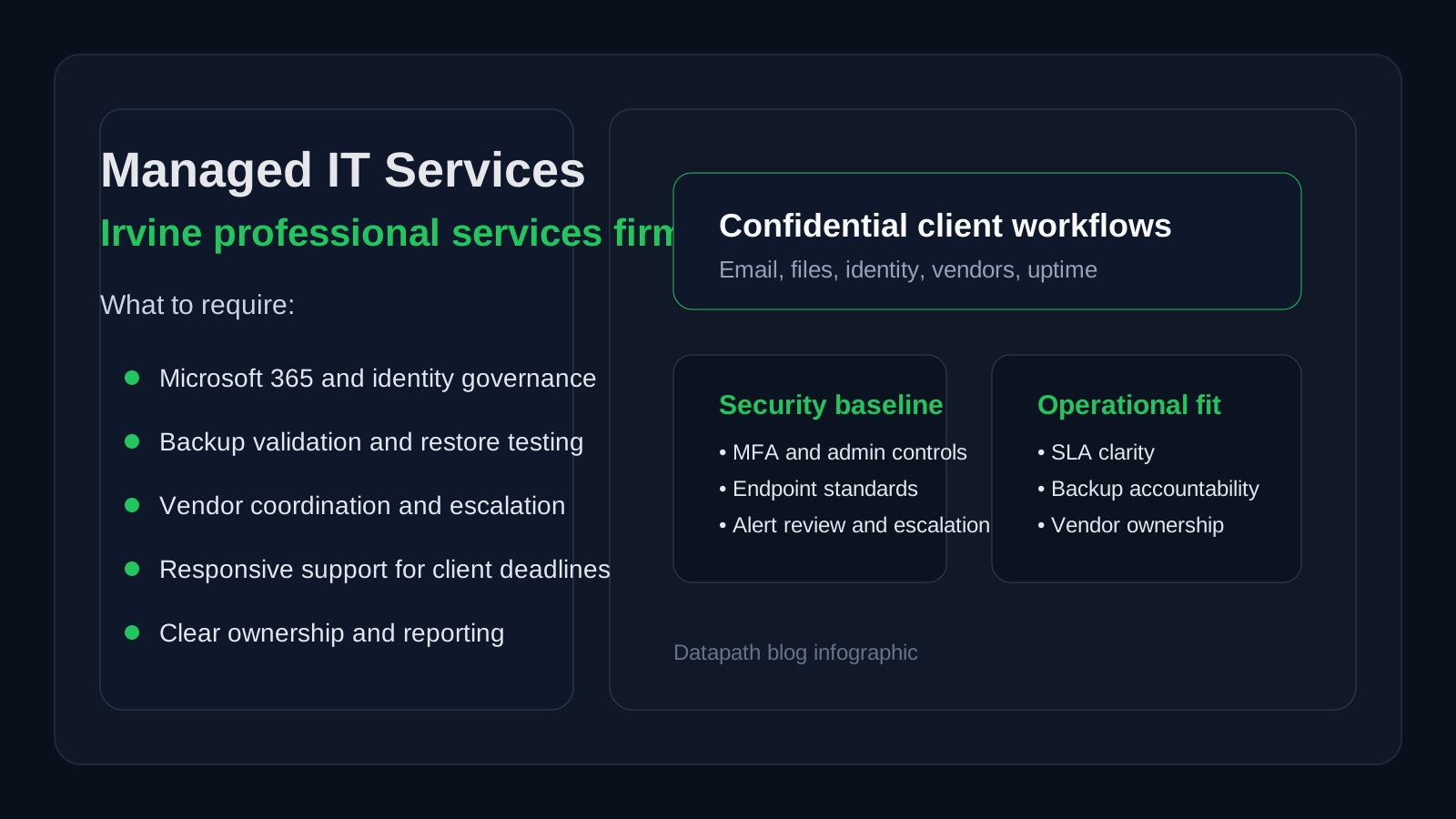

What should professional services firms in Irvine require from managed IT services?
Professional services firms in Irvine should require managed IT services that protect confidential client information, support fast and dependable user response, harden Microsoft 365 and identity controls, validate backups, and create clear accountability when vendors or systems fail. In practice, that means the provider should explain exactly how it handles privileged access, endpoint standards, security alerts, onboarding and offboarding, line-of-business support, and after-hours escalation before a disruption turns into a client-service problem.123
That matters because most professional services firms do not struggle with technology only when a server goes down. They struggle when small operational failures stack up: an inbox compromise exposes client conversations, a permissions mistake leaks files, a shared drive issue delays billable work, or a vendor handoff drags on while nobody clearly owns resolution. In our view, the right managed IT partner is the one that reduces that ambiguity and makes the environment easier to run.
For Irvine firms comparing providers, we recommend looking at this topic alongside Datapath’s homepage, our managed IT services overview, our IT consulting and storage services, and related articles like What Does a Managed IT Contract SLA Usually Include?, How to Validate Managed Service Responsiveness After Hours, and How to Compare Managed IT Pricing: Fixed Fee vs Per-User vs Tiered.
Why do professional services firms have different managed IT requirements?
Professional services firms have different managed IT requirements because the environment revolves around confidential data, deadline-driven work, and a heavy dependence on email, document systems, identity controls, and vendor coordination. A provider that treats a law office, accounting practice, architecture firm, or consulting group like a generic office usually misses the operational details that actually create risk.245
Client trust is usually the real system that needs protection
Professional services organizations are hired to handle sensitive work: financial records, legal documents, HR files, contracts, designs, strategy materials, and regulated communications. The business may use ordinary tools like Microsoft 365, SharePoint, Teams, cloud storage, line-of-business applications, scanners, and multifunction printers, but the risk profile is not ordinary. A broken workflow can stall billable time. A misconfigured permission can expose client data. A weak offboarding process can leave old access paths open far longer than leadership realizes.
That is why we usually tell firms to evaluate IT around operational trust, not just ticket volume. The question is not whether a provider can reset passwords. It is whether the provider can support a business where data handling, responsiveness, and executive confidence all matter at once.
Email, identity, and files are usually more important than flashy infrastructure
A lot of managed IT sales conversations focus on devices, servers, or generic monitoring dashboards. Those things matter, but many professional services firms live or die on a different layer: identity security, email resilience, shared files, cloud collaboration, and mobile access. Microsoft has continued to emphasize the role of identity protection, MFA, conditional access, and least-privilege administration in reducing common compromise paths.26
We think buyers should ask whether the MSP is strong in:
- Microsoft 365 tenant governance
- account provisioning and deprovisioning discipline
- role-based access and admin separation
- SharePoint and OneDrive permission hygiene
- phishing-resistant MFA and identity monitoring
- backup and recovery for cloud and file data
- vendor coordination for specialty software and document workflows
If the provider mainly talks about a help desk and antivirus, the model may be too shallow for a professional services environment.
What should be included in managed IT services for an Irvine professional services firm?
Managed IT services for an Irvine professional services firm should include responsive user support, endpoint and patch management, Microsoft 365 administration, identity controls, backup oversight, vendor coordination, security monitoring, and leadership reporting that translates technical work into business impact. The exact stack can vary, but the accountability should not.124
User support should reflect the pace of client-facing work
Professional services teams often work in bursts around deadlines, filings, client reviews, closings, month-end cycles, proposals, or board meetings. A slow response to an Outlook sync issue, PDF software failure, scanner problem, VPN interruption, or file-share outage can affect multiple staff members before it ever looks like a formal incident.
That is why managed IT support should define more than business-hours availability. Buyers should understand:
- how priorities are assigned
- what counts as a critical issue
- whether after-hours escalation exists
- how line-of-business vendor tickets are coordinated
- who owns client communication during a major issue
- whether executive or practice-leadership incidents are handled differently
We usually prefer providers that can describe escalation rules clearly instead of promising vague “white glove” support.
Identity and Microsoft 365 governance should be part of the baseline
Most Irvine firms now depend heavily on Microsoft 365 for email, document sharing, collaboration, and mobile productivity. That makes identity governance one of the most important parts of the operating model. CISA and Microsoft both continue to stress MFA, privileged access discipline, and stronger controls around admin activity because compromised identities remain one of the easiest ways for attackers to get in.26
A credible MSP should be able to support:
- MFA enforcement for users and administrators
- conditional access where appropriate
- admin-role review and separation of duties
- secure onboarding, role changes, and offboarding
- mailbox and sign-in anomaly escalation
- SharePoint and Teams access governance
- documented standards for endpoints that access firm data
We think this matters more than buyers often expect. Many firms assume email security is “handled” because Microsoft 365 is already in place. In reality, the real issue is whether someone is governing that tenant consistently.
Backup and recovery should be tested, not assumed
Professional services firms often assume their data is recoverable because it lives in the cloud, on a NAS, or inside a specialized practice platform. That assumption can get dangerous fast. Backup planning should define what data is protected, where copies live, how often restores are tested, and what the recovery sequence looks like when a deadline-sensitive workflow is affected.37
We usually want to see backup coverage clarified across:
- Microsoft 365 data such as Exchange, SharePoint, and OneDrive
- file servers or NAS systems
- line-of-business applications or hosted databases
- local workstation data where applicable
- retention and restore responsibilities across vendors
If the MSP cannot explain what is covered versus what is merely assumed to be covered, leadership is probably carrying more risk than it realizes.
Vendor coordination should be built into the service model
Professional services environments often depend on a tangle of outside vendors: document management, tax platforms, practice-management systems, billing tools, CRM, VoIP, secure file exchange, and industry-specific cloud applications. The biggest delays often show up between those vendors rather than inside one system.
That is one reason we think vendor coordination should be treated as a core part of managed IT rather than an optional courtesy. A capable provider should help own incident triage, track who is responsible for what, and keep the firm from paying staff to babysit technical finger-pointing. For many leadership teams, that is where managed IT becomes much more valuable than raw ticket handling.
How should Irvine firms evaluate an MSP before signing?
Irvine firms should evaluate an MSP by looking for documented scope, operational maturity, security ownership, and evidence that the provider understands confidentiality-heavy workflows instead of just generic office support. A polished proposal matters less than whether the provider can explain how service actually works when time pressure and client risk show up together.145
Ask for concrete accountability, not broad promises
We think firms should push past generic phrases like “strategic partner,” “24/7 support,” or “security-first.” Those claims are easy to make and hard to interpret. Better diligence questions include:
- What systems, users, and vendors are in scope?
- What response and resolution targets apply by priority?
- How are privileged changes reviewed and documented?
- Who owns vendor escalation when a cloud app or telecom issue affects work?
- How are backups validated and how often are restores tested?
- What reporting does leadership receive each month?
- What exactly happens after hours if a critical workflow goes down?
The answers usually reveal whether the MSP runs on process or on improvisation.
Look for signs the provider can support confidentiality-heavy workflows
Professional services firms do not always need healthcare-style compliance support, but they often do need stronger controls around confidentiality, access hygiene, matter or client data separation, secure remote access, and evidence that user lifecycle management is being handled correctly. NIST CSF 2.0 remains useful here because it frames cybersecurity around governance, protect, detect, respond, and recover functions rather than isolated tools.4
That framework is practical because it pushes buyers to ask broader questions:
- Is ownership clear?
- Are important systems inventoried?
- Are admin roles controlled?
- Are important alerts reviewed meaningfully?
- Are recoverability assumptions tested?
- Can leadership understand what is improving and what remains exposed?
In our experience, firms that ask those questions early end up with fewer surprises after contract signature.
Make sure reporting is useful to leadership
A good monthly report should do more than list closed tickets. We think leadership should be able to see recurring themes, aging risks, backup or patch exceptions, open vendor issues, identity or security concerns, and planned improvement work. If reporting cannot help a managing partner, COO, or operations lead understand where risk and friction are accumulating, it is probably not doing enough.
That is also why we recommend comparing providers against adjacent Datapath guidance like What to Ask in the First MSP Vendor Call, Switching MSPs: A Practical Checklist to Avoid Downtime and Surprises, and the broader resources and guides hub.
Why Datapath for managed IT services in Irvine?
We think the best managed IT model creates calmer operations, clearer ownership, and fewer preventable surprises. For Irvine professional services firms, that usually means combining responsive support with tighter Microsoft 365 governance, backup discipline, practical cybersecurity operations, and vendor coordination that does not fall apart when people are busy.
That is the lens Datapath brings to managed IT, cybersecurity, and operational accountability work. We help firms reduce recurring friction, strengthen security basics, and connect technical decisions to client-service risk instead of treating everything like a generic ticket queue. If your firm wants a provider that can support confidentiality-heavy workflows without adding more ambiguity, start with the Datapath homepage, review our managed IT services overview, explore our IT consulting and storage services, or talk with our team.
FAQ: managed IT services in Irvine for professional services firms
What should managed IT services include for a professional services firm?
Managed IT services should usually include responsive support, endpoint and patch management, Microsoft 365 administration, identity controls, backup oversight, vendor coordination, and reporting that shows leadership where risk and recurring friction are building.
Why do professional services firms need stronger identity controls?
Because email, document access, and shared cloud platforms often hold confidential client information. Weak onboarding, offboarding, MFA, or admin-role discipline can expose sensitive data and disrupt deadline-driven client work.
Is local Irvine support still important if most help is remote?
Yes, when local presence is paired with strong process. Remote support handles many daily issues efficiently, but local reach still matters for office moves, networking problems, hardware failures, and situations where on-site coordination helps the firm recover faster.
How do you compare Irvine MSPs fairly?
Define your workflow, security, and reporting requirements first. Then compare providers on scope clarity, response expectations, Microsoft 365 and identity maturity, vendor coordination, backup validation, and whether they can explain accountability without hiding behind vague sales language.
Sources
- Datapath Managed IT Services
- Microsoft Digital Defense Report: Identity and Email Attack Trends
- CISA Cyber Essentials
- NIST Cybersecurity Framework 2.0
- Microsoft Zero Trust guidance
- Datapath: How to Validate Managed Service Responsiveness After Hours
- Datapath: Microsoft 365 Backup vs Retention: What IT Teams Need to Know
