
How should you compare managed IT pricing models?
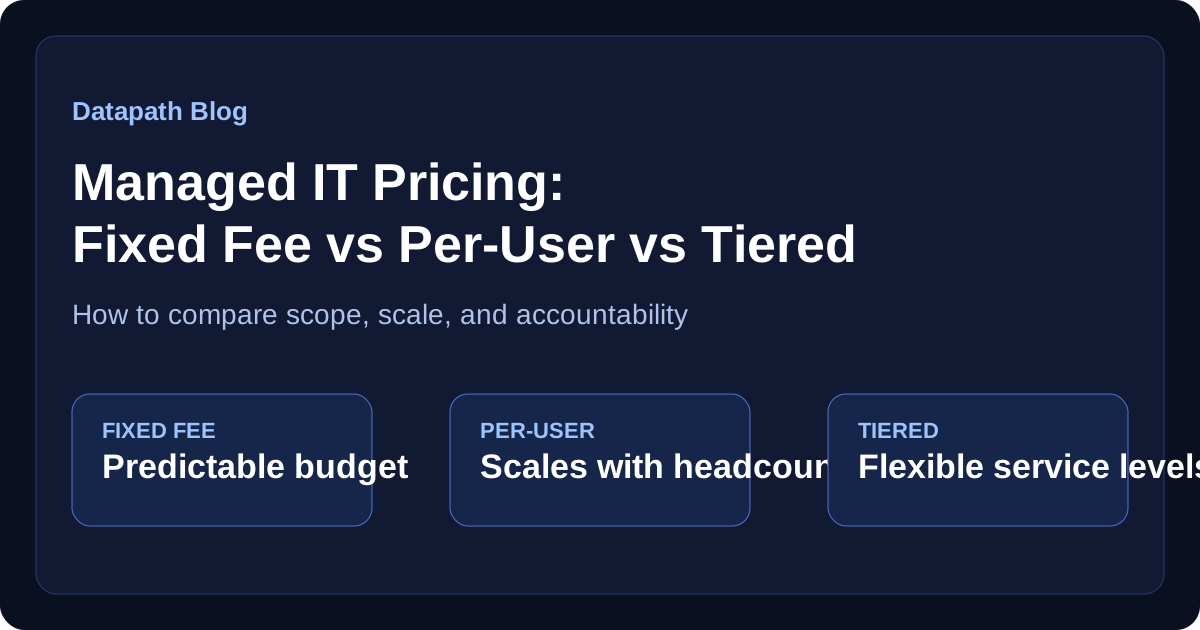
You should compare managed IT pricing by looking at what is actually included, what is excluded, how costs scale as your business changes, and whether the agreement supports the outcomes you care about most: uptime, security, responsiveness, and accountability. Fixed-fee pricing usually favors predictability, per-user pricing usually favors headcount-based scaling, and tiered pricing usually favors flexibility across different service levels.123
The mistake we see most often is buyers comparing proposals as if they were interchangeable monthly subscriptions. They usually are not. Two MSPs can quote similar numbers while offering very different coverage for after-hours support, cybersecurity tooling, vendor management, strategic planning, or project work. If you want a useful comparison, you need to evaluate the service model behind the price, not just the invoice line.
If your team is already reviewing broader managed IT services, using an MSP evaluation guide, or defining SLA metrics that prove accountability, pricing should be one part of that larger decision framework.
What does fixed-fee managed IT pricing usually mean?
Fixed-fee managed IT pricing usually means you pay a consistent monthly amount for an agreed scope of recurring services. The provider prices the relationship around your environment, support expectations, security requirements, and operational complexity rather than charging directly by each employee every month.14
In practice, a fixed-fee agreement often works best when your business wants cost predictability and your environment is stable enough to define a clean service baseline.
What fixed-fee pricing usually covers
A true fixed-fee arrangement often includes:
- help desk support within defined hours
- monitoring and alerting for endpoints, servers, and network devices
- patch management and routine maintenance
- user onboarding and offboarding within a standard scope
- baseline cybersecurity controls such as endpoint protection and policy management
- vendor coordination for common incidents or recurring issues
What matters is not the label but the contract language. Some providers advertise “all-inclusive” support while carving out onsite work, after-hours incidents, major Microsoft 365 issues, firewall administration, backups, or escalation-heavy events into extra-billable buckets. That is where many low-looking fixed-fee quotes stop looking cheap.
Where fixed-fee pricing is strongest
We generally like fixed-fee pricing when a business wants to treat IT as a steady operating expense and avoid month-to-month surprises. It supports forecasting, simplifies budgeting, and makes it easier to evaluate provider performance against service expectations instead of labor hours.15
It can also encourage a more proactive operating model. If the provider is paid the same whether things break constantly or run smoothly, a well-run MSP has an incentive to standardize, automate, and prevent recurring issues instead of living off ticket volume.
Where fixed-fee pricing can go wrong
Fixed-fee pricing breaks down when scope is vague. If your agreement does not clearly define what counts as recurring support, what counts as project work, and what triggers out-of-scope billing, you can end up with a predictable base fee plus a steady stream of exceptions.46
We would be cautious if a quote is fixed-fee but cannot answer questions like:
- Which systems are actually covered?
- Is after-hours response included?
- Are onsite visits included?
- Are strategic planning and budgeting conversations included?
- What security tools are bundled versus resold separately?
- What happens when you add a site, a business application, or a compliance obligation?
What does per-user managed IT pricing usually mean?
Per-user managed IT pricing usually means the monthly cost is tied to the number of supported users in your organization. Each employee, or each employee in a defined support category, carries a recurring monthly charge.12
This model is easy for buyers to understand because it scales in a way that feels intuitive: more employees usually means more support demand, more identities to secure, more devices to manage, and more business workflows to protect.
Why per-user pricing appeals to growing companies
Per-user pricing can work well for businesses that are hiring steadily, standardizing around cloud platforms, and want a pricing model that grows alongside headcount rather than device count alone. It is often easier to forecast than piecing together separate charges for users, workstations, servers, and support incidents.25
For companies with a fairly consistent user profile, it can also reduce negotiation friction. Instead of rebuilding the whole contract when the business grows, you can often just true-up the supported user count.
Where per-user pricing can distort value
The problem with per-user pricing is that not every user creates the same support burden. A front-line worker sharing limited systems, a power user with several business-critical apps, and a regulated executive with complex access requirements should not automatically be treated as operationally identical.36
This model can also hide infrastructure costs. Some proposals look simple on a per-user basis, then separately bill for servers, cloud administration, network hardware, security stack expansion, or advanced backup and recovery. That is not inherently wrong, but it means the per-user number is not the whole price story.
Questions to ask about per-user pricing
If a provider quotes you per-user pricing, ask:
- Does every user include a workstation, or are devices billed separately?
- How are shared devices handled?
- Are executives, contractors, kiosk users, and frontline users priced differently?
- Are Microsoft 365, identity security, backup, and compliance tooling included?
- What services are environment-based rather than user-based?
- What happens to cost if your headcount grows faster than your infrastructure complexity?
Those answers determine whether per-user pricing is genuinely simple or just looks simple at first glance.
What does tiered managed IT pricing usually mean?
Tiered managed IT pricing usually means the provider offers multiple support packages, each with a different level of included coverage, tooling, service responsiveness, and strategic involvement. Buyers choose the service tier that best matches their operational maturity and risk tolerance.12
You can think of tiered pricing as a packaged way to separate basic support from more mature managed services.
What changes from one tier to the next
The exact structure varies by provider, but tiers often change around:
- support hours and response targets
- depth of monitoring and remediation
- cybersecurity stack maturity
- backup and disaster recovery coverage
- inclusion of vCIO or strategic planning time
- reporting, compliance support, and documentation cadence
- access to onsite support or higher-priority escalation
That can be useful when a business knows it needs more than bare-minimum help desk support but is not ready to buy the fullest service model available.
Why tiered pricing is useful
Tiered pricing can be a strong fit when you want flexibility without a fully custom contract on day one. It lets a provider standardize operations while giving buyers a clear picture of what changes as service levels increase.25
For some organizations, it is also a good internal budgeting tool. Leadership can decide whether it wants to fund baseline support, a more resilience-focused middle tier, or a more strategic and compliance-ready premium tier.
Where tiered pricing creates confusion
The main risk is comparing tier names instead of comparing actual outcomes. A “premium” package at one MSP may still provide weaker security tooling, slower after-hours response, or less strategic guidance than a “standard” package somewhere else. Tiers are not industry standards. They are marketing wrappers around provider-specific scope decisions.4
That means you still have to ask line-by-line questions about coverage, exclusions, tooling, and escalation paths.
Which pricing model is usually best for budget predictability?
If budget predictability is the top priority, fixed-fee pricing usually wins. It creates the cleanest recurring IT operating expense and makes it easier to forecast annual spend, especially if your environment and service expectations are stable.15
Per-user pricing can also be predictable if headcount changes slowly and the proposal is genuinely all-in for the supported user population. Tiered pricing can be predictable too, but only if the business stays within the chosen tier and does not regularly trigger upsells, add-ons, or out-of-scope requests.
We would summarize it this way:
| Model | Predictability strength | Common budgeting risk |
|---|---|---|
| Fixed fee | Highest when scope is mature | vague exclusions create surprise project bills |
| Per-user | Strong when headcount is stable | infrastructure and security add-ons can distort total cost |
| Tiered | Moderate to strong | buyers assume tier labels mean more than they actually do |
Which pricing model scales best as a business grows?
Per-user pricing is often the easiest model to scale administratively because cost rises with employee count. That makes it appealing for businesses in active hiring mode.2
Tiered pricing can scale well when the real change is not just more users but more operational complexity. For example, a company moving from simple support needs to tighter security, formal reporting, and more mature response expectations may benefit more from moving up a service tier than from just adding more users to the same plan.
Fixed-fee pricing can still scale, but it usually requires more deliberate renegotiation as your business changes. If you are adding sites, regulated workflows, new cloud systems, or more demanding uptime requirements, the provider will eventually need to reprice around the environment you actually have.
What should buyers compare besides the monthly number?
The monthly number matters, but we would never treat it as the primary decision point. The better comparison is what the agreement buys you operationally.
1. Scope clarity
Can you tell, in plain English, what is included every month and what is not? If not, the quote is not ready for comparison.
2. Service responsiveness
What are the response and restoration expectations by priority? Does after-hours support exist only on paper, or is it contractually defined?7
3. Security coverage
Does the monthly price include the controls your business actually needs, such as endpoint protection, MFA policy support, identity monitoring, log review, backup validation, and vendor coordination?
4. Strategic support
Is the provider just running tickets, or are they also helping with lifecycle planning, budgeting, risk decisions, and quarterly review discipline?
5. Project boundary definition
Which changes are recurring support and which become separate projects? This is one of the biggest drivers of unexpected spend.
6. Accountability model
Will the provider report on outcomes like uptime, recurring incidents, security posture, ticket aging, and root-cause trends, or will you mainly get a bill and a ticket portal?
How should regulated or growth-focused businesses think about pricing?
Regulated and growth-focused businesses should generally compare pricing models against business risk, not just support volume. If your environment has audit pressure, uptime sensitivity, third-party oversight demands, or meaningful cybersecurity exposure, the cheapest monthly support structure is often not the least expensive decision over time.35
For those businesses, pricing needs to answer bigger questions:
- Will this model support compliance evidence and change discipline?
- Does it include the security stack we actually need?
- Can it handle after-hours operational risk?
- Does it support business continuity, vendor coordination, and escalation quality?
- Will leadership get enough visibility to govern the relationship?
That is why we usually recommend evaluating managed IT pricing alongside adjacent decisions like managed IT scope design, switching MSPs without downtime, and outsourced help desk budgeting.
What is the best way to choose between fixed fee, per-user, and tiered pricing?
The best way to choose is to match the model to the operating reality of your business.
- Choose fixed fee when you want the cleanest recurring budget and your scope can be defined clearly.
- Choose per-user when headcount is the main driver of demand and your user base is relatively standardized.
- Choose tiered when you want room to buy different service maturity levels without jumping straight into a fully custom engagement.
If we were advising a buyer, we would ask them to compare each proposal using the same scorecard:
- total expected annual cost
- included recurring services
- excluded work and likely extras
- response and restoration expectations
- cybersecurity and backup coverage
- strategic planning and reporting cadence
- contract flexibility as the business changes
That produces a far better decision than just asking which proposal has the lowest monthly number.
Frequently asked questions
Is fixed-fee managed IT always cheaper?
No. Fixed-fee managed IT is often easier to budget, but it is not automatically cheaper. The real value depends on what is included, how much out-of-scope billing still occurs, and whether the provider is actually covering the security, support, and strategic work your business needs.
Is per-user pricing better for fast-growing companies?
Often, yes. Per-user pricing can be easier for fast-growing companies to forecast because cost rises with headcount. But buyers still need to confirm how infrastructure, security tools, and more complex environments are priced.
When does tiered pricing make the most sense?
Tiered pricing makes the most sense when a buyer wants a choice between service maturity levels and expects needs to evolve over time. It can be a practical middle ground between bare-bones support and a heavily customized engagement.
What is the biggest mistake when comparing MSP pricing?
The biggest mistake is comparing the monthly number without comparing scope, exclusions, service levels, project boundaries, and security coverage. Low monthly pricing often looks different once those details are exposed.
Footnotes
-
IT Support Guys, “Fixed Fee vs. Per-User vs. Tiered Pricing for Managed IT Services,” accessed April 15, 2026, https://www.itsupportguys.com/blog/fixed-fee-vs-per-user-vs-tiered-pricing-for-managed-it-services/. ↩ ↩2 ↩3 ↩4 ↩5 ↩6
-
Techvera, “Understanding Managed IT Service Pricing Models,” accessed April 15, 2026, https://www.techvera.com/blog/understanding-managed-it-service-pricing-models/. ↩ ↩2 ↩3 ↩4 ↩5 ↩6
-
Dataprise, “How to Choose the Right Managed IT Service Provider,” accessed April 15, 2026, https://www.dataprise.com/resources/blog/how-to-choose-the-right-managed-it-service-provider. ↩ ↩2 ↩3
-
LogicMonitor, “Managed IT Services Pricing: What to Expect,” accessed April 15, 2026, https://www.logicmonitor.com/blog/managed-services/managed-it-services-pricing-what-to-expect. ↩ ↩2 ↩3
-
CompTIA, “What Are Managed IT Services?,” accessed April 15, 2026, https://www.comptia.org/content/articles/what-are-managed-it-services. ↩ ↩2 ↩3 ↩4 ↩5
-
Netrio, “How MSP Pricing Works,” accessed April 15, 2026, https://netrio.com/blog/msp-pricing-models/. ↩ ↩2
-
OpenText, “Service Level Agreements Explained,” accessed April 15, 2026, https://www.opentext.com/what-is/service-level-agreement. ↩
