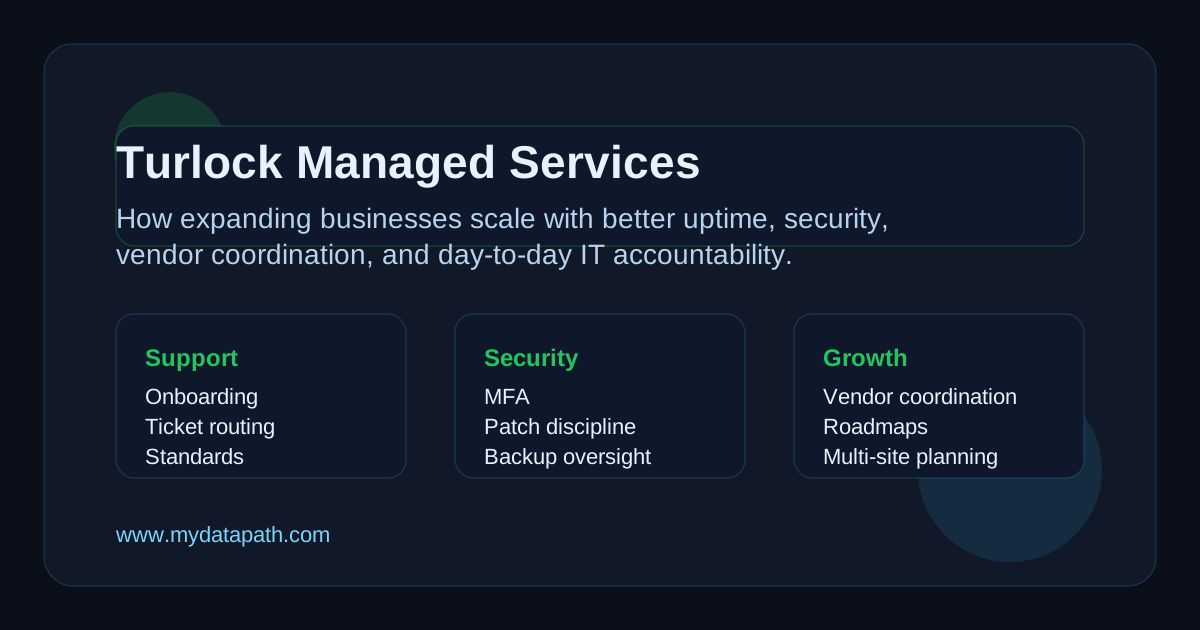

How do Turlock managed services help an expanding business scale?
Turlock managed services help an expanding business scale by giving it a more predictable IT operating model: proactive monitoring, structured support, stronger cybersecurity, better backup oversight, cleaner vendor coordination, and clearer planning for growth.123 Instead of waiting for systems to break under heavier demand, a managed services partner helps the business add users, locations, applications, and security controls without turning every change into an avoidable fire drill.
That matters because growth usually exposes IT weaknesses that felt manageable at a smaller size. A company can limp along for a while with a part-time technician, scattered vendors, inconsistent patching, and backup assumptions nobody tests. Once hiring accelerates, remote work expands, cloud usage grows, or customers start expecting tighter response times, those weak spots become expensive. In our experience, the real value of Turlock managed services is not just technical support. It is operational stability during a period when the business is changing fast.
For Central Valley businesses opening new roles, adding software, supporting field teams, or formalizing internal processes, that stability can make the difference between growth that feels controlled and growth that feels chaotic.
Why does growth put so much pressure on IT?
Growth changes the shape of day-to-day IT work. More employees means more devices, more onboarding, more permissions, more password resets, and more ways for small process gaps to multiply. New revenue lines often bring in additional vendors, cloud tools, compliance expectations, or reporting needs. Even something as simple as hiring across two offices instead of one can change the support model dramatically.45
We usually see expanding businesses run into pressure in five places first:
- user onboarding and offboarding
- network and Wi-Fi capacity
- cybersecurity and access control
- backup and recovery expectations
- vendor sprawl and unclear ownership
Those issues are rarely independent. If onboarding is inconsistent, permissions drift. If permissions drift, security gets weaker. If security gets weaker, insurance, compliance, and downtime risks all get harder to manage. That is why a scaling business needs more than ad hoc support. It needs a service model that connects support, standards, and accountability.
What breaks first when the business outgrows informal IT?
Usually it is not one dramatic outage. It is recurring friction: laptops arriving late for new hires, nobody owning MFA enrollment, printers and conference rooms failing more often, vendors blaming one another, or leadership not knowing whether the environment is actually secure. Those small failures slow hiring, frustrate staff, and create risk that compounds quietly.
That is where managed services become useful. A mature provider should not just react faster. It should reduce how often those problems occur by documenting the environment, standardizing the stack, and treating recurring issues as signals that operations need to improve.
Why is Turlock-specific context still relevant?
Turlock businesses often need practical support models, not bloated enterprise frameworks. Many are growing regionally, adding sites across the Central Valley, or balancing in-office operations with cloud platforms like Microsoft 365 and line-of-business applications. They need systems that stay supportable without requiring a giant internal IT department too early.
A provider that understands the Central Valley context should recognize that leadership often cares less about flashy tooling and more about questions like these:
- Can our team stay productive as we add people?
- Can we support multiple locations without more confusion?
- Can we tighten security without slowing everyone down?
- Can somebody own coordination across vendors, internet, cloud, backup, and support?
- Can we grow without letting downtime and risk grow with us?
What should managed services actually do during expansion?
A serious managed services relationship should help the business scale in ways leadership can feel. We think that should show up across support, infrastructure, security, continuity, and planning.
1. Standardize support as headcount grows
As a company expands, inconsistency becomes expensive. New hires need devices, licenses, access, documentation, and support expectations that are repeatable.16 If every onboarding event is improvised, the business wastes time and increases security drift.
Managed services help by creating a repeatable operating rhythm for:
- device provisioning and replacement
- user onboarding and offboarding
- ticket triage and escalation
- software deployment and patching
- after-hours or urgent support workflows
That kind of standardization is not glamorous, but it is one of the clearest signs that IT is ready for growth.
2. Improve uptime as systems get more complex
Expanding businesses usually become more dependent on cloud applications, identity systems, internet connectivity, remote collaboration tools, and specialized software. When more revenue-producing work depends on those systems, downtime becomes harder to absorb.27
A good managed services provider should use monitoring, maintenance, and trend review to catch common issues before they interrupt operations. That includes things like storage capacity, failed backups, aging endpoints, patch exceptions, unstable connectivity, and recurring hardware problems.
If the provider is doing the job well, leadership should see fewer surprises, not just better excuses after an outage.
3. Add security controls that fit the business stage
Growth expands the attack surface. New employees, more endpoints, more third-party tools, and more remote access all create additional paths for error or abuse. That is one reason we recommend evaluating Turlock managed services alongside Datapath guidance on managed cybersecurity services, Microsoft 365 security best practices, and our broader solutions overview.
For most expanding businesses, the managed services provider should at least help with:
| Control area | Why it matters during growth |
|---|---|
| MFA and identity hygiene | More users means more credential risk |
| Endpoint protection | New devices add more exposure |
| Patch discipline | Growth often creates exception sprawl |
| Access reviews | Permissions become messy fast |
| Security awareness reinforcement | New hires need guidance quickly |
| Backup monitoring | Recoverability matters more as dependency grows |
A growing business does not need to become an enterprise SOC overnight. It does need fewer blind spots.
4. Coordinate vendors and systems under one operating model
Many expanding companies accumulate vendors faster than they build governance. One company manages phones. Another handles internet. Another owns line-of-business software. Microsoft 365 sits somewhere else. Backup is nobody’s clear responsibility until there is a restore problem.
Managed services can reduce that drag by becoming the central operational layer: documenting dependencies, tracking open issues, coordinating escalations, and giving leadership one clearer place to start. We think that matters especially for businesses that are too large for completely informal support but still lean enough that executive time gets pulled into IT confusion.
5. Support planning before growth decisions create technical debt
Scaling is easier when infrastructure decisions happen before the pain gets severe. A good provider should help the business look ahead on budgeting, hardware lifecycle, cloud changes, wireless upgrades, office moves, vendor transitions, and risk reduction priorities. That is where managed services become more than support. They start functioning as a planning layer.
If the provider cannot help leadership think beyond tickets, the relationship will feel reactive no matter how good the help desk is.
How should a growing Turlock business evaluate managed services?
A growing Turlock business should evaluate managed services based on operating discipline, service clarity, recovery readiness, security ownership, and how well the provider handles change. The growth question is not whether the MSP can fix a workstation. It is whether the MSP can keep the environment manageable while the business keeps moving.
What questions should leadership ask?
We recommend asking direct, operational questions such as:
- How do you onboard 10 new employees cleanly and quickly?
- What happens when we add a second site or remote team?
- Which systems are monitored, and who reviews alerts?
- How are backups checked and how often are restores tested?
- What is included in security by default?
- How do you handle vendor coordination during an outage?
- What monthly reporting will leadership receive?
- How do you help with roadmap, lifecycle, and budgeting decisions?
Those questions usually surface the difference between a provider that has a growth-ready operating model and one that mostly sells reassurance.
What warning signs should make you skeptical?
We get skeptical when a managed services provider cannot describe onboarding, reporting, escalation, or backup validation in concrete terms. Other warning signs include:
- vague support boundaries
- no clear owner for security responsibilities
- weak documentation habits
- little discussion of standards or lifecycle planning
- no explanation of how the service scales with headcount
- generic promises about 24/7 monitoring without operational detail
A scaling business needs less ambiguity, not more.
When does managed services create the most value?
Managed services usually create the most value when a business is large enough that technology problems now affect revenue, customer experience, compliance posture, or hiring momentum, but not yet large enough to justify building full specialty coverage in house.38 That often includes organizations with:
- 25+ employees and growing
- multiple vendors or sites
- cloud-heavy workflows
- recurring support inconsistency
- rising insurance or compliance pressure
- leadership that needs cleaner visibility into IT decisions
For those teams, the value is not just outsourced labor. It is a cleaner system for running technology.
Why Datapath for Turlock managed services?
We think expanding businesses in Turlock need more than generic support promises. They need a provider that can connect help desk execution, cybersecurity basics, vendor coordination, backup readiness, and longer-term planning in one accountable operating model. That is how IT stays usable while the business scales.
Datapath supports organizations that need stability without unnecessary complexity. We focus on support workflows that reduce friction, security practices that fit real-world operations, and planning that helps leadership make better decisions before growth creates avoidable risk. If your team is comparing providers now, review our managed IT services in Turlock guide, our resources and guides hub, and the Datapath homepage. If you want to talk through where your current model is getting strained, talk with our team.
FAQ: Turlock managed services for growing businesses
How do Turlock managed services help a growing business scale?
Turlock managed services help a growing business scale by standardizing support, improving uptime, tightening security, and making it easier to add users, vendors, software, and locations without increasing operational chaos.
Are managed services better than break-fix support during expansion?
Usually yes. Break-fix support starts after something fails, while managed services are designed to reduce avoidable interruptions through monitoring, maintenance, standardization, and clearer accountability.
What should a Turlock managed services provider include?
A provider should include proactive monitoring, help desk support, patching, cybersecurity basics, backup oversight, vendor coordination, and planning support for hiring, growth, and infrastructure changes.
When should an expanding company switch to managed services?
A company should usually switch when technology issues start slowing onboarding, creating recurring downtime, exposing security gaps, or consuming too much executive time through vendor confusion and reactive firefighting.
Sources
- GroupOne IT: Managed IT Services Turlock
- VaultEdge IT: Managed IT Services in Turlock
- CISA Cyber Essentials
- Microsoft: Planning for user lifecycle management in Microsoft 365
- Ready.gov: Business Emergency Plans and Recovery
- NIST Cybersecurity Framework 2.0
- IBM Cost of a Data Breach Report 2024
- U.S. Small Business Administration: Manage your business
