
What PCI DSS network segmentation requirements matter most for multi-site businesses?
The most important PCI DSS network segmentation requirements for multi-site businesses are not about proving that VLANs exist on a diagram. They are about proving that the cardholder data environment is actually isolated, that only necessary traffic can cross segmentation boundaries, that shared services are tightly controlled, and that the isolation is tested often enough to hold up during both an assessment and a real security event.12 For distributed businesses, the challenge is usually consistency: every branch, store, warehouse, or remote office creates another place where scope can quietly expand if segmentation standards drift.
That matters because PCI DSS treats systems that connect to, can impact, or can compromise the cardholder data environment with far more scrutiny than many teams expect.1 In a multi-site environment, one weakly controlled location can turn what looked like a small cardholder-data footprint into a much larger compliance and security problem.
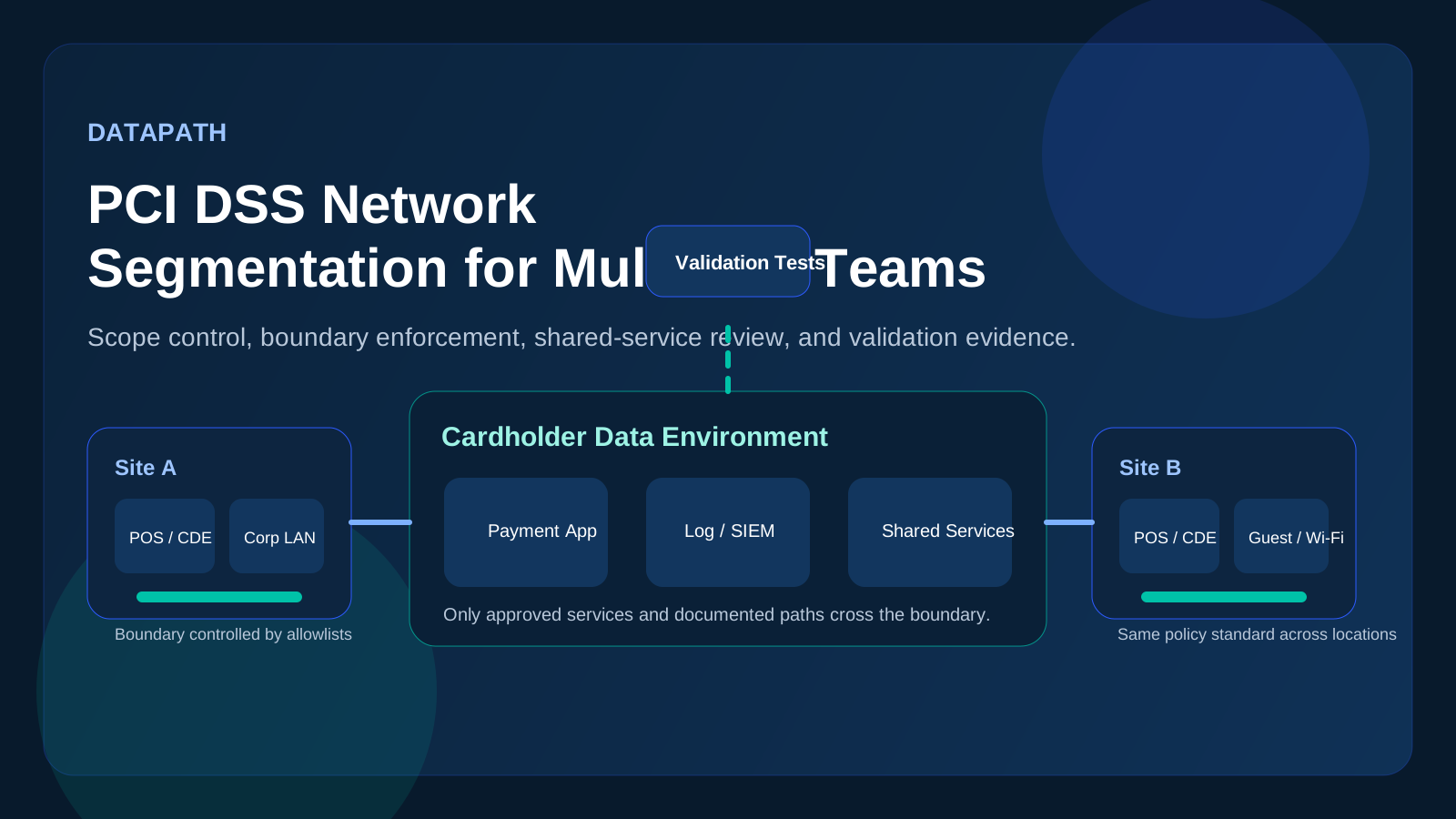
For Datapath’s audience, the practical question is not “Do we say we have network segmentation?” It is “Can we show exactly where the cardholder data environment begins, what is allowed to talk to it, how every site follows the same boundary rules, and what evidence proves those controls are still working?”
Why does PCI DSS care so much about segmentation in multi-site environments?
Because segmentation affects both scope and blast radius. The PCI Security Standards Council has long explained that segmentation is not strictly required, but it is one of the most effective ways to reduce PCI DSS scope and keep compromises in out-of-scope systems from reaching the cardholder data environment.1 For multi-site businesses, that benefit becomes even more important because branch infrastructure, local internet connections, shared corporate services, wireless networks, third-party support paths, and inconsistent change control all create more opportunities for accidental scope expansion.
A lot of organizations assume they can keep PCI contained just by putting payment devices on a separate network. In practice, that is rarely enough. If authentication services, remote management tools, jump hosts, monitoring systems, patching platforms, or poorly controlled firewall rules can still reach the environment broadly, assessors will look hard at whether those systems also affect PCI scope.13
That is why we recommend treating segmentation as an operating discipline, not a one-time architecture project. If your organization is balancing payment security with broader governance and accountability issues, our managed IT services overview and financial services solutions page help frame the bigger model that has to support those controls.
What should a multi-site business define before building PCI segmentation controls?
Before changing firewall rules or drawing new network zones, the business should define scope, ownership, and shared-service dependencies clearly enough that every site is working from the same playbook.
What systems and locations belong in scope?
A multi-site business should identify every place where cardholder data is stored, processed, or transmitted, then map the systems that connect to or can materially affect those paths.1 That usually includes more than payment terminals. In practice, teams should confirm:
- which stores, offices, clinics, or branches accept card payments
- which local network segments support point-of-sale, payment applications, or payment-connected devices
- which corporate systems provide identity, logging, monitoring, patching, DNS, or management services
- which third parties have remote support or integrated access
- which cloud or hosted platforms process or relay payment-related traffic
This is where many programs go wrong. They define the cardholder data environment too narrowly and forget about the shared infrastructure that can still change, reach, or undermine it.
How should the organization document segmentation boundaries?
It should document exactly which networks are in scope, which are out of scope, what traffic is allowed between them, and what technical controls enforce that decision. The PCI SSC guidance is explicit here: separate network segments alone do not automatically create effective segmentation. The controls have to specifically enforce separation and prevent compromise from traveling from out-of-scope systems into the cardholder data environment.1
A strong boundary document should include:
- network diagrams by site and for shared corporate services
- firewall or access-control policy standards
- approved ports, protocols, and business justifications
- remote-access rules and administrative pathways
- the systems that are allowed to bridge environments, if any
- change-control ownership for every boundary exception
That level of clarity makes assessments easier and also reduces the chance that a local workaround quietly breaks the design.
What technical controls usually matter most for PCI DSS network segmentation?
The control set has to do more than divide traffic. It has to prove that the environment is isolated intentionally and monitored continuously.
Are VLANs enough to satisfy PCI segmentation expectations?
Usually not by themselves. VLANs can be part of the design, but they are not a magic compliance shortcut. The PCI SSC has been clear that segmentation requires controls that specifically create and enforce separation.1 A business may use VLANs, subnets, VRFs, internal firewalls, ACLs, microsegmentation, or cloud segmentation controls, but the question is whether those controls actually prevent unauthorized or unnecessary connectivity to the cardholder data environment.
For most multi-site organizations, that means pairing logical separation with policy enforcement such as:
- internal firewalls between user, server, wireless, guest, and payment networks
- default-deny rules with explicit allowlists
- restricted administrative access paths
- separate handling for third-party vendor connections
- monitoring that shows attempted policy violations
If your business is already reviewing PCI obligations more broadly, this also pairs naturally with our PCI DSS compliance checklist for financial services and FTC Safeguards Rule risk assessment template guide.
What should firewall policy look like across multiple sites?
Firewall policy should be standardized centrally even if enforcement happens locally. A branch or store should not invent its own version of what traffic is acceptable into the cardholder data environment. For multi-site businesses, we usually recommend a model that defines baseline segmentation policy once, then allows only documented site-specific exceptions.
A practical firewall standard should answer:
| Control area | What the team should define | Why it matters |
|---|---|---|
| CDE ingress | Which systems may initiate connections into the cardholder data environment | Reduces unnecessary exposure from corporate and branch networks |
| CDE egress | Which outbound services are allowed and why | Prevents quiet sprawl and harder-to-detect exfiltration paths |
| Shared services | How identity, logging, DNS, patching, or management systems interact with the CDE | Shared infrastructure often expands scope when it is not tightly controlled |
| Remote support | Which vendors or admins may connect, through what path, with what approval model | Third-party and admin access are common weak points |
| Exception handling | Who approves temporary openings and when they expire | Temporary rules have a bad habit of becoming permanent |
That discipline matters because branch variation is where many otherwise solid segmentation strategies start to erode.
How should shared services be handled?
Shared services are one of the biggest sources of PCI scoping confusion. Multi-site businesses often want centralized identity, endpoint tooling, monitoring, SIEM ingestion, patching, DNS, or remote support to touch the payment environment. Sometimes that is operationally necessary. But each shared service has to be evaluated carefully because if it can impact the security of the cardholder data environment, it may be in scope.14
We recommend documenting for each shared service:
- what business function it performs
- what systems it can reach in the CDE
- what permissions it holds
- what segmentation and authentication controls limit that access
- what logging proves activity is reviewable
- whether a narrower design could reduce PCI scope
This is also where multi-site businesses benefit from stepping back and asking whether convenience is expanding compliance burden unnecessarily.
How should a multi-site business validate that PCI segmentation actually works?
Testing is where architecture claims turn into evidence. If segmentation is used to reduce PCI DSS scope, the organization has to validate that those controls really isolate the cardholder data environment the way the diagrams and rule sets say they do.12
What should testing include?
A practical validation program should include more than one type of check. We usually recommend a mix of:
- firewall and ACL review against approved standards
- network-path validation from out-of-scope segments
- internal vulnerability scanning and rule verification
- segmentation-focused penetration testing where applicable
- log review for denied and anomalous traffic
- periodic review of administrative and vendor access paths
The goal is not to prove that the environment looked segmented once. It is to prove that segmentation still works after device swaps, branch expansions, software updates, emergency rule changes, and staff turnover.
How often should segmentation be reassessed?
At minimum, it should be reassessed whenever material network changes happen and in line with the testing cadence expected for PCI validation.12 In practice, reassessment should also be triggered by:
- new branch openings or site consolidations
- changes to payment applications or processors
- migration of shared services
- new vendor support arrangements
- major firewall policy changes
- detection of unauthorized pathways or failed controls
A multi-site business changes faster than its diagrams do. If the diagrams and test evidence lag too far behind the actual environment, both compliance confidence and real security drop quickly.
What mistakes create the biggest PCI segmentation problems for distributed businesses?
The biggest mistakes usually come from inconsistency, not ignorance. Most teams know they should isolate payment systems. The real failures happen when standards weaken over time.
Where do multi-site environments usually drift?
In our experience, drift usually shows up in a few predictable places:
- branch exceptions that bypass the standard firewall design
- support tools with broader access than anyone intended
- wireless or guest networks that are not isolated cleanly
- undocumented vendor tunnels or remote management paths
- shared services that keep accumulating privilege
- diagrams and inventories that no longer match reality
That is why we push teams to think operationally. Segmentation only helps when change control, documentation, and review are mature enough to preserve the design.
Why is “reduced scope” sometimes misleading?
Because teams sometimes declare systems out of scope without proving that the segmentation truly prevents them from affecting the cardholder data environment. The PCI SSC warns directly against assuming that simple separation equals effective segmentation.1 If a system can still reach, administer, authenticate, or materially impact the CDE, an assessor may still consider it relevant to scope.
That is especially important for businesses with many sites and a centralized IT model. The centralization may be operationally smart, but it has to be designed intentionally or it will widen PCI exposure instead of simplifying it.
Why Datapath for PCI segmentation and multi-site compliance support?
We think the best PCI segmentation work makes the environment easier to understand and easier to operate. For multi-site businesses, that usually means standardizing site architecture, tightening shared-service access, documenting exceptions cleanly, and creating evidence that leadership and assessors can both follow.
If your organization is trying to reduce PCI scope without creating fragile one-off designs, start with the Datapath homepage, review our managed IT services overview, explore our resources and guides hub, or talk with our team about where your current network model is creating the most compliance and operational friction.
Frequently Asked Questions
Is network segmentation required by PCI DSS?
Not as a standalone requirement in the simple sense, but PCI guidance strongly recommends segmentation because it can reduce scope and help keep out-of-scope systems from compromising the cardholder data environment.1
Are VLANs enough for PCI DSS network segmentation?
Usually no. VLANs can help organize traffic, but effective PCI segmentation depends on controls that actively enforce separation, such as firewalls, ACLs, tightly restricted access paths, and testing that proves isolation really works.13
Why is segmentation harder for multi-site businesses?
Because every branch, store, or remote office creates another place where local exceptions, shared services, vendor access, or inconsistent firewall policy can quietly expand scope or weaken the boundary around the cardholder data environment.
What evidence should a business keep for PCI segmentation?
Teams should keep current network diagrams, approved rule standards, change-control records, shared-service access documentation, test results, and logs that show segmentation controls are operating as intended.124
Sources
- PCI SSC: Guidance for PCI DSS Scoping and Network Segmentation
- Tigera: 7 Steps to Implementing Network Segmentation for PCI DSS Compliance
- NordLayer: PCI DSS Network Segmentation Guide
- Akamai: How Network Segmentation Simplifies PCI DSS Compliance