
What should an IT roadmap template for regulated businesses include?
An IT roadmap template for regulated businesses should include business goals, regulatory requirements, risk-ranked initiatives, budget ranges, owners, target dates, dependencies, and success metrics. We think the roadmap should also separate must-do compliance and resilience work from strategic modernization work, because regulated teams usually get in trouble when everything is labeled “high priority” and nothing is sequenced clearly.12
In practical terms, the roadmap is not just a project list. It is the document leadership can use to answer five important questions:
- What risks matter most right now?
- Which controls or systems need to change first?
- What will it cost?
- Who owns each move?
- How does this work support the business instead of just satisfying an auditor?
That matters because healthcare groups, financial firms, municipalities, school systems, and other regulated organizations rarely have the luxury of planning in a clean, empty environment. They are usually balancing aging infrastructure, compliance obligations, cyber insurance pressure, limited internal bandwidth, and real uptime expectations at the same time. A good roadmap turns that complexity into something leadership can actually govern.
Teams working through roadmap design often also need adjacent guidance on what a vCIO does, how to build a vCIO roadmap, how to audit Microsoft 365 admin roles, how to build a cloud readiness assessment, our managed IT services approach, and the broader Datapath resource library.
Why do regulated businesses need a different kind of IT roadmap?
A generic roadmap usually focuses on projects. A regulated-business roadmap needs to focus on risk, evidence, resilience, and accountability.
Compliance deadlines are not the same as technical priorities
One of the biggest mistakes we see is treating a compliance requirement as if it automatically defines the best technical sequence. It does not. A framework may require audit logging, access review, backup validation, vendor oversight, or incident response evidence, but those controls still have dependencies. For example, centralized identity, asset inventory, and logging maturity often have to improve before downstream controls become realistic or measurable.13
That is why a roadmap should group work into logical control areas instead of scattering tasks across disconnected teams. If the organization cannot explain how identity, endpoint security, backup recoverability, vendor governance, and change management fit together, the roadmap is too shallow.
Budget pressure changes how priorities should be framed
Regulated teams are often asked to justify spending not only to IT leadership, but also to finance committees, boards, executive leadership, or public-sector stakeholders. A roadmap helps translate technical work into business language: reduced downtime, lower audit friction, better cyber insurance positioning, stronger vendor accountability, and less operational rework.24
We think that translation layer is essential. Without it, important initiatives get framed as “tool upgrades” instead of what they really are: risk reduction and operational stability decisions.
Modernization has to support governance, not fight it
Modernization is easy to oversimplify. Replacing legacy infrastructure, standardizing cloud platforms, tightening access controls, or redesigning backup architecture can absolutely improve efficiency and security. But if modernization work is not tied back to compliance and operating discipline, it often creates more drift instead of less.56
The right roadmap keeps modernization from becoming a disconnected wish list. It answers why a migration, platform cleanup, or lifecycle refresh matters now, what risk it addresses, and what proof of completion leadership should expect.
What fields should go inside the roadmap template?
We recommend using a roadmap table or planning sheet with one row per initiative and at least these columns.
| Field | Why it matters |
|---|---|
| Business driver | Shows whether the work is tied to compliance, resilience, cost control, growth, or modernization |
| Regulatory or policy requirement | Connects the initiative to HIPAA, GLBA, CJIS, CMMC, SOC 2, internal policy, or insurance obligations |
| Current-state risk | Explains what is broken, missing, weak, or too manual today |
| Initiative | Names the actual project or control improvement |
| Priority | Helps leadership distinguish urgent remediation from planned optimization |
| Owner | Prevents shared-accountability drift |
| Dependencies | Makes sequencing visible |
| Target quarter | Keeps timing realistic |
| Budget range | Turns technical planning into financial planning |
| Success metric | Defines what “done” looks like |
| Evidence required | Clarifies what must be documented for audit, review, or executive reporting |
That structure works because it forces the roadmap to be both operational and executive-friendly. It is specific enough for IT planning, but clear enough for leadership review.
A practical IT roadmap template for regulated businesses
We recommend organizing the roadmap into four buckets: stabilize, secure, govern, and modernize.
1. Stabilize the environment
This bucket covers the work that reduces recurring operational friction and prevents obvious downtime issues from swallowing the rest of the roadmap.
Typical items include:
- asset inventory cleanup
- unsupported system identification
- backup failure review and restore testing
- alerting and monitoring baseline improvements
- network documentation and dependency mapping
- ticket trend analysis for recurring root causes
If the environment is unstable, higher-level planning tends to collapse back into firefighting.
2. Secure the highest-risk control areas
This is where most regulated organizations need stronger sequence discipline. We usually recommend prioritizing:
- identity and privileged access control
- MFA and conditional access enforcement
- endpoint protection and patching discipline
- email security and phishing resilience
- logging and audit visibility
- third-party access governance
- incident response ownership and escalation
NIST’s Cybersecurity Framework 2.0 continues to reinforce the need for governance, protection, detection, response, and recovery as connected operating disciplines, not isolated purchases.3 We think that is exactly how the roadmap should be structured.
3. Govern budget, vendors, and evidence
This section is often underbuilt, but it is where a roadmap becomes useful to leadership.
A regulated-business roadmap should show:
- which vendors create overlapping cost or risk
- which subscriptions or systems should be consolidated
- which initiatives are required before audits, renewals, or certification windows
- which reports or artifacts will prove control maturity
- which items belong in capital planning versus operating expense
This is also where quarterly business reviews or vCIO-style planning become valuable. The roadmap should not just say what IT wants to do. It should show what the business is buying in return.
4. Modernize intentionally
After the environment is more stable and visible, modernization work becomes much easier to justify and sequence.
Common roadmap initiatives here include:
- legacy server retirement
- Microsoft 365 or cloud governance cleanup
- network segmentation redesign
- standardized endpoint lifecycle planning
- SaaS access governance
- business continuity and disaster recovery improvements
- location or vertical-specific infrastructure upgrades
The key is that modernization should be anchored to measurable outcomes: reduced support burden, better control evidence, improved resilience, or lower operational risk.56
How should teams prioritize roadmap items?
We recommend a simple prioritization model:
Priority 1: Required to reduce immediate audit, security, or uptime risk
These are the items that create material exposure if ignored for another quarter. Examples include missing MFA coverage, failed backup validation, unsupported systems in critical workflows, or lack of logging for high-risk platforms.
Priority 2: Required to improve control maturity and budget discipline
These items are not always emergencies, but they make the operating model stronger. Think role reviews, vendor rationalization, endpoint standardization, and policy cleanup.
Priority 3: Important modernization work with strategic upside
These are the projects that improve flexibility, scalability, and long-term efficiency once the operational baseline is stronger.
We like this model because it prevents a roadmap from becoming either panic-driven or fantasy-driven. It creates room for realistic sequencing.
How often should a regulated business review its IT roadmap?
A regulated business should review its IT roadmap quarterly, with lighter monthly check-ins for critical items. Quarterly reviews are usually the best cadence because they align with budgeting, leadership planning, control maturity checks, and vendor discussions. Monthly reviews are still useful for urgent remediation or projects already in flight.
During each review, we recommend asking:
- What changed in the threat or compliance environment?
- Which initiatives slipped, and why?
- Which risks were actually reduced this quarter?
- What evidence was produced?
- What should move into next quarter, and what should be deferred?
That review cycle matters because roadmaps age quickly. New insurance requirements, mergers, vendor changes, infrastructure failures, or application shifts can all change priority faster than annual planning cycles admit.
What does a simple sample roadmap look like?
Here is a practical example structure.
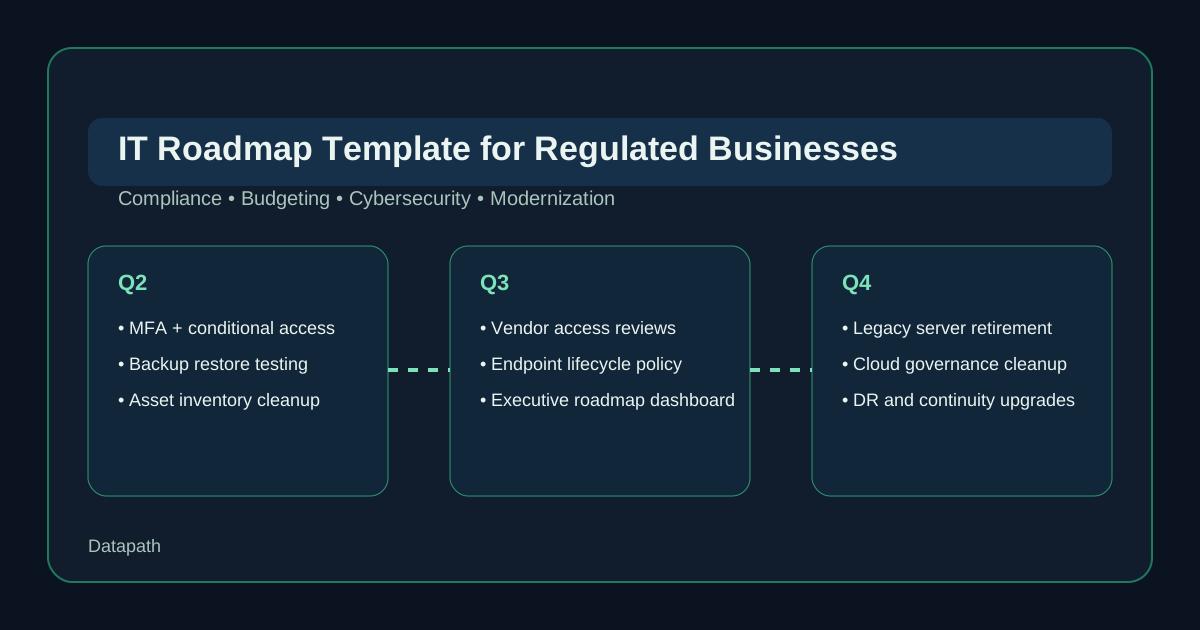
| Quarter | Initiative | Driver | Owner | Budget Range | Success Metric |
|---|---|---|---|---|---|
| Q2 | Enforce MFA and conditional access for all privileged accounts | security + compliance | IT lead | $$ | 100% privileged accounts protected |
| Q2 | Validate backup restores for critical systems | resilience + audit readiness | infrastructure owner | $ | documented restore tests completed |
| Q2 | Create vendor access review process | compliance + vendor risk | operations + IT | $ | quarterly vendor access register in place |
| Q3 | Standardize endpoint lifecycle and patching policy | security + budget | IT manager | $$ | supported endpoint baseline reaches target |
| Q3 | Build executive IT roadmap dashboard | governance + finance | vCIO / leadership | $ | quarterly dashboard delivered |
| Q4 | Retire legacy line-of-business server and migrate dependencies | modernization + resilience | infrastructure owner | $$$ | legacy workload retired with validated cutover |
The details will vary, but the structure stays useful across most regulated environments.
Why Datapath for roadmap planning in regulated environments?
We think regulated organizations need more than generic “IT strategy.” They need a planning model that connects compliance, cybersecurity, budgeting, vendor oversight, and modernization into one operating picture leadership can use.
That is why our approach focuses on accountability first: what matters most, who owns it, what it costs, what it depends on, and how the business will know the work actually improved risk or resilience. If a roadmap cannot answer those questions, it is probably not ready yet.
FAQ: IT roadmap template for regulated businesses
What is an IT roadmap template for a regulated business?
It is a planning framework that maps IT initiatives to compliance requirements, business goals, budget ranges, ownership, timing, and measurable outcomes so leadership can govern risk and modernization together.
What should be prioritized first on the roadmap?
Usually the first priorities are the items that reduce immediate security, audit, or uptime risk, such as identity controls, backup validation, logging visibility, unsupported systems, and vendor-access discipline.
How detailed should the roadmap be?
Detailed enough to show owners, dependencies, target quarters, and budget ranges, but not so detailed that it becomes a project-management dump. We recommend a leadership-level roadmap with supporting operational plans underneath it.
How often should regulated businesses update the roadmap?
Quarterly is the best default cadence, with lighter monthly reviews for urgent initiatives or active remediation work.
Sources
- NIST Cybersecurity Framework 2.0
- CISA Cyber Guidance for Small and Midsize Businesses
- Info-Tech: IT Financial Management Improvement Roadmap Template
- RealVNC: IT Budget Planning 2026
- IBM Center for The Business of Government: A Roadmap for IT Modernization in Government
- ComplyAdvantage: The 2026 Regulatory Roadmap
