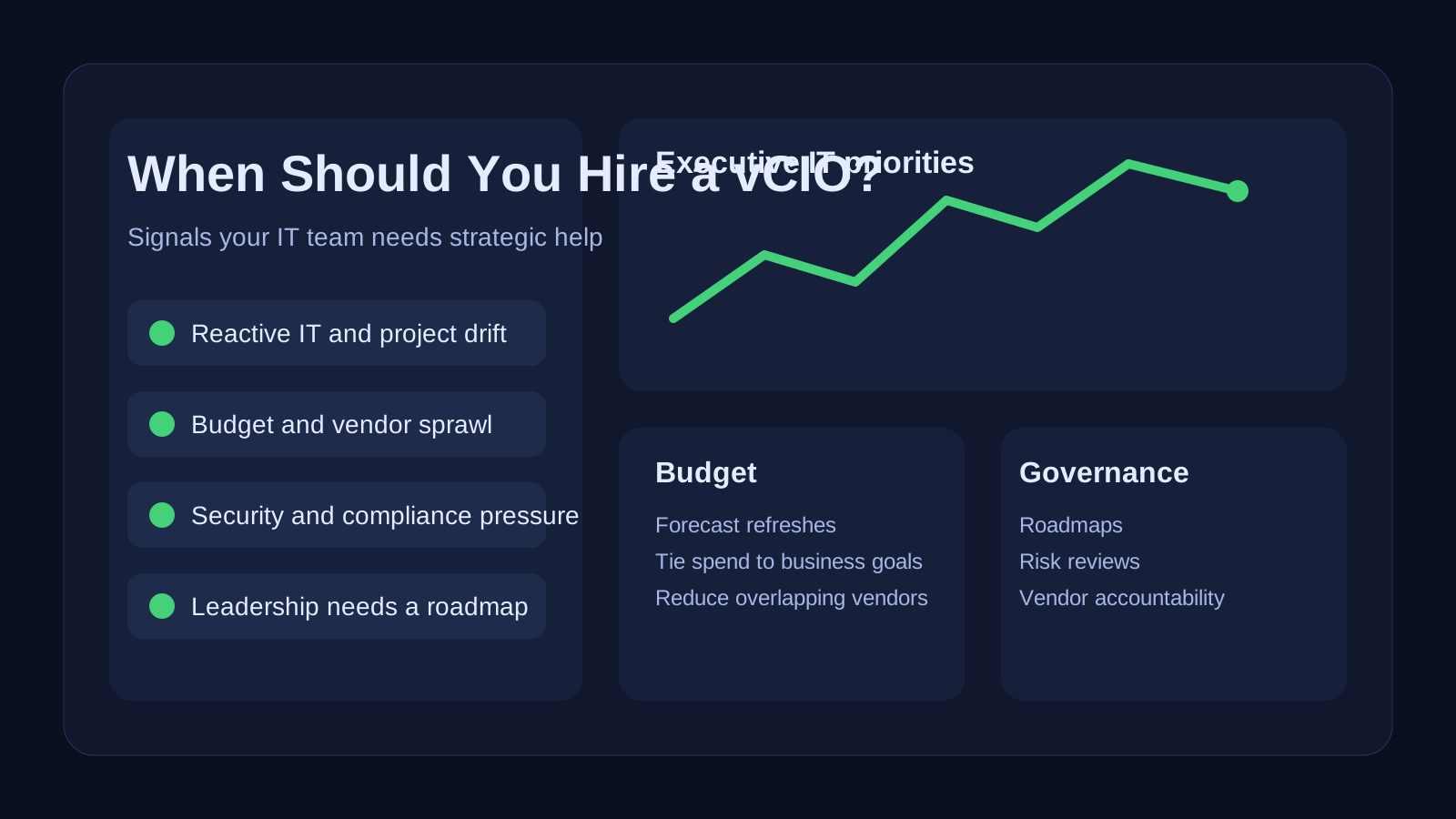

When should a business hire a vCIO?
A business should hire a vCIO when technology has become too important to manage informally, but a full-time CIO still feels premature. In practice, that usually happens when growth, security pressure, compliance demands, budgeting complexity, or major technology decisions start outrunning the internal team’s strategic bandwidth.12
That matters because many companies do not fail for lack of effort. They fail because their internal IT team is buried in support tickets, vendor issues, user requests, renewals, and day-to-day firefighting. The business may still be functioning, but leadership can feel the strain: projects drag, priorities blur, technology spend rises, and nobody is fully confident that IT is moving in the right direction.
At Datapath, we think this is the core question: does your business need more hands, or does it need better direction? When the real gap is planning, governance, prioritization, and executive visibility, that is usually where a vCIO becomes valuable.
What does a vCIO actually do?
A virtual Chief Information Officer provides executive-level technology leadership on a fractional or outsourced basis. Unlike a traditional CIO, a vCIO is not usually a full-time employee. Unlike a help desk or standard MSP role, the job is not primarily to close tickets or keep infrastructure running. The real value is strategic oversight: roadmap planning, budgeting, governance, vendor management, lifecycle planning, risk review, and aligning IT decisions with business goals.13
A practical vCIO engagement often includes:
- quarterly IT roadmap and budget planning
- leadership reporting on priorities, risks, and open decisions
- vendor review and contract guidance
- lifecycle planning for devices, infrastructure, and cloud services
- security and compliance alignment
- project prioritization and sequencing
- translating technical issues into business-level decisions
That distinction matters. Plenty of businesses already have operational support. Fewer have someone clearly responsible for deciding what should happen next, what should wait, what should cost more later if delayed, and how technology should support growth.
What signs show your internal IT team needs strategic help?
The strongest signal is usually not one dramatic failure. It is a pattern of friction. If several of the signs below are true at the same time, the business probably needs strategic IT leadership rather than just more reactive support.
1. IT is mostly reactive
If your team spends most of its time dealing with tickets, outages, access requests, recurring user issues, and urgent vendor escalations, strategy tends to disappear.24 Work still gets done, but it is the work with the loudest alert or the nearest deadline.
That often leads to a familiar pattern:
- upgrades happen late
- documentation goes stale
- recurring issues never fully die
- backups, access reviews, or lifecycle planning drift
- bigger projects keep getting postponed
A vCIO helps break that cycle by creating a roadmap and forcing decisions about sequencing, ownership, and tradeoffs.
2. Technology spend keeps rising, but the strategy is fuzzy
Many businesses can list what they are paying for, but not why the current mix of tools, vendors, subscriptions, and projects actually supports the business well. Budget pressure increases, but visibility does not.25
If leadership is asking questions like these, it is usually a warning sign:
- Why are we paying for overlapping tools?
- Which projects matter most this year?
- What refreshes are coming, and when?
- Are we spending enough on security, or just buying noise?
- Which vendor relationships are helping us versus creating complexity?
A strong vCIO should make budgeting more legible. That means not just forecasting spend, but tying technology investments to risk reduction, user experience, growth, and business resilience.
3. The business is growing faster than the IT operating model
Growth stresses weak planning. A company can often get by with informal decision-making when it is smaller, in one location, or running on a simpler stack. But once the business adds headcount, offices, cloud systems, compliance obligations, remote users, or more complex vendors, the cracks show up fast.2
Common symptoms include:
- new locations or teams are onboarded inconsistently
- system ownership is unclear
- different departments buy tools independently
- infrastructure standards drift
- vendor sprawl becomes harder to manage
- security controls become inconsistent across sites or teams
That is often the moment when internal IT stops needing just support capacity and starts needing leadership structure.
4. Big decisions feel unowned or under-planned
Cloud migrations, ERP changes, security tooling upgrades, Microsoft 365 governance, backup redesign, and office moves all create higher-stakes decisions. If nobody is clearly framing the business case, dependencies, risks, timing, and budget impact, those projects often become expensive chaos.23
A vCIO is useful here because they can pressure-test questions such as:
- Is this project actually necessary now?
- What should happen first?
- Which risks are operational versus strategic?
- What does success look like in business terms?
- Which dependencies will create delays if ignored?
That kind of decision discipline is often what businesses are really missing.
5. Security, compliance, or cyber insurance pressure is getting harder to manage
As organizations mature, they get asked harder questions about MFA coverage, privileged access, backup testing, vendor governance, audit evidence, and incident readiness. Those questions may come from regulators, customers, insurers, boards, or leadership itself.67
Internal IT teams may be technically capable, but still too stretched to maintain the governance layer around those controls. That is where strategic help matters. The business may not need a full-time CIO, but it does need someone making sure controls, ownership, and evidence all line up.
This is especially common in healthcare, finance, education, local government, and other regulated or accountability-heavy environments where technology decisions have real audit and continuity consequences.
6. Leadership wants clearer answers than IT can reasonably provide today
Sometimes the cleanest signal is executive frustration. Not because the internal team is weak, but because the leadership questions have changed.
Examples include:
- What should our IT priorities be for the next 12 months?
- Where are our biggest operational risks?
- Which systems are aging into failure?
- How should we budget for upgrades or security improvements?
- Are we managing vendors well enough?
- What are we postponing that could become expensive later?
If the team can answer tactical questions but struggles to answer strategic ones, the gap is not effort. It is role design. A vCIO exists to close that gap.3
7. Internal IT is strong operationally but stretched strategically
This is one of the most common patterns we see. The internal IT team is competent, trusted, and essential. They know the environment well. They are capable of keeping systems moving. But they are overloaded with the daily burden of support, maintenance, and issue triage.
That means important strategic work gets pushed to the edge:
- roadmap planning
- standards documentation
- vendor review
- lifecycle policy
- risk prioritization
- executive reporting
- project sequencing
A vCIO should not replace a good internal team. It should make that team more effective by giving them structure, escalation support, and a clearer strategic frame.
8. Hiring a full-time CIO feels too early or too expensive
For many small and mid-sized businesses, the need for strategic leadership is real, but not necessarily full-time. A permanent CIO may be hard to justify if the business mainly needs senior planning, governance, and decision support rather than a daily executive operator.23
That is why a vCIO model exists in the first place. It gives the business access to executive-level judgment without forcing a full-time leadership hire before the company is ready.
When is a vCIO better than just adding more IT support?
A vCIO is usually the better move when the problem is not simply workload volume. If the business mostly needs more ticket coverage, faster response, or more hands for implementation, then additional support capacity may be the right answer.
But if the recurring problem sounds more like this, strategic help is usually the missing layer:
- we are busy, but not sure the priorities are right
- we keep spending money without a clear roadmap
- projects keep slipping because nobody is steering them
- security and compliance work feels fragmented
- leadership lacks confidence in the overall direction
- internal IT needs someone helping at the planning level
That difference matters. More support can reduce pain. Better leadership can reduce confusion.
What should a business expect from a good vCIO engagement?
A good vCIO should create clarity, not jargon. The output should be visible in planning, budgeting, and decision quality.
We think the business should expect:
- a clear view of top IT priorities
- a roadmap tied to business goals and realistic timing
- cleaner budget planning and lifecycle forecasting
- stronger vendor accountability
- better alignment between day-to-day IT work and executive priorities
- more disciplined conversations around risk, security, and compliance
- simpler reporting leadership can actually use
If a vCIO engagement only produces slide decks and vague strategy language, it is missing the point. The work should improve execution, not just the appearance of planning.
How do you know the timing is right now?
The right time is usually before the environment becomes chaotic, not after. If several of the warning signs in this article are already visible, the business is probably at the point where strategic oversight would pay off.
In our experience, the best time to bring in a vCIO is when leadership starts realizing that technology is no longer just background infrastructure. It has become a business dependency, a risk surface, a budget category that needs discipline, and a lever that can either support growth or quietly slow it down.
That is the moment when informal IT management stops being good enough.
Businesses working through that transition often also benefit from related guidance such as:
- What Is a vCIO and When Should a Growing Company Hire One?
- vCIO Roadmap Template for Mid-Market IT Planning
- IT Asset Lifecycle Management Policy: A Practical Guide for Growing Companies
- How to Validate Managed Service Responsiveness After Hours
Final answer
A business should hire a vCIO when technology has become too important, risky, or expensive to manage informally, but a full-time CIO still feels premature. The clearest signs usually include reactive IT, unclear budgeting, stalled major projects, rising vendor complexity, growing compliance or cyber insurance pressure, and leadership frustration with low visibility into priorities and risk. If the internal team is strong at operations but stretched on strategy, a vCIO is often the right next step.
FAQ
What is a vCIO?
A vCIO is a virtual Chief Information Officer who provides executive-level IT strategy, planning, governance, and budgeting support on a fractional or outsourced basis.
When should a company hire a vCIO?
A company should usually hire a vCIO when technology decisions are becoming more expensive, risky, or business-critical, and the internal team no longer has enough strategic bandwidth to manage them well.
What signs show an internal IT team needs strategic help?
Common signs include reactive firefighting, unclear IT budgeting, delayed projects, weak roadmap planning, rising vendor sprawl, compliance pressure, and leadership questions the team cannot answer confidently at a strategic level.
Is a vCIO the same as a managed service provider?
No. An MSP usually focuses on operational support and service delivery. A vCIO focuses on strategy, prioritization, governance, budgeting, and business alignment.
Does every growing company need a full-time CIO?
No. Many businesses need senior IT leadership before they need a full-time executive hire. That is often where a vCIO model makes sense.
Footnotes
-
TechTarget. “virtual CIO (vCIO).” https://www.techtarget.com/searchcio/definition/virtual-CIO-vCIO ↩ ↩2
-
AudienceScience. “The Right Time to Bring in Strategic IT Leadership.” https://www.audiencescience.com/strategic-it-leadership-timing/ ↩ ↩2 ↩3 ↩4 ↩5 ↩6
-
Simplex-IT. “Does My Company Need a CIO or a vCIO?” https://www.simplex-it.com/blog/does-my-company-need-a-cio-or-a-vcio ↩ ↩2 ↩3 ↩4
-
ACT. “5 Signs Your Business Could Benefit from a vCIO.” https://www.act.bm/5-signs-your-business-could-benefit-from-a-vcio/ ↩
-
Hartman Executive Advisors. “5 Reasons Your Business Needs a Strategic IT Leader.” https://hartmanadvisors.com/5-reasons-your-business-needs-a-strategic-it-leader/ ↩
-
CISA. “Cyber Essentials.” https://www.cisa.gov/resources-tools/resources/cyber-essentials ↩
-
NIST. “Cybersecurity Framework (CSF) 2.0.” https://www.nist.gov/cyberframework ↩